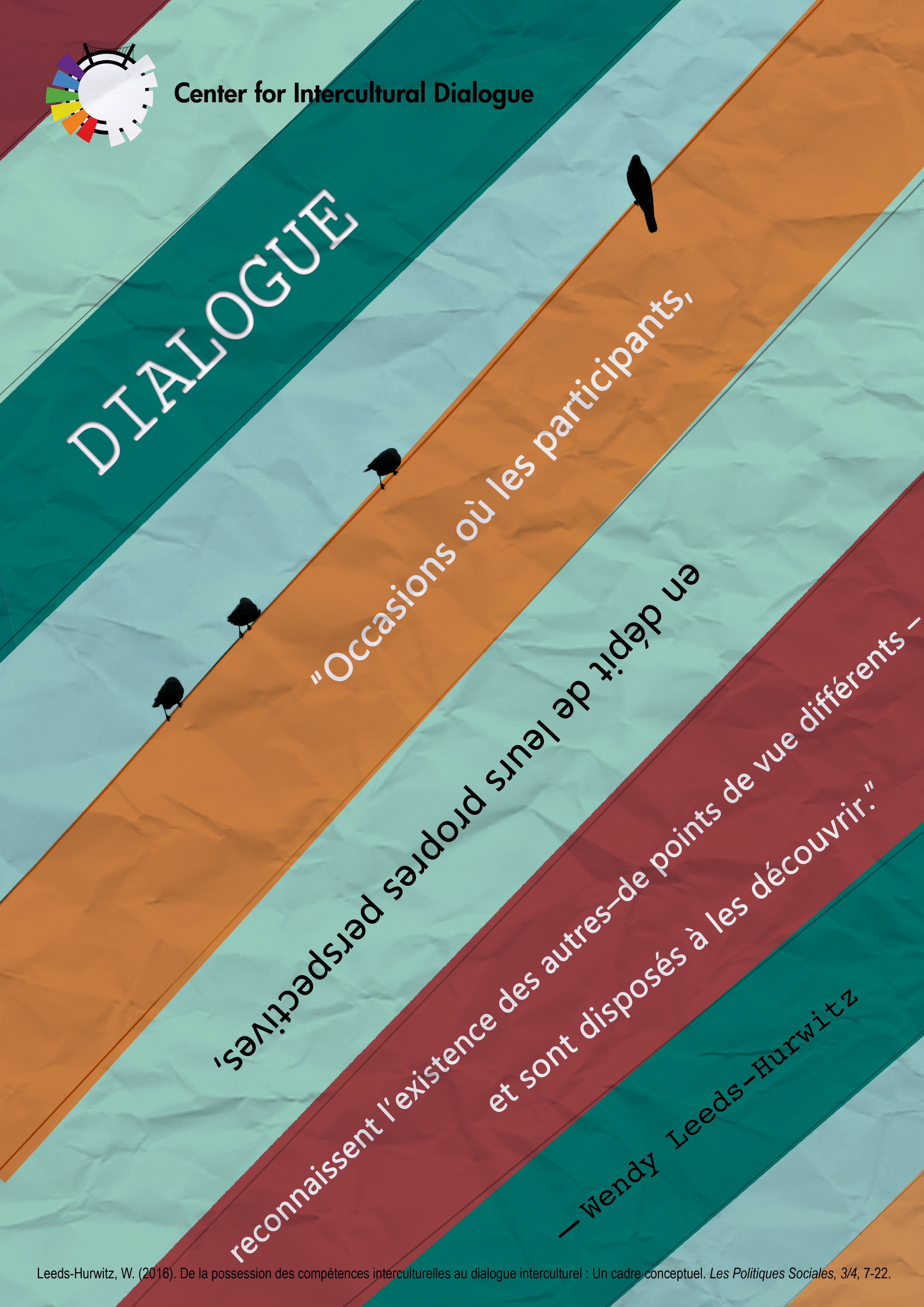
This is another of the posters designed by Linda J. de Wit, and now translated into French. For this poster, you literally have to look from a different perspective to read the quote; the picture of birds on a wire also represents taking different perspectives. The source of the quote is:
Leeds-Hurwitz, W. (2016). De la possession des compétences interculturelles au dialogue interculturel: Un cadre conceptuel [Moving from having intercultural competencies to constructing intercultural dialogues: A conceptual framework]. Les Politiques Sociales, 3/4, 7-22.
As with other series, CID Posters are available for free on the site; just click on the thumbnail to download a printable PNG. They may be downloaded, printed, and shared as is, without changes, without cost, so long as there is acknowledgment of the source.
As with other CID Publications, if you wish to contribute an original contribution, please send an email before starting any work to receive approval, to minimize inadvertent duplication, and to learn about technical requirements. As is the case any series, posters should be created initially in English. If you want to volunteer to translate a poster into a language in which you are fluent, send in a note before starting, to receive approval and to confirm no one else is working on the same one.
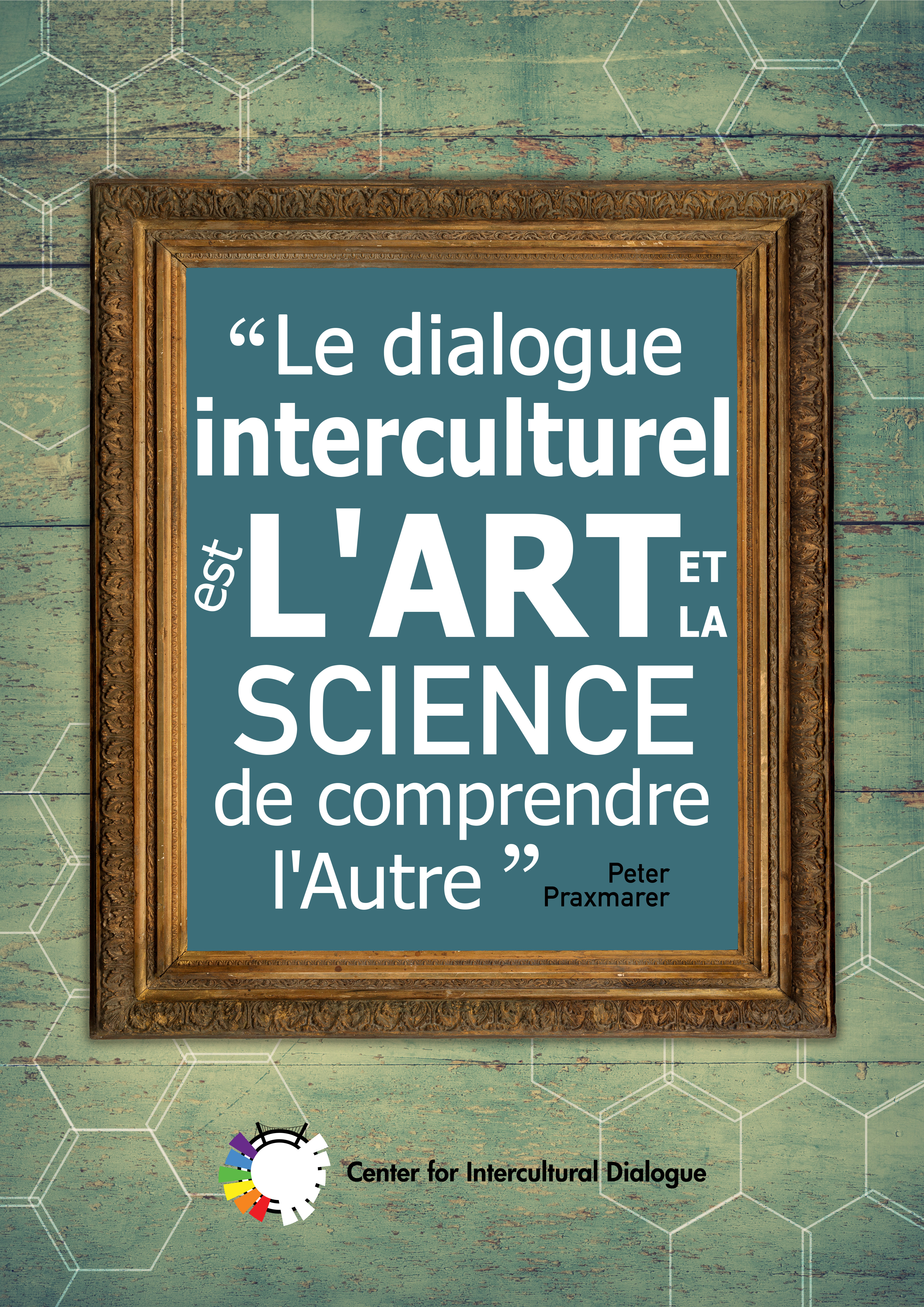
This is the third of the posters designed by Linda J. de Wit, in her role as CID intern. The quote by Peter Praxmarer does not come from a publication, but from a Skype conversation we had on April 25, 2017. I was struck by what he said, and how nicely it summed up the concept of intercultural dialogue, and requested permission to turn the definition into a poster, and he graciously agreed. In terms of visual design, Linda indicated “art” by the picture frame, and “science” by the design in the background. Hopefully this definition will find a wide audience, because I think it does a better and more concise job of explaining intercultural dialogue than other definitions I’ve seen.
As with other series, CID Posters are available for free on the site; just click on the thumbnail to download a printable PNG. They may be downloaded, printed, and shared as is, without changes, without cost, so long as there is acknowledgment of the source.
As with other CID Publications, if you wish to contribute an original contribution, please send an email before starting any work to receive approval, to minimize inadvertent duplication, and to learn about technical requirements. As is the case any series, posters should be created initially in English. If you want to volunteer to translate a poster into a language in which you are fluent, send in a note before starting, to receive approval and to confirm no one else is working on the same one.
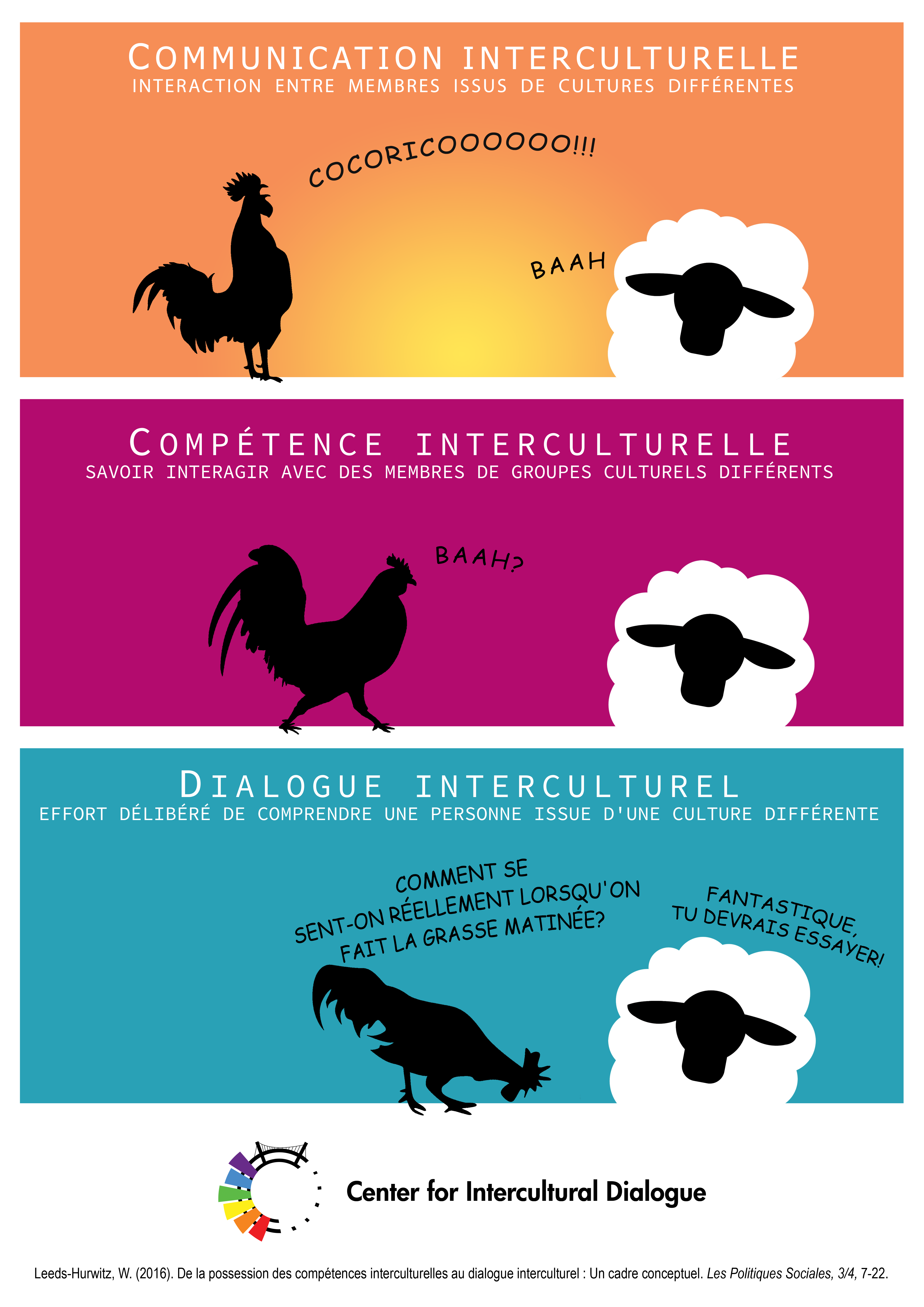
This is another of the posters designed by Linda J. de Wit, and now translated into French. This one provides a quick and easy way to understand, and differentiate between, the concepts of “intercultural communication,” “intercultural competence,” and “intercultural dialogue,” using a rooster and a sheep to represent members of different cultures (and she notes that the animals are vector designs by vecteezy.com).
The article where these explanations of these concepts (as well as lots of other concepts) were published is:
Leeds-Hurwitz, W. (2016). De la possession des compétences interculturelles au dialogue interculturel: Un cadre conceptuel [Moving from having intercultural competencies to constructing intercultural dialogues: A conceptual framework]. Les Politiques Sociales, 3/4, 7-22.
As with other series, CID Posters are available for free on the site; just click on the thumbnail to download a printable PNG. They may be downloaded, printed, and shared as is, without changes, without cost, so long as there is acknowledgment of the source.
As with other CID Publications, if you wish to contribute an original contribution, please send an email before starting any work to receive approval, to minimize inadvertent duplication, and to learn about technical requirements. As is the case any series, posters should be created initially in English. If you want to volunteer to translate a poster into a language in which you are fluent, send in a note before starting, to receive approval and to confirm no one else is working on the same one.
Part of the iLEGEND III project, the training course aims at providing participants with new skills and competences on Global Education, Intercultural/Interfaith Dialogue and Human Rights. It targets education practitioners in the formal and non-formal sector, media professionals and members of Civil Society Organisations and Faith-Based Organisations to:
reflect on Global Education, its concept, principles, and methodology;
analyse relevant notions related to Intercultural/Interfaith Dialogue, such as culture, discrimination, racism, majority/minority, inclusion/exclusion, etc;
develop specific competences focused on defusing and recognising potential conflicts, and actively promoting a culture of peace and non-violence;
promote networking among participants involved in global awareness-raising or educational actions.
The conceptual and methodological framework of the course is based on the Global Education Guidelines, systematised by the North-South Centre. Through a non-formal learning approach, collaborative and interactive activities and exercises allow participants to contribute to their own learning process.
The training course is fully online, hosted on HELP CoE e-learning platform. Two tutors will accompany participants during the 4-week activity. The expected workload is approximately 25 hours in total. The activity programme is structured in 4 modules (one module per week). The training course will be mainly asynchronous: this means that each participant will learn on their own schedule and pace, completing activities and exercises. At the end of the training, participants will obtain a certificate of participation.
40 participants will be selected for this activity, preferably between 18 and 30 years old, and coming from one of the North-South Centre member state, a Southern neighborhood or Sub-Saharan Africa country or a Council of Europe member state. However, a quota is available for citizens from other countries. The course will take place in English.
Given how often the Center for Intercultural Dialogue publishes translations, it seems particularly appropriate to point out this article.
Words Without Borders, one of the few magazines in the world dedicated to literature in translation, is turning 20 at a fraught time: Around the world, wars are raging. Writers are being jailed, dissident voices silenced and books banned.
As the magazine’s staff considered its anniversary celebrations — a virtual gala on Nov. 2, following a live one on Oct. 25 — one question was pressing: How do you find words, let alone celebrate them, when bombs are dropping?
The answer, said Karen M. Phillips, the magazine’s executive editor and publisher, was right there, baked into their mission — to gather and celebrate international literature, and in doing so, strengthen the connection between readers and writers around the world. Given the current political climate, the need for such conversations has never been more vital.
“Words Without Borders does this heroic job of bringing the world close to us,” said Courtney Hodell, the director of literary programs at the Whiting Foundation, which presented one of their inaugural Whiting Literary Magazine Prizes to the magazine in 2018. “At times like this, that feels like an essential and fundamental human act.”
UNESCO created an e-platform for intercultural dialogue in 2018, which recent followers may not have noticed. It is designed to be “a global collaborative hub” intended “to promote good practices from all over the world, that enable to build bridges between people from diverse backgrounds in order to create more inclusive societies through mutual understanding and respect for diversity.”
One section presents a concepts glossary, explaining terms from intercultural dialogue to cultural identity to intercultural citizenship. These will be particularly familiar to all those who have previously read Intercultural Competences: A conceptual and operational framework from 2013, which I drafted for UNESCO (with many contributions by others named in the notes), as they all come directly from that publication.
Based on the experience of a citizenship project about the post-colonial condition and Afro-European interculturality, this essay reflects on digital storytelling, and co-creative practices as relevant literacy and education strategies for furthering interculturality in contemporary societies. The authors propose storytelling as a tool for intercultural dialogue, in the framework of media literacy.
…we need educational strategies and literacies that continue to provide the training of imagination required for intercultural dialogue in the information society (p. 302)
…manga can be a powerful cultural text for increasing intercultural understanding, breaking cultural stereotypes and potentially dispelling prejudices (p. 77)
Perry, Raihanah and Mohd Lazim investigate Japanese manga as a site for intercultural understanding and engagement. Their focus in this article is on “the Japanese manga Satoko and Nada Volume 1 by Yupechika, which narrates the friendship between Satoko, a young Japanese woman, and Nada, her Saudi Muslim roommate.” They analyze three themes: food, fashion, and faith. They see their reading as “a microcosm of the type of dialogue needed in the world today to overcome the acute racism and xenophobia” and conclude:
Culturally responsive teaching was one of the main themes in my second annual summer study abroad program on Intercultural Perspectives on Teaching and Learning at NYU London (July 3-17, 2023).
A defining measure of culturally responsive teaching is how, and the extent to which, teachers use “the cultural characteristics, experiences, and perspectives of ethnically diverse students as conduits for teaching them more effectively. It is based on the assumption that when academic knowledge and skills are situated within the lived experiences and frames of reference of students, they are more personally meaningful, have higher interest appeal, and are learned more easily and thoroughly” (Gay, 2002, p. 106).
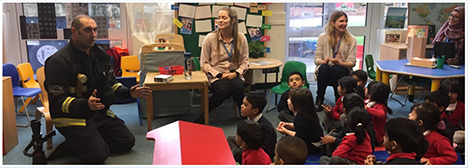
A class in session at Mayfair Primary School. (Photo credit: Mayfair Primary School)
This has been a useful concept to the graduate learners in my program this summer. Several of these learners are themselves in-service public-school teachers (from pre-K to middle school) in New York City with expertise in the like of music education, early childhood education, special education, etc. With from five to more than 25 years of teaching experiences among them, these learners have witnessed a steady influx of immigrant students from diverse national backgrounds and cultural heritages in their increasingly multicultural classrooms (e.g., Bardolf et al., 2023). While the diversity offers exciting possibilities for enhancing intercultural awareness among the students, it also presents a multitude of challenges in language teaching (e.g., ESL), intercultural adaptation, family support or engagement, professional development of the teaching staff, and so on. Hence, one of the course’s main learning objectives has been to identify the challenges facing their counterparts in London who teach in similarly multicultural settings, as well as how the latter address these challenges or take advantage of what these challenges may present.
In this regard, we visited two elementary schools and two secondary schools in London, Mayflower Primary School and St. Andrew’s (Barnsbury) CofE Primary School, as well as Parliament Hill School (an all-girls school) and William Ellis School (an all-boys school). These four public schools are in part defined by the multicultural and multilingual backgrounds of their respective student populations, while Mayflower Primary, located in the eastern borough of Tower Hamlets in London, has the distinction of enrolling about 90% of its students from multiple generations having Bangladeshi family heritage. While our field study did not uncover any one-size-fits-all curricular design or teaching method, we did discover that storytelling has been an effective culturally responsive pedagogy in these four schools.
Identifying itself as “a storytelling school,” for example, Mayflower Primary uses storytelling as a pedagogy throughout its curriculum, beginning with nursery school. Dependent upon the grade level, and with input from multiple sources (including teachers in the schools, students and their families, members from the school’s community, etc.), a number of stories are chosen to become an integral part of every class’s teaching and learning materials. Throughout the school year, teachers and their students engage in various reading, writing, discussion, interpretation, and re/telling of these stories, some of which are culturally relevant to the heritage backgrounds of the students. According to Heba Al-Jayoosi, Mayflower Primary’s Assistant Headteacher and Inclusion and Research Leader, storytelling has been an effective tool in helping students promote their skills in reading, writing, language development, communication, and so on.
Equally important is that storytelling can also promote students’ intercultural competence (Arasaratnam, 2014) which can, in turn, help facilitate intercultural dialogue (Leeds-Hurwitz, 2014) in the long run. In a special presentation on “Storytelling and the Early Years” to my students in the summer program, Alice Jones Bartoli of King’s College London spoke about how storytelling plays an important role in helping facilitate young children’s social and emotional development. Through dialogic reading, sustained shared attention, and re/telling of stories, especially those relevant to their heritage backgrounds, students come to develop their reading and writing or literacy skills, their self-confidence or self-image, as well as their creative expression abilities. Storytelling in such a teaching and learning context also enhances students’ exposure to stories with cultural or heritage elements that are at first unfamiliar to them, as they gain opportunities to listen to, reflect upon, and comprehend or understand cultural narratives other than their own.
All the learners in the program expressed in their individual final field research reports that they plan to utilize what they learned in London this summer either in furthering their graduate studies in social work or world language education or in acting as agents of change when they return to teach in their public schools in New York City. Of course, it is quite early to tell how and to what extent their experiences and the wonderful work of our professional colleagues in London can be applied to the New York context. But I hope to report on such impact in a future update.
Casey Man Kong Lum, Associate Director
Center for Intercultural Dialogue
In a few locations within Germany, interfaith cooperation is leading to Christian/Muslim or Christian/Jewish/Muslim kindergartens.
Gifhorn – a small town in Lower Saxony – started Germany’s first Christian/Muslim kindergarten in 2018, after several years of planning and organization.
The vision fostered by local religious leaders sees kindergarten as a novel form of institutionalised dialogue, producing “conflict mediators” and “resilient children” who are “less prone to violence”.
An opposition campaign by the far-right Alternative for Germany (AfD) backfired, and actually ended up increasing enrollment in the school. For a well-balanced report, and links to information about several other interfaith kindergartens in Germany, see the Emmerich article.

 This is another of the posters designed by Linda J. de Wit, and now translated into French. For this poster, you literally have to look from a different perspective to read the quote; the picture of birds on a wire also represents taking different perspectives. The source of the quote is:
 Just in case anyone wants to cite this poster, the following would be the recommended format:

 Center for Intercultural Dialogue