ABC Asia-Pacific Conference (China)

The 14th Association for Business Communication (ABC) Asia-Pacific Conference
November 27–29, 2015
Guangdong University of Foreign Studies
Guangzhou, China

We are living in the 21st Century of increased level of globalisation and internationalisation in which people of different countries, cultures and communities interact more frequently than ever. Along with this trend, communication across cultures also poses great challenges for both academics and practitioners alike in business and management contexts. The conference therefore aims to focus on the diversity and complexities of business communication across countries and cultures.

Click here for the full call for papers (submission deadline: June 30, 2015).

Study Abroad in Cuba with Adelphi University 2015

Winter break study abroad course in Cuba

Adelphi University’s journalism program is offering a 2-week study abroad course in Cuba this January. The course is worth 3-credits and open to undergraduate students from all universities.

This unique course, “Global Perspectives: Cuba in Transition,” introduces students to the transition underway in Cuba due to the recent opening of diplomatic and economic relations with the U.S.  From January 5 to 16, 2016, the class will travel to Cuba and visit Havana as well as some more rural parts of the western Cuban coastline.

Students will be interviewing, shooting video, capturing audio, reporting, writing and reading. They will be meeting government officials, dissidents, local business owners, media professionals and a host of citizen-driven organizations and ultimately engage with how Cubans and outsiders are already attempting to leverage and respond to this critical moment in history.

All-inclusive cost (flights, housing, food, tuition, activities, visa fees) is approximately  $6,900. Apply by October 1, 2015.

University of Colorado-Boulder job ad

The Department of Communication in the College of Media, Communication and Information at the University of Colorado-Boulder invites applicants for a tenure-track, assistant or associate professor position with expertise in the study of Difference, Disagreement, or Conflict in Interaction in one of the following communication contexts: community, cultural/intercultural, interpersonal, environment, political, or mediated. A PhD in Communication or a closely related field that includes training in the analysis of discourse or interaction is required at the time of appointment, as is a record of excellence in teaching and research. We are looking for applicants who study practices and processes of interaction in actual contexts, and, potentially, are engaged in intervening and designing them.

The position involves 40% research, 40% teaching (i.e. 2 courses per semester) and 20% service, and it will start August 2016.  Salary will be commensurate with the level of experience. To apply candidates should submit a letter or application, a current CV, a copy of 1-2 published articles, evidence of teaching excellence, and contact information (email address and phone) for three qualified reviewers.  Applications are accepted electronically, position number F02924.

Review of applications will begin October 23rd, 2015 and will continue until the position is filled. For full consideration, letters of recommendation will be due no later than October 27th, 2015. Additional questions may be emailed to Professor Cindy White, Search Chair.

The College of Media, Communication and Information is the first new college at CU in 53 years. CMCI is at the forefront of the revolution in communication and digital technology, and is a distinctive, collaborative, interdisciplinary and entrepreneurial enterprise where students engage with world-class faculty to learn, create and analyze media content in all its many forms.  CMCI is establishing a new standard for teaching and scholarship in communication, media and information, and we are seeking faculty to join our growing enterprise and who can contribute to building a diverse educational environment through research, teaching, and/or service.

The University of Colorado is an Equal Opportunity employer committed to building a diverse workforce. We strongly encourage applications from women, racial and ethnic minorities, individuals with disabilities, and veterans. Alternative formats of this ad can be provided upon request for individuals with disabilities by contacting the ADA Coordinator.

CFP: Ebenezer Soola Conference on Communication (Nigeria)

3rd  EBENEZER SOOLA CONFERENCE ON COMMUNICATION

The conveners of the 3rd Ebenezer Soola Conference on Communication hereby invites abstracts and full papers from all academics and professionals in all fields of media and communication for presentation and discussion at the conference. Papers should however be based on the conference theme and sub-themes.

Theme:  COMMUNICATION, CHANGE MANAGEMENT AND SUSTAINABLE DEVELOPMENT IN THE 21ST CENTURY
Date: September 27th – 30th, 2016.
Venue:  Conference Centre, University of Ibadan, Ibadan, Nigeria.

The Problem: Change is the only thing that is constant in life. Nigeria, and indeed, the whole world are witnessing rapid changes in all spheres of life. The challenge facing humanity today is how these changes are managed. Change management has been defined as the application of the set of tools, processes, skills and principles for managing the people’s side of change to achieve the required outcomes of the change project or initiative. How do we combine communication with these tools, processes, skills and principles to achieve and sustain positive changes in our society? This is the problem that this conference seeks to engage.

Sub-Themes:
–       Communication, Change Management and People-Centred Development
–       Communication, Change Management and Transformation
–       Communication, Change Management and Government Reportage of its activities
–       Communication, Change Management and Corporate Reporting Culture
–       Communication, Change Management and Social Responsibility
–       Communication, Change Management and Gender Rights
–       Communication, Change and Risk Management in the Oil and Gas Sector
–       Change Management and the Broadcast Media
–       Change Management and the Print Media
–       Change Management and the Social Media
–       Change Management and the New Media of Communication
–       Change Management and the Traditional Media of Communication
–       Change Management and Political Communication
–       Change Management and Journalism
–       Change Management and Development Communication
–       Change Management and Sustainable Development
–       Communication, Social Fairness and Democratic Legitimacy
–       Communication, Conflict and Institutional Change
–       Communication, Community and Common Destiny

Arrival: Tuesday, September 27th 2016.
Conference days: Wednesday 28th – Thursday 29th, September 2016
Departure: Friday, 30th September 2016

Paper Submission Guidelines:
–       Abstracts should not be more than 200 words, typed single spaced with 12 points regular Times New Roman.
–       Abstracts should have title, name of author(s) and full contact details: institution, postal address, personal email address and telephone numbers.
–       Full papers should not be more than 20 pages A4, typed 1.5 spacing with 12 points regular Times New Roman using the APA style of referencing.
–       The first page of the paper should indicate the title, name of author(s), and full contact details: institution, postal address, personal email address and telephone numbers. All other pages of the paper must not feature any of these details.
–       Abstracts and full papers should be sent as an MS Word attachment to the conference email address: soolaconference@yahoo.com

Abstract Submission Deadline – 1st August 2016
Full Paper Submission Deadline – 1st September 2016

Publications
–         Papers that pass the process of blind, peer-review of journals shall be published in two reputable international journals, namely, the Journal of Communication and Media Research and the Journal of Communication and Language Arts.
–         Other papers will be published in a well-edited book. (Note: not a book of readings, but a thematic, educational and instructional book.)

For further information please contact:
Dr. Eserinune McCarty Mojaye
Secretary, Conveners Committee

Kent State University job ads: Global Communication

Two Tenure Track Assistant Professor Positions at Kent State University

The School of Communication Studies at Kent State University invites applications for two tenure-track positions at the rank of Assistant Professor.  Applicants for the first position must have a strong program
of research focusing on Health Communication (Position #996999). Applicants with a secondary focus in Global Communication or Organizational Communication are highly desirable.  Applicants for the
second position must have a strong program of research focusing on Global Communication (Position #989517).  Applicants with a secondary focus in Organizational Communication, Health Communication, or Mediated/Mass Communication are highly desirable.  Both tenure-track faculty members will have the opportunity to be involved and teach in the undergraduate and graduate programs in the School of Communication Studies in their respective areas.

The School is one of four in the College of Communication and Information, led by Dean Amy Reynolds.  The School has 16 full-time faculty members at the Kent Campus and administrative support including
marketing, technology, and international program coordinators.  The school also has 7 full-time faculty members at Regional Campuses. The School of Communication Studies serves approximately 850 undergraduate majors and 60 graduate students.  Academic programs include an undergraduate major with six concentration areas (applied, interpersonal, organizational, health, public/mediated, and global
communication), a social and behavioral science oriented M.A. program, a dual MA/MBA program, and a college-wide Ph.D. program.

Kent State is a comprehensive graduate and undergraduate, residential, Carnegie Doctoral Research Extensive University. It is located in Kent, Ohio, within 45 minutes of Cleveland, Akron and Youngstown. The University is the third largest in Ohio, with an enrollment of about 41,000 students.  Kent State University is ranked by the Carnegie Foundation for the Advancement of Teaching among the nation’s top 74 public high-research universities, and ranked in the coveted first-tier of U.S. News & World Report’s 2015 edition of Best Colleges.  Kent State University is identified by the Chronicle of Higher Education as one of the Great Colleges to work for 2015.

We expect an employment start date of August, 2016.  The Ph.D. or equivalent is expected by the start of the semester of employment.  If the degree is not yet completed, the new hire will be initially at the
level of Instructor, and on a term basis.  Applicants should possess excellent publication and teaching credentials commensurate with years of experience. A strong commitment to academic and community service is also desired.  Salary will be commensurate with credentials and experience.  Kent State University offers benefits to same-sex and different sex domestic partners.

A letter of interest, vitae, three letters of recommendation, copies of (or links to) 2-3 representative published articles or chapters, a teaching philosophy, and any other information the candidate deems
relevant should be submitted online. The letter of interest should indicate a primary research interest area and linkages to any of the desired secondary research interest areas.

For more information, please contact Dr. Paul Haridakis, Search Committee Chair. Screening of applicants will begin December 1 and continue until the position is filled.

Kent State University is an affirmative action, equal opportunity employer and committed to a diverse community. Minorities and women are encouraged to apply.

Dominic Busch Profile

ProfilesDominic Busch is a Professor of Intercultural Communication and Conflict Research at Universität der Bundeswehr München, Germany. He received his doctorate in 2005 at Europa-Universität Viadrina Frankfurt (Oder), Germany. From 2006 to 2011 he was a Junior Professor in Intercultural Communication at Europa-Universität Viadrina Frankfurt (Oder).

Dominic BuschIn his research on intercultural communication, he explores the epistemological, ontological, and axiological premises of how intercultural communication is approached from an academic angle. To this end, he takes the perspective of discourse analysis. While research on intercultural communication often has strong disagreements between different paradigms, the minimum common ground is that culture and intercultural communication are talked about in both academia and in Western societies’ everyday life. Culture and intercultural communication are thus objects of discourse, and thus first and foremost discursive constructions. Several characteristics of the field of intercultural communication can be observed on the basis of this assumption:

Both everyday discourses and academic discourses around intercultural communication constitute themselves in such a way that their object never ceases to be perpetuated and never disappears – even if this might actually represent a plausible goal of dealing with it. Discourses are shaped by power structures and hegemonies, and this is how core understandings of intercultural communication emerge. Their permanent self-preservation can also be described by the phenomenon of the dispositive after Michel Foucault, as Dominic Busch shows in his 2013 book. Discourse on intercultural communication fabricates problems for which, at the same time, it always provides only partial solutions. Even the strongest paradigm shift cannot overcome this, but will always only reinforce the dispositive.

At the same time, the discourse on intercultural communication is never void of interests, and research is never strictly heuristic: the study of intercultural communication is always based on societies’ aspirations of an ideal coexistence. The perceptions of problems are impossible without visions of how things should actually be better. Visions, however, traditionally do not have a seat in social science research; they are often regarded as unscientific. However, we cannot really understand how research questions are framed and how studies in this field are arranged if authors and readers would not share ideals about how to deal with interculturality, ideals that are only subtly expressed in the texts.

In his research, Dominic Busch aims to show how research on intercultural communication seeks to deal with this dilemma. To this end, it is first necessary to uncover and identify the normative ideas on how to deal with interculturality – which can also be referred to as visions. Based on a discourse analysis of academic texts on intercultural communication over a period of 50 years, Dominic Busch shows in his article “The Changing Discourse of Intercultural Ethics” how these orientations change over time. Instead of a linear development, these re-orientations have been rather circular. Only in recent times a parallel diversification of different orientations in intercultural writings can be observed – along with a new disorientation and open search in an increasingly complex world, questioning old paradigms more and more.

A comparison with overarching social science paradigms and epistemologies, however, reveals how dominant these ethical orientations are. Social research is debating the implementation of post-qualitative research methods with the aim of avoiding exerting epistemic violence through research. This should involve authors reflecting more on their own positionality and instead of researching their partners, they should give voice to these partners themselves. In their article “New Methodologies – New Interculturalities?” Dominic Busch and Emilian Franco explore how papers in the research field of intercultural communication manage these issues by using new methods such as participatory research, autoethnography, and arts-based research. From a critical point of view, Busch and Franco find that many studies often do not really meet the standards of such methodologies. However, Busch and Franco show that, seen as parts of an ethical discourse on interculturality, these new methods serve as a basis for authors’ ethical and visionary reflections on a desirable way of dealing with interculturality.

Intercultural mediation is a powerful example of this visionary orientation in discourses on intercultural communication. A great many different disciplines share some interest in intercultural mediation: These include, for example, cultural anthropology, translation research, foreign language didactics, and political science research on international relations, in addition to research on intercultural communication and conflict management. Upon closer examination, these disciplines often conceive of intercultural mediation in very different ways. However, there is one common vision that unites them: that constructive pathways to intercultural understanding will always exist. This is reason enough from an ethical point of view to further promote and develop such fields of research. The Routledge Handbook of Intercultural Mediation by Dominic Busch provides an insight into this interdisciplinary field and its potentials.

Discourse analysis should therefore not be seen only as criticism, but always as a constructive prospect for development. Even more, the insight into the constructivist character of notions of cultures may open the opportunity (and the responsibility) to encourage forms of intercultural dialogue on a local and on a global level to discuss and to define notions of how positive (intercultural) coexistence may be designed. In these respects, Dominic Busch explores the potential of concepts like intercultural sustainability as well as contributions from cosmopolitanism to intercultural dialogue.

For more detailed information as well as a list of German language publications please visit Dominic Busch’s website.

Selected publications in English:

Busch, D. (Ed.). (2023). The Routledge handbook of intercultural mediation. New York: Routledge.

Busch, D., & Franco, E. (2022). New methodologies—New interculturalities? The visionary discourse of post-qualitative research on the intercultural. Language and Intercultural Communication, 1–13. DOI: 10.1080/14708477.2022.2133136.

Busch, D. (2021). The changing discourse of intercultural ethics: A diachronic meta-analysis. Journal of Multicultural Discourses, 16(3), 189–202. DOI: 10.1080/17447143.2020.1803887.

Busch, D. (2019). Intercultural conflict mediation. In P. Moy (Ed.), Oxford bibliographies in communication. New York: Oxford University Press.

Busch, D., & Möller-Kiero, J. (2017). Sustainability and ethnic peace discourse: In search for synergies from bringing together discourses on intercultural communication and on global sustainability. ESSACHESS: Journal for Communication Studies, 10(1), 217-237.

Busch, D. (2016). Does conflict mediation research keep track with cultural theory? A theory-based qualitative content analysis on concepts of culture in conflict management research. European Journal of Applied Linguistics, 4(2), 181-207.

Busch, D., & Möller-Kiero, J. (2016). Rethinking interculturality will require moral confessions: Analysing the debate among convivialists, interculturalists, cosmopolitanists and intercultural communication scholars. Interculture Journal, 15(26), 43-57.

Busch, D. (2015). Conflict Management in Organizations. In A. D. Smith, X. Hou, J. Stone, R. Dennis, & P. Rizova (Eds.), The Wiley Blackwell encyclopedia of race, ethnicity, and nationalism (pp. 1–5). John Wiley & Sons. DOI: 10.1002/9781118663202.wberen340.

Busch, D. (2015). Culture is leaving conversation analysis, but is it really gone? The analysis of culturalist performances in conversation. Journal of Intercultural Communication, 39, 1-17.

Busch, D. (2015). Mediation. In J. M. Bennett (Ed.), The Sage encyclopedia of intercultural competence (pp. 608–611). Sage. DOI: 10.4135/9781483346267.n199.

Busch, D. (2012). Cultural theory and conflict management in organizations: How does theory shape our understanding of culture in practice? International Journal of Cross Cultural Management, 12(1), 9–24. DOI: 10.1177/1470595811413106.

Busch, D. (2010). Shopping in hospitality: Situational constructions of customer–vendor relationships among shopping tourists at a bazaar on the German–Polish border. Language and Intercultural Communication, 10(1), 72–89. DOI: 10.1080/14708470903452614.

Busch, D. (2009). What kind of intercultural competence will contribute to students’ future job employability? Intercultural Education, 20(5), 429–438. DOI: 10.1080/14675980903371290.


Work for CID:

Dominic Busch has written a guest post, Some Observations on Internal Social Discourses on the Recent Increase of Refugee Immigration into Germany, as well as KC76: Intercultural Sustainability and KC106: Intercultural Medication. He has translated KC1: Intercultural Dialogue, KC2: Cosmopolitanism, KC76: Intercultural Sustainability, and KC106: Intercultural Mediation, as well as Poster 6: Dialogue Defined and Poster 7: Social Justice / Social Harmony into German. He also frequently reviews translations into German.

CFP Sociology of Communication, Knowledge & Culture (Austria)

Call for Papers
Research Committee on Sociology of Communication, Knowledge and Culture (Rc14)
3rd ISA Forum of Sociology
July 10-14, 2016 (Vienna, Austria)

The abstract (300 words) must be submitted in English, French or Spanish.

Program Coordinators
Christiana CONSTANTOPOULOU, Panteion University, Greece, christiana.constantopoulou@panteion.gr
Luc BONNEVILLE, Ottawa University, Canada, luc.bonneville@uottawa.ca

Call for Abstracts 
14 April 2015 – 30 September 2015 24:00 GMT

Anyone interested in presenting a paper should submit an abstract on-line to a chosen session of RC/WG/TG.

Universität der Bundeswehr München job ad

Universität der Bundeswehr München announces the vacancy of a Professorship in “Education with a Special Focus on International Comparative and Intercultural Education Research.” The professorship is based in the University’s department of education providing BA and MA courses in education. Both courses concentrate on aspects of intercultural education, media education as well as adult education. Universität der Bundeswehr München is a civic university designed for the provision of degree courses to future officers of the German army (Bundeswehr).

Munich job ad

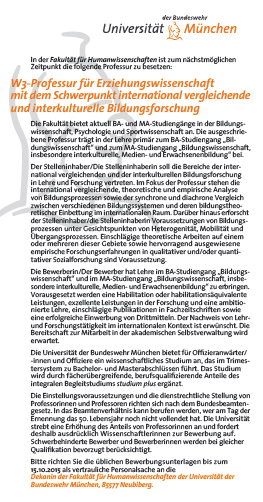
In der Fakultät für Humanwissenschaften ist zum nächstmöglichen Zeitpunkt die folgende Professur zu besetzen:
W3-Professur für Erziehungswissenschaft mit dem Schwerpunkt international vergleichende und interkulturelle Bildungsforschung

Die Fakultät bietet aktuell BA- und MA-Studiengänge in der Bildungswissenschaft, Psychologie und Sportwissenschaft an. Die ausgeschriebene Professur trägt in der Lehre primär zum BA-Studiengang „Bildungswissenschaft“ und zum MA-Studiengang „Bildungswissenschaft, insbesondere interkulturelle, Medien- und Erwachsenenbildung“ bei.

Der Stelleninhaber/Die Stelleninhaberin soll die Bereiche der international vergleichenden und der interkulturellen Bildungsforschung in Lehre und Forschung vertreten. Im Fokus der Professur stehen die international vergleichende, theoretische und empirische Analyse von Bildungsprozessen sowie der synchrone und diachrone Vergleich zwischen verschiedenen Bildungssystemen und deren bildungstheoretischer Einbettung im internationalen Raum. Darüber hinaus erforscht der Stelleninhaber/die Stelleninhaberin Voraussetzungen von Bildungsprozessen unter Gesichtspunkten von Heterogenität, Mobilität und Übergangsprozessen. Einschlägige theoretische Arbeiten auf einem oder mehreren dieser Gebiete sowie hervorragend ausgewiesene empirische Forschungserfahrungen in qualitativer und/oder quantitativer Sozialforschung sind Voraussetzung.

Die Bewerberin/Der Bewerber hat Lehre im BA-Studiengang „Bildungswissenschaft“ und im MA-Studiengang „Bildungswissenschaft, insbesondere interkulturelle, Medien- und Erwachsenenbildung“ zu erbringen. Vorausgesetzt werden eine Habilitation oder habilitationsäquivalente Leistungen, exzellente Leistungen in der Forschung und eine ambitionierte Lehre, einschlägige Publikationen in Fachzeitschriften sowie eine erfolgreiche Einwerbung von Drittmitteln. Der Nachweis von Lehrund Forschungstätigkeit im internationalen Kontext ist erwünscht. Die Bereitschaft zur Mitarbeit in der akademischen Selbstverwaltung wird erwartet.

Die Universität der Bundeswehr München bietet für Offizieranwärter/-innen und Offiziere ein wissenschaftliches Studium an, das im Trimestersystem zu Bachelor- und Masterabschlüssen führt. Das Studium wird durch fächerübergreifende, berufsqualifizierende Anteile des integralen Begleitstudiums studium plus ergänzt.

Die Einstellungsvoraussetzungen und die dienstrechtliche Stellung von Professorinnen und Professoren richten sich nach dem Bundesbeamtengesetz. In das Beamtenverhältnis kann berufen werden, wer am Tag der Ernennung das 50. Lebensjahr noch nicht vollendet hat. Die Universität strebt eine Erhöhung des Anteils von Professorinnen an und fordert deshalb ausdrücklich Wissenschaftlerinnen zur Bewerbung auf. Schwerbehinderte Bewerber und Bewerberinnen werden bei gleicher Qualifikation bevorzugt berücksichtigt.

Bitte richten Sie die üblichen Bewerbungsunterlagen bis zum 15.10.2015 als vertrauliche Personalsache an die Dekanin der Fakultät für Humanwissenschaften der Universität der Bundeswehr München, 85577 Neubiberg.

CFP Cinema and History: Time, Memory, Identity in the Images of the New Millenium (Italy)

Call for Papers

CINEMA & HISTORY
Time, memory, identity in the images of the new millennium
26-27 November 2015
Università degli Studi Roma Tre
Dipartimento di Filosofia, Comunicazione e Spettacolo

The deadline has been extended to September 30, 2015

Conference convenors: Christian Uva and Vito Zagarrio

Institutional partners:
University of Leeds Centre for World Cinemas (UK)
Victoria University of Wellington (NZ)
SISSCO (Società Italiana per lo Studio della Storia Contemporanea)
CPA (Centro Produzione Audiovisivi) – Università degli Studi Roma Tre
Cinema e Storia. Rivista di studi interdisciplinari (Rubbettino Editore)

The 21^st annual international conference of the Dipartimento Filosofia, Comunicazione e Spettacolo (formerly Dipartimento Comunicazione e Spettacolo) of Università Roma Tre will consider the relationship between cinema and history, identifying new directions and contemporary approaches in the field.

This conference reprises a theme central to discussion in the 1980s, when a number of important symposia and publications in Italy responded to the translation of key French scholarship. Returning to the question of cinema and history after three decades implies the consideration of aspects and forms of knowledge absent from those earlier debates. Bringing the discussion right up to date, the aim of this conference is to employ a plurality of discourses to explore in greater depth the theme of cinema and history and to clarify a crucial relationship that has been essential to cinema since its inception.

Taking as its premise the fact that in our digital era the relationship between cinema and history is played out over a broad and complex terrain, the conference seeks to consider cinema in /hybrid /and /expanded /terms. This may require analysing cinema’s relationship with history within a broader mediatic context, taking into account – for instance – adjacent and tangential media such as television, videoart, internet and videogames. The convenors therefore warmly invite contributions that aim to problematize the relationship between cinema and history in ways not limited to the following:
-the use of cinema and history as a /method/ or lens through which to read a range of film categories beyond any historical film ‘genre’: films that, while setting their action in the present, suggest a dialectical and critical attitude towards the past, especially in order to address conceptions and perceptions of national, cultural, gender and political identity; films that are capable of addressing and affecting contemporary imaginaries and mentalities, thus becoming historical /agents/ in their own right; films that become precious primary sources for scholars, by embodying the customs and material habits of their time; films which, though set in the present, allow us to reflect on material and everyday “microhistories” in which the story “dissolves”
time and erupts into the present (Baudrillard);
-the rethinking and transcending of traditional film histories by seeing cinema and history in the light of a hybrid and global iconographic system that forces us to wonder whether we should thinking in terms distinct from the “longue durée” and allows us to avoid “textbook” slogans and stereotypes;
-history as critique, between ‘the end of history’ (Fukuyama) and its traumatic return following 9/11;
-history as /imaginary /(Ferro) and as /myth /(Rosen), but also as /atmosphere/;
-counter-factual history (“What if?”);
-history as /anti-history/: a form of projection into the past of scepticism and disillusion with present and future;
-history as /anachronistic/ configuration: according to Georges Didi-Huberman this is a ‘heretical’ approach to image and history; while it confirms the necessity to conceive of cinema and history as part of visual culture, Didi-Huberman’s perspective stresses the intimate ‘exuberance’, ‘complexity’ and ‘overdetermination’ (/Überdeterminierung/) of images, forcing a rethinking the cinema-history relationship within the context of the /construction of memory/;
-from ‘historical facts’ to ‘memory facts’ (Ricoeur): cinema as site of memory (both individual and/or collective); cinema as an ideal space in which to activate not the ‘time of dates’ (Bloch) but instead a dimension – often framed negatively as nostalgia (Boym) – that humanizes history and constantly reconfigures it;
-the digital imaginary between memory and history (Burgoyne);
-theoretical and practical reconsiderations of cinema through a feminist and gendered lens: analysing the dynamics of production and reception; the interaction between Foucauldian genealogical thought and feminist theories;
-from /‘official’ history/ to /‘popular’ history/, from /engagé /to escapist cinema: the cinema-history relationship as an opportunity to reframe works that have traditionally been excluded from the analysis of cinema and history, not least because of the enduring legacy and role of /engagement /in representing the past (Landy, O’Leary);
-the study of the experience and reception of the historical film, in all its possible variations;
-history in audio-visual contexts: from television to videoart;
-history in videogames;
-history and photography;
-the employment and potential of digital technology in quantitative methods to serve an expanded understanding of cinema and history.

We will consider every proposal (300-500 words), with 5 keywords, 3-5 bibliographic references, and a brief biography of the proponent, submitted via email before September 30th, 2015. Selections results will be announced before October 9th.

Official languages of the Conference: English, French, Italian.

During the conference will be held the following workshops:
Italian Cinemas/Italian Histories
Organizer and chair: Alan O’Leary (University of Leeds)

How have Italians used films to negotiate their histories and interrogate their identities over more than a century of Italian cinema? This workshop will discuss the aims and research methods of a major
project intended to reconfigure the understanding of the relationship between Italian cinema and history.

Cinema and the Construction of the Nation: Italian Identities Between History and Memory
Organizers and chairs: Sally Hill (Victoria University of Wellington),
Giacomo Lichtner (Victoria University of Wellington)

Focusing on Italy as a case study that is both emblematic and anomalous, the workshop’s starting point is the hypothesis that the Italian case is emblematic, because Italian cinema has traditionally made effective and widespread use of stereotype to construct a sanitised and homogeneous narrative of national identity, but also an anomalous one, because it has dealt ambiguously with the nation’s historical contradictions. While every nation’s history is contested, Italy’s inability to construct a shared narrative of its recent past suggests that the peculiarity of Italian ‘memory’ lies in the coexistence of ‘divided memories’ (Foot, 2009).

Conference website: http://uniromatre.wix.com/cinemaestoria#!home/c17ca