Presented by SIETAR AUSTRALASIA and the Office of Aboriginal and Torres Strait Islander Leadership and Strategy at the University of Canberra. Organizers want to hear from non-indigenous and indigenous people about indigenous peoples’ contribution to and in any area/field.
If you are interested in translating one of the Key Concepts, please contact me for approval first because dozens are currently in process. As always, if there is a concept you think should be written up as one of the Key Concepts, whether in English or any other language, propose it. If you are new to CID, please provide a brief resume. This opportunity is open to masters students and above, on the assumption that some familiarity with academic conventions generally, and discussion of intercultural dialogue specifically, are useful.
The School of Modern Languages at the Georgia Institute of Technology invites applications for Visiting Assistant Professor of Chinese. This position is full-time with a 2/2 teaching load and is renewable for up to two years. The successful candidate will have (1) a PhD in hand by August 1, 2019; (2) native or near native-level competence in Chinese; (3) an active research and publication agenda; and (4) documented evidence of successful teaching of Chinese language, at both lower and upper levels, particularly content-based language courses. The candidate will join a robust Chinese program, with undergraduate majors and minors in Chinese, as well as graduate level instruction. The candidate may teach a variety of courses of interest, including Chinese-American and Chinese culture; cross- and intercultural studies (including languages for business, technology, science, and heritage learners); environmental and media studies; Chinese civilization, thought and philosophy; and the Chinese classics, as well as other specialized courses. The candidate will also be involved in graduate curriculum development in Chinese. Preferred areas of expertise include Chinese-American culture; Chinese literature, culture, history, and media; environmental and digital humanities; and the study of science and technology.
Essex Business School is undertaking a major expansion of its teaching and research activities, and accordingly is seeking to make an additional appointment, at the Professorial level in the field of International Business or Strategy (Southend Campus). This key appointment will have a vital role in enhancing the School’s research profile, developing undergraduate and postgraduate teaching and supervision and extending the School’s profile regionally, nationally and internationally.
This article asks questions relevant to many contexts of intercultural dialogue: “What actually happens when people are in the midst of unyielding disagreement? How do people accomplish intractability in interaction, and what might this tell us about the social and practical achievement and function of seemingly-incompatible positions in conflict?”
Abstract: “We examine how participants in a moral conflict hold fast to their beliefs during a highly publicized moment in an ongoing social controversy. We apply discourse analysis to a video-recorded confrontation between a same-sex couple seeking a marriage license, and a county clerk refusing to provide the license for religious reasons, which took place after the overturning of the Defense of Marriage Act in the U.S.A. (and had prohibited same-sex couples from marrying).We examine how pragmatics of account avoidance sequences and framing are deployed in interaction to accomplish “being morally principled.” This case illustrates how mediated public conversations around social changes provide participants opportunities to perform moralities and define the terms of debate in relation to cultural institutions. We reflect on how the consequence of this event is a form of debate in which participants speak past each other ritualistically, constructing worldviews as incompatible and problems as unresolvable.”
Paul Voakes is Professor of Journalism at the University of Colorado Boulder. He submitted the following comments about his Fulbright award.
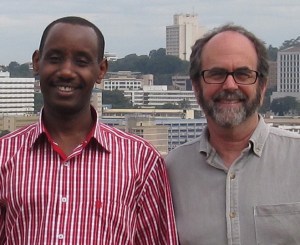
Paul Voakes (right) with Aaron Mushengyezi, then chair of the Mass Communication department at Makerere University.
The primary purpose of my specialist assignment at Makerere University in Kampala, Uganda, in April-May of 2012, was to work with the chair and faculty of the Mass Communication Department to evaluate the current strength of the Department’s graduate program and think strategically about its sustainability. I think it worked out pretty well. I was one of the leaders of the two-day faculty retreat (May 9-10) in which we achieved consensus on the structure and content of the new MA curriculum. I constructed the 10,000-word document (in the format required by the university) that would enable approval of the new curriculum. I was told several times that this effort had been stalled for three years, until my contribution to the effort. I also researched Ph.D. programs in Mass Communication in Africa and then assessed the graduate-teaching resources in the department. The result was a 5,000-word report and recommendation, which I submitted to the chair on May 23.
The secondary purposes of the assignment were to (a) develop possible partnerships (for training, exchanges or research collaborations for faculty or students) between the University of Colorado and Makerere University, and (b) lead class sessions at both the undergraduate and master’s levels, as requested. I drafted a Memorandum of Understanding between the University of Colorado and Makerere University, which would accommodate development of collaborations and exchanges of faculty and students. The document has the approval of the legal offices at both universities, but budget constraints at Makerere have hindered the implementation of physical exchanges. In terms of my teaching, I delivered 12 guest lectures over my six-week stay, on topics ranging from public relations ethics and communication for development to investigative reporting techniques and feature-writing tips.
I also enjoyed a few meetings with the larger Ugandan journalism community. I gave a talk to the “U.S. Press Corps,” an organization of Ugandan journalists sponsored by the U.S. Embassy in Kampala. I also represented Makerere at The Kampala Dialogue, a day-long regional conference to observe UNESCO’s World Press Freedom Day. I gave a 30-minute talk and participated in the Q&A panel at the end of the day.
Most rewarding, as I now look back, are the personal relationships I was able forge with colleagues at Makerere. One example: The University of Colorado Boulder is particularly known for Environmental Science, and we are also home to one of the world’s few centers for Environmental Journalism. In the fall of 2013, 18 months after my assignment, our center hosted an international conference on the communication of climate change. I encouraged one of my faculty colleagues at Makerere to submit a paper, which was accepted. Travel funding, however, is a constant hindrance for our Ugandan colleagues as they attempt to develop their scholarly careers. Because of our Fulbright-enabled connection, I was happy to host the Ugandan colleague in our home and get her conference registration fee waived. Thus airfare was her only major expense for the conference. She presented the paper in Boulder and later got it published in an international journal on environmental communication. In Boulder she was also able to forge new relationships with scholars globally in this field.
The United Nations has declared 2019 as the International Year of Indigenous Languages. In recognition of this, Language is encouraging submissions dealing with research on any aspect of Indigenous languages. This call is very broad – articles in any area of linguistics will be considered – phonetics, phonology, morphology, syntax, semantics, psycholinguistics, sociolinguistics, computational linguistics, language policy, historical linguistics, methodologies, revitalization, and so on. Papers will go through the normal review procedure.
This conference seeks to explore, analyse and discuss the complex concept of nonviolence as a strategy toward peace and progress. It will apply an interdisciplinary approach to various manifestations of nonviolence and will also act as an academic space to explore solutions for creating peace. The conference will bring together scholars from different fields including philosophy, religion, sociology, international relations, history, literature, art, peace studies, cultural studies, political studies and others.
Continuing translations of Key Concepts in Intercultural Dialogue, today I am posting KC#30: Critical Intercultural Communication, which Rona Tamiko Halualani wrote for publication in English in 2014, and which Filipa Subtil has now translated into Portuguese.
If you are interested in translating one of the Key Concepts, please contact me for approval first because dozens are currently in process. As always, if there is a concept you think should be written up as one of the Key Concepts, whether in English or any other language, propose it. If you are new to CID, please provide a brief resume. This opportunity is open to masters students and above, on the assumption that some familiarity with academic conventions generally, and discussion of intercultural dialogue specifically, are useful.
The successful applicant will spend 1 year at Coventry University, the second year at Deakin University and the remaining 1.5 years at Coventry University. Successful candidates will receive a full scholarship covering course fees and living costs. Students will study in both Universities and on successful completion will be awarded a PhD by both.
The Intercultural Dialogue (ICD) approach differentiates itself from other methods of engaging with diverse societies, principally by encouraging dialogue with the cultural ‘Other’ for its own sake, rather than being outcome focused. However, critics of ICD ask whether it is relevant outside of the European context where it was developed (Aman; 2012); and whether it is applicable in fragile contexts, where for example, there is conflict over sovereignty (Phipps; 2014). In recognition of such critiques this PhD explores the utility of ICD as a framework in a non-European / Western setting which is a fragile context and has a long standing disputed status.
The PhD candidate will conduct ICD workshops with youth belonging to stakeholder communities within the disputed region in order to explore the utility of ICD as both a) a research tool for academic exploration of community and stakeholder perspectives; and b) a framework for promoting inter-group dialogue between communities and stakeholders within fragile contexts. The student will be provided with extensive training and guidance on ICD by the supervision team and will work closely with a partner NGO within the setting, who will support with the facilitation of workshops for qualitative data gathering and participant observation.
Informal enquiries are essential before application; contact Dr Serena Hussainto discuss this opportunity.

 Call for Proposals: SIETAR Australasia 2019: Indigenous Peoples’ Contribution in Australia and Globally. Canberra, Australia, March 22 – 23, 2019. Deadline: 28 February 2019.





 Center for Intercultural Dialogue