Moral Foundations, Moral Conflict & Moral Injury Webinar

EventsMoral Foundations, Moral Conflict and Moral Injury: A Communication Perspective, CMM Institute, Webinar, November 4, 2020, 12 to 1:30pm EST.

As a follow-on to the 2020 CMM Institute Virtual Learning Exchange, participants are pleased to present a special topic webinar on the ways that CMM concepts and heuristics can help to better understand the conflict among competing and conflicting moral frameworks, and potential impact on social justice, mental health, and the enactment of democracy in our social systems and institutions.

The format organizers envision is to provide several short introductory presentations covering various forms of moral conflict. These may include: moral foundations theory; moral conflict and conflict resolution; metaphors of war and combat in new media (and alternative metaphors to these, such as jazz improvisation); and impact of “moral injuries” of military and veterans caused by failures to prevent harm and episodes of perceived betrayal. This will be followed by a guided open discussion of ways that CMM theory and heuristics may be applied to identify, analyze, and possible re-imagine these and similar conflicts of meaning.

Email your RSVP to Barton Buechner, and you will receive information about how to register via Zoom.

CFP LSI Approaches to Racial Justice

Conferences

Call for proposals: Innovations in LSI Approaches to Racial Justice in Research and Pedagogy, Language and Social Interaction Division, International Communication Association, Denver, CO, May 27-31, 2021 (hybrid format). Deadline: October 14, 2020.

The current social and political climate – involving anti-black racism and anti-racist movements – has highlighted enduring racial inequality in the United States and internationally. These current events have prompted widespread interest among academics about ways that racism, whiteness, and structural inequality are pervasive in our own fields. Language in Social Interaction, like most academic fields, includes scholars who focus on questions of racial justice in their research and pedagogy. In this panel, organizers invite these LSI scholars to give short presentations (5 minutes or less) on innovative, effective methods for engaging with racial justice from an LSI perspective. Presentations should provide audience members with ideas or practical tools for how to engage with questions of racial justice in research and pedagogy. Submissions could address, but are not limited to:

  • Innovative undergraduate or graduate pedagogy activities
  • Innovative approaches to data sessions
  • Innovations in analytic methods to reveal racial inequality, highlight minority or marginalized voices, or decenter whiteness
  • Using LSI approaches and methods in innovative ways to create social change
  • Reflections on ways that whiteness pervades the LSI academic community & innovative ideas for the future of the field

Organizers encourage participation of ethnically and nationally diverse scholars, of graduate students and faculty, and of scholars from a variety of LSI sub-areas. The goal is to produce a collaborative, useful session for all those involved. Please email abstracts of 150-300 words to Natasha Shrikant by October 15, 2020. Abstracts should include details of your presentation and clearly connect to
LSI research or pedagogy.

U Toronto: Mediated Communication (Canada)

“JobAssociate Professor of Mediated Communication, Institute of Communication, Culture, Information & Technology, University of Toronto Mississauga, Mississauga, Ontario, Canada. Deadline: October 20, 2020.

The Institute of Communication, Culture, Information and Technology (ICCIT) at the University of Toronto Mississauga invites applications for a full-time tenure stream appointment in the area of Mediated Communication at the rank of Associate Professor. The position start date is July 1, 2021, or shortly thereafter. Candidates must have a PhD in communication, sociology, computational social science, network science, information science, or a related area. Candidates must have a demonstrated exceptional record of excellence in research and teaching. They must demonstrate an excellent research program emphasizing the application of quantitative methods, big data analytics, network analysis, or mixed methods with a strong quantitative component, to study the role of technologically mediated communication in society. ICCIT seeks candidates whose research and teaching interests complement and strengthen existing strengths. Candidates will have an established international reputation and will be expected to sustain and lead innovative and independent research at the highest international level and to maintain an outstanding, competitive, and externally funded research program.

Beyond Conflict: Chief Program Officer (USA)

“JobChief Program Officer, Beyond Conflict, Boston, MA. Deadline: none listed, posted September 30, 2020.

Beyond Conflict is searching for an entrepreneurial, innovative, and ambitious team player to lead its program team. The Chief Program Officer will oversee all program and research activities and bear primary responsibility for programmatic strategic planning and growth. The Chief Program Officer will also build and manage the organization’s emerging Science-Informed Design consulting practice.

The successful candidate for this role should have extensive experience facilitating strategic mission-driven planning processes, overseeing a diverse portfolio of projects, coaching and mentoring staff, generating revenue for nonprofit organizations, and enabling evidence-based learning. The Chief Program Officer will work with the Director of Development to construct a revenue generation strategy. Together with program staff, they will help secure grants, contracts, and major gifts that further Beyond Conflict’s work.

U Oxford PHD Studentship: Anthropology or Migration Studies (UK)

“Studentships“DPhil Studentship in Anthropology or Migration Studies, School of Anthropology and Museum Ethnography, University of Oxford. Deadline: January 22, 2021.

Applications are invited for a DPhil studentship in anthropology or migration studies. This studentship will be for a maximum duration of 3 years and include a stipend and research expenses of no less than £36,000 per annum (with additional support during the fieldwork year). Starting in October 2021 this studentship will be within the framework of the European Research Council project “Emptiness: Living Capitalism and Democracy After (Post)Socialism.” Funding from the European Research Council means that applicants of all nationalities are eligible for this project. If/when Brexit occurs, the project will be supported by the UK Government under identical rules.

The DPhil student will be part of a research team led by Dr Dace Dzenovska and hosted by the University of Oxford’s School of Anthropology and Museum Ethnography and the Centre on Migration, Policy, and Society. Under the supervision of Dr Dace Dzenovska, the student will be responsible for developing and carrying out their own original project in Ukraine, Belarus, or Russia (other locations within the former socialist world may be considered) within the overarching analytical and methodological frame of the project. The student will also undertake collaborative work with other team members. The project will study the emptying cities, towns, and villages in Eastern Europe and Russia through the lens of “emptiness” as a concrete historical formation that has emerged in conditions when socialist modernity is gone and promises of capitalist modernity have failed.

CFP Crisis, Conflict, and Cultural Relations in Media Environments

“PublicationCall for Papers: Crisis, Conflict, and Cultural Relations in Media Environments, to be edited by Ahmet Atay (Wooster) and Margaret D’Silva (Alabama, Tuscaloosa). Deadline for Abstract only: October 15, 2020.

In the wake of current cultural, social, and political happenings and due to the ongoing global COVID-19 related health crisis, the role of new media technologies is heightened. The current global pandemic created new cultural and political conflicts, presenting new issues, heightening some of the oppressive structures, and creating newer troubles for members of marginalized communities. As a result, people are turning to media technologies to escape reality, to find solutions, and to create new online communities to belong.

Digital communication connects residents of different countries in an invisible web of entanglement that creates a layered global identity beyond the confines of national borders. Our collective ideas of our past, our perceptions of the present, and projections for the future are influenced by our constantly changing information and communicative environment. This book takes a broad theoretical and applied perspective to describing conceptual links among conflict, crisis, and cultural relations in a mediated world.

This call invites abstracts for an edited book that takes qualitative, interpretive, and critical and cultural perspectives in examining the reciprocal relationship among new media, culture, and crisis in the context of communication.

Israel Institute for Advanced Studies Fellowships (Israel)

FellowshipsOpen Call for Individual Fellowships 2022-2023, Israel Institute for Advanced Studies (IIAS), University of Jerusalem, Jerusalem, Israel. Deadline: December 1, 2020.

IIAS invites scholars from Israel and abroad to submit proposals for an individual fellowship at the IIAS for the 2022-2023 academic year. Topics may cover any research area from any discipline and must seek to be innovative, with the potential to impact research in the field. The IIAS provides fellows with a nurturing and stimulating academic environment, as well as administrative support. Fellows from abroad receive a generous fellowship and subsidized accommodation.

Scholars may be from Israel or abroad and must have a tenured position with an academic research institution. This fellowship is not open for post-docs. The IIAS academic year runs from September 1 to June 30. Residencies are open for 10 months and 5 months.

There is also an Open Call for Research Groups 2022-2023.

U Basel Postdoc in Social Exclusion/Ostracism (Switzerland)

PostdocsPostdoctoral Researcher, Center for Social Psychology, Department of Psychology, University of Basel, Basel, Switzerland. Deadline: October 15, 2020.

The Center seeks to expand their research team in either of the two following two areas: 1) fluency research; 2) research on social exclusion/ostracism. You will be working in a highly motivated research team that combines experimental work with the use of representative survey data. This is a postdoctoral position for a period of two years with the possibility of extension by four more years. The salary is very attractive and additional resources are available for research and conference travel. Teaching can be in German or English and amounts to three courses per year. International applications are strongly encouraged.

KC49 Intersectionality Translated into Spanish

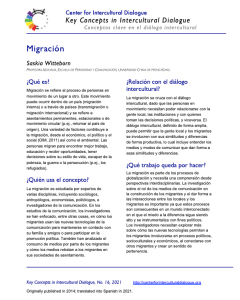
Key Concepts in ICDContinuing translations of Key Concepts in Intercultural Dialogue, today I am posting KC#49: Intersectionality, which Gust Yep published in English in 2015, and which Daniel Mateo Ordóñez has now translated into Spanish.

As always, all Key Concepts are available as free PDFs; just click on the thumbnail to download the PDF. Lists organized chronologically by publication date and numberalphabetically by concept in English, and by languages into which they have been translated, are available, as is a page of acknowledgments with the names of all authors, translators, and reviewers.

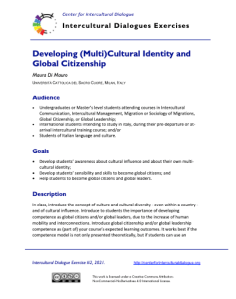
KC49 Intersectionality_Spanish

Yep, G. (2020). Interseccionalidad. (D. M. Ordóñez, trans.) Key Concepts in Intercultural Dialogue, 49. Available from:
https://centerforinterculturaldialogue.org/wp-content/uploads/2020/09/kc49-intersectionality_spanish.pdf

The Center for Intercultural Dialogue publishes a series of short briefs describing Key Concepts in Intercultural Dialogue. Different people, working in different countries and disciplines, use different vocabulary to describe their interests, yet these terms overlap. Our goal is to provide some of the assumptions and history attached to each concept for those unfamiliar with it. As there are other concepts you would like to see included, send an email to the series editor, Wendy Leeds-Hurwitz. If there are concepts you would like to prepare, provide a brief explanation of why you think the concept is central to the study of intercultural dialogue, and why you are the obvious person to write up that concept.


Creative Commons License
This work is licensed under a Creative Commons Attribution-NonCommercial-NoDerivatives 4.0 International License.

IMéRA Fellowships (France)

Fellowships

Call for applications: Fellowships, IMéRA Institute for Advanced Study at Aix-Marseille University, France. Deadline: 13 October 2020.

Each year IMéRA hosts about thirty scientists and artists from all disciplines (residents), selected after an evaluation procedure with the most stringent international standards, shortlisting of applications and external evaluators. IMéRA promotes innovative experimental interdisciplinary approaches in all areas of knowledge. Applications accepted in one of the following: