U Sheffield: Research Associate (UK)

“Job

Research Associate Covid-19 PPE for Refugees, Sheffield Institute for International Development, University of Sheffield, Sheffield, UK. Deadline: 19 February 2021.

Sheffield Institute for International Development has a position for a Social Science researcher in Sheffield Institute for International Development (SIID). They are looking for someone with a passion for crafting positive change through using your skills in quantitative and qualitative Social Science methodologies. The successful candidate will be part of an interdisciplinary team that is passionate about improving the lives and livelihood opportunities for refugees and marginalised communities. The project seeks to do this through the lens of Covid-19 personal protective equipment (PPE).

You’ll work alongside scientists and engineers, social scientists and arts practitioners, trainers and development workers to improve the quality and access to Covid-19 PPE for the vulnerable groups that they support. The team will be working with research and development organisations in Jordan to use available resources to develop context specific PPE for Covid-19 and to understand how its availability influences people’s behaviour. Participants will work remotely where possible so you will be working primarily from home, and integrate into and support a multi-national, multicultural team while having the ability to work independently and with only intermittent guidance.

U Queensland: Applied Linguistics (Australia)

“Job

Lecturer in Applied Linguistics, School of Languages and Cultures, University of Queensland, St. Lucia, Australia. Deadline: 11 March 2021.

The School of Languages and Cultures at the University of Queensland is looking to appoint a Lecturer in Applied Linguistics in the process of extending its international research profile in an area of relevance to the current teaching and research profile of the program. Individuals with research and teaching interests in any area of applied linguistics are welcome to apply, although those with an interest in one or more of the following areas of applied linguistics are especially encouraged to apply: text analytics, quantitative methods, research methods. Research interests in one or more of the languages taught in the school would also be advantageous.

The successful appointee will engage in undergraduate teaching and postgraduate supervision, undertake and contribute to further development of the School’s Applied Linguistics program, as well as performing research, service/engagement and other activities associated with the School. This position is located at the picturesque St Lucia campus, renowned as one of Australia’s most attractive university campuses, and located just 7km from Brisbane’s city centre.

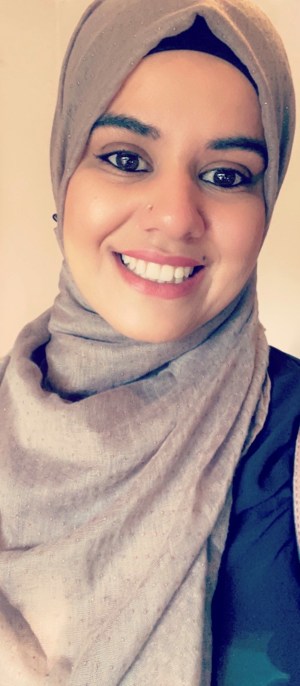
Maria Hussain Profile

ProfilesMaria Hussain is a Lecturer in Management at Leeds University Business School, a Senior Fellow of the Higher Education Academy and a Certified Business and Management Educator.

Her expertise lies in; inclusive management education, intercultural communication and organisational culture relating to EDI (race- equity) in complex organisations. Maria was recently recognised for her contribution to global intercultural competence in Management education in UPSIGN‘s 2022/23 list of 75 notable British Pakistani academics, trainers and teachers to mark Pakistan’s 75th anniversary of Independence. UPSIGN is a charity that works globally to promote mentoring, support and the education of UK-based British Pakistanis (and Pakistanis) and highlighting their work in education and academia. UPSIGN is also committed to working towards the UN SDG’s and reducing the impact of the climate emergency.

Maria is a co-opted member of the British Academy Management national Council, providing steer on equity and inclusive educational practice within Business Education. She has recently been appointed to the Chartered Association of Business Schools national EDI Committee. In 2022, she was also appointed as a national Race Equality Charter institutional application reviewer at Advance HE. Institutionally, Maria co-chairs the Muslim Staff Network, the first faith-based staff network in the sector. This important work has influenced university-wide EDI policy and ongoing implementation on the intersection of race-religion in addressing outcomes and awarding ‘gaps.’

Furthermore, Maria has recently won a prestigious fellowship at the Leeds Institute of Teaching Excellence. Her research project entitled: Enhancing the value placed on diversity: from the international classroom to the global workplace explores attitudes towards diversity from both student and employer perspectives.

Recent publication:
Hussain, M. (2021). Creating cultural insights: Making inroads into cultural exchange. In A. Manning, & S. Colaiacomo (Eds.), Innovations in internationalisation at home (pp 75-91). Cambridge, UK: Cambridge Scholarly Publishing.

For further information please see Maria’s work profile.

Please connect with her on LinkedIn.


Work for CID:
Maria Hussain participated in the the CID/UNESCO focus groups for the Futures of Education Initiative.

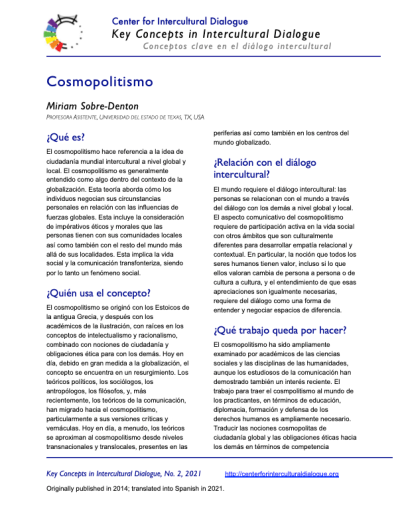
KC2 Cosmopolitanism Translated into Spanish

Key Concepts in ICDContinuing translations of Key Concepts in Intercultural Dialogue, today I am posting KC#2: Cosmopolitanism, which Miriam Sobre-Denton wrote for publication in English in 2014, and which  Jhon Eduardo Mosquera Pérez has now translated into Spanish.

As always, all Key Concepts are available as free PDFs; just click on the thumbnail to download. Lists of Key Concepts organized alphabetically by conceptchronologically by publication date and number, and by languages into which they have been translated, are available, as is a page of acknowledgments with the names of all authors, translators, and reviewers.

KC2 Cosmopolitanism_SpanishSobre-Denton, M. (2021). Cosmopolitismo. (J. E. Mosquera Pérez, Trans.). Key Concepts in Intercultural Dialogue, 2. Available from: https://centerforinterculturaldialogue.org/wp-content/uploads/2021/02/kc2-cosmopolitanism_spanish.pdf

If you are interested in translating one of the Key Concepts, please contact me for approval first because dozens are currently in process. As always, if there is a concept you think should be written up as one of the Key Concepts, whether in English or any other language, propose it. If you are new to CID, please provide a brief resume. This opportunity is open to masters students and above, on the assumption that some familiarity with academic conventions generally, and discussion of intercultural dialogue specifically, are useful.

Wendy Leeds-Hurwitz, Director
Center for Intercultural Dialogue


Creative Commons License
This work is licensed under a Creative Commons Attribution-NonCommercial-NoDerivatives 4.0 International License.

CFP Interdisciplinary Studies in Diasporas

“Publication

Call for book proposals: Interdisciplinary Studies in Diasporas book series with Peter Lang, edited by Irene Maria F. Blayer and Dulce Maria Scott.

Interdisciplinary Studies in Diasporas opens a discursive space in diaspora scholarship in all fields of the humanities and social sciences. The volumes published in this series comprise studies that explore and contribute to an understanding of diasporas from a broad spectrum of cultural, literary, linguistic, anthropological, historical, political, and socioeconomic perspectives, as well as theoretical and methodological approaches. The series welcomes original submissions from individually and collaboratively authored books and monographs as well as edited collections of essays. All proposals and manuscripts are peer reviewed.

CFP GLOCAL COMELA 2021 (Greece)

ConferencesCall For Abstracts: The Global Council on Anthropological Linguistics (GLOCAL) Conference on Europe and Mediterranean Linguistic Anthropology (COMELA) 2021, National and Kapodistrian University of Athens, Greece July 21-24, 2021. Deadline:  March 10, 2021.

Theme – Bounded Languages … Unbounded / Περιορισμένες Γλώσσες … Απεριόριστες, a theme highly pertinent to Europe and Mediterranean at the current time, encapsulates the ongoing struggle throughout Mediterranean and European regions. As the continuous tension between demarcation, and the concurrent legitimization, of languages, language ideologies, and language identities, enters an era where new modes of interactivity require language communities to take on roles superordinate to the past, flexible citizenship now operates within, and not only across, language communities, to unbind languages, and to create new boundaries, unlike those ever seen throughout history.

Over 450 scholars globally will gather to present papers and to engage in progressive discussion on the Linguistic Anthropology, Language and Society, Sociolinguistics, and related fields of Europe and Mediterranean. The GLOCAL COMELA is fully Non-Profit, assisting scholars in impeded economic positions, who require funding to access the COMELA Conference, and who display strong ability in their work. GLOCAL COMELA proceedings are SCOPUS / ISI (AHCI / SSCI / CPCi) indexed and contribute to ranked and cited publications for all those accepted to present. The GLOCAL COMELA publishes papers presented at the GLOCAL COMELA 2021 in Top Tier Journal Publication Special Issues.


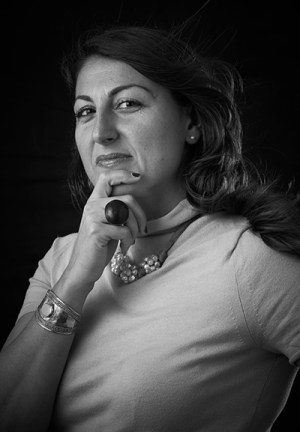
Maura Di Mauro Profile

ProfilesMaura Di Mauro teaches Intercultural Management at the Catholic University of the Sacred Heart of Piacenza, Italy, and in other universities.

Maura Di Mauro

She is an Intercultural Trainer, Consultant and Coach, and an expert on Sustainability and Social Innovation. She has experience in assessment and development center activities for large multinational groups, both in Italy and abroad, in training managerial teams on the development of their intercultural and global skills, on leading multicultural teams, and on Diversity and Inclusion Management Design Strategies. From 2016 to 2019 she was the President of SIETAR Italia, and Board Member of SIETAR Europe, and has served as consultant to ISMU Foundation and other groups for research and training projects.

Publications include:

Di Mauro, M. (2021). Includere e valorizzare le competenze dei Migranti: TRAINING toolkit sul diversity management. ISMU Foundation.

Boerchi, D., Di Mauro, M., & Sarli, A. (2020). Guidelines for the identification and assessment of migrants’ soft skills. ISMU Foundation.

Di Mauro, M., & Gehrke, B. (2019). Feeling Italian. SIETAR Italia

Di Mauro, M., & Taratuhina, Y. (Eds.). (2019). East and West relations bridging: SIETAR Russia and SIETAR Europa 2018 Conference Proceedings.

Di Mauro, M. & Gehrke, B. (Eds.). (2018). Multicultural identities: Challenging the sense of belonging, Conference proceeding of IX SIETAR Italia International Conference. Fondazione Intercultura.

Di Mauro, M. (2016). Tourism: An opportunity for mobility and intercultural encounters. Intercultural Training and Consulting for the development of the tourism industry. In E. J. Nash, N. C. Brown, & L. Bracci (Eds.), Intercultural horizons: Identities, relationships and languages in migration (vol. 4). Newcastle upon Tyne, UK: Cambridge Scholars.

Di Mauro, M. (2015). The extension of intercultural competence today: from individual effectiveness, to innovative, responsible and sustainable practices. In L. Bracci, N. C. Brown, & E. J. Nash (Eds.), Intercultural horizons: Intercultural competence – key to the new multicultural societies of the globalized world (vol. 3). Newcastle upon Tyne, UK: Cambridge Scholars.


Work for CID:

Maura Di Mauro participated in a CID/UNESCO focus group for the Futures of Education Initiative, and wrote ICD Exercise #2.

U Fribourg: Communication Studies (Switzerland)

“JobProfessor of Communication Studies (tenured), Department of Communication and Media Research, University of Fribourg, FR, Switzerland. Deadline: 1 March, 2021.

The Faculty of Management, Economics and Social Sciences of the University of Fribourg (Switzerland) invites applications for the full-time position of Professor (tenured) in Communication Studies. The professorship is with the Department of Communication and Media Research DCM and comes with one fully funded PhD position. The appointment begins in early 2022.

The position requires a specialization in individual (micro-level) issues of communication and media research from a social scientific perspective. This includes but is not limited to research fields like media exposure, media use and media effects and/or audience studies and/or media and online communication content. Moreover, candidates should be able to contribute to teaching in other areas on the Bachelor level, for instance journalism research or media economics and media management. Finally, they should also take the digital transformation of communication and media into account in their current and/or future research and teaching activities.

UNC Ashville: University Fellow for Faculty Diversity in Sociology (USA)

PostdocsUniversity Fellow for Faculty Diversity in Sociology, Department of Sociology and Anthropology, University of North Carolina, Ashville, Ashville, NC. Deadline: Open until filled, but review begins March 1, 2021.

To support the development of a more diverse professoriate, the Department of Sociology and Anthropology at UNC Asheville invites applications for the new University Fellowship for Faculty Diversity (University Fellows) Program. The program invites pre-doctoral and post-doctoral candidates looking specifically to take on an academic position at a liberal arts institution which takes equal pride in the excellence of its faculty’s teaching and the quality of its faculty’s scholarship and creative production.

Applicants must hold a Ph.D. in Sociology or be a Ph.D. candidate nearing the completion of their degree (ABD). The University Fellow will teach Introduction to Sociology, along with other courses in the fellow’s area of expertise. While the fellow’s area of specialization is open, we are looking for a critical teacher-scholar whose teaching and research complement and enhance the department’s social justice focus. The successful candidate will have a lightened teaching load, extensive mentorship, and support for the development of their pedagogy and scholarship. The term of appointment is 2 (post doc) to 3 (pre doc) years. Following this term, the University Fellow may be offered a tenure-track position in the Department. Additional information about the University Fellowship program may be found at this link: https://academicaffairs.unca.edu/faculty-openings/university-fellowship-for-faculty-diversity/.

UNESCO Futures of Education Focus Groups Completed

“UNESCO”

The Center for Intercultural Dialogue held 3 focus groups as part of the UNESCO Futures of Education Initiative, January 28, 29, and 30, 2021.

UNESCO Futures of EducationThanks first to Nazan Haydari, member of the CID Advisory Board, who who served as moderator of one of the groups, and organized the technology through Istanbul Bilgi University.

Thanks next to all of the participants for all of their ideas. They included: Evangelos Afendras (Greece), Chukwuemeka Amajo (Nigeria), Diana Bebenova-Nikolova (Bulgaria), Giovanna Carloni (Italy), Ivett Rita Guntersdorfer (Germany), Mohammed Guamguami (Morocco), Maria Hussain (UK), Teresa Joseph (India), Emilija Jovanovska (USA/Macedonia), Lasana Kazembe (USA), Sergei Kladko (Russia), Maura Di Mauro (Italy), Katrien Mertens (Belgium), Isabel Mohedano Sohm (Spain), M. L. Papusa Molina (Mexico), Maja Nenadovic (Netherlands), Sushil Oswal (USA), Chris Peltier (France), Anne-Nelly Perret-Clermont (Switzerland), Yehuda Silverman (Canada/USA), and Arianna Vettorazzi (Netherlands/Italy).

The report synthesizing our discussions will be completed, submitted to UNESCO, and posted to this site shortly. [update: now posted here]

For everyone else with an interest in the topic but who was unable to respond quickly enough to participate, in addition to the relevant publications posted previously, UNESCO has now offered several additional possibilities:

Passive participation: you may follow the developments on their website, as they post updates.

Active engagement: there are several possibilities:

  • Take the 1-minute survey on the top 3 challenges and purposes of education
  • Write your thoughts on what they see as the one major issue for the futures of education (max 1000 words).
  • Submit an original artwork of what education might look like in 2050.