MOOC Intercultural Communication 2021 (China)

“MOOCs”Intercultural Communication MOOC, Shanghai International Studies University (SISU), Shanghai, China. Opens March 15, 2021 with free access for 7 weeks from any start date between March-July 2021.

In a time when online learning helps those limited by COVID measures, the SISU-Future Learn “Intercultural Communication” course provides an important forum for cross-cultural exposure and interaction. To help connect people virtually world-wide again, a new run of the course opens March 15 until July 2021 and offers FREE access from the day of enrollment for 7 weeks of learning. Nearly 65,000 have enrolled in the SISU-FutureLearn “Intercultural Communication” MOOC course from nearly 200 global countries and regions since it was first launched in 2015.

The course invites participation on every “learning step”. Learners of all ages and backgrounds and our active team of Mentors comment on their questions, insights, “likes,” or responses to others. The “5 week” structure (which you can go through at your own pace) addresses topics like

  • Comprehending Intercultural Communication
  • Contextualizing Cultural Identities
  • Comparing Cultural Communication Styles
  • Clarifying and Contrasting Values
  • Cultivating Intercultural Adaptation
     
    to guide active participants toward greater awareness and practice of intercultural competence.


CFP Cyber Dystopia/Utopia? Digital Interculturality

“PublicationCall for Abstracts: Cyber Dystopia/Utopia? Digital Interculturality between Cosmopolitanism and Nationalism, Special Issue of Interculture Journal. Deadline: 1 April 2021.

While the cyber utopian thinkers of the early 1990s predicted the coming of a networked society in which the old hierarchical structures of business and culture would disappear, and the early 2010s, with the Arab Spring, the Occupy Movement and new ‘hacktivism’, appeared firstly as a progressive golden age of online political engagement, a more unpleasant type of Internet culture has gained traction within the past few years. As Angela Nagle has written: “The emergence of this new online right is the full coming to fruition of the transgressive anti-moral style, its final detachment from any egalitarian philosophy of the left or Christian morality of the right” (Kill All Normies, 2017, p. 39). Yet, the cyber utopian thinkers of the early 1990s were not wrong: The Internet does indeed have the potential to be a source of positive cosmopolitanism, whether understood in a philosophical- normative, descriptive or processual sense, and may facilitate both trans-local conversations on global matters and the decentring of discourse, allowing for the participation of a wider variety of agents and (sub)cultures in discussion.

For a special issue of the open-access Interculture Journal (spring, 2022), and within the framework of the research project “ReDICo: Researching Digital Interculturality Co-operatively,” funded by the German Federal Ministry for Education and Research, editors would like to interrogate the topic of “Cyber Utopia/Dystopia? Digital Interculturality between Cosmopolitanism and Nationalism” from a variety of angles. Issue editors will be Dr. Luisa Conti and PD Dr. Fergal Lenehan.

Fatemeh Kamali-Chirani Interview

“Interviews”Dr. Fatemeh Hippler (birth name: Kamali-Chirani) was interviewed about international relations, intercultural dialogue, and refugee work on February 4, 2021, by Rehana Paul, CID intern.

Dr. Hippler answers the following questions:

  • What is the role of intercultural dialogue in International Relations?
  • How does refugee work require an understanding of dialogue between cultures?

For a comparison of international communication with intercultural, intracultural, and cross-cultural communication, see CID Posters, #4: Types of cultural communication.

U Macau: Assistant Prof in Communication (China)

“Job

Assistant Professor in Communication, Faculty of Social Sciences, University of Macau, Macau, China. Deadline: May 8, 2021.

The Department of Communication of the Faculty of Social Sciences invites applications for the position of Assistant Professor in Communication. They are looking for applicants in journalism, specifically in English news writing, reporting, and editing. A track record of high quality research and publication through internationally respected outlets or demonstrated ability is a must. Qualifications and willingness to teach the following courses are expected: English News Writing; English News Editing; Advanced News Writing and Reporting in English; and Workshop: English Publication. Additional courses may be assigned to match the teaching needs of the department, faculty, and university.

Ryerson U: Canada Research Chair in Migration and Democracy (Canada)

“JobTier 2 Canada Research Chair in Migration and Democracy in a Settler-Colonial Context, Department of Sociology, Ryerson University, Toronto, Canada. Deadline: 31 March 2021.

Located in downtown Toronto, the largest and most culturally diverse city in Canada and on the territory of the Anishinaabeg, Haudenosaunee and the Wendat Peoples, the Department of Sociology in the Faculty of Arts at Ryerson University invites applications for a Tier 2 Canada Research Chair (CRC) in Migration and Democracy in a Settler-Colonial Context. Upon successful nomination to the CRC program, the candidate will be appointed to a tenure track position at the rank of Assistant or Associate Professor, effective July 1, 2022, subject to final budgetary approval.

In collaboration with Ryerson University, the successful candidate will develop the CRC nomination for the October 19, 2021 deadline. The CRC appointment is tenable for five years and renewable once. All nominations are subject to review and final approval by the CRC Secretariat. Further details on the CRC eligibility criteria can be found here.

UNESCO Futures of Education Weekly Polls

“UNESCO”Weekly poll, UNESCO Futures of Education Initiative, UNESCO, Paris, France.

UNESCO’s #FuturesOfEducation initiative is exploring how knowledge and learning can shape the future of humanity and the planet. The question they have posed is: What do we want education to look like in 2050? Everyone is invited to participate in their weekly Education 2050 Poll and help design the #FuturesOfEducation. (It is unclear how long they will host these polls.)

Read basic information about the Futures of Education Initiative. Or read the CID Report for UNESCO Futures of Education, sharing the results of 3 focus groups we organized at their request.

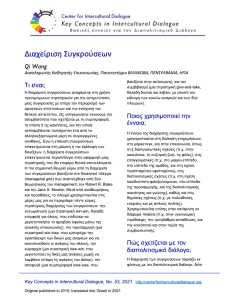
KC53 Conflict Management Translated into Greek

Key Concepts in ICDContinuing translations of Key Concepts in Intercultural Dialogue, today I am posting KC#53: Conflict Management, which Qi Wang wrote for publication in English in 2015, and which Anastasia Karakitsou has now translated into Greek.

As always, all Key Concepts are available as free PDFs; just click on the thumbnail to download. Lists of Key Concepts organized chronologically by publication date and number, alphabetically by concept, and by languages into which they have been translated, are available, as is a page of acknowledgments with the names of all authors, translators, and reviewers.

KC53 Conflict management_GreekWang, Q. (2018). Conflict management [Greek]. (A. Karakitsou, trans). Key Concepts in Intercultural Dialogue, 53. Available from: https://centerforinterculturaldialogue.org/wp-content/uploads/2021/03/kc53-conflict-management_greek.pdf

If you are interested in translating one of the Key Concepts, please contact me for approval first because dozens are currently in process. As always, if there is a concept you think should be written up as one of the Key Concepts, whether in English or any other language, propose it. If you are new to CID, please provide a brief resume. This opportunity is open to masters students and above, on the assumption that some familiarity with academic conventions generally, and discussion of intercultural dialogue specifically, are useful.

Wendy Leeds-Hurwitz, Director
Center for Intercultural Dialogue


Creative Commons License
This work is licensed under a Creative Commons Attribution-NonCommercial-NoDerivatives 4.0 International License.

Fulbright in the Classroom

Fulbrights

Call for Volunteers and Grant Applicants, Fulbright in the Classroom, Department of State, Washington, DC. Deadline: May 1, 2021.

For those who have been affiliated with the Fulbright Program, there is an opportunity to promote international understanding by sharing your Fulbright experiences with K-through-College students through Fulbright in the Classroom. All Fulbrighters are welcome to participate, especially recently returning students and ETAs, and visiting grantees. By participating in Fulbright in the Classroom, you can bring a personal perspective on the country you visited or share information about your home country. Please note that you must be a member of the Fulbright Association to participate in FIC or to apply for the grant.

You may participate as (1) a volunteer in your own area, and/or (2) apply for a $750 Fulbright Classroom Grant to reach out digitally to under-represented communities nationwide. Fulbright in the Classroom is primarily an education outreach program, but it will also raise the profile of the Fulbright Program. The goal is to benefit especially communities who are not fully represented in the Program by inspiring future applicants. There is a webinar on March 18 to learn more about the grant and its application.

NOTE: Fulbrighters are also invited to participate in the 75th Anniversary classroom program administered by the State Department (only for the year 2021). Click here to register.

CFP Critical Intercultural Communication Studies

“Publication

Call for Proposals: Critical Intercultural Communication Studies Book Series, Peter Lang. Series Editors: Thomas Nakayama and Bernadette Calafell.

Critical approaches to the study of intercultural communication have arisen at the end of the 20th century and are poised to flourish in the new millenium. As cultures come into contact driven by migration, refugees, the internet, wars, media, transnational capitalism, cultural imperialism, and more, critical interrogations of the ways that cultures interact communicatively are a needed aspect of understanding culture and communication. This series will interrogate – from a critical perspective – the role of communication in intercultural contact, in both domestic and international contexts. Through attentiveness to the complexities of power relations in intercultural communication, this series is open to studies in key areas such as postcolonialism, transnationalism, critical race theory, queer diaspora studies, and critical feminist approaches as they relate to intercultural communication. Proposals might focus on various contexts of intercultural communication such as international advertising, popular culture, language policies, hate crimes, ethnic cleansing and ethnic group conficts, as well as engaging theoretical issues such as hybridity, displacement, multiplicity, identity, orientalism, and materialism. By creating a space for these critical approaches, this series will be a the forefront of this new wave in intercultural communication scholarship. Manuscripts and proposals are welcome which advance this new approach.

ICD Exercise #2

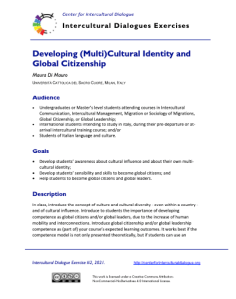
ICD ExercisesThe next ICD Exercise is now available. Maura Di Mauro has written about Developing (multi)cultural identity and global citizenship.

ICD Exercise 2 Di MauroDi Mauro, M. (2021). Developing (multi)cultural identity and global citizenship. Intercultural Dialogue Exercises, 2. Available from: 
https://centerforinterculturaldialogue.org/wp-content/uploads/2021/02/icd-exercise-2-di-mauro.pdf

If you have an exercise you’ve used that works, and you would like to share it, please submit it. All authors will be asked to answer the same set of questions, and to make the exercises available for others to use, thus these are being published with a Creative Commons license (as is the case for all CID publications). If you are new to CID, please provide a brief resume. This opportunity is open to masters students and above, on the assumption that some familiarity with academic conventions generally, and discussion of intercultural dialogue specifically, are useful.

Wendy Leeds-Hurwitz, Director Center for Intercultural Dialogue


This work is licensed under a Creative Commons Attribution-NonCommercial-NoDerivatives 4.0 International License.