CIDOB: Research Fellow, Global Cities (Spain)

“JobResearch Fellow, Global Cities Programme, Barcelona Centre for International Affairs (CIDOB), Barcelona, Spain. Deadline: 6 February 2022.

CIDOB is a think tank for international affairs that seeks to analyse global issues that affect political, social and governance dynamics, from the international to the local. CIDOB promotes innovation in the analysis of global politics, with the aim of transcending classical international relations structures and considering the growing impact of global phenomena on local realities and vice versa. In 2017, CIDOB in collaboration with Barcelona City Council launched the Global Cities Programme (GCP). The GCP produces policy-oriented analyses of cities as transnational political actors; their role in European and global governance; and their ability to provide sustainable development solutions in the framework of the 2030 Agenda and beyond. Working in close collaboration with Barcelona City Council, the programme’s research and other outputs are focused on supporting cities in Europe, the Mediterranean and globally to tackle the green and digital transitions and related socioeconomic challenges.

CIDOB’s Global Cities Programme is seeking a Research Fellow to lead its research on the digital transition of cities. The successful candidate will analyse and support cities’ ambitions to test and upscale innovative digital solutions in a socially and environmentally sustainable manner; identify municipal governance challenges that arise from digital transformations; and monitor and assess regulation and policy standards that promote fair, transparent and ethical uses of digital technologies in urban space.
UNESCO: Programme Coordinator Migration (France)

“JobProgramme Coordinator for Migration, Displacement, Emergencies & Education, UNESCO, Paris, France. Deadline: 5 February 2022.

Under the overall authority of the Assistant Director-General, Education, guidance from the Director, Division for Education 2030, and direct supervision from the Chief of Section for Migration, Displacement, Emergencies and Education, the incumbent coordinates UNESCO’s strategic engagement in the areas of migration, displacement, emergencies, and education in the frameworks of SDG-Education 2030 Agenda and the Futures of Education and in alignment with the Global Compacts for Refugees and for Safe, Orderly and Regular Migration and other global instruments through positioning the Organization at the global level and providing technical support and advice at the regional and national levels through/with the Field Offices and Institutes. S/he engages in key global mechanisms, such as the Geneva Global Hub, INEE, and ensures UNESCO’s visibility and substantive intellectual and technical contributions. Also s/he conceptualizes and delivers global initiatives of UNESCO’s comparative advantage from funding proposals to design to reporting in close coordination and collaboration with the Education Sector, other Sectors, Field Offices and Institutes. In addition, s/he may lead a team of colleagues on particular thematic areas, evaluating progress and performance. Moreover, s/he provides strategic advice and technical support to enhancing UNESCO’s operations in the Field.

CFP IADA 2022: Dialogue in a Globalised and Digital World (Russia & Online)

ConferencesCall for papers: Dialogue in a Globalised and Digital World: Retrospective and Prospective Studies, July 12-14, 2022, RUDN University, Moscow, Russia (Hybrid format). Deadline: March 1, 2022.

UPDATE: as of March 10, this conference has been canceled: “The current war that is raging in Ukraine, the result and continuation of blatant denial of all the resources of fruitful dialogue, does not permit to hold such an event.”

The twenty-first century opened us up to a new reality. New smart, digital technologies raised communication opportunities to new heights. One does not even need a computer to participate from the eastern part of the world in a dialogue with someone who is in the west part of the globe. Smartphone is enough. Such worldwide famous programs as MS Teams and Zoom serve many communication needs, including gesture and mimics, as one can both hear and see our interlocutors.

Popular and political discourse is invested in globalization. As we nearly got used to the term ‘globalized world’, this world starts turning back again to national ideals. Integration or disintegration – that is the question?
Covid time is not over. What has it brought to us? Deeper knowledge of how to communicate from a distance or depression and desocialisation? Maybe both. One thing is clear. We cannot change strange and cruel circumstances at once, but we can help people and peoples obtain a new understanding and knowledge of how to survive and make life better through constructive dialogue.

Migration processes captured the globe as well. People of different nations hardly understand each other. Communication barriers based on cultural peculiarities can be brought down. It might be time to work out a migration linguistic policy; a time to ‘break the communication ice’ among the nations.

An interdisciplinary approach to the problem of understanding, friendship and cooperation through constructive dialogue is one more goal to achieve.

All the above mentioned challenges will be the aim of this conference.

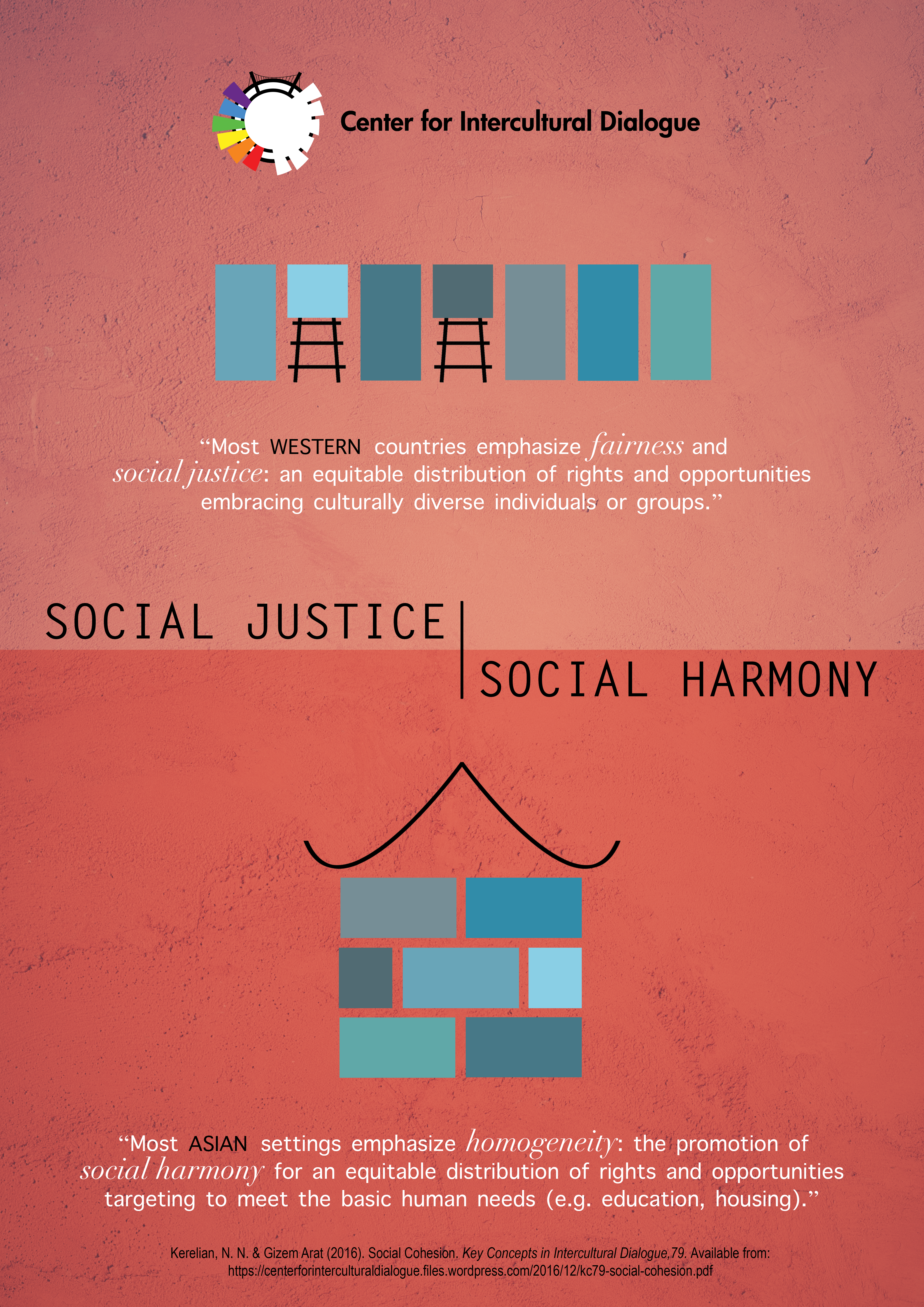
CID Poster #7: Social Justice/Social Harmony (reprise)

CID Posters(We are reprising the series of posters, because it has been several years since they were originally created, and they are much too wonderful to let them not be noticed by newcomers to the site!)

This is the next of the posters designed by Linda J. de Wit, then in her role as CID intern. This is the first poster to use one of the Key Concepts in Intercultural Dialogue as the source. The content here comes from KC79: Social Cohesion, written by Narine Nora Kerelian & Gizem Arat.

Social Justice/Social HarmonyJust in case anyone wants to cite this poster, the following would be the recommended format:

Center for Intercultural Dialogue. (2017). Social justice/social harmony. CID Posters, 7. Available from:
https://centerforinterculturaldialogue.org/wp-content/uploads/2017/08/social-justice-harmony.png

As with other series, CID Posters are available for free on the site; just click on the thumbnail to download a printable PDF. They may be downloaded, printed, and shared as is, without changes, without cost, so long as there is acknowledgment of the source.

As with other series, if you wish to contribute an original contribution, please send an email before starting any work to receive approval, to minimize inadvertent duplication, and to learn about technical requirements. As is the case with other CID Publications, posters should be created initially in English. Given that translations of the Key Concepts in Intercultural Dialogue have received so many views, anyone who wishes to translate their own poster into another language (or two) is invited to provide that as well. If you want to volunteer to translate someone else’s poster into a language in which you are fluent, send in a note before starting, to receive approval and to confirm no one else is working on the same one.

Wendy Leeds-Hurwitz
Director, Center for Intercultural Dialogue
intercult.dialogue AT gmail.com


Creative Commons License
This work is licensed under a Creative Commons Attribution-NonCommercial-NoDerivatives 4.0 International License.

Beyond Borders: PHD Scholarships (Germany)

“Studentships“

PHD Scholarships at multiple levels, Borders, Migration, and Knowledge, Beyond Borders, Hamburg, Germany. Deadline: 1 March 2022.

Beyond Borders invites applications from Ph.D. students worldwide studying borders and bordering phenomena in different regions of the world. Both empirical research based on extensive fieldwork and projects centered on theoretical reflection are eligible for support. Innovative and challenging research questions as well as comparative approaches are highly welcome. There are Start-up scholarships, PHD Scholarships, and Dissertation completion scholarships.

The migration of people is intimately connected to the migration of knowledge and culture. However, strong international borders still define what is considered national literature, art, or history and which artists, writers, and thinkers from which parts of the world gain global recognition. We invite project applications that explore how national and international canons are produced and changed. Under what conditions do knowledge and culture circulate easily, and when are they blocked? What powers and interests are served when canons are defined? How do museums, universities, archives, and libraries change when traditional intellectual and cultural power centers are displaced or decentered?

Questions concerning borders, migration, knowledge production and circulation as well as social and cultural transfers across nations are the focus of the current call for applications for Ph.D. scholarships. They encourage applications for projects concentrating on following aspects, although other topics will also be considered: trajectories of migration and mobility of cultural and intellectual production; social and cultural dimensions of borders; cultural borders and their manifestation in arts and cultural production; circulation of ideas and knowledge; the changing understanding of the “national”; transnational and global cultural institutions and canons; decolonizing decoloniality – what is a decentered approach to producing, disseminating, teaching about and acting upon knowledge in more equitable ways.

CFP Middle East Dialogue 2022 (Virtual)

EventsCall for proposals: Middle East Dialogue 2022, Policy Studies Organization, March 18, 2022 (Virtual). Deadline: February 12, 2022.

The Policy Studies Organization (PSO) and The Digest of Middle East Studies (DOMES) have announced the official call for proposals for their annual Middle East Dialogue. The event aims to promote dialogue about current policy concerns in the Middle East, and to provide a civil space for discussion across the religious and political spectrum. As in years past, they invite scholars, policy-makers, and other leaders within the global and local community to respectfully, and productively, discuss the diverse range of issues affecting the region.

KC68 Social Justice Translated into Turkish

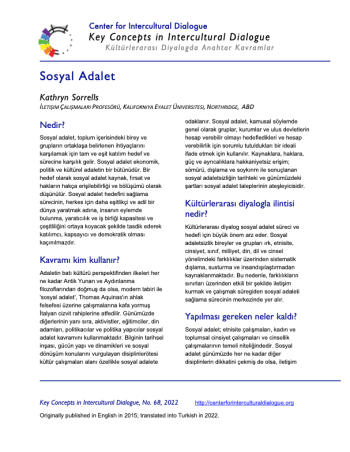
Key Concepts in ICDContinuing translations of Key Concepts in Intercultural Dialogue, today I am posting KC#68: Social Justice, which Kathryn Sorrells wrote for publication in English in 2015, and which Candost Aydın has now translated into Turkish.

As always, all Key Concepts are available as free PDFs; just click on the thumbnail to download. Lists of Key Concepts organized alphabetically by conceptchronologically by publication date and number, and by languages into which they have been translated, are available, as is a page of acknowledgments with the names of all authors, translators, and reviewers.

KC68 Social Justice_TurkishSorrells, K. (2022). Social justice [Turkish]. (C. Aydın, Trans.). Key Concepts in Intercultural Dialogue, 68. Available from: https://centerforinterculturaldialogue.org/wp-content/uploads/2021/12/kc68-social-justice_turkish.pdf

If you are interested in translating one of the Key Concepts, please contact me for approval first because dozens are currently in process. As always, if there is a concept you think should be written up as one of the Key Concepts, whether in English or any other language, propose it. If you are new to CID, please provide a brief resume. This opportunity is open to masters students and above, on the assumption that some familiarity with academic conventions generally, and discussion of intercultural dialogue specifically, are useful.

Wendy Leeds-Hurwitz, Director
Center for Intercultural Dialogue


Creative Commons License
This work is licensed under a Creative Commons Attribution-NonCommercial-NoDerivatives 4.0 International License.

U Essex: International Management (UK)

“Job

Senior Lecturer in International Management, Essex Business School, University of Essex, UK. Deadline: 4 February 2022.

The Strategy, Operations, and Entrepreneurship (SOE) Group lies within Essex Business School, which is undertaking a major expansion of SOE’s teaching and research activities, accelerating its growth and development. The post-holder will contribute to the development of the Group and School through research and teaching in International Management. They welcome applications in any area of International Management, including, but not restricted to, International Marketing, Comparative and International HRM, Strategy, and Inter-Cultural Communication.

Durham U: Intercultural / International Education (UK)

“JobAssociate Professor in Intercultural & International Education, Education Studies, Durham University, Durham, UK . Deadline: 4 February 2022.

The School of Education at Durham University seeks to appoint a talented individual to the role of Associate Professor in Intercultural and International Education. They welcome applications from those with research and teaching interests in the broad field of Intercultural and International Education and /or subfield(s) of this wide area of expertise as relevant to diverse educational sectors and provider types. Applicants will be required to contribute to the International and Comparative Education research cluster. Research topics may include but are not limited to: Internationalisation and internationalisation at home; Critical approaches to intercultural communication and intercultural competence; Intercultural education; Critical intercultural pedagogy; Language, migration, and education; Social justice and global citizenship; Decolonial approaches to intercultural education and intercultural communication.


CFP Communicative Response to Anti-Asian Racism

“PublicationCall for Papers: Special Issue of Asian Journal of Communication: Communicative Response to Anti-Asian Racism. Deadline for abstract: 15 February 2022.

Special issue editors: Dr. Jin-Ae Kang, Dr. YoungJu Shin, Dr. Do Kyun Kim, & Dr. Peter J. Schulz.

This special issue strives to create and continue the social discourse on anti-Asian racism and, simultaneously, contribute to preventing further anti-Asian racism; issue editors hope to provide researchers, practitioners, and policy decision-makers with insights for communicative policy making and campaigns for social change to promote justice, diversity, equity, and inclusion in the global community. They welcome diverse theoretical and methodological approaches. Possible topics to be addressed include, but are not limited to:

  • Media representation of Asians: Media coverage on Asians and anti-Asian hate crimes

  • Cross-national and/or cross-cultural comparative studies of anti-Asian sentiment

  • Intra-Asian racism: Anti-Asian racism that are found within Asian countries such as hostile sentiment against Africans or Indians in China, or against Chinese in Korea or Japan.

  • Influence of COVID-19 on anti-Asian sentiment and racism

  • Social media, free speech, and anti-Asian hate speech

  • Anti-Asian hate crime and mental and physical health

  • Interpersonal communication about anti-Asian racism, coping strategies, and social support

  • Issues of justice, diversity, equity and inclusion regarding anti-Asian prejudice in an organization setting: leadership prototypes, stereotypes and micro-aggression in workplaces, etc.

  • Diversity, inclusion, and equity issues focusing on Asians or anti-Asian sentiment among the professionals in media industry such as journalism, public relations, advertising, film, etc.

  • Activism among Asians against anti-Asian racism: activism in digital media, social change, mobilization, and political engagement of Asians or Asian ethnic organizations

  • Communication strategies responding to anti-Asian sentiment and hate crime

  • Effects of anti-Asian sentiment / crime in schools including K-12 and higher education