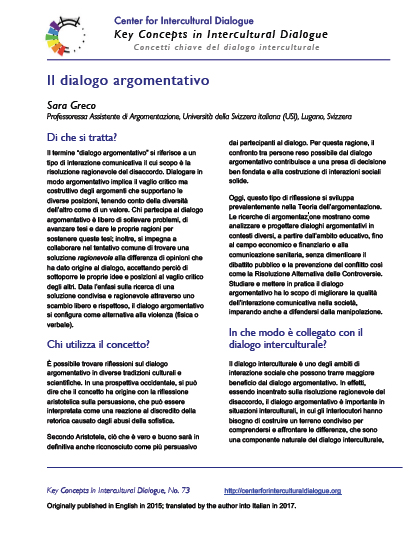
Key Concept #73: Argumentative Dialogue Translated into Italian

Key Concepts in ICDContinuing translations of Key Concepts in Intercultural Dialogue, today I am posting the translation of KC73: Argumentative Dialogue. Sara Greco wrote this in English in 2014 and has now translated it into Italian.

As always, all Key Concepts are available as free PDFs; just click on the thumbnail to download. Lists of Key Concepts organized chronologically by publication date and number, alphabetically by concept, and by languages into which they have been translated, are available, as is a page of acknowledgments with the names of all authors, translators, and reviewers.

KC73 Argumentative Dialogue_ItalianGreco, S. (2017). Il dialogo argomentativo. Key Concepts in Intercultural Dialogue, 73. Available from: https://centerforinterculturaldialogue.org/wp-content/uploads/2017/01/kc73-argumentative-dialogue_italian.pdf

If you are interested in translating one of the Key Concepts, please contact me for approval first because dozens are currently in process. As always, if there is a concept you think should be written up as one of the Key Concepts, whether in English or any other language, propose it. If you are new to CID, please provide a brief resume. This opportunity is open to masters students and above, on the assumption that some familiarity with academic conventions generally, and discussion of intercultural dialogue specifically, are useful.

Wendy Leeds-Hurwitz, Director
Center for Intercultural Dialogue


Creative Commons License
This work is licensed under a Creative Commons Attribution-NonCommercial-NoDerivatives 4.0 International License.

Key Concept 41: Yuan Translated into Chinese

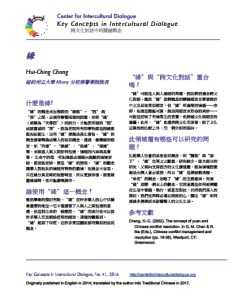
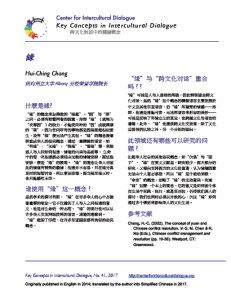
Key Concepts in ICDContinuing translations of Key Concepts in Intercultural Dialogue, today I am posting the translation of KC41: Yuan. Hui-Ching Chang wrote this in English in 2014 and has now translated it into both Traditional Chinese and Simplified Chinese.

As always, all Key Concepts are available as free PDFs; just click on the thumbnail to download. Lists of Key Concepts organized chronologically by publication date and number, alphabetically by concept, and by languages into which they have been translated, are available, as is a page of acknowledgments with the names of all authors, translators, and reviewers.

KC41 Yuan_Chinese-trad
Yuan in Traditional Chinese
KC41 Yuan_Chinese Simplified
Yuan in Simplified Chinese


Chang, H.-C. (2017). Yuan [Traditional Chinese]. Key Concepts in Intercultural Dialogue, 41. Available from:
https://centerforinterculturaldialogue.org/wp-content/uploads/2017/01/kc-41-yuan_chinese-trad2.pdf

Chang, H.-C. (2017). Yuan [Simplified Chinese]. Key Concepts in Intercultural Dialogue, 41. Available from:
https://centerforinterculturaldialogue.org/wp-content/uploads/2019/10/kc-41-yuan_chinese-sim.pdf

If you are interested in translating one of the Key Concepts, please contact me for approval first because dozens are currently in process. As always, if there is a concept you think should be written up as one of the Key Concepts, whether in English or any other language, propose it. If you are new to CID, please provide a brief resume. This opportunity is open to masters students and above, on the assumption that some familiarity with academic conventions generally, and discussion of intercultural dialogue specifically, are useful.

Wendy Leeds-Hurwitz, Director
Center for Intercultural Dialogue


Creative Commons License
This work is licensed under a Creative Commons Attribution-NonCommercial-NoDerivatives 4.0 International License.

Key Concept 22: Cultural Identity Translated into Turkish

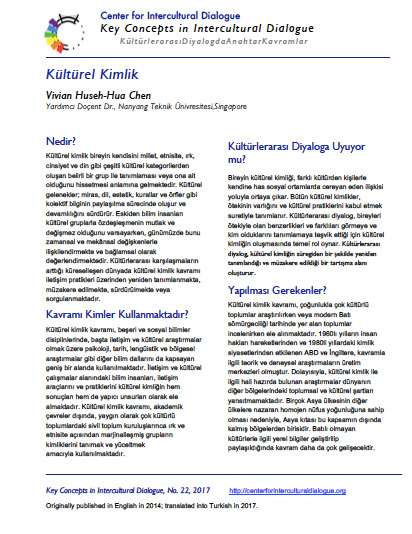
Key Concepts in ICDContinuing translations of Key Concepts in Intercultural Dialogue, today I am posting the translation of KC22: Cultural Identity. Vivian Huseh-Hua Chen wrote this in English in 2014 and it now has been translated into Turkish by Kenan Çetinkaya.

As always, all Key Concepts are available as free PDFs; just click on the thumbnail to download. Lists of Key Concepts organized chronologically by publication date and number, alphabetically by concept, and by languages into which they have been translated, are available, as is a page of acknowledgments with the names of all authors, translators, and reviewers.

KC22 Cultural Identity_TurkishChen, V. H-H. (2017). Kültürel Kimlik. (K. Çetinkaya, Trans.) Key Concepts in Intercultural Dialogue, 22. Available from:
https://centerforinterculturaldialogue.org/wp-content/uploads/2017/01/kc22-cultural-identity_turkish.pdf

If you are interested in translating one of the Key Concepts, please contact me for approval first because dozens are currently in process. As always, if there is a concept you think should be written up as one of the Key Concepts, whether in English or any other language, propose it. If you are new to CID, please provide a brief resume. This opportunity is open to masters students and above, on the assumption that some familiarity with academic conventions generally, and discussion of intercultural dialogue specifically, are useful.

Wendy Leeds-Hurwitz, Director
Center for Intercultural Dialogue


Creative Commons License
This work is licensed under a Creative Commons Attribution-NonCommercial-NoDerivatives 4.0 International License.

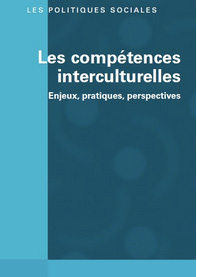
Les compétences interculturelles: Enjeux, pratiques, perspectives

Special Issue LPS About a year ago, Johanna Maccioni asked if I would write an article for a special issue of the journal Les Politiques Sociales on Les compétences interculturelles: Enjeux, pratiques, perspectives [Intercultural competences: Stakes, practices and perspectives] which she was editing with Cédric Juliens. I agreed, and wrote the draft, which we discussed when we both happened to be in Paris in April. It was translated over the summer; in fall Yves Winkin helped by reviewing the entire translation with me when we were both in Victoria. The issue has just been published, and is now available. As a Belgian journal published in French, the overview provided below is in French, however abstracts of all of the articles are available in French, English and Spanish. My thanks to Johanna for the invitation which led to a model of intercultural collaboration.

Wendy Leeds-Hurwitz, Director
Center for Intercultural Dialogue


Présentation [Overview]

Lors de vagues de migrations successives, des millions de personnes ont gagné l’Occident dans la perspective d’une vie meilleure. Migrants et natifs du pays d’accueil ont alors fait l’expérience de la rencontre. Mais quand les différences culturelles sont perçues sur le mode de la hiérarchie, des rapports de force s’installent. Les travailleurs sociaux doivent-ils préconiser l’assimilation ou négocier sur fond d’interculturalité ? Et lors de cette négociation, quelles compétences les acteurs mettent-ils en jeu ? Ce numéro propose un état de la question des compétences interculturelles. Il clarifie certains enjeux identitaires, explore des pratiques actuelles et pose une réflexion pour l’avenir.

Sommaire [Table of Contents]

Présentation [Introduction] by Johanna Maccioni and  Cédric Juliens

De la possession des compétences interculturelles au dialogue interculturel : un cadre conceptuel [Putting intercultural skills and abilities at the service of dialogue: A conceptual framework] by Wendy Leeds-Hurwitz

L’interculturalisme québécois : un modèle alternatif d’intégration [Inter-culturalism in Quebec: An alternative model of integration] by Sabine Choquet

Reconnaissance : entre égalité et diversité [Recognition: Between equality and diversity] by Audrey Heine and Laurent Licata

« Islam-médicament » et « Coran-pharmacie » : du religieux comme forme de soin [“Islam the medicine, the Koran the pharmacist”: Religious practice as a form of care] by Eléonore Meriem Armanet

Enjeux de formation à la démarche interculturelle : exemple du milieu des soins [What is at stake in intercultural approaches: The example of the area of health care] by Johanna Maccioni

Le choc culturel : révélateur des difficultés des travailleurs sociaux intervenant en milieu de migrants et réfugiés [“Culture-shock”: A telling sign of the difficulties of social workers working with migrants and refugees by Margalit Cohen-Emerique

L’évaluation des compétences interculturelles [The evaluation of intercultural competences] by Anne Bartel-Radic

Les mobilités académiques comme opportunité pour les compétences interculturelles : de l’endoctrinement à l’acceptation des imaginaires [What happens when students exchange universities: The chance to be at
home in a different culture and replace received ideas with a new imaginative world] by Fred Dervin

« La première fois que j’ai vu de la neige en Belgique, je croyais que c’était du sucre. » Entretien avec l’équipe de médiatrices interculturelles du « Foyer » [“The first time I saw snow in Belgium I thought it was sugar”: A discussion with the team of female intercultural mediators at the cultural centre, Molenbeek, Brussels] by Juliens Cédric and Chikhi Hamida

« C’est à l’Eden que je songeais » [“C’est à l’Eden que je songeais”] by Frédéric Dussenne

Compétences interculturelles : entre droit à la diversité et nécessité du vivre ensemble [Intercultural competence between the right to diversity and the need to live together] by Altay Manço

Key Concept #31: Indigenous Translated into Kapampangan

Key Concepts in ICDToday sees the addition of a new language to the translations of the Key Concepts in Intercultural Dialogue.  S. Lily Mendoza wrote KC31: Indigenous in English in 2014, which she has now translated into Kapampangan. [NOTE: this translation was updated in 2020, and the original 2017 version replaced.]

As always, all Key Concepts are available as free PDFs; just click on the thumbnail to download. Lists of Key Concepts organized chronologically by publication date and number, alphabetically by concept, and by languages into which they have been translated, are available, as is a page of acknowledgments with the names of all authors, translators, and reviewers.

KC31 Indigenous_KapampanganMendoza, S. L. (2020). Katutubu. Key Concepts in Intercultural Dialogue, 31. Available from:
https://centerforinterculturaldialogue.org/wp-content/uploads/2020/10/kc31-indigenous_kapampangan_v2.pdf

If you are interested in translating one of the Key Concepts, please contact me for approval first because dozens are currently in process. As always, if there is a concept you think should be written up as one of the Key Concepts, whether in English or any other language, propose it. If you are new to CID, please provide a brief resume. This opportunity is open to masters students and above, on the assumption that some familiarity with academic conventions generally, and discussion of intercultural dialogue specifically, are useful.

Wendy Leeds-Hurwitz, Director
Center for Intercultural Dialogue


Creative Commons License
This work is licensed under a Creative Commons Attribution-NonCommercial-NoDerivatives 4.0 International License.

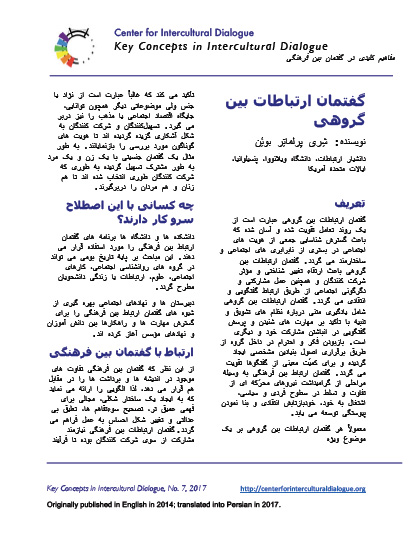
Key Concept #7: Intergroup Relations (IGR) Dialogue Translated into Persian

Key Concepts in ICDContinuing translations of Key Concepts in Intercultural Dialogue, today I am posting KC7: Intergroup Relations (IGR) Dialogue, which Sherry Perlmutter Bowen wrote in English in 2014, and which Ramin Hajianfard has now translated into Persian.

As always, all Key Concepts are available as free PDFs; just click on the thumbnail to download. Lists of Key Concepts organized chronologically by publication date and number, alphabetically by concept, and by languages into which they have been translated, are available, as is a page of acknowledgments with the names of all authors, translators, and reviewers.

KC7 IGR Dialogue in PersianBowen, S. P. (2017). Intergroup relations (IGR) dialogue [Persian]. (R. Hajianfard, Trans). Key Concepts in Intercultural Dialogue, 7. Available from: https://centerforinterculturaldialogue.org/wp-content/uploads/2018/08/kc7-igr_persian-revised.pdf

If you are interested in translating one of the Key Concepts, please contact me for approval first because dozens are currently in process. As always, if there is a concept you think should be written up as one of the Key Concepts, whether in English or any other language, propose it. If you are new to CID, please provide a brief resume. This opportunity is open to masters students and above, on the assumption that some familiarity with academic conventions generally, and discussion of intercultural dialogue specifically, are useful.

Wendy Leeds-Hurwitz, Director
Center for Intercultural Dialogue


Creative Commons License
This work is licensed under a Creative Commons Attribution-NonCommercial-NoDerivatives 4.0 International License.

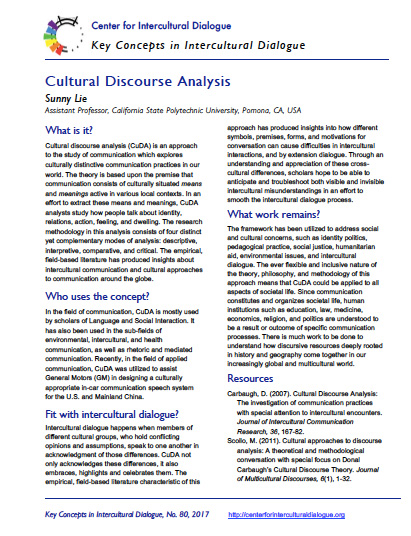
KC80: Cultural Discourse Analysis by Sunny Lie

Key Concepts in ICDThe next issue of Key Concepts in intercultural Dialogue is now available. The goal is to expand the concepts available to discussions of intercultural dialogue. Click on the thumbnail to download the PDF. Lists organized chronologically by publication date and numberalphabetically by concept in English, and by languages into which they have been translated, are available, as is a page of acknowledgments with the names of all authors, translators, and reviewers.

kc80-cultural-daLie, S. (2017). Cultural discourse analysis. Key Concepts in Intercultural Dialogue, 80. Available from:
https://centerforinterculturaldialogue.org/wp-content/uploads/2017/01/kc80-cultural-discourse-analysis2.pdf

The Center for Intercultural Dialogue publishes a series of short briefs describing Key Concepts in Intercultural Dialogue. Different people, working in different countries and disciplines, use different vocabulary to describe their interests, yet these terms overlap. Our goal is to provide some of the assumptions and history attached to each concept for those unfamiliar with it. As there are other concepts you would like to see included, send an email to the series editor, Wendy Leeds-Hurwitz. If there are concepts you would like to prepare, provide a brief explanation of why you think the concept is central to the study of intercultural dialogue, and why you are the obvious person to write up that concept.


Creative Commons License
This work is licensed under a Creative Commons Attribution-NonCommercial-NoDerivatives 4.0 International License.

KC79: Social Cohesion by Narine Nora Kerelian & Gizem Arat

Key Concepts in ICDThe next issue of Key Concepts in intercultural Dialogue is now available. This is KC79: Social Cohesion by Narine Nora Kerelian and Gizem Arat. Click on the thumbnail to download the PDF. Lists organized chronologically by publication date and numberalphabetically by concept in English, and by languages into which they have been translated, are available, as is a page of acknowledgments with the names of all authors, translators, and reviewers.

KC79 Social CohesionKerelian, N. N., & Arat, G. (2016). Social cohesion. Key Concepts in Intercultural Dialogue, 79. Available from:
https://centerforinterculturaldialogue.org/wp-content/uploads/2016/12/kc79-social-cohesion.pdf

The Center for Intercultural Dialogue publishes a series of short briefs describing Key Concepts in Intercultural Dialogue. Different people, working in different countries and disciplines, use different vocabulary to describe their interests, yet these terms overlap. Our goal is to provide some of the assumptions and history attached to each concept for those unfamiliar with it. As there are other concepts you would like to see included, send an email to the series editor, Wendy Leeds-Hurwitz. If there are concepts you would like to prepare, provide a brief explanation of why you think the concept is central to the study of intercultural dialogue, and why you are the obvious person to write up that concept.


Creative Commons License
This work is licensed under a Creative Commons Attribution-NonCommercial-NoDerivatives 4.0 International License.

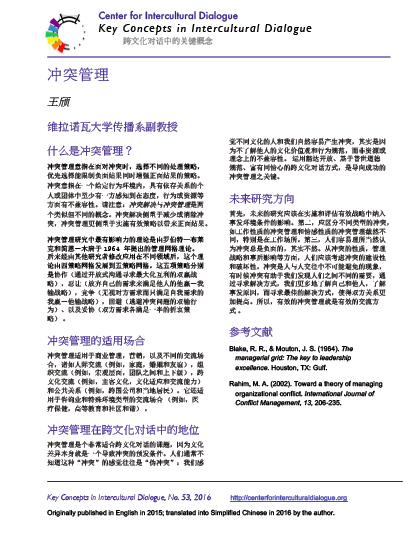
Key Concept #53: Conflict Management Translated into Chinese

Key Concepts in ICDContinuing translations of Key Concepts in Intercultural Dialogue, today I am posting KC53: Conflict Management, which Qi Wang wrote in English in 2015, and which she has now translated into Simplified Chinese.

As always, all Key Concepts are available as free PDFs; just click on the thumbnail to download. Lists of Key Concepts organized chronologically by publication date and number, alphabetically by concept, and by languages into which they have been translated, are available, as is a page of acknowledgments with the names of all authors, translators, and reviewers.

KC53 Conflict management_ChineseWang, Q. (2016). Intercultural capital [Simplified Chinese]. Key Concepts in Intercultural Dialogue, 53. Available from:
https://centerforinterculturaldialogue.org/wp-content/uploads/2016/12/kc53-conflict-management_chinese.pdf

If you are interested in translating one of the Key Concepts, please contact me for approval first because dozens are currently in process. As always, if there is a concept you think should be written up as one of the Key Concepts, whether in English or any other language, propose it. If you are new to CID, please provide a brief resume. This opportunity is open to masters students and above, on the assumption that some familiarity with academic conventions generally, and discussion of intercultural dialogue specifically, are useful.

Wendy Leeds-Hurwitz, Director
Center for Intercultural Dialogue


Creative Commons License
This work is licensed under a Creative Commons Attribution-NonCommercial-NoDerivatives 4.0 International License.

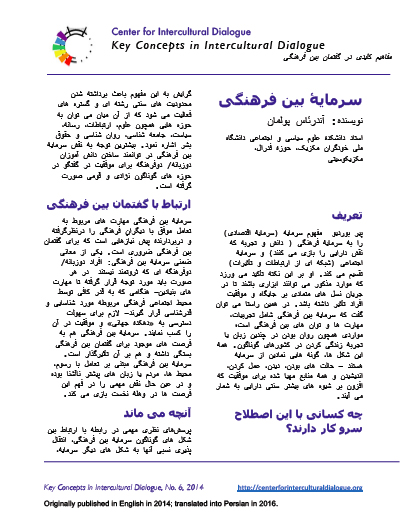
Key Concept #6: Intercultural Capital Translated into Persian

Key Concepts in ICDContinuing translations of Key Concepts in Intercultural Dialogue, today I am posting KC6: Intercultural Capital, which Andreas Pöllmann wrote in English in 2014, and which Ramin Hajianfard has now translated into Persian.

As always, all Key Concepts are available as free PDFs; just click on the thumbnail to download. Lists of Key Concepts organized chronologically by publication date and number, alphabetically by concept, and by languages into which they have been translated, are available, as is a page of acknowledgments with the names of all authors, translators, and reviewers.

KC6 Intercultural Capital_PersianPöllmann, A. (2016). Intercultural capital [Persian]. (R. Hajianfard, trans). Key Concepts in Intercultural Dialogue, 6. Available from:
https://centerforinterculturaldialogue.org/wp-content/uploads/2018/08/kc6-intercultural-capital_persian-revised.pdf

If you are interested in translating one of the Key Concepts, please contact me for approval first because dozens are currently in process. As always, if there is a concept you think should be written up as one of the Key Concepts, whether in English or any other language, propose it. If you are new to CID, please provide a brief resume. This opportunity is open to masters students and above, on the assumption that some familiarity with academic conventions generally, and discussion of intercultural dialogue specifically, are useful.

Wendy Leeds-Hurwitz, Director
Center for Intercultural Dialogue


Creative Commons License
This work is licensed under a Creative Commons Attribution-NonCommercial-NoDerivatives 4.0 International License.