Project for Advanced Research in Global Communication


PARGC Presents Inaugural PARGC Press Paper by Michael Curtin

The Project for Advanced Research in Global Communication (PARGC) is pleased to present PARGC Paper 1, the inaugural publication of PARGC Press, entitled In the Shadow of Official Ambition: National Media Policy Confronts Global Media Capital.

Michael Curtin gave PARGC’s Inaugural Distinguished Lecture in Global Communication at the Annenberg School for Communication, University of Pennsylvania, on September 18, 2013— less than three months after PARGC’s founding on July 1, 2013.

The Publication of the lecture as PARGC Paper 1 inaugurates a new venture, PARGC Press, dedicated to publishing PARGC papers and co-publishing books resulting from PARGC symposia.

PARGC Paper 1 draws on Curtin’s current book project, Media Capital, which compares cities that have become centers of the global film and television industries, such as Bombay, Lagos, and Miami. In the paper, Curtin explores the implications of Chinese cultural policy within the broader context of media globalization, providing a framework for understanding the logics of media capital and the challenges confronting national governments, making comparisons to Arab, African, and Indian media, reflecting on the prospects for creativity and diversity in film and television.

Download here: http://bit.ly/1kqlBZ0

Contact:
Marina Krikorian
Project Coordinator
Project for Advanced Research in Global Communication
The Annenberg School for Communication, University of Pennsylvania

Save

CFP From Multitudes to Crowds in Social Movements (Lisbon)

CALL FOR ABSTRACTS
From Multitude to Crowds in Social Movements – publics, gatherings, networks and media in the 21th century
Lisbon, 26-27 January 2015
Co-organized by CECL/CECC
hosted by the Catholic University of Portugal

The International Conference “From Multitude to Crowds in Social Movements – publics, gatherings, networks and media in the 21th century” aims to discuss media relevance on present-day social movements and if and how collective action is being transformed in contemporary mediatized societies (Adolf, 2011; Burton, 2010). How should we think the relation between mediatization and public experience? What is the symbolic meaning attached to the occupation of public spaces such as streets, plazas or official premises? How do social movements’ commitment to change (Tilly, 1977) use social media to establish a unified system of belief? How do they relate to the “crisis of representation” in contemporary social and political systems? What is the place of crowds in social movements? What is the relation between multitudes, crowds and publics? How do publics engage in “public action regimes” (Cefaï and Pasquier, 2003)? How are Sociology, Political Science and Communication Sciences reacting to the new developments in social organization and public expression?

This two-day event brings together scholars from a variety of disciplines such as Communication Sciences, Sociology or Political Science to bring an updated perspective on the ways notions of multitude, crowds, social movements and media intersect. It proposes to study social movements repertoires and how social groups are led to adapt, improvise and invent new ones, under the social constraints imposed by the use or presence of media.

Confirmed Speakers:
Dr. Christian Borch (Copenhagen Business School, CBS, Department of Management, Politics and Philosophy); Dr. Erik Neveu (Sciences Po Rennes) Dr. Gustavo Cardoso (ISCTE- Lisbon Universitary Institute) Dr. João Carlos Correia (University of Beira Interior)

A Multidisciplinary and Interdisciplinary Conference comprehending the following keywords:
Social Movements Studies; Media Studies; Political Communication; Social Networks; Media Events; Public Sphere; Social Movements Sociology; Sociology of the Publics; Crowds; Multitudes; Social Psychology; Social Policy and Law.

Official Language: English
Submission of Abstracts:
We welcome proposals of no more than 300 words, by August 31st 2014, including a title, abstract, four keywords, a short-bio and affiliation details. Send the proposals in RTF or PDF format to the following email: frommultitudetocrowds@gmail.com

Timeline
Submission of Abstracts Deadline: August 31st 2014
Notification on the Acceptance of the Abstract: October 1st 2014
Submission of Full Paper Deadline: December 15th 2014
Registration Fee:
Early-bird (until October 31st, 2014) – 80 Euros
Standard (from November to December 2014) – 130 Euros
Last Minute (January 2015) – 180 Euros
Undergraduate Students – 25 Euros

CFP Aging in place vs aging in distance

Call for Submission:
Ageing in Place Versus Ageing in Distance: Improving Age-care through Communication
A Special Section of China Media Research

This special section (CMR-2015-02) invites scholars from across disciplines to address the timely issue of improving the experiences of ageing and age-care through communication within specific social and cultural contexts. Age-care creates a range of challenges not only for the older generation but also for their younger generations. Provision of care to older people is of increasing importance. Internationally, public health policies encourage “ageing in place”; however, the increasing cross-border movements of people result in a sizable population of older people who are or will be ageing outside their home country. “Ageing in distance” can be even more challenging, as older migrants often experience isolation, depression, cultural and communication barriers, and exclusion. They feel belonging to neither “where they came from” nor “where they are residing”. Given the trend of international immigration and population ageing, we face economic, social, and cultural imperatives to support older people to age well either in their homeland or in a foreign land.

We would welcome papers that enhance our understanding of how age and ageing is perceived in different cultures, what roles the mass media can play in constructing and perpetuating stereotypes about older people, how the formal model of community care can better link with the model of family care to form a culturally appropriate age-care model for immigrants in particular and the larger population in general. Topic areas include, but not limited to, stereotypes of older people; social media and older people; cultural assumptions of ageing and age-care; communication campaigns that enhance understanding between older and younger generations, mass media coverage of older people and audience effects, and cross-cultural adjustment of older migrants.

Submissions must not have been previously published nor be under consideration by another publication. We will accept the extended abstract (up to 1,000 words) of the paper at the first stage of the reviewing process. Please email your extended abstract as MS Word attachment to the Guest Editor of the special section, Dr Shuang Liu by July 25, 2014. The complete manuscript must be received by September 5, 2010 after the extended abstract is accepted. Complete manuscripts should be prepared in accordance with APA publication manual (6th ed.) and should not exceed 8,000 words including tables and references. All manuscripts will be reviewed and the authors will be notified of final acceptance/rejection decision. Please visit China Media Research for more information about the quarterly journal, which publishes both printing and online versions. For inquiry, please contact Dr Shuang Liu and/or CMR co-editor, Professor Guo-Ming Chen.

Università della Svizzera italiana job ad

Università della Svizzera italiana
Faculty of Communication Sciences

The Institute for Public Communication of the Faculty of Communication Sciences invites applications for a full time tenure track position as Assistant Professor of Intercultural Communication.

The Faculty of Communication Sciences is characterized by its emphasis on research and commitment to the highest teaching standards. It offers a young and dynamic context which is highly international and interdisciplinary, studying Communication from many complementary viewpoints, both as disciplines and as fields of application.

Research and teaching carried out within the Institute for Public Communication cover different fields, ranging from public communication and political communication to social marketing, communication law and psychology. So far intercultural communication has been part of the public communication area. It has now been decided to develop this growing field as a specific area of research and teaching within the Institute.

The new chair of intercultural communication will be multi-disciplinary in nature and address both the theoretical and practical dynamics linked to intercultural communication. The core areas of interest are intercultural competence, communication in and with intercultural communities and organisations as well as the challenges of internationality and plurilingualism. The research orientations should be developed in collaboration, and where possible in synergy, with the other research projects underway in the Institute and the Faculty.

We look for candidates in particular from the field of communication sciences, but also from political science, sociology, public administration, anthropology, linguistics and other related fields. A strong commitment to research and solid methodological grounding should be demonstrated by publications in international peer-reviewed journals and other significant publications in the field. A demonstrated ability to address the theoretical and practical issues of intercultural communication will also be valued. Prior professional experience in intercultural contexts, whether in government, administration, NGOs or international organisations, as well as multilingual proficiency are significant asset for this position.

Job description and responsibilities
The successful candidate will be expected to:
*promote and develop the area of intercultural communication within the Institute for Public Communication;
*teach introductory courses at the Bachelor level and more specialized courses at the Master level, notably as part of the Master in Public Management and Policy (the teaching workload encompasses 9 ECTS for an assistant professor);
*develop and carry-out a research agenda centred on Intercultural Communication, including the obtention of research grants, the publication of academic contributions and the active participation to and contribution in international academic forums;
*assume the academic responsibility of the Executive Master in Intercultural Communication and of the Eurocampus programme;
*co-ordinate research assistants’ activities and supervise PhD candidates;
*participate actively in the work of the Faculty Council and related ad-hoc bodies notably within the Institute for Public Communication. The candidate could, for example, take the direction of the Laboratorio di Studi Mediterranei.

The ideal candidate will have:
*a Ph.D. in Intercultural Communication or in a field related to intercultural communication;
*a documented contribution to research in the field, notably through publications and
conference presentations;
*adequate experience of teaching academic courses on the subject at various levels;
*experience of designing, developing and coordinating educational programmes in the field;
*experience of, or at least the willingness to address the issue of intercultural communication in the Swiss context;
*professional experiences in intercultural contexts;
*active participation in the field’s international research and educational networks, as well as demonstrated leadership and commitment to service to the institution and to the profession.

The application is for an assistant professor rank position.

Since USI aims to increase the percentage of women in research and teaching, women academics are particularly encouraged to apply.

Residence and language
The professor should reside in Ticino (Italian-speaking part of Switzerland); he or she is expected to be present at the university for no less than four days a week. The University’s graduate programmes are mainly taught in English, while Bachelor classes are taught in Italian. Fluency in Italian, while beneficial, will be required from the second year. Knowledge of other languages, in particular an official language of Switzerland (French or German), is a valuable asset for this position.

Required documentation
Applicants should submit:
*a letter of application addressed to the Dean of the Faculty
*a detailed CV/resume and list of publications, together with documentation of relevant academic qualifications, teaching and professional experience
*copies of a minimum of 3 and maximum of 10 publications of relevance for the position

Please send copy of the application in digital form.

Deadline
Application received by end of September 2014 will be given priority.
Please send your complete application file to the Faculty Dean:
Prof. Lorenzo Cantoni
Facoltà di scienze della comunicazione
Università della Svizzera italiana
Via Giuseppe Buffi 13
CH-6904 Lugano

For further information, please contact the Director of the Institute for Public Communication
Prof. Bertil Cottier


Erasmus Mundus: Intercultural Mediation 2014-15

Call for scholars scholarship open until 7th of July 2014

Master Erasmus Mundus “Intercultural Mediation: Identities, Mobilities, Conflicts” offers interdisciplinary training for excellence in 4 semesters, Federated by joint research programs within a consortium: Université de Lille (France), Katholieke Universiteit Leuven (Belgique), University College Cork (Irlande), Université « Babes-Bolyai » (Roumanie), Université de Wroclaw (Pologne), Université Cheikh Anta Diop de Dakar (Sénégal), Universidad Nacional Autónoma de México (Mexique) and Université Fédérale de Rio de Janeiro (Brésil). Des professionnels et des institutions publiques et privées (Professionals and public and private institutions associated with them).

Located in territories shaped by migration, these institutions have been led to question the social changes, cultural and resulting policies and now extend to the global society. It therefore became necessary to train experts of migration, integration, management of cultural and linguistic diversity, with particular expertise in ethics.

Save

Robyn Penman Profile

ProfilesRobyn Penman (PhD, University of Melbourne) is an independent communication scholar and consultant to government on communication and social policy matters.

Robyn PenmanShe was a Founding Director of the Communication Research Institute of Australia (1987-2000) and an Adjunct Professor in Communication at the University of Canberra (1999-2005). Robyn is a past President (1985-6) and Life Member of the Australian and New Zealand Communication Association, has served on the International Communication Association board (2002-3) and is a Visiting Senior Member, Linacre College, Oxford (1987). She was also the Associate Editor of the Australian Journal of Communication (1984-2003) and has served on the editorial boards of Communication Theory and Human Communication Research. She is currently a board member of the CMM Institute, Co-Director of the Cosmopolis2045 project, and General Editor of CMMi Press.
Robyn has devoted her scholarly career to the development of a practical-theoretic approach to understanding communicating as a relational practice. She has been equally as focused on asking questions about what makes for good communicating, especially in the public, civic sphere, and how this understanding can be used to make better social worlds. She is the author of five books—Communication Process and Relationships, Not the Marrying Kind (with Yvonne Stolk), Reconstructing Communicating: Looking to a Future, Making Better Social Worlds (with Arthur Jensen) and Justice in the Making: Relating, Participating, Communicating—along with many book chapters and journal articles.

Robyn welcomes contact via email.


Work for CID:

Robyn Penman has written KC4: Coordinated Management of Meaning (CMM), KC8: Public Dialogue, KC15: Cultural Pluralism, KC29: Dialogue Civility, and KC37: Dialogic Listening. She has also written two guest posts, Feeling Felt: The Heart of the Dialogic Moment? and Dialogue in the Interests of Justice. And she provided a book review of The coordinated management of meaning: A festschrift in honor of W. Barnett Pearce. Finally, she served as initial graphic design consultant for CID, establishing the format for Key Concepts in Intercultural Dialogue.

LSE Fellow: Media Governance & Policy (London)

LSE Fellow (Media Governance & Policy)

Department of Media and Communications
The London School of Economics and Political Science

Location: London
Salary: £32,794 to £39,669
Fixed term 12 months
Application deadline: July 5, 2014

Applications are invited from outstanding candidates in the field of media and communications. The successful candidate will join an established and successful department, on grade point average ranked third in the UK in the 2008 Research Assessment Exercise.

Applicants should demonstrate research excellence and a commitment to critically assessing claims about ways to theorise and empirically research mediated relationships between media and communications technologies and the social world.

We particularly welcome applications from those with expertise that contributes to understanding the social, political, economic and/or cultural dimensions of social and technological change in today’s complex mediated environment.

We would seek someone who works at the intersection of media policy and ethics, especially with regard to issues around public media and media policy such as regulation, journalism, governance, and law. They would be expected to connect with the Department’s journalism think-tank Polis and the Media Policy Project.

You will have (or will have submitted) a PhD in a relevant discipline by the post start date. You will also have a proven record of research published in key journals; or evidence that such a record is being developed.

You will also demonstrate the ability to teach on a range of courses currently on offer within the Department of Media and Communications and to contribute to areas not currently covered.

The other criteria that will be used when shortlisting for this post can be found in the person specification which is attached to this vacancy on the LSE’s online recruitment system. To apply for this post, or see those details, please go to www.lse.ac.uk/jobsatlse and select “Vacancies”.

Save

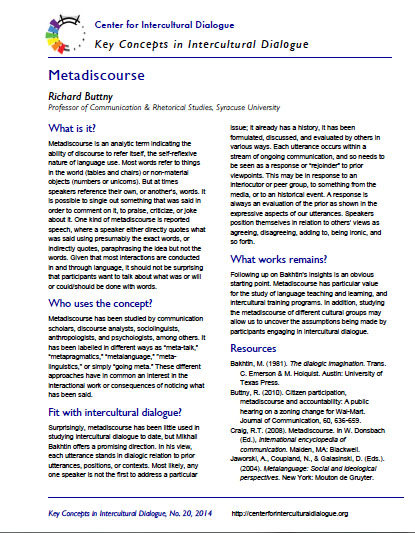
Key Concept #20: Metadiscourse by Richard Buttny

Key Concepts in ICDThe next issue of Key Concepts in intercultural Dialogue is now available. This is KC20: Metadiscourse by Richard Buttny. As always, all Key Concepts are available as free PDFs; just click on the thumbnail to download.Lists organized  chronologically by publication date and numberalphabetically by concept in English, and by languages into which they have been translated, are available, as is a page of acknowledgments with the names of all authors, translators, and reviewers.

kc20-sm

Buttny, R. (2014). Metadiscourse. Key Concepts in Intercultural Dialogue, 20. Available from:
https://centerforinterculturaldialogue.org/wp-content/uploads/2014/06/key-concept-metadiscourse.pdf

The Center for Intercultural Dialogue publishes a series of short briefs describing Key Concepts in intercultural Dialogue. Different people, working in different countries and disciplines, use different vocabulary to describe their interests, yet these terms overlap. Our goal is to provide some of the assumptions and history attached to each concept for those unfamiliar with it. As there are other concepts you would like to see included, send an email to the series editor, Wendy Leeds-Hurwitz. If there are concepts you would like to prepare, provide a brief explanation of why you think the concept is central to the study of intercultural dialogue, and why you are the obvious person to write up that concept.


Creative Commons License
This work is licensed under a Creative Commons Attribution-NonCommercial-NoDerivatives 4.0 International License.

Euromed Dialogue Award 2014

The Anna Lindh Foundation and the Fondazione Mediterraneo are launching the ninth edition of the Euromed Dialogue Award under the theme of ‘Social Resilience and Creativity’, in the framework of the 10th Anniversary of the Anna Lindh Foundation, to take place in Naples (Italy), next October.

The ALF Euro-Med Award recognises the achievements of individuals and organisations that have been at the forefront of promoting Intercultural Dialogue in the Euro-Mediterranean region. Candidates for the Award can be nominated either as an individual or as an organisation and must be based in one of the member countries of the Euro-Med Partnership. Nominating organisations are requested to submit online their nomination proposals for the Award candidates before 30 June 2014 – midnight (Cairo time).

The winner shall receive a financial contribution of 5,000 euros in recognition of their work for Intercultural Dialogue in the Euro-Med region and a trophy, to be delivered by the Euro-Med Award Jury in a prestigious bestowing ceremony.

The Anna Lindh Foundation for Inter-Cultural Dialogue promotes knowledge, mutual respect and inter-cultural dialogue between the people of the Euro-Mediterranean region, working through a network of more than 3,000 civil society organisations in 43 countries. Its budget is co-funded by the EU and the EU member states.

CFP Education in Action: The Crucible of College Media

Education in Action: The Crucible of College Media (tentative title)

We are soliciting essays to be chapters in book to be published by the Peter Lang Publishing Group. The focus of the book is college media organizations (radio stations, newspapers, websites). These organizations are most often formed at the undergraduate level adjunct to more formal curriculum offerings. We are interested in essays about the process of learning and the learning outcomes of these organizations. The proposed volume thematically will emphasize how students learn through the give and take of shared experiences. The finished volume may include essays that are experiential narratives of this learning and how it has been instrumental in a later career. Please contact us for a list of proposed topics or suggest one that you think be relevant. Chapters will be 4,000 words roughly. We’ll respond with a style sheet and guidelines if your proposed chapter-essay fits our project.

Contact:
Gregory Adamo, Ph.D.
Associate Professor
School of Global Journalism and Communication
Morgan State University

Allan DiBiase, EdD
Retired
Plymouth State University