Key Concept #23: Afrocentricity by Molefi Kete Asante

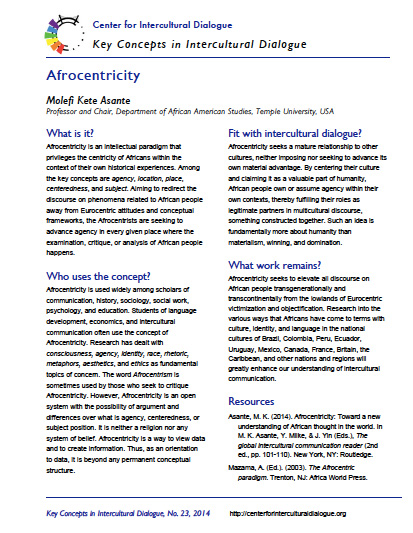
Key Concepts in ICDThe next issue of Key Concepts in intercultural Dialogue is now available. This is KC23: Afrocentricity by Molefi Kete Asante. As always, all Key Concepts are available as free PDFs; just click on the thumbnail to download.Lists organized  chronologically by publication date and numberalphabetically by concept in English, and by languages into which they have been translated, are available, as is a page of acknowledgments with the names of all authors, translators, and reviewers.

kc23-sm

Asante, M. K. (2014). Afrocentricity. Key Concepts in Intercultural Dialogue, 23. Available from:
https://centerforinterculturaldialogue.org/2014/07/14/key-concept-23-afrocentricity-by-molefi-kete-asante/

The Center for Intercultural Dialogue publishes a series of short briefs describing Key Concepts in intercultural Dialogue. Different people, working in different countries and disciplines, use different vocabulary to describe their interests, yet these terms overlap. Our goal is to provide some of the assumptions and history attached to each concept for those unfamiliar with it. As there are other concepts you would like to see included, send an email to the series editor, Wendy Leeds-Hurwitz. If there are concepts you would like to prepare, provide a brief explanation of why you think the concept is central to the study of intercultural dialogue, and why you are the obvious person to write up that concept.


Creative Commons License
This work is licensed under a Creative Commons Attribution-NonCommercial-NoDerivatives 4.0 International License.

PHD Studentship Cinema (UK)

PhD Studentship in British Silent Cinema and the Transition to Sound: 1927-1933

Applications are invited for an AHRC-funded PhD studentship based at De Montfort University’s Cinema and Television History (CATH) Research Centre, Leicester. This full-time, three-year PhD will be fully-funded (fees and maintenance) as part of a major project to research the transition between silent and sound cinema in Britain. The overall project will consider the impact of the arrival of sound cinema looking at new technologies, business models, production practices, solutions in cinema architecture and design, and the impact on musicians, audiences and cinema going, as well as the films produced during this transitional period.

Research and supervision
The successful applicant will work as part of a project team based at De Montfort University, Leicester, in partnership with the University of Stirling (UoS). The PhD will be supervised by Laraine Porter (Project Leader) and Steve Chibnall (Professor of British Cinema), and the successful applicant will have a dedicated work station within the CATH Centre’s accommodation. The Centre is part of the Midlands 3 Cities Doctoral Training Partnership, and is one of the leaders in its field with three major funded projects and over 30 staff, research students and associate research fellows. One of its external partners is The Cinema Museum in London, which will be a vital research resource for the
project.

Other project team members include Senior Researcher, Geoff Brown  (London), Dr Sarah Neely (UoS), Professor John Izod (UoS) and a UoS PhD student ship also to be appointed. The DMU studentship will be based in the Cinema and Television History Research Centre housed within the Leicester Media School.

This PhD studentship will complement the project by considering the impact of the arrival of sound cinema on localised British cinema exhibition, distribution and reception and how new technical demands forced the industry, outside of London, to adapt. Taking account of regional variations in cinema culture and practice, market forces and audience tastes, the student will conduct empirical research on case studies including different cinema chains and associated operations; the impact on subsidiary businesses such as local equipment manufacturers and cinema service industries and the overall effect on local cinema economies, culture and programming. It is expected that the student will open up new avenues of research using resources such as local business and municipal records alongside national cinema business, trades union and associated trades archives. The research will focus on cities and market towns in the Midlands including Leicester, Nottingham, Birmingham, Derby etc.

Indicative areas of research could include:
· The influence of local political, cultural, economic and geographical factors on the speed and nature of the transition to sound cinema and the overall timescales across urban, market town and rural areas
· Local organisations and businesses that thrived or became victims of the new sound technologies and the extent to which national and international factors such as the 1927 Cinematograph Act or the economic depression compounded their fortunes
· What local solutions were deployed, including any localised inventors, manufacturers, architects and suppliers and the kinds of local business models adopted.
· The response of regional audiences to the arrival of sound looking at issues such as regional identity, cultural difference and any localised resistance.

Entry Requirements
· First class or upper second class undergraduate degree or an equivalent overseas qualification in a relevant subject.
· It is expected that applicants will also hold a Masters degree in a relevant subject, or show evidence of achieving this by October 2014
· EU applicants will be required to show proof of English language ability to the level of IELTS 6.5 with at least 5.5 in each component (or equivalent). An undergraduate or master’s degree taught in a majority English-speaking country and awarded in the last five
years would satisfy this requirement.
· Available only to applicants who are UK nationals or other EU nationals who are permanently resident in the UK.
· Available for full-time registration only
· Applicants must be able to start in October 2014

You will have a background in film studies, cultural studies, or historical studies, preferably with an interest in the business and economics of cinema. Applicants will need to demonstrate an aptitude for scholarly research.

This is an excellent opportunity to be part of a major British cinema history project and we welcome applications from interested parties.

How to apply
The following documents are required to complete your application:
– A completed Application Form for Admission to a Research Degree Programme
– A completed Annexe to Application Form for Admission to a Research Degree Programme
– Two academic references
– Copies of your highest degree certificate and transcripts
– For EU applicants, proof of your English language qualifications (described above)
– A copy of your CV
– A 2 page personal statement that
a) Demonstrates your excellent academic performance in a field related to the proposed research, with explicit reference being made to your undergraduate and postgraduate research.
b) Explains why you want to undertake this research and what approaches you might take
c) Demonstrates your experience of working with primary and secondary historical sources including archival research.
d) Demonstrates your ability to organise and work independently

Please contact Morgan Erdlenbruch to receive copies of the application, annexe, and reference forms. Completed applications should also be submitted by email to this address. Informal enquiries should be directed to Laraine Porter.

Closing date for applications 5pm Friday 18 July 2014. Interviews will be held at De Montfort University in mid-August.

U Pennsylvania job ad in digital culture

Tenure track assistant professor in the area of digital culture at Annenberg School for Communication

The University of Pennsylvania’s Annenberg School for Communication seeks to hire a tenure track assistant professor in the area of digital culture, to begin fall semester 2015. Applicants’ research and teaching should contribute to grounded theories of the relationship between digital media and ongoing cultural and socio-political transformations.

Applicants must hold a Ph.D. in Communication or related fields by the start of appointment.  Candidates who add to our School and University’s diversity are strongly encouraged to apply.

The Annenberg School for Communication at the University of Pennsylvania is a graduate school of communication theory and research, with 20 full-time faculty and approximately 80 doctoral students representing a wide range of disciplinary backgrounds and interests. The faculty also has primary responsibility for an undergraduate communication major within the School of Arts and Sciences.

Submit letter of interest, curriculum vitae, three names of references, and three articles, chapters or other research to Professor Michael X. Delli Carpini, Dean, Annenberg School for Communication, University of Pennsylvania via email. To be considered applications must be postmarked no later than October 3, 2014.

For more information and instructions on applying visit
http://facultysearches.provost.upenn.edu/postings/238

.

CFP Urban Communities in Conflict and Dialogue preconference

Call for Submissions
Pre-Conference on Urban Communities and Communication at 2014 NCA Conference:
Urban Communities’ Present(s), Past(s), & Future(s) In Conflict and In Dialogue

Chicago, Illinois
Wednesday, November 19
Full Day (9 am – 5 pm)

Co-Chairs
Matthew Matsaganis, State University of New York – Albany, NY
Peter Haratonik, The New School, New York, NY

Respondents
Susan Drucker, Hofstra University, Hempstead, NY
Gary Gumpert, Urban Communication Foundation, Great Neck, NY

DESCRIPTION & RATIONALE
Under the title “Technology is Not Driving Us Apart After All,” a recent New York Times article featured the research of Keith Hampton, a sociologist by training and a scholar of communication. Hampton’s (and his students’) work builds on the groundbreaking work of sociologist William H. Whyte. In the late 1960s and 1970s, Whyte, working with the New York City Planning Commission led a series of granular studies of the city’s public spaces. He and his collaborators spent many hours filming and photographing people in public spaces, taking detailed notes about how they behaved. The project became known as the Street Life Project. It was considered revolutionary in urban planning, both because of the methods employed and its findings. Whyte argued that this type of close and systematic observation of human behavior would provide insights into how policy could help people lead happier lives; lives in which individuals would not feel alienated from their neighbors.

Hampton’s work has taken on a similar set of questions, focusing though on what many deem to be the atomizing forces of our day: new communication technologies and, of course, the Internet.

Beyond the actual and fascinating findings of this work, the project undertaken by Hampton and his students reminds us that in our future-focused societies, researchers, too, frequently forget to look back to the past. Hampton revisited and learned from Whyte. Looking back can be enlightening.

Inspired by this example and in response to the call for submissions for the 2014 NCA conference, this preconference will bring together scholars and professionals from multiple areas within the discipline, but also from other fields of inquiry, to explore and discuss theoretical perspectives, new and ongoing field research findings, as well as case studies aimed at enhancing our understanding of:
(a) Communication patterns in urban communities;
(b) How these patterns are shaped by and shape the physical, built, and social environment of the places we live in;
(c) How the communication ecologies we construct in the process of our everyday lives impact our well-being; and
(d) The positive and negative ways in which policy interventions influence the communication environment of cities.
Historical perspectives on any of these topics, research revisiting old and persistent issues of everyday life in the city, and longitudinal studies will be particularly welcomed.

FORMAT
The pre-conference will unfold in a series of higher density panels, which will be organized thematically, and during which more colleagues (approximately 6) will be invited to present short position papers, research reports, or case studies (length: 7-10 pages, double-spaced). Presentations will be brief to allow more time for dialogue and debate among presenters and audience members. There will be 4-5 such panels held throughout the course of the day. The final number will depend on the number and quality of submissions, as well as the range of themes that emerge out of the submissions.

PROCEDURES FOR SUBMITTING ABSTRACTS & PAPERS To participate, please submit an abstract for the short position paper, research report, or case study you wish to contribute to the pre-conference. The deadline for submitting an abstract, which should be no longer than 200-250 words, is September 1. Abstracts should be submitted electronically to the co-chairs, Matthew Matsaganis and Peter Haratonik.

A committee composed of NCA members with UCF representation will review all submissions and inform the authors of the submissions rated the highest by October 1, 2014.

For colleagues whose abstract is accepted, full papers (7-10 pages in length, double-spaced) will have to be submitted by November 1. They will be made available in advance of the pre-conference, so that participants/attendees have a chance to review them prior to the actual meeting on November 19 in Chicago. The final seminar schedule will also be made available by November 15, 2014.

More information regarding the pre-conference at NCA will be made available later in the summer and over the first few weeks of fall via the Urban Communication Foundation’s website and Facebook page.

Key Concept #22: Cultural Identity by Vivian Hsueh-Hua Chen

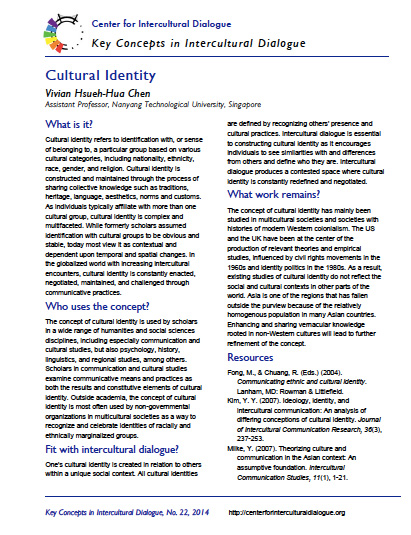
Key Concepts in ICDThe next issue of Key Concepts in intercultural Dialogue is now available. This is KC22: Cultural Identity by Vivian Hsueh-Hua Chen. As always, all Key Concepts are available as free PDFs; just click on the thumbnail to download. Lists organized  chronologically by publication date and numberalphabetically by concept in English, and by languages into which they have been translated, are available, as is a page of acknowledgments with the names of all authors, translators, and reviewers.
kc22-sm

Chen, V. H.-H. (2014). Cultural identity. Key Concepts in Intercultural Dialogue, 22. Available from:
https://centerforinterculturaldialogue.org/wp-content/uploads/2014/07/key-concept-cultural-identity.pdf

The Center for Intercultural Dialogue publishes a series of short briefs describing Key Concepts in intercultural Dialogue. Different people, working in different countries and disciplines, use different vocabulary to describe their interests, yet these terms overlap. Our goal is to provide some of the assumptions and history attached to each concept for those unfamiliar with it. As there are other concepts you would like to see included, send an email to the series editor, Wendy Leeds-Hurwitz. If there are concepts you would like to prepare, provide a brief explanation of why you think the concept is central to the study of intercultural dialogue, and why you are the obvious person to write up that concept.


Creative Commons License
This work is licensed under a Creative Commons Attribution-NonCommercial-NoDerivatives 4.0 International License.

Statelessness and Transcontinental Migration conference (Spain)

‘Statelessness and Transcontinental Migration’
UNU-GCM’s Second Conference

UNU-GCM is organizing its second conference on ‘Statelessness and Transcontinental Migration’, on 24th and 25th July 2014. It will include five sections addressing issues of: citizenship, human security, urban vulnerabilities, non-state actors in migration management and sub-Saharan migration to the Mediterranean. Alongside the academic discussions, non-academic events will address statelessness through artistic production and activities.

This conference focuses on a range of issues related to the wellbeing and recognition of people who traverse continents devoid of citizenship. Issues related to refugees remain crucially unanswered in debates and policies surrounding migration. In the wake of acknowledgement within the academy that it is not always possible to isolate refugees from migrants, this conference analyses a range of contexts where dignity and human rights are compromised through the absence of legal and political recognition. By focusing on situations of extreme vulnerability and on lives lived on the borderline, this conference seeks to articulate and address urgent needs with regard to the stateless migrants who have entered Europe.

Keynote speakers:
Professor Eduard Sagarra iTrias, ‘The Necessity of Immigration in the Globalized World’, President of the United Nations Associations of Spain (ANUE), Barcelona / University of Barcelona
Professor Khadija Elmadmad, ‘Statelessness and Migration: The Case of de facto and de jure
stateless children in Morocco’, Director of The UNESCO Centre, The Law and Migration (CUDM)

American Academy in Berlin fellowships

Residential Fellowships, American Academy in Berlin

The American Academy in Berlin invites applications for its residential fellowships for 2015/2016, as well as early applications for the academic years 2016/2017 and 2017/2018. The deadline is Monday, September 29, 2014 (12 pm EST or 6 pm CET). Applications may be submitted online or mailed to the Berlin office.

The Academy welcomes applications from emerging and established scholars and from writers and professionals who wish to engage in independent study in Berlin. Approximately 25 Berlin Prizes are conferred annually. Past recipients have included historians, economists, poets and novelists, journalists, legal scholars, anthropologists, musicologists, and public policy experts, among others. The Academy does not award fellowships in the natural sciences.

Fellowships are typically awarded for an academic semester or, on occasion, for an entire academic year. Bosch Fellowships in Public Policy may be awarded for shorter stays of six to eight weeks. Fellowship benefits include round-trip airfare, partial board, a $5,000 monthly stipend, and accommodations at the Academy’s lakeside Hans Arnhold Center in the Berlin-Wannsee district.

Following a peer-reviewed evaluation process, an independent Selection Committee reviews finalist applications. The 2015/16 Berlin Prizes will be announced in late February 2015.

CFP Communicating Prejudice

Call for Chapters for Edited Book
Communicating Prejudice: An Appreciative Inquiry Approach
Proposal Submission Deadline:  October 10, 2014
Editors: Camara, S. K., Drummond, D. K., & Hoey, D. M.
Publisher: Nova Publishing, Inc.

Objective:
In the conclusion of his edited book Communicating Prejudice, Michael Hecht called for an intellectual movement beyond understanding prejudice and its personal and social effects on individuals to a more proactive approach that inquires about appreciation as a serious subject of investigation.

Our edited book, Communicating Prejudice: An Appreciative Inquiry Approach, will blend direct unsettling lived experiences with a deep exploration of appreciation, respect and empowerment. We seek contributions which will speak boldly about personal experiences with prejudice with reflections on practical emancipatory frameworks that generate new directions and tools for dialogue. These meta-narratives should display the potential for creating opportunities for inclusivity, transformation, growth and social justice. We hope to draw on key concepts from a variety of disciplines, including Communication, Sociology, Education, Psychology, and Gender Studies.

Recommended topics include, but are not limited to, the following:
*Meta-analyses of Prejudice: Pre and Post racial America
*Autoethnographic Accounts of Prejudice and Transformation
*Examining Historical and Present initiatives to reduce prejudice
*Exploring Varying Contexts of Prejudice (e.g., Gender, Sexual Orientation, Race, Disability)
*Approaches to Appreciative Structures and Prejudicial Experiences
*Theoretical insights to opening dialogue with others
*Fostering appreciative conversations to defeat exclusion
*Co-creating Business and Organizational transformation
*Dealing with difficult situations and reframing conflict
*Contributions to Social Justice

Submission Procedure:
To have an original chapter considered for inclusion in this peer-reviewed volume, submit it with a 100-word abstract. Please include a separate title page with the author(s) and complete contact information, with brief author bio(s) to the editors by October 10, 2014. Indicate in your email cover letter which of the aforementioned topics your chapter best fits. Quantitative and qualitative research articles are limited to a maximum of 25 pages of text excluding references. Personal narratives or essays are limited to 10 pages.

Important Dates:
October 10, 2014– Chapter Submission Deadline
January 15 1, 2015- Notification of Acceptance
June 1, 2015– Chapter Feedback to Authors
October 15, 2015– Final Edited Submission Due

Mob-ility symposium (Italy)

Mob-ility Symposium
Wake Forest University
October 10, 2014
Casa Artom, Venice, Italy

Submissions due July 31, 2014

The story of Camillo Artom is one of mobility, the theme of the Mob-ility Symposium, to be held on October 10, 2014. The Symposium is an opportunity to reflect on the movement of persons, ideas, traditions, goods, and the political, social, and cultural ramifications of mobility, as they relate to the changing practices in travel, the environment, social-economic status, and technology.

These often include, but are not limited to, discussion of citizenship, immigration, diasporas, belonging, and place. Specifically, the Symposium invites a focus on the people who move (the ‘mob’ in mobility): migrants, travelers, tourists, temporary citizens, and asylum seekers, refugees, stateless people. Venice is a perfect site for the ‘Mob-ility Symposium’ as a historic trade city, a merchants’ harbor where people have always come and gone.

Keynote speaker: Dima Mohammed, a Palestinian argumentation scholar who is currently working at the Argumentation Lab of the Instituto de Filosofia da Nova at the Universidade Nova de Lisboa, Portugal. Her domain of specialization includes argumentation theory, philosophy of language, persuasion research and political philosophy.

Invited: papers, paper abstracts, discussion panels, and encourage creative submissions related to all aspects of mobility, including:
*Migration, immigration, emigration
*Diaspora, exile, refuge, asylum
*Citizenship rights, nationality, borders
*Socio-economic status
*Travel, transportation
*Technology, mobile modes of communication
*Environment, sustainability
*Security, surveillance

Papers must not exceed 25 pages and must include a title, the author’s/s’ affiliation, and contact information. Paper Abstracts must not exceed 2 pages and must include a title, the
author’s/s’ affiliation, and contact information. Discussion Panels or Performances/Creative Expressions must include a 250-word rationale, a 250-word abstract of each proposed paper or contribution, and a list of presenters with affiliation and contact information.

Submissions from faculty, students, artists, activists, practitioners, and community members are all encouraged. Thanks to the Provost’s Office for Global Affairs, the Symposium is free and open to the public. Space is limited.

Send/Email all submissions to:
Alessandra Von Burg
Department of Communication
Box 7347, Reynolda Station
Wake Forest University
Winston-Salem, NC 27109

Key Concept #21: Reflexivity by Raúl Alberto Mora

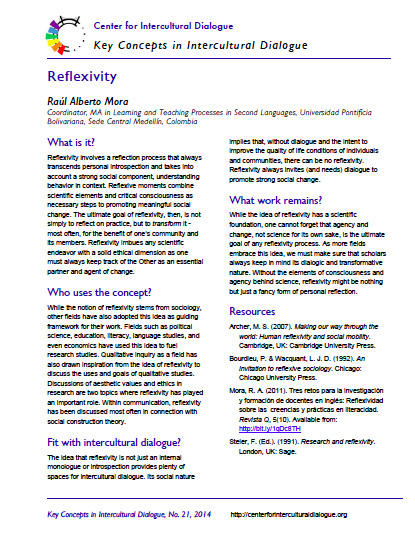
Key Concepts in ICDThe next issue of Key Concepts in intercultural Dialogue is now available. This is KC21: Reflexivity by Raúl Alberto Mora . As always, all Key Concepts are available as free PDFs; just click on the thumbnail to download.Lists organized  chronologically by publication date and numberalphabetically by concept in English, and by languages into which they have been translated, are available, as is a page of acknowledgments with the names of all authors, translators, and reviewers.
kc21-sm

Mora, R. A. (2014). Reflexivity. Key Concepts in Intercultural Dialogue, 21. Available from:
https://centerforinterculturaldialogue.org/wp-content/uploads/2014/06/key-concept-reflexivity.pdf

The Center for Intercultural Dialogue publishes a series of short briefs describing Key Concepts in intercultural Dialogue. Different people, working in different countries and disciplines, use different vocabulary to describe their interests, yet these terms overlap. Our goal is to provide some of the assumptions and history attached to each concept for those unfamiliar with it. As there are other concepts you would like to see included, send an email to the series editor, Wendy Leeds-Hurwitz. If there are concepts you would like to prepare, provide a brief explanation of why you think the concept is central to the study of intercultural dialogue, and why you are the obvious person to write up that concept.


Creative Commons License
This work is licensed under a Creative Commons Attribution-NonCommercial-NoDerivatives 4.0 International License.