Key Concept #47: Cultural Contracts Theory by Ronald L. Jackson II

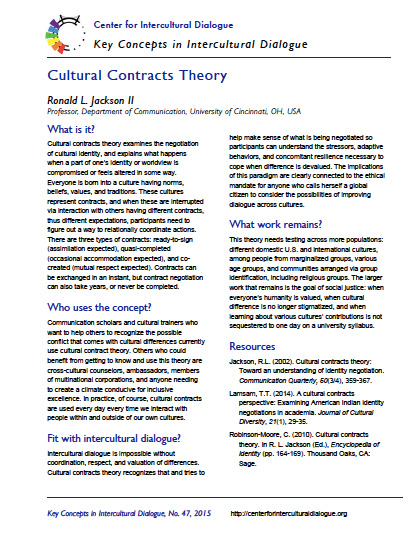
Key Concepts in ICDThe next issue of Key Concepts in intercultural Dialogue is now available. This is KC47: Cultural Contracts Theory by Ronald L. Jackson II. As always, all Key Concepts are available as free PDFs; just click on the thumbnail to download. Lists organized  chronologically by publication date and numberalphabetically by concept in English, and by languages into which they have been translated, are available, as is a page of acknowledgments with the names of all authors, translators, and reviewers.

kc47-sm

Jackson, R. L. (2015). Cultural contracts theory. Key Concepts in Intercultural Dialogue, 47. Available from: https://centerforinterculturaldialogue.org/wp-content/uploads/2015/01/key-concept-cultural-contracts-theory.pdf

The Center for Intercultural Dialogue publishes a series of short briefs describing Key Concepts in Intercultural Dialogue. Different people, working in different countries and disciplines, use different vocabulary to describe their interests, yet these terms overlap. Our goal is to provide some of the assumptions and history attached to each concept for those unfamiliar with it. As there are other concepts you would like to see included, send an email to the series editor, Wendy Leeds-Hurwitz. If there are concepts you would like to prepare, provide a brief explanation of why you think the concept is central to the study of intercultural dialogue, and why you are the obvious person to write up that concept. Feel free to propose terms in any language, especially if they expand our ability to discuss an aspect of intercultural dialogue that is not easy to translate into English.


Creative Commons License
This work is licensed under a Creative Commons Attribution-NonCommercial-NoDerivatives 4.0 International License.

Gonzaga-in-Cagli Project

Gonzaga University has announced that the Gonzaga-in-Cagli Project is now available to undergraduate as well as graduate students from any university.  This will be the 12th year of the International Media Project in Cagli, Italy. Students can earn up to six graduate or undergraduate credits in communication and leadership in this cultural immersion project that stresses media convergence.  We would like you and your students to consider this summer. Recently one of our projects was featured in the American Journalism Review. We say “Go Out a Tourist and come back a World Citizen.”

The program includes instruction in language and culture as well as photo, video, web design, writing and blogging.  Class begins in Florence and moves to historical Cagli in the Apennine Mountains.  The program also includes a day trip to the beautiful Renaissance city of Urbino, and there is free “weekend travel”  Dates are June 8 – June 24, 2015.  The program has won several awards and is considered one of the best buys in Study Abroad.

The deadline for application is February 1, 2015.  Please contact me if I can provide any additional information.

Professor John S. Caputo
Gonzaga University

CFP Truth in the Public Sphere

Jason Hannon is seeking contributors for a volume on truth, communication, and the public sphere. If you are interested in participating in this project, please submit an abstract of no more than 200 words, along with a brief bio, to Jason Hannon by February 1, 2015.

A. AIM
The proposed book, Truth in the Public Sphere, will explore the role of truth in different domains of social and political life. It will present a new set of expository essays from a variety of theoretical and philosophical perspectives. The aim is to challenge conventional thinking on truth by investigating the meaning and power of truth in different dimensions of the public sphere.

B. DESCRIPTION
Truth is a basic and primordial concept. It has long been and remains indispensible to multiple domains of thought and practice, including law, government, science, and religion. In the humanities, however, the idea of truth is commonly regarded with suspicion and cynicism. Truth is seen as an antiquated metaphysical illusion at best and an instrument of power and coercion at worst. The idea of truth therefore elicits strikingly different attitudes. For millennia, philosophers have debated the meaning and possibility of truth, proposing a range of complex theories. However, in the twentieth century, philosophers such as G. E. Moore, Gottlob Frege, Bertrand Russell, and Alfred Tarski have argued that truth is indefinable. In a similar vein, Donald Davidson has argued that instead of seeking to define truth, we should instead try to understand what role it plays in observable human behavior (i.e. linguistic interaction). More recently, the pragmatist philosopher Jeffrey Stout has argued that truth matters to democracy. This volume takes its cue from Davidson and Stout by exploring the role of truth in our social and political world from the perspective of communication. To this end, the volume examines the function and value of truth in four dimensions of the public sphere: 1) language and discourse, 2) ethics and justice, 3) journalism and politics, and 4) media, art, and aesthetics.

C. TARGET AUDIENCE
Although this volume will speak to a general humanities audience, it has been designed for students and scholars of rhetoric, media studies, communication theory, and the philosophy of communication.

D. SCOPE, CONTENT, METHODOLOGY
The proposed volume has been divided into four parts: 1) language and discourse; 2) ethics and justice; 3) journalism and politics; and 4) media, art, aesthetics. The essays in the volume will answer questions such as the following:
– What role does truth play in language and communication?
– Is communication possible without a commitment to truth?
– What role does truth play in ethics and social justice?
– Do we live in a post-truth world?
– What are the consequences of post-truth journalism?
– How do media and communication professionals conceptualize truth?
– What is the connection between truth and aesthetics?
– How do music and art capture truth?
– How does truth function in comedy, especially in political satire?

E. TABLE OF CONTENTS
We are seeking contributions for each of the following sections. Please note that we are open to suggestions for other topics.

PART I: LANGUAGE & DISCOURSE
Suggested topics include:
– Rhetoric
– Genealogy
– Hermeneutics
– Deconstruction
– Critical Theory
– Pragmatism
– Analytic and Post-Analytic Philosophy

PART II: ETHICS & JUSTICE
Suggested topics include:
– Feminism, truth, and women’s emancipation
– Postcolonialism, truth, and resistance
– Truth in the thought and speeches of Mahatma Gandhi
– Truth in the thought and speeches of Martin Luther King, Jr.
– Jacques Ranciere, truth, and education

PART III: JOURNALISM & POLITICS
Suggested topics include:
– Media Witnessing
– Post-truth journalism
– Post-truth politics
– Wikileaks

PART IV: MEDIA, ART, AND AESTHETICS
Suggested topics include:
– Truth in music
– Truth in visual art (including painting, photography, and street art)
– Truth in humor (especially satire)
– Truth in film

F. ABSTRACTS
If you are interested in participating in this project, please submit an abstract of no more than 200 words, along with a brief bio, to Jason Hannon by February 1, 2015. Those whose abstracts are accepted will be asked to submit their proposed chapter by August 31st, 2015.

Howard University job ad

Tenure-track Associate/Full Professor
Department of Communication, Culture & Media Studies, Howard University

The Department of Communication, Culture and Media Studies, with a doctoral-level program, seeks to fill a tenure-track position at the Associate or Full Professor level in U.S. multicultural media and communication studies. We are seeking a historical and critical scholar who can teach a range of doctoral-level courses in and serve on dissertation committees.  Applicants should have substantive knowledge in at least two of the following:  media industries, popular culture, communication policy, audience research, political economy of communication, media globalization, communication technologies, or media and social movements, as these relate to the African American experience.  Incorporation of multicultural concerns, e.g., gender, race, ethnicity, socio-economic class, sexuality and/or nationality, in the applicant’s research agenda is essential.  Responsibilities would include teaching 4-6 courses per year, mentoring students in their research, serving on dissertation committees, participating in other administrative committees, carrying on a full program of research, and exercising leadership within the broader profession.

Qualifications
Applicants should possess an earned doctorate in a communications field or a related discipline.  The ideal candidate will have at least six years of full-time teaching experience and a publications track record, as well as demonstrated promise for research and publication.  Applicants should also possess an understanding of the broader field of communications as well as specific knowledge in mass communications, as listed above.

The Department, School and University
The Department of Communication, Culture and Media Studies (CCMS) offers doctoral-level studies leading to the Ph.D.  The person hired will help to build the CCMS program through course re/development, by carrying on an active program of scholarship and publication, and through mentorship of students. The department has a diverse community of approximately 50 doctoral students from the United States and other nations, and a core faculty of five, with additional affiliate faculty from other departments in the recently restructured School of Communications.  The School of Communications is an interdisciplinary unit composed of two undergraduate departments (Strategic, Legal and Management Communications; and Media, Journalism and Film) and two graduate departments (Communication, Culture and Media Studies; and Communication Sciences and Disorders). Howard University is a private research university comprising 13 schools and colleges.  A historically Black institution in Washington, D.C, Howard was created by the Congress of the United States in 1867to educate and otherwise advance African Americans and those from other underserved populations.  Howard produces the largest number of African American recipients of doctoral degrees on campus than any other institution in the United States.  In keeping with Howard’s mission, the CCMS Department is committed to preparing academicians and research professionals to assume positions of leadership both nationally and internationally.  Applicants must demonstrate an understanding for and support of Howard University’s mission.

Application process
Send (1) a letter of application, (2) a current curriculum vitae, and (3) three current letters of recommendation to:
Dr. Carolyn M. Byerly, chairperson
Department of Communication, Culture & Media Studies
School of Communications, Howard University
525 Bryant St. NW, Washington, DC 20059

Review of applications will begin on January 30, 2015 and continue until the position is filled.  The new hire will begin August 2015.  Howard University is an affirmative-action, equal opportunity employer.  The university offers benefits to married couples, both same sex and different sex.

Charlie Hebdo and Intercultural Dialogue

Guest PostsCharlie Hebdo and Intercultural Dialogue by Peter Praxmarer.

Dear readers of this page:

As so many all over, I am following the unfolding of the dynamics of the Paris events. I do not think that I have particularly much to say about this, but I do want to share some thoughts that trouble me. They have to do with the Paris crimes and with intercultural communication; “intercultural communication” here understood as a research field in contemporary social science and/or the humanities, as a professional practice, and as the social practice of living together in a multifaceted and diversified society.

I do not want to enter into the debate about free speech vs. obscurantist or fundamentalist religious faith, but would like to draw your attention to the possibly problematic relationship between limitless free speech and expression on the one hand, and respect for the dignity of all human beings on the other. This problem is very well addressed n a series of discussions provided by “Democracy Now” (take it from 11:59 onwards). Separate interviews/contributions/debates with Art Spiegelman, Gilbert Achcar, Tariq Ramadan and others can be downloaded. For those who read German, these reflections of a Swiss historian may also be of interest.

More succinct, but equally telling, are the caricatures by Joe Sacco of The Guardian (caricature against caricature, so to speak), who takes a different stance than the one taken now by the hardcore provocateurs-and-proud-of-it, in the name of unbridled freedom of expression or in the name of xenophobia or utter racism.

What happened in Paris very much involves satire, also satire as a form of communication. The question: “To what culture does satire pertain?” or headings such as “The satirical differences of cultures” are probably idle ones, at least in this context, even though some people hail satire as a hallmark of a culture of democracy. Likewise, speculating about that particularly vitriolic “French” form of satire, developed since the French Revolution, which some see as typically Charlie Hebdo sarcasm, does probably not yield too much in this respect. At any rate, I think one can make some points regarding satire as a form of (intercultural) communication.

When analyzing acts of speech, argumentation – indeed, communicative utterances in all forms and communicative (re-)actions –, certain questions are all too seldom asked: “cui bono” or “cui prodest”, and the question “why”. Why do we communicate what and how we do, for what reason, to what end and purpose, and to whose benefit? Analyzing the Charlie Hedbo caricatures (and the earlier Danish ones) by asking these simple questions, one could come to the conclusion that efficiency as well as effectiveness of communication can also be measured in terms of the underlying reason and purpose. Seen in this way, a superior and refined intercultural communication competency would be, to say it with J.M.C. Le Clézio: (Coexister, c’est) comprendre ce qui peut offenser l’autre.

Considering all this, I am not so sure if I can without reserve underwrite “Je suis Charlie” – it depends on what Charlie stands for: if Charlie stands for the journalists and the others murdered, yes, then I can indeed identify with and proudly defend Charlie, just as I could say Je suis Ahmed. If Charlie stands for the right and license to provoke, to offend, to denigrate, in the name of free speech seen as universal, absolute and unilateral human right without corresponding duty and obligation to respect the Other, then I would not like to be seen with this sign in my hands.

A number of points could still be made while reflecting on, and trying to analyze and interpret, these Paris events. Let me just refer to two, which I think are particularly important for those who deal, professionally or in other ways, with intercultural communication:

First, we have to resist any attempt to construe this barbaric act as a clash of cultures or civilizations, or religions, as “Islam against the West”. Even in its more qualified form of “Radicalized Islam”, “Islamic Terrorism” or the like – let’s leave Islam, the Moslems, and indeed culture, out of this. The fact that some individuals use the terminology of a religion and profess to be violent and criminal defenders of a faith does not mean that that religion and its faithful are violent and criminal. Any analysis of this in terms of legitimization and ideological justification is much more explanatory than in terms of culture or religion. No cultural essentialism here – this may be a hard blow for those interculturalists who live off and by culturalizing anything and everything, including conflicts and violence. Equally, any appeal to identity, “Western”, “Christian” or other should be carefully avoided in this context – identity anyways being a very problematic concept that one anthropologist (Francesco Remotti) considers “poisonous”, while a famous economist, Amartya Sen, warns us about the potential of violence inherent in what the French call repli identitaire.

Secondly, what happened is clearly a failure of inclusion, of integration – socially, politically, economically, psychologically and, why not, “culturally”. In a wider context: the free-market-consumer-capitalism-cum-liberal-democracy model of integration does not work anymore (not my thought alone, but the thought of such prominent scholars as Joseph E. Stiglitz, Thomas Piketty, Tony Judt, Richard Wilkinson, Immanuel Wallerstein, Richard Sennett, Colin Crouch, and a host of others). France, as other European countries, has been unable to give to all of her immigrants the space and opportunities where to develop, where to grow into and together with society. Add to this the stigmatization and all too often outright enmity towards Muslims in today’s Europe – the veritable construction of an inner and outer enemy, as exercised daily by xenophobic and populist-nativist (usually right-wing) political parties and certain media – and then you get that type of social climate and political culture, in which violence thrives. Moreover, this climate in Europe is exacerbated by what happens in many of the Muslim majority countries, from corrupt or utterly undemocratic regimes backed by the (capitalist) West for economic or geopolitical reasons, to direct, almost always US-led, military intervention in Iraq, Afghanistan, Syria and elsewhere. And, in the specific case of France, consider that nation’s colonial past, particularly in North Africa.

I think that we, as interculturalists, cannot ignore the wider, indeed global, context of what is happening (in Europe and elsewhere) in the name of Islam and anti-Islam, but should be well aware of the fact that there are other than “cultural” reasons, factors and dimensions that fuel this conflict.

The only way out of this, and here our contribution and the very name of, and idea behind, the Center for Intercultural Dialogue come in, is to search for (new and original) ways of understanding, dialogue and inclusion – intercultural communication as science (or is it an art?) and practice of human understanding and dialogue, to put it loftily…

Cordially yours,
Peter Praxmarer

Download the entire post as a PDF.

University of Hawaii at Hilo job ad

Assistant, Associate or Full Professor of Communication, position #82900, University of Hawai’i at Hilo, College of Arts and Sciences, general funds, permanent, nine-month, tenure track, full-time position, to begin approximately August 2015, pending position clearance and availability of funding.

Duties and Responsibilities:
Assistant Professor:  Develop social media/digital culture courses, teach COM 270 Introduction to Theories of Human Communication, contribute to the department’s curriculum in the areas of health, intercultural, interpersonal, media, and organizational communication. Teach three courses (service, GE, and major courses) each semester in face-to-face and on-line contexts, on campus and around the Big Island of Hawai‘i as needed and assigned. Serve as an academic advisor, maintain scholarly productivity, and participate in university and community service.

Associate Professor:  Same as Assistant Professor

Professor:  Same as Assistant Professor

Minimum Qualifications:
Assistant Professor:  Doctorate in Communication or related field from an accredited college or university with specialization in social media/digital culture (ABD candidates expected to receive doctorate by August 1, 2015 may apply); able to teach courses in social media/digital culture, communication theory, and other courses in the department’s existing areas; interest in Asian and/or the Pacific cultures; teaching experience in multicultural settings.

Associate Professor:  In addition to the Assistant Professor as stated above; minimum of five (5) years of full-time college or university teaching at the rank of Assistant Professor; documentation of high quality teaching performance, high quality scholarly and/or creative contributions and service to the academic life of a college.

Professor:  In addition to the Associate Professor as stated above; minimum of five (5) years of full-time college or university teaching at the rank of Associate Professor or higher.

Desirable Qualifications:  Interest in cross-disciplinary education and/or grant writing skills.

Pay range:  Commensurate with qualifications and experience.

To Apply:  Submit a resume, letter of application, evidence of teaching effectiveness, transcript(s) showing degrees and course work appropriate to the position (copies are acceptable, however original official transcripts will be required prior to employment), and three (3) letters of recommendation.  All requested documents/information become the property of the University of Hawaii at Hilo. Failure to submit all required documents shall deem an application to be incomplete. Incomplete applications will not be considered.

Application address:  Dr. Jing Yin, Search Committee Chair, Department of Communication, Humanities Division, College of Arts and Sciences, University of Hawai‘i at Hilo, 200 West Kāwili Street, Hilo, HI 96720-4091

Inquiries:  Dr. Jing Yin

Closing date:  Continuous recruitment, application review begins February 16, 2015 and will continue until the position is filled.

UH Hilo is an EEO/AA Employer M/W/Disability/Veterans

Peter Praxmarer Profile

ProfilesPeter Praxmarer, lic.oec.publ. (University of Zurich, 1977) and Docteur ès sciences politiques (The Graduate Institute, Geneva, 1984), is, since 2003, Executive Director of EMICC (European Masters in Intercultural Communication), a network of ten European universities specializing in intercultural communication, at Università della Svizzera italiana (USI) Lugano, Switzerland.

Peter Praxmarer
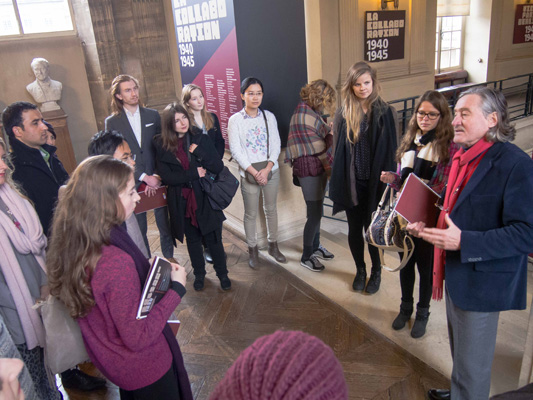
Praxmarer (right) with students of the 2014 Paris Eurocampus in the Archives nationales de France, Paris

For a number of years he taught international politics and relations in the United States (Temple University, University of Pennsylvania, Brown University and University of Rhode Island). He also was a consultant for UNITAR and the United Nations University on issues of social development, and has worked in the private sector (publishing, agriculture, art and antiques). During the wars in ex-Yugoslavia he participated in a fact-finding and assessment mission visiting UN peacekeeping forces in the Krajina region (Croatia), and served as Field and Training Coordinator with the OSCE Mission in Kosovo, for which he has also developed training programs in the field of democratization and good governance.

His main research focus is on epistemological issues (conceptualizations) in IC studies and the social sciences in general. His teaching is mainly on conceptualizations of “The Other”, as well as on intercultural communication in international organizations, and in particular peace communication in post-conflict and emergency contexts. He also works on academic cultures.

During the past ten years he has taught and lectured at more than two dozen universities in Europe and the US, and supervised a number of Bachelor and Master theses for students at different universities.

He also gives workshops and training courses in intercultural communication for different publics, including teachers at various levels, tourism professionals, immigration officials, paramedical personnel, healthcare professionals and managers.


NOTE: Peter Praxmarer passed away quite suddenly on November 5, 2017. He was a good friend to CID and will be sorely missed. A few concrete results of our frequent conversations follow. He wrote Key Concepts in Intercultural Dialogue #39: Otherness and the Other(s), translated it into both German and Italian, compiled a reader with study materials on intercultural communication competence, and prepared a poem, Languages of Peace. He wrote a guest post on Charlie Hebdo and intercultural dialogue, and responded at length to a guest post by Dominic Busch on refugees in Germany. During a Skype call with me, he came up with the concise definition of intercultural dialogue that was turned into CID Poster #3.
– Wendy Leeds-Hurwitz

Yang Liu Graphic Designs: East Meets West

Academics tend to discuss cultural differences in words. Designers show them visually. Yang Liu grew up in China, but then moved to Germany, becoming a designer. One of her projects, East meets West, consists of a series of comparisons of Chinese vs. German assumptions based on  her own experiences.

Her designs have been exhibited in both China and Germany, as well as being widely available on the internet. For further information, see her own website, or one of the many articles describing her work, including these:

Aw, Jean. (2007). Interview with Yang Liu- 11.13.07. NOTCOT.

Saleme, Shawn. (2013). East Meets West : An Infographic Portrait by Yang Liu. Visual News.

Save

CFP World Conference on Pluricentric Languages (Austria)

Call for Papers: World-Conference on Pluricentric Languages and their Non-Dominant Varieties
Organized by the International Working Group on Non-Dominant Varieties of Pluricentric Language (WGNDV)
July 08–11, 2015, University of Graz, Austria
Submission deadline: March 30, 2015
Notification of acceptance: April 15, 2015
Publication of papers: A volume of selected papers is to be published by Peter Lang Verlag, Frankfurt.
All papers for the conference and the publication will be peer-reviewed.

The conference will also have a section on language technology providing scholars the possibility to present their methods and approaches in corpus linguistics, natural language processing and the computational treatment of linguistic variation existing between and within national varieties.

The organizers of this 4th conference of the Working Group on Non-Dominant Varieties of Pluricentric Languages (WGNDV) would like to invite scholars from around the world to participate. The conference is devoted to the description of pluricentric languages and in particular of non-dominant national varieties of plc. languages. These are the varieties that are small by the number of their speakers and their symbolic power, and are not the primary norm-setting centres of the language. They may often be falsely attributed the status of a “dialect”, and have little or no codification of their norms. Typically, nd-varieties often have to legitimate their norms towards the dominant varieties etc. The previous conferences of the WGNDV have shown that non-dominant varieties around the world have many linguistic and sociolinguistic features in common. We would therefore like to deepen our knowledge and invite scholars from around the world to take part in the conference and give insight into the situation and features of as many nd-varieties and plc. languages as possible.

Objectives of the 4th conference:
The WGNDV wishes to continue in the line of the previous conferences and to extend the scope of its research. The main objectives of this conference are:
1.    To get more information about the situation of as many pluricentric languages and non-dominant-varieties in order to get empirically secure descriptions of effects of non-dominance.
*on the identity of their speakers,
*on the identity of their language communities,
*on the treatment of norms in written and spoken language,
*on the principles of codification and their spread to younger generations, and
*on methods in language-technology, how linguistic variation between and within national varieties and nd-varieties in particular can be treated and modelled computationally.

2.    To get exhaustive reports of the situation of as many plc. languages and nd-varieties around the world as possible and in particular of lesser known and researched plc. languages and nd-varieties like:
*Albanian, Aramaic, Aromunian, Basque, Bengali, Chinese, Croatian, Guaraní, Hebrew, Hindi/Urdu, Hungarian, Kiswahili / Swahili, Kurdish, Mapudungun, Occitan, Pashto, Punjabi, Quechua, Tamil, Romanian, Russian etc.
*ND-varieties of English in Europe, Americas, Africa and Asia;
*ND-varieties of French in Europe, Africa, Asia and America;
*ND-varieties of Spanish in the Americas and in Asia;
*ND-varieties of Portuguese in South-America, Africa and Asia;
*ND-varieties of German in Austrian, Belgium, Italy, Switzerland, Liechtenstein, Luxemburg; and
*Reports on the development of Russian in the former member-states of the Soviet Union

3.    To deepen the theory of plc. languages and the methods for the description of nd-varieties in particular in respect to:
*migrant varieties creating new types of pluricentricity;
*second level forms of pluricentricity within national varieties and their theoretical treatment;
*strategies for coping with language shift caused by electronic media and satellite TV spreading dominant norms to non-dominant varieties;
*the treatment of linguistic and pragmatic features of nd-varieties in education in primary and secondary schools;
*principles of codification in diglossic language communities of plc. languages, esp. the treatment of divergent linguistic forms that are common in everyday communication;
*the usage of endonormative codification strategies and their impact on the development of varieties and languages;
*measures of status planning and corpus planning etc. etc.

Important dates:
All scholars working in this field are invited to submit proposals for papers/workshops by 30th March 2015.
Notification of acceptance: 15th April 2015.

Contents of papers:
Papers (25 mins. + 5 mins. discussion) should address one or more of the above mentioned objectives of the conference as mentioned above and should thus provide:
*Information about the situation of any pluricentric language and any non-dominant-varieties in order to get empirically secure descriptions.
*To get exhaustive reports of the situation of lesser known and researched plc. languages and nd-varieties (see the list) and may be of “new” plc. languages that have not previously been identified.
*Data that deepen the theory of plc. languages and the methods for the description of nd-varieties.
*Suggestions for other topics are welcome!<

Contents of workshops:
Workshops (90 minutes long) should concern specific languages and their various non-dominant varieties, and particular methodological problems in the description of non-dominant varieties.

Abstracts:
All abstracts must be written in English and copied into the field “abstract” on the registration page or submitted via email as an attachment in Word format.
*Abstracts for 25-minutes papers should not exceed 3000 characters (1 page A4) including 4 keywords. Suggested topics for presentations can be downloaded from the conference website.
*Abstracts for 90-minutes workshops should not exceed 5000 characters (1 1/2 page A4) including 4-8 keywords. Workshop organizers should outline the overall structure of the workshop and provide names of the participants.

Conference language(s) and Sections:
The conference languages will be English and German plus the languages of the sections for specific languages if there are enough presentations to establish a section. The following sections are envisaged: English, French, German, Portuguese, Russian, Spanish, a general section and a language technology section. All presentations at the conference must be written in English, although the oral presentation can be held in the language of the section.

CFP Professional Communication, Social Justice, and the Global South

CALL FOR PAPERS
Professional Communication, Social Justice, and the Global South
Guest editors:
Gerald Savage, Illinois State University, Emeritus Faculty, USA
Godwin Y. Agboka, University of Houston Downtown, USA

Professional communicators are working all over the world. They practice in business, industry, government, charitable non‐profit organizations, non‐governmental organizations, and intergovernmental organizations. And yet, nearly all of the research on international professional communication has focused on corporate contexts in the “developed” world. Consequently, international technical communication practice and research tends to focus on barely more than half of the world’s nations included in the 2013 United Nations Human Development Index. These are nations ranked as “very high” or “high” on the human development scale. Only a few nations ranked as “medium” receive much notice—China, Thailand, Philippines, and South Africa are the most prominent.

Many of the nations regarded as “low” on the Human Development Index are sites of transnational corporate activity, of which a significant amount involves various kinds of resource development of questionable benefit to the people of those nations. However, a number of NGOs throughout the world pay close attention to the unfair, unjust, and environmentally detrimental activities of exploitative transnational corporations among indigenous and marginalized populations. These NGOs’ work includes research, legal action, and extensive documentation. Many transnational corporations also document their development and other business activities in sensitive areas of the world, some of them for purposes of accountability for their efforts at corporate social responsibility, others for purposes of denying or whitewashing egregious activities.

Only a handful of studies in professional communication, published over the past fifteen years, have addressed these issues (Agboka, 2013a, 2013b; Dura, Singhal, & Elias, 2013; Ilyasova & Birkelo, 2013; Vijayaram, 2013; Smith, 2006, 2012; Walton & DeRenzi, 2009; Walton, 2013; Walton, Price, & Zraly, 2013). This is especially troubling, considering that a wide range of other professions have given extensive attention to their roles in development activities among unenfranchised populations—such professions as engineering, medicine, agriculture, economics, business management, computer science, and geography. Professional communication scholars and practitioners have taken great pride in the part played by communication professionals in all of these fields, but too little research/ scholarship in professional communication has kept pace with the global social consciousness these other fields have demonstrated for many years regarding the impacts of their work beyond the industrialized Global North. This special issue attempts to address this need.

For this special issue we seek articles, commentaries, teaching cases, and reviews focusing on research studies, corporate, NGO, or government documentation relating to fair practices, environmental and social justice, and human rights in what is variously referred to as the Third and Fourth Worlds, Developing Countries, or the Global South. “Global South” and “Fourth World” are terms intended to include populations that are not necessarily in the southern hemisphere and that also do not include only nation states. Thus, the terms can include populations within “First World” nations, including the U.S. We especially seek proposals from scholars and practitioners who are indigenous to Global South populations or whose work connects with or affects populations in the Global South. The issue will also include several interviews with practitioners who are working in or with Global South populations.

Suggested topic areas include, but are not limited to:
• Intercultural research that takes place in Global South contexts
• Localization and translation for audiences in Global South sites
• Intersections of globalization and localization, and their associated challenges
• Workplace practices that impact specific Global South contexts
• Ethics in the context of the Global South
• Corporate, NGO, or other organizations’ documentation practices in Global South
contexts
• Curriculum design perspectives that address Global South perspectives
• The complexities of cross‐cultural collaborations between Global South and Global
North team members or among teams distributed across Global South cultures.
• Crisis communication in the contexts of the Global South
• Social justice implications of technology deployment and uses in the Global South

Proposals to be developed into
• Original research articles of 5,000 to 7,000 words of body text.
• Review articles of 3,000 to 5,000 words of body text.
• Focused commentary and industry perspectives articles of 500 to 3,000 words of body text.
• Teaching cases of 3,000 to 5,000 words of body text (deadline for submissions of manuscript proposals is February 15, 2015).
Submission procedures:
• Cover page containing your name, institutional affiliation, and email address.
• Prepare the cover page and manuscript with 1.5 line spacing and Times New Roman, 12‐point font.
• 500‐word proposal for original research articles, review articles, and teaching cases; 250‐word proposals for focused commentary and industry perspectives.
• All submissions will be reviewed by at least two readers, whether you are submitting a research article, a review article, industry perspective article, or teaching case.
• Submit via email to Gerald Savage or Godwin Agboka
• Proposals should be sent as a .docx, .doc, or .rtf file attached to an email message with the subject line: “Proposal for Special Issue on Professional Communication, Social Justice, and the Global South.”

Schedule
• Submission deadline for manuscript proposals: February 15, 2015
• Notification of proposal acceptances: March 15, 2015
• Submission deadline for first drafts of full manuscripts: June 15, 2015
• Submission deadline for revised drafts of manuscripts: November 1, 2015
• Expected date of publication: February 28, 2016.
Journal Editors: Rosário Durão & Kyle Mattson
Website: http://www.connexionsjournal.org/>www.connexionsjournal.org
connexions • international professional communication journal (ISSN 2325‐6044)

References
Agboka, Godwin Y. (2013a). Participatory localization: A social justice approach to
navigating unenfranchised/disenfranchised cultural sites. Technical Communication
Quarterly, 22(1), 28‐49.
Agboka, Godwin Y. (2013b). Thinking about social justice: Interrogating the international in international technical communication discourse. connexions: international professional communication journal, 1(1), 29‐38.
Dura, Lucia, Singhal, Arvind, & Elias, Eliana (2013). Minga Peru’s strategy for social change in the Peruvian Amazon: A rhetorical model for participatory, intercultural practice to advance human rights. Journal of Rhetoric, Professional Communication and Globalization, 4(1), 33‐54.
Ilyasova, K. Alex, & Birkelo, Cheryl (2013). Collective learning in east Africa: Building and transferring technical knowledge in livestock production. In Han Yu & Gerald Savage (Eds.), Negotiating Cultural Encounters: Narrating Intercultural Engineering and Technical Communication (pp. 103‐121). Hoboken, NJ: John Wiley and Sons.
Smith, Beatrice Quarshie (2006). Outsourcing and digitized work spaces: Some implications of the intersections of globalization, development, and work practices. Journal of Adolescent and Adult Literacy, 49(7), 596‐607.
Smith, Beatrice Quarshie (2012). Reading and Writing in the Global Workplace: Gender, Literacy, and Outsourcing in Ghana. Plymouth, UK: Lexington Books.
Vijayaram, Vaishnavi Thoguluva (2013). Learning curve. In Han Yu & Gerald Savage (Eds.), Negotiating Cultural Encounters: Narrating Intercultural Engineering and Technical Communication (pp. 61‐80). Hoboken, NJ: John Wiley and Sons.
Walton, R., & DeRenzi, B. (2009). Value‐sensitive design and health care in Africa. IEEE Transactions on Professional Communication, 52, 346‐358.
Walton, R. (2013). How trust and credibility affect technology‐based development projects. Technical Communication Quarterly, 22, 85‐102.
Walton, R., Price, Ryan, & Zraly, Maggie (2013). Rhetorically navigating Rwandan research review: A fantasy theme analysis. Journal of Rhetoric, Professional Communication and Globalization, 4, 78‐102.