American University of Kuwait job ad

AMERICAN UNIVERSITY OF KUWAIT
College of Arts and Sciences
Department of Communication and Media

The American University of Kuwait (AUK) is a private university in Kuwait organized on the U.S. model of undergraduate liberal arts education. The medium of instruction is English. The University is accredited by the Council for Private Universities of the Kuwait Ministry of Higher Education. AUK also has a Memorandum of Understanding with Dartmouth College in Hanover, NH. AUK admitted its first students in September 2004 and currently has approximately 2,000 students and over 120 UG faculty members.

The University is seeking terminally qualified faculty committed to excellence in teaching, scholarly research, and service. American education or teaching experience is preferred as is evidence of research activity. Outstanding communication skills, cultural sensitivity, and effective use of classroom media and technology are expected. Faculty rank will be determined by the candidate’s degree and previous employment history. Successful candidates will teach undergraduate classes to majors and non-majors of diverse cultural backgrounds, conduct research, participate in student advising, honor office hours, and serve on faculty committees.

AUK offers competitive compensation, as well as an attractive and comprehensive benefits package. There is no personal income tax, and US citizens may be eligible to take advantage of the IRS foreign tax exclusion. AUK is an equal opportunity employer, fully committed to becoming a model university of the twenty-first century in the region.

Contracts are issued for 3 years and are renewable.

Application Instructions:
Application packages are to be submitted electronically to faculty@auk.edu.kw (attachments must not exceed 10 MB per e-mail). The package should contain the following:
1) Cover letter, detailing the candidate’s specific interest in AUK, and how the candidate’s past experience provides a suitable basis for performance in the position for which they are applying;
2) A current CV;
3) Statement on research and service and statement of teaching methodology, including curricular development that the individual has initiated and executed;
4) Copies of teaching evaluations if available;
5) The names and addresses, both electronic and postal, of three referees;
6) Two recent publications /two writing samples;

In completing your application, please quote position code number. Incomplete applications will not be considered. For full consideration, applications should be reviewed by August 28, 2015.

Visit the AUK website to learn about the degree programs, university facilities, and campus life.

Electronic Media (Position Code No. 15-201- ICA 06): Full-time position in electronic media. Rank Assistant Professor, or higher, depending upon qualifications and experience. The candidate will possess the necessary expertise required for the development of a new track in electronic media in the Department. The ideal candidate will be able to teach a variety of classes in digital media, social media, and other forms of ‘new’ media. The ability to teach inter-disciplinary classes is a plus. Practical industry experience is desirable. The ideal candidate will also aid in curriculum development and program assessment and carry out other tasks assigned by the Chair. Ph.D in Media Studies / Communication, and/or a related discipline, is required.

Media Studies (Position Code No. 15-202- ICA 06): Full-time position in Media Studies. Rank Assistant Professor, or higher, depending upon qualifications and experience. The ideal candidate will be able to teach courses in media planning, public relations and advertising, advertising campaigns, and media and cultural studies. A focus on the Arab world is desirable. The ability to teach inter-disciplinary courses is a plus. Practical industry experience is desirable. The ideal candidate will also aid in curriculum development and program assessment and carry out other tasks assigned by the Chair. Ph.D. in Media Studies / Communication, and/or a related discipline is required.

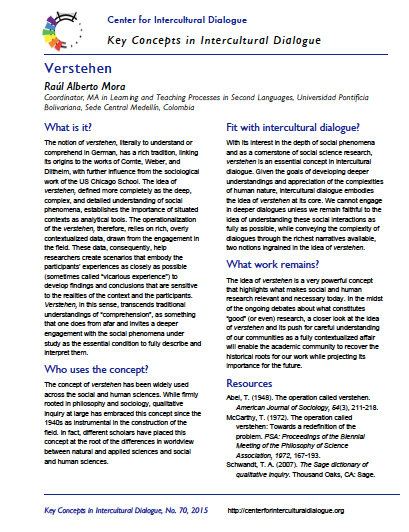
Key Concept #70: Verstehen by Raul Mora

Key Concepts in ICDThe next issue of Key Concepts in intercultural Dialogue is now available. This is KC70: Verstehen by Raul A. Mora. As always, all Key Concepts are available as free PDFs; just click on the thumbnail to download. Lists organized chronologically by publication date and number, alphabetically by concept in English, and by languages into which they have been translated, are available, as is a page of acknowledgments with the names of all authors, translators, and reviewers.

KC 70 Verstehen by Raul Mora

Mora, R. A. (2015). Verstehen. Key Concepts in Intercultural Dialogue, 70. Available from: https://centerforinterculturaldialogue.org/wp-content/uploads/2015/07/kc70-verstehen-by-raul-mora.pdf

The Center for Intercultural Dialogue publishes a series of short briefs describing Key Concepts in Intercultural Dialogue. Different people, working in different countries and disciplines, use different vocabulary to describe their interests, yet these terms overlap. Our goal is to provide some of the assumptions and history attached to each concept for those unfamiliar with it. As there are other concepts you would like to see included, send an email to the series editor, Wendy Leeds-Hurwitz. If there are concepts you would like to prepare, provide a brief explanation of why you think the concept is central to the study of intercultural dialogue, and why you are the obvious person to write up that concept.


Creative Commons License
This work is licensed under a Creative Commons Attribution-NonCommercial-NoDerivatives 4.0 International License.

Spark Grants – Humanities Washington (Seattle)

Spark Grant Guidelines
Spark Grants bring to life Humanities Washington’s mission of sparking conversation and critical thinking to help create informed, engaged communities across our state. Spark Grants support projects at large and small organizations that encourage thoughtful consideration of issues and provide social, historical and philosophical context to better understand our complex world.

While there are many opportunities for individuals to access information – e.g., the media, Internet, books – there are relatively few outlets for people to share their thoughts, ideas, and concerns about this information with other people, especially those with viewpoints different from their own. Spark Grants are available to help “spark” and sustain these important conversations.

We are especially interested in supporting programs that bring together diverse groups of people. To serve broader audiences and promote partnerships, Spark Grants will only be awarded to projects that are the result of a collaboration between two or more organizations. In addition, these projects must be:
• Based in dialogue and discussion
• Open to the general public
• Free or low-cost to attend

Project formats may include:
• Lectures and readings
• Community conversations
• Reading and discussion groups
• Public forums
• Panel presentations

Spark Grants can be used to fund public programs that build on themes developed in a larger project, such as discussions in conjunction with exhibitions or film festivals.

2015 Spark Grant Timeline
• Letter of intent due: August 28, 2015
• Full applications due: September 25, 2015
• Grant applicants notified of funding decisions: Week of November 23, 2015
• Funded grant activity can begin: December 15, 2015

Who is Eligible for Funding
Any nonprofit organization or public agency is eligible to apply for a Spark Grant. While applicants do not need to be incorporated or have tax-exempt status, they must be organized for nonprofit purposes and funded activities must clearly serve a Washington state audience. In addition:
• Organizations may apply for a Spark Grant only once in a calendar year.
• Organizations that have previously received Humanities Washington funding must submit a final report before applying again with a new project.

Individuals are not eligible to receive Humanities Washington grants.

Award Amounts
Spark Grants are awarded through a competitive grant process. Award amounts range from $1,001 to $7,500. Please note that Humanities Washington has limited grant funds to award, and not all eligible applicants may receive funding. Please review the list of permitted project costs and matching funds requirements.

How to Apply for a Spark Grant
Please review the How to Apply page to see if your project is eligible for funding and to access the online application form. We also strongly recommend that you review the Application Tips before starting your application.

Grant Writing Consultation
Humanities Washington staff is available to consult with applicants on draft proposals by telephone or in person by appointment prior to any application deadline (a minimum of four weeks before the deadline is advised). We strongly recommend that you review the Application Tips before starting your application and/or contacting staff. Calls and emails are returned to applicants in the order they are received in our office. We will contact all applicants who submit a Letter of Interest to discuss the proposed project.

CFP Hands-on History: Exploring New Methodologies for Media History Research (London)

HANDS-ON HISTORY: EXPLORING NEW METHODOLOGIES FOR MEDIA HISTORY RESEARCH
8—10 February 2016
Geological Society, London

Confirmed keynote speakers:
* Prof. Susan J. Douglas (Professor of Communication Studies, University of Michigan)
* Dr. Gerard Alberts (Associate Professor of the History of Mathematics and Computing, University of Amsterdam)

“Media Scholars and Amateurs of All Countries and Disciplines, Hands-on!” *

Recent years have witnessed a growing turn to experimental historical research in the history of media technologies. In addition to archival investigation and oral history interviews, historians and enthusiasts are increasingly uncovering histories of technology through hands-on exercises in simulation and re-enactment. Equipment lovingly restored by amateurs, or preserved by national heritage collections, is being placed in the hands of the people who once operated it, provoking a new and rich flood of memories.

The turn to experimental research raises profound methodological questions. The unreliability of narrative memory is well proven, but what do we know about the limits of haptic and tactile memory? To what extent is it possible to elicit useful memories of technological arrays when parts of those arrays are missing or non-functional? How do the owners of old equipment shape the historical narratives which are stimulated by their collections?

Hands-On History is a colloquium designed to facilitate discussion of these issues between historians, users, curators and archivists (amateur and professional) who are making use of and taking part in these historical enquiries. In addition to a series of keynote presentations by leading scholars in the field, the event will also include stimulating workshops on specific focus areas. While the focus of the event will be on media technologies, broadly defined, we invite contributions from other areas of technology and from other academic disciplines.

This colloquium aims to make a decisive intervention in this emerging area of academic interest. It is part of the ADAPT project, a European Research Council funded project investigating the history of television production technologies through hands-on simulations. Research conducted by ADAPT will form a key case study for the colloquium.

In order to facilitate productive discussion, numbers will be limited. It is expected that papers presented will form the basis of an edited collection focused on hands-on historical research.
We invite proposals for research presentations, panel discussions, and historical equipment demonstrations. Presentations may take whatever format is most appropriate, and we welcome approaches which deviate from the traditional 20 minute lecture.

Please send a brief proposal to Nick Hall by 28 August 2015.

* Andreas Fickers and Annie van den Oever, “Experimental Media Archaeology: A Plea for New Directions” 2013

American Cultural Centers and Cultural Programming in China

American Cultural Centers and Cultural Programming in the People’s Republic of China

The Public Affairs Section (PAS) of the U.S. Embassy in Beijing, China is pleased to announce an open competition for assistance awards. PAS invites organizations to submit proposals for the establishment of an American Cultural Center (ACC) through an existing partnership with a Chinese institution and/or comprehensive U.S. cultural-related programming at space provided by a Chinese partner institution as needed.

The ACCs created through this initiative are open to organization/institution faculty, staff, and students of all levels, as well as the general public for specific events. The ACCs’ goal is to provide a space to create a community and interactions that allow Chinese audiences to better understand the United States, its culture, society, government, language, law, economic system, and values. The ACCs seek to address the broad spectrum of responsible U.S. opinions in a climate of academic freedom and open-ended inquiry. Areas of programming at ACCs may include (but are not limited to):
– Invited public, private, and academic speakers to engage audiences on U.S. culture, society, government, language, law, economic system, and values, etc.;
– Cultural programming representing a broad range of U.S. visual and performing arts;
– Information resources on U.S. culture, society, government, language, law, economic system, and values, etc. in print and/or electronic form.

Eligible applicants:
Nonprofits having a 501(c)(3) status with the IRS, other than institutions of higher education
Public and State controlled institutions of higher education
Private institutions of higher education

The Public Affairs Section (PAS) of the U.S. Embassy in Beijing, China is pleased to announce an open competition for assistance awards through this Request for Applications (RFA). PAS invites U.S. post-secondary accredited institutions of higher learning (Public, Private, and State) and not-for-profit organizations subject to 501 (c) (3) of the tax code to submit proposals for the establishment of an American Cultural Center (ACC) through an existing partnership with a Chinese institution and/or comprehensive U.S. cultural-related programming at space provided by a Chinese partner institution as needed. PAS will award three grants up to US$100,000 per grant.

Closing date for applications:
July 31, 2015

CFP Global Conference on Science Communication (Istanbul)

Call for proposals
14th International Public Communication of Science and Technology (PCST) Conference: The Global Conference on Science communication

PCST: the global network for science communication and the Turkish hosts of the 2016 PCST conference in Istanbul remind you that the deadline for proposals for the conference is 12 noon GMT on 1 September 2015.

If you are active in science communication research, practice, training or education do consider submitting proposals for the 14th International PCST (Public Communication of Science and Technology) Conference to be held in Istanbul, Turkey, on 26–28 April 2016.

PCST 2016 is organized by the PCST International Network and hosted by Hacettepe University, Ankara. PCST conferences are a forum for discussing a wide range of issues in science communication but proposals for PCST 2016 are especially welcome on the conference’s main theme, Science communication in a digital age. Issues and questions associated with this main theme are discussed on the conference web site.

Proposals are also invited on the following themes:
• Trends in public communication of science and technology
• Science communication policies
• Evaluating public communication of science and technology
• Ethics and aesthetics of science communication
• Science communication in science centres and museums
• Science communication for social inclusion and political engagement
• Gender and diversity in science communication
• Social networks for science communication.

Proposals should include a summary description (maximum 300 words) of the proposed paper or session and the conference theme or themes with which the proposal is associated.

Proposers will be asked to select a presentation format from this menu:
Panel sessions: statements and discussion with 3–4 contributors on a single theme, preferably with an international dimension and international participation. The panel participants should NOT submit their individual contributions separately.
Individual papers: presentations of research or reflection that will be delivered in parallel sessions. Preference will be given to proposals based on original research that will be completed at the time of the conference.Posters: these will be presented orally as well as being displayed.
Workshops: demonstrations and descriptions of science communication practices with commentary and discussion on their application and effectiveness.
Performance: short dramatization, or screening of video, on issues or controversies relevant to science communication, followed by discussion.

Proposers should take care to ensure that their proposals
• emphasise the key questions, aims and findings of the project described
• can be understood by readers who are not specialists in the relevant field of research or practice
• are as clear and coherent as they can be (allowing for various levels of competence in English)
• specify the stage of the research or practice project they are addressing – Is it complete? Will it be complete by the time of the conference?
• state what is new or original about the work or what contribution it might make to science communication research or practice.

If a proposal for a paper is intended to be presented alongside another paper or papers from the same project, or on a closely related topic, this should be indicated in the text of the proposal.

In order to submit a proposal, participants must pre-register at the conference website, and create a login and password. The participant will then need to login to his/her restricted area and access the space where abstracts will be posted directly using the specified form.

Submitted proposals will be reviewed by members of the PCST Scientific Committee. All successful proposers will be notified by 15 November 2015.

Each individual will have, as lead author or organizer, no more than one proposal for a paper, one proposal for a panel and one proposal for a poster approved, that is, a maximum of three contributions in total. It is assumed that the lead author is also the intended presenter. An individual may be associated as co-author with additional contributions to the conference.

It is not necessary to pay the conference fee at the time of submission of the abstracts for proposals. However, papers will only be confirmed in the programme when the speakers have registered for the conference and paid the fee. The presenting author will be required to make the payment by a date that will be given in the notification of acceptance.

The official language of the conference is English: all the proposals should be submitted in English. The presentations will also be in English. Proposals must be submitted here up to 12 noon (GMT) on 1 September 2015. Authors can also revise abstracts up to that deadline.


ICA Executive Director job ad

EXECUTIVE DIRECTOR
International Communication Association

The International Communication Association (ICA) seeks an experienced and resourceful leader to partner with the executive committee, the board of directors, and its members in its next phase of development. The International Communication Association is an academic association for scholars interested in the study, teaching and application of all aspects of human and mediated communication. It began more than 60 years ago as a small organization of U.S. researchers and now is truly international with more than 4500 members in over 80 countries. Since 2003, ICA has been officially associated with the United Nations as a non-governmental organization (NGO). More information can be obtained from the ICA website.

The executive director oversees and facilitates the core activities of ICA, including a vibrant and innovative publishing program, a complex annual conference and bi-annual regional conferences, and divisional priorities and activities. The executive director develops and maintains key business and community partnerships/sponsorships, enhances financial sustainability, guides strategic growth, and helps shape policy that fosters high-quality research and dissemination of that research. The position, based in Washington, DC, oversees a staff of five and an annual budget of approximately $2,000,000 USD. Domestic and international travel is required.

The ideal candidate will preferably have at least five successful years as an executive or senior manager at an academically oriented nonprofit organization of similar budget size with experience negotiating, planning and implementing large conferences. Highly relevant and equivalent experience will also be considered. The salary for the position will be commensurate with the candidate’s experience and qualifications. Compensation includes a comprehensive employee benefits package, including a generous retirement plan.

Applicants should send their resumes and cover letters describing their interest in ICA, their qualifications and how their professional experience addresses the qualifications required, via email. Review of the applications will begin immediately and continue until a successful candidate is identified. Resumes without cover letters will not be considered. Desired start date is January 2016. ICA will maintain the confidentiality of the candidates until the finalists are selected.

The International Communication Association is an equal opportunity employer. Qualified applicants are considered for employment without regard to age, race, ethnicity, religion, sex, national origin, sexual orientation, gender identity or expression, disability or veteran status.

The full description of the position and application process can be accessed here.

CFP Super Diversity and Multiculturalism: SIETAR Australasia (Cairns, Australia)

Super Diversity and Multiculturalism: Managing and understanding diversity and culture at home and abroad
SIETAR AUSTRALASIA INAUGURAL CONFERENCE
16-18 October 2015
Cairns, Queensland, AUSTRALIA

We invite theoretical and practical contributions questioning all forms of multiculturalism from dance, art to indigenous cultural sovereignty. This represents a small sample of the topics we would like to discuss. This is an inter-disciplinary conference.

Our inaugural conference is about multiculturalism locally and globally. We would like to encourage and promote a deeper dialogue about multitudes of cultures co-existing without one dominating any of them. This is the ideal of multiculturalism we are aiming to explore in our conference: How to share without being subsumed.

We encourage all our participants to explore these ideas, to demonstrate and to find new ways to unite cultures in their presentations, workshops, or film, or any other performing art medium. We would like to explore the notion of how we can all co-exist and share our different cultures, but without being subsumed into one another’s culture. So join us in sharing your culture with my culture for us to create our culture together.

Topics:
1.                     Community and national identity
2.                     Multiculturalism in the workplace
3.                     Multicultural art in all forms
4.                     Hybrid culture
5.                     Multiculturalism and local culture
6.                     Indigenous culture and multiculturalism
7.                     Constructing multicultural identity
8.                     Religion and multiculturalism
9.                     Cohabiting in a global world
10.                   Denial of local culture into global culture
11.                   Symbols and culture
12.                   Multiculturalism in your country
13.                   Peace and multiculturalism
14.                   Superdiversity
15.                   Interfaith community and multiculturalism
16.                   Multiculturalism between nations
17.                   Multiculturalism and diplomacy
18.                   Multiculturalism international relations
19.                   Your culture and Multiculturalism
20.                   Australia and Multiculturalism
21.                   Australia and Islam
22.                   Multiculturalism and the Australasia region
23.                   Multiculturalism and global corporations
24.                   Multiculturalism and branding: place branding
25.                   Multiculturalism, tangible culture, intangible culture

Note: Papers on other relevant topics are welcome too.

Deadline for abstracts: 30 July 2015
Notification of acceptance: 15 August 2015
Early-bird registration: 15 August 2015

Abstracts should be a maximum of 300 words in length. Pre-congress and workshops submissions should be 500 – 1000 words in length. All abstracts will be published online in the SIETAR Australasia Journal. Selected papers will have the opportunity to be published in a Peer-Reviewed journal.

If you are interested in contributing to the conference or have the capacity for sponsorship please contact Hatice or Sevika at info@sietaraustralasia.com

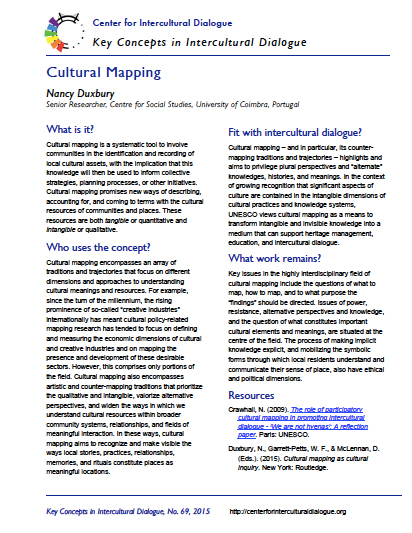
Key Concept #69: Cultural Mapping by Nancy Duxbury

Key Concepts in ICDThe next issue of Key Concepts in intercultural Dialogue is now available. This is KC69: Cultural Mapping by Nancy Duxbury. As always, all Key Concepts are available as free PDFs; just click on the thumbnail to download. Lists organized chronologically by publication date and number, alphabetically by concept in English, and by languages into which they have been translated, are available, as is a page of acknowledgments with the names of all authors, translators, and reviewers.

Key Concept 69: Cultural Mapping by Nancy Duxbury

Duxbury, N. (2015). Cultural mapping. Key Concepts in Intercultural Dialogue, 69. Available from: https://centerforinterculturaldialogue.org/wp-content/uploads/2015/06/kc69-cultural-mapping.pdf

The Center for Intercultural Dialogue publishes a series of short briefs describing Key Concepts in Intercultural Dialogue. Different people, working in different countries and disciplines, use different vocabulary to describe their interests, yet these terms overlap. Our goal is to provide some of the assumptions and history attached to each concept for those unfamiliar with it. As there are other concepts you would like to see included, send an email to the series editor, Wendy Leeds-Hurwitz. If there are concepts you would like to prepare, provide a brief explanation of why you think the concept is central to the study of intercultural dialogue, and why you are the obvious person to write up that concept.


Creative Commons License
This work is licensed under a Creative Commons Attribution-NonCommercial-NoDerivatives 4.0 International License.

Cultural Mapping as Critical Inquiry

Cultural Mapping as Cultural InquiryBook note: Cultural Mapping as Cultural Inquiry, edited by Nancy Duxbury, W.F. Garrett-Petts, and David MacLennan, has just been published by Routledge.

This edited collection provides an introduction to the emerging interdisciplinary field of cultural mapping, offering a range of perspectives that are international in scope. As a mode of inquiry, cultural mapping is both theoretical and practical. Those involved in cultural mapping seek to explore the richness and complexity of local meanings of place. For many, these artistic and ethnographic activities are linked to strategies of change and animation. Cultural mapping has become a valuable tool in policy, planning, and sustainability initiatives. In countries and contexts across the world, cultural mapping is recognized as a legitimate way to protect cultural traditions and to give expression and value to local cultural creations.

The chapters of this book address these themes, drawing on examples from Australia, Canada, Estonia, the United Kingdom, Egypt, Italy, Malaysia, Malta, Palestine, Portugal, Singapore, Sweden, Syria, the United Arab Emirates, the United States, and Ukraine. Contributors explore innovative ways to encourage urban and cultural planning, community development, artistic intervention, and public participation in cultural mapping—recognizing that public involvement and artistic practices introduce a range of challenges spanning various phases of the research process, from the gathering of data, to interpreting data, to presenting “findings” to a broad range of audiences. The book responds to the need for histories and case studies of cultural mapping that are globally distributed and that situate the practice locally, regionally, nationally, and internationally.

Contents
Cultural Mapping as Cultural Inquiry: Introduction to an Emerging Field of Practice by Nancy Duxbury, W. F. Garrett-Petts and David MacLennan

Part I: Mapping the Contours of an Emerging Field
Cultural Mapping and Planning for Sustainable Communities by Graeme Evans
One Strategy, Many Purposes: A Classification for Cultural Mapping Projects by Leonardo Chiesi and Paolo Costa
Cultural Mapping: Analyzing Its Meanings in Policy Documents by Eleonora Redaelli
Cultural Mapping in Ontario: The Big Picture by Sharon Jeannotte

Part II: Platforms for Engagement and Knowledge Through Mapping
Wedjemup Wangkiny Koora, Yeye and Mila Boorda (Wedjemup Talking from the Past, Today, and the Future): An Ex-Modern Way of Thinking and Mapping Landscape into Country? by Len Collard and Grant Revell
Understanding the Full Impact of Cultural Mapping in Ukraine by Linda Knudsen McAusland and Olha Kotska
Engaging Public, Professionals, and Policy-Makers in the Mapping Process by Janet Pillai Mapping Cultures: Spatial Anthropology and Popular Cultural Memory by Les Roberts and Sara Cohen
“Reading the City”: Cultural Mapping as Pedagogic Inquiry by Stuart Burch
City Readings and Urban Mappings: The City as Didactic Instrument by Paulo Providência

Part III: Inquiry, Expression, and Deepening Understanding of Place
Time, Aggregation, and Analysis: Designing Effective Digital Cultural Mapping Projects by Elaine Sullivan and Willeke Wendrich
Beyond Paper Maps: Archeologies of Place by Abby Suckle and Seetha Raghupathy
Mapping the Complexity of Creative Practice: Using Cognitive Maps to Follow Creative Ideas and Collaborations by Roberta Comunian and Katerina Alexiou
From Work to Play: Making Bodies in Flight’s Performance Walk Dream→work by Sara Giddens and Simon Jones
Maraya as Visual Research: Mapping Urban Displacement and Narrating Artistic Inquiry by Glen Lowry, M. Simon Levin and Henry Tsang (Maraya)
Beyond the Brochure: An Unmapped Journey into Deep Mapping by Kathleen Scherf