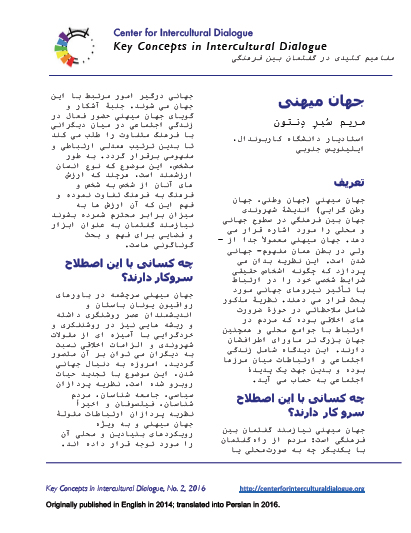
Key Concept #66: English Medium Instruction Translated into Turkish

Key Concepts in ICDContinuing translations of Key Concepts in Intercultural Dialogue, today I am posting the translation of KC66: English Medium Instruction. Ali Karakas wrote this in English in 2015, and has now translated it into Turkish.

As always, all Key Concepts are available as free PDFs; just click on the thumbnail of the translation to read it. Lists of Key Concepts organized chronologically by publication date and number, alphabetically by concept, and by languages into which they have been translated, are available, as is a page of acknowledgments with the names of all authors, translators, and reviewers.

KC66 EMI_TurkishKarakas, A. (2016). İngilizceyle Eğitim. Key Concepts in Intercultural Dialogue, 66. Available from: https://centerforinterculturaldialogue.org/wp-content/uploads/2016/09/kc66-emi_turkish.pdf

If you are interested in translating one of the Key Concepts, please contact me for approval first because dozens are currently in process. As always, if there is a concept you think should be written up as one of the Key Concepts, whether in English or any other language, propose it. If you are new to CID, please provide a brief resume. This opportunity is open to masters students and above, on the assumption that some familiarity with academic conventions generally, and discussion of intercultural dialogue specifically, are useful.

Wendy Leeds-Hurwitz, Director
Center for Intercultural Dialogue


Creative Commons License
This work is licensed under a Creative Commons Attribution-NonCommercial-NoDerivatives 4.0 International License.

CFP Refugees and Work

The ESPMI Network is pleased to announce a call for submissions for the third volume of the Refugee Review. The Refugee Review, a publication of the ESPMI Network, is an open access, peer-reviewed e-journal that features a range of submission styles as contributed by scholars, practitioners, activists, and those working and studying within the field of forced migration. The Refugee Review platform, based at no particular institution and tied to no particular location, offers a unique publishing opportunity for those in the early stages of their work and careers, as well as for established scholars that support this mission. Those who submit can expect dialogue with the ESPMI’s e-journal team throughout the publishing process, and are encouraged to work with ESPMI to strengthen and promote the e-journal in the spirit of open scholarship and collaboration. While we support the opinions and perspectives that all contributors may have, ESPMI has a commitment to equity, respect and honouring the dignity of all persons, and accordingly, we may reserve the right to refuse, or request amendment of, any submissions that we believe may degrade the dignity of a particular group.

Refugee Review: Refugees and Work
Deadline for Abstract Submissions: October 7, 2016

Submit to: refugeereview@gmail.com. Please send questions to the same address.
Please remember to state clearly in the subject line what kind of submission you are sending and include 5 – 10 key words. Submissions should be no longer than 400 words.

2016 Call for Submissions – Download the PDF here.

In the past year the issue of refugees and forced migration has taken centre stage in public discourse of many countries from extensive coverage of multiple ongoing humanitarian crises to a growing populist backlash that has taken several regions by storm. Despite the high level political and media interest in the topic, many aspects are left to be discussed and many academic stones remain unturned. We invite submissions of abstracts for three different categories: academic articles, opinion papers and practitioner reports, and multimedia submissions (please see below for a description of each type.) Regardless of the submission type, the topic should relate primarily to refugees and forced migration. We welcome new approaches, preliminary results from field research and multidisciplinary research pertaining to all aspects of refugee studies, including changing legal standards, gaps in protection, regional case studies, gender-related aspects, and policy responses.

Recent years have seen large influxes of refugee arrivals in many countries, eliciting substantial debate on rights and protection needs of refugees and asylum seekers. In some countries populist discourse positions refugees as a threat to economic security, while other countries put labour restrictions or requirements onto arriving refugees. To further this discussion from a more nuanced perspective, for this issue we are particularly interested in receiving submissions on the topic “Refugees and Work.” Examples of research themes: Are long-term labour restrictions for refugees and asylum seekers legal under international law? How do refugee movements relate to and create informal labour markets? How do refugees negotiate and/or integrate into the labour market of host societies? How may the right to work be positioned for rejected asylum seekers, or those seeking refuge in countries identified as transit nodes? How may one complicate the binary between ‘economic migrant’ and ‘refugee’? In what ways do media discourses on refugees pose them as threats to working class jobs? We encourage critical perspectives that take race, class, and gender into account.

Submission Categories:

We recognize and value the multidisciplinary nature of forced migration studies, and therefore encourage submissions from across various disciplines—including but not limited to political science, law, anthropology, ethics and philosophy, sociology, economics, public health, and media studies. You may submit to any submission category, regardless of where you locate your study or practice. Please identify which submission category your piece is being submitted under. We encourage you to consider the range of submission styles available in this Call for Submissions during the development of your piece and structure/develop your submission accordingly. We require all contributing authors to submit an abstract for review prior to submission of a complete piece. You will be informed of the acceptance of your abstract within two weeks, after which time you have six weeks to complete and submit your final piece.

Submissions will go through a peer review process and those selected will go through a peer editing process before publication. The editing team may, when deemed appropriate, move your piece to a different submission section (for example from the Academic Article section to the Opinion Piece section) if they feel it is better suited to another category.

Read Refugee Review Volume ll

Mohan J. Dutta Profile

ProfilesMohan J Dutta is Dean’s Chair Professor of Communication at Massey University (New Zealand), and Director of the Center for Culture-Centered Approach to Research and Evaluation (CARE) directing research on culturally-centered, community-based projects of social change communication.


Mohan Dutta
Professor Dutta teaches and conducts research in international health communication, critical cultural theories of health and social change, poverty and unequal health outcomes in the backdrop of neoliberal policies, health activism in globalization politics, indigenous cosmologies of health, subaltern studies and dialogue, and public policy and participatory social change communication. Currently, he serves as Editor of the “Critical Cultural Studies in Global Health Communication Book Series” with Routledge, Specialty Chief Editor of the Health Communication section of the open access journal, Frontiers in Communication, and sits on the editorial board of seven journals including Communication Theory, Journal of Computer Mediated Communication, and Annals of the International Communication Association. Before arriving to NUS, he served as Associate Dean of Research & Graduate Education in the College of Liberal Arts at Purdue University, a Service Learning Fellow, and a fellow of the Entrepreneurial Leadership Academy. Also at Purdue, he served as the Founding Director of the Center for Poverty and Health Inequities (COPHI), where he continues to hold an Affiliate appointment.

Professor Dutta holds a Bachelor of Technology (Honors) in Agricultural Engineering from the Indian Institute of Technology (IIT), Kharagpur, and a PhD in Mass Communication from the University of Minnesota. He began his career at Purdue University in 2001, was tenured in 2005, and became Full Professor in 2009. In June, 2010, he was appointed as the Lim Chong Yah Professor of Communication and New Media at the National University of Singapore (NUS), and formally joined NUS as Professor of Communication in July, 2012.

Mohan Dutta’s research examines marginalization in contemporary healthcare, health care inequalities, the intersections of poverty and health experiences at the margins, political economy of global health policies, the mobilization of cultural tropes for the justification of neo-colonial health development projects, the meanings of health in the realms of marginalized experiences in highly underserved communities in the global South, and the ways in which participatory culture-centered processes and strategies are organized in marginalized contexts to bring about changes in neo-colonial structures of global oppression and exploitation. Engaging in dialogues with subaltern communities at the global margins in imagining alternative spaces that resist neoliberal formations forms the crux of Professor Dutta’s academic and activist projects. At the Center for Culture-Centered Approach to Research and Evaluation (CARE), Professor Dutta leads 19 culture-centered projects spread across 7 countries exploring the roles of listening, participation, and dialogue in creating infrastructures for alternative rationalities of health and wellbeing. These projects highlight the role of local cultural practices in transforming health, and in strengthening community-state relationships in securing community access to infrastructures of health and wellbeing. Ultimately, Professor Dutta hopes that this work offers an entry point for transformative communicative practices and networks of solidarity that connect the imaginaries of the global South in offering alternative structures of global organizing grounded in the spirits of justice, equality, and dignity.

U Melbourne Job Ad: Head, School of Culture & Comm (Australia)

Head, School of Culture & Communication
University of Melbourne – School of Culture & Communication, Faculty of Arts
Closes: 6th October 2016

The School of Culture and Communication, Faculty of Arts, University of Melbourne, wishes to appoint a distinguished academic as Head of School, Culture and Communication. The successful applicant will have a strong research, teaching and engagement record and a proven track record in leadership.

The Dean and Heads of School constitute the senior leadership team of the Faculty of Arts, and the successful applicant will both manage her or his School as well as assist with the running of the Faculty.

PLEASE DO NOT apply via the University website. Applications should be submitted to The Insight Group, Executive Search Consultants. Cover letter, CV and a document addressing the selection criteria should be emailed to Dr Leslie Kilmartin at lkilmartin[at]insightgroup.com.au

Dr. Kilmartin of The Insight Group is managing enquiries relating to this appointment.

Cal Poly Job Ad: Mediated Representations of Race, Gender, Ethnicity

Assistant Professor – Mediated Representations of Race, Gender, and/or Ethnicity at California Polytechnic State University, San Luis Obispo

COMMUNICATION STUDIES: Full-time, academic year, tenure-track Assistant Professor specializing in Mediated Representations of Race, Gender, and/or Ethnicity in the Department of Communication Studies in the College of Liberal Arts at California Polytechnic State University, San Luis Obispo, California, to begin September 7, 2017. Salary is commensurate with qualifications and experience. Initial appointment is for two years, subject to renewal.

A Ph.D. in Communication Studies or related field is required. ABD candidates with degree completion expected by August 2017 will be considered. The ideal candidate will provide evidence of a demonstrated commitment to research and scholarship. Coursework relevant to the
instructional assignment is required as the minimum academic preparation. Evidence of successful university-level teaching is required. Teaching responsibilities may include Media Effects; Media, Self and Society; Gender Communication, Intercultural Communication;
Intergroup Communication; Critical Cultural Studies and Communication; Media Criticism; Human Communication and Technology; Communication Theory; Research Methods; Public Speaking; and/or Senior Project as determined by applicant background and department need.

The College of Liberal Arts strongly values inclusion and diversity especially in the classroom among its areas of study. This is one of seven searches in the College of Liberal Arts intended to increase curricular coverage of areas related to inclusivity and diversity, and successful candidates will be expected to contribute to strengthening the college’s efforts in these areas. The other searches are for positions in Social Sciences, English, History, and Psychology & Child
Development. It is anticipated that a minimum of four hires will be made across these searches.

HOW TO APPLY: Complete online faculty application at WWW.CALPOLYJOBS.ORG and submit it to Requisition #104183. Please attach to your electronic application the following required materials: cover letter, current vita, recent evaluations of teaching effectiveness, examples of scholarship, and unofficial copy of transcript. Please be prepared to provide three professional references with names and email addresses when completing application. Cal Poly will directly solicit letters from the individuals listed by applicants. Official sealed transcript showing highest degree earned will be required prior to appointment. This position is open until filled. REVIEW BEGIN DATE: October 14, 2016. Applicants with complete files by the Review Begin Date will be given full consideration.

At California Polytechnic State University, San Luis Obispo, we believe that cultivating an environment that embraces and promotes diversity is fundamental to the success of our students, our employees and our community. Bringing people together from different backgrounds,
experiences and value systems fosters the innovative and creative thinking that exemplifies Cal Poly’s values of free inquiry, cultural and intellectual diversity, mutual respect, civic engagement, and social and environmental responsibility.

Cal Poly’s commitment to diversity informs our efforts in recruitment, hiring and retention. California Polytechnic State University is an affirmative action/equal opportunity employer.

Cal State Sacramento Job Ad: Intercultural/International Communication

Tenure Track Instructional Faculty – Communication Studies
(Intercultural/International) at California State University, Sacramento

California State University, Sacramento, seeks applications for a specialist in Intercultural Communication for a tenure-track appointment as an assistant professor to start in the Fall 2017 semester.

REQUIRED
Education: Ph.D. in Communication Studies. ABD candidates will be considered. ABD candidates will be required to complete the doctorate by August 2017.

Required Knowledge & Abilities: Evidence of excellence in teaching at the university level. Teach introductory, advanced, and graduate level courses.  Interest in and the ability to conduct scholarly research.  A demonstrated ability to work with a diverse population.

PREFERRED
Preference given to those with teaching and research background in quantitative methods.
Experience: Prior teaching experience at the college or university level and with students from diverse groups.
Teaching/research in developing areas of intercultural/international communication such as globalization, cross-cultural communication, health communication and/or co-cultural dimensions of diverse societies.

Duties include providing curricular leadership in international/intercultural communication and teaching introductory, advanced and graduate level courses. Faculty will be expected to advise
students; engage in scholarly activities; and provide service to the department, campus, and community.

Review of applications will begin October 1, 2016; however, position will remain open until filled.  Applications must be submitted online.  Applications must include the following:
–       A letter indicating the applicant’s interest in the position and the way in which the applicant meets the qualifications
–       Curriculum vitae
–       Evidence of teaching excellence (e.g., syllabi, teaching evaluations)
–       Evidence of creative activity and/or scholarly research
–       Three to five recent professional references, including names and contact information
–       Unofficial transcripts from institutions granting post-secondary degrees to applicant

* Candidates must include the application materials as a single PDF.
* Additional documentation and letters of recommendation may be required
at a later date.

CFP Discourse: Multidisciplinary Perspectives (UK)

One day-colloquium on ‘Discourse: Multidisciplinary Perspectives’
University of Sussex, Friday 18th November 2016 (Please note the change of date)

Call for papers

The English Language & Linguistics group at the University of Sussex is organizing a one-day colloquium on ‘Discourse: Multidisciplinary Perspectives’. We invite papers from the full range of disciplines that use discourse analysis, such as literature, media studies, anthropology, history, linguistics, politics, psychology, gender studies, medicine, education, literature and more.  The sub-topic of the colloquium is ‘Reflections on Representation, Identity and/or (Non)Belonging’, which we encourage participants to interpret in the broadest sense. As such, we welcome both illustrative research papers detailing discourse analyses on the topic/s, as well as position papers which help show how representation, identity and (non)belonging are understood from a discourse perspective within your particular discipline. Various perspectives are encouraged and some themes which have emerged from discussions with colleagues across disciplines include:
• representation of public/political figures or groups in the media,
• patients’ self-accounts in medicine/psychology,
• defendants’ self-presentations in criminology/law,
• negotiation of self-identity in the classroom in sociology/education or representation of values in public and/or educational texts
• identity construction in oral/written memories of war veterans and/or historical crucial moments in oral history
• and much more.

We hope that the event will lead to greater understanding of how discourse is conceptualised and approached across disciplines and reveal opportunities for interdisciplinary collaboration. Depending on interest, we also envisage a selection of papers being published in a special issue of CADAAD Journal (Critical Approaches to Discourse Analysis Across Disciplines).

If you are interested in contributing a paper, please send a 300 word abstract to Roberta Piazza (r.piazza[at]sussex.ac.uk) by September 30th 2016.

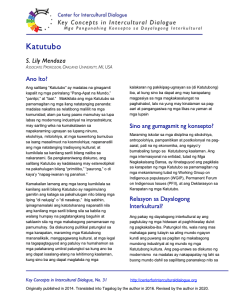
Key Concept #1: Intercultural Dialogue Translated into German

Key Concepts in ICDContinuing translations of Key Concepts in Intercultural Dialogue, today I am posting KC1: Intercultural Dialogue, which I published in English in 2014 as the first in the series, and which Dominic Busch has now translated into German.

As always, all Key Concepts are available as free PDFs; just click on the thumbnail to download. Lists of Key Concepts organized chronologically by publication date and number, alphabetically by concept, and by languages into which they have been translated, are available, as is a page of acknowledgments with the names of all authors, translators, and reviewers.

KC1 Interkultureller dialog_GermanLeeds-Hurwitz, W. (2016). Interkultureller dialog. (D. Busch, trans). Key Concepts in Intercultural Dialogue, 1. Available from:
https://centerforinterculturaldialogue.org/wp-content/uploads/2016/09/kc1-icd_german.pdf

If you are interested in translating one of the Key Concepts, please contact me for approval first because dozens are currently in process. As always, if there is a concept you think should be written up as one of the Key Concepts, whether in English or any other language, propose it. If you are new to CID, please provide a brief resume. This opportunity is open to masters students and above, on the assumption that some familiarity with academic conventions generally, and discussion of intercultural dialogue specifically, are useful.

Wendy Leeds-Hurwitz, Director
Center for Intercultural Dialogue


Creative Commons License
This work is licensed under a Creative Commons Attribution-NonCommercial-NoDerivatives 4.0 International License.

Key Concept #9: Communicative Competence Translated into Chinese

Key Concepts in ICDContinuing translations of Key Concepts in Intercultural Dialogue, today I am posting KC9: Communicative Competence, written by John Corbett and published in English in 2014, now translated into both traditional and simplified Chinese by Daisy Li.

As always, all Key Concepts are available as free PDFs. Click on the thumbnail of the translation you wish to read. Lists of Key Concepts organized chronologically by publication date and number, alphabetically by concept, and by languages into which they have been translated, are available, as is a page of acknowledgments with the names of all authors, translators, and reviewers.

KC9 Comm Competence_Chinese trad
Traditional Chinese
KC9 Comm Competence_Chinese sim
Simplified Chinese


Corbett, J. (2016). Communicative competence [Simplified Chinese]. (D. Li, Trans.). Key Concepts in Intercultural Dialogue, 9. Available from: https://centerforinterculturaldialogue.org/wp-content/uploads/2016/09/kc-9-communicative-competence_chinese-sim3.pdf

Corbett, J. (2016). Communicative competence [Traditional Chinese]. (D. Li, Trans.). Key Concepts in Intercultural Dialogue, 9. Available from: https://centerforinterculturaldialogue.org/wp-content/uploads/2016/09/kc-9-communicative-competence_chinese-trad.pdf

If you are interested in translating one of the Key Concepts, please contact me for approval first because dozens are currently in process. As always, if there is a concept you think should be written up as one of the Key Concepts, whether in English or any other language, propose it. If you are new to CID, please provide a brief resume. This opportunity is open to masters students and above, on the assumption that some familiarity with academic conventions generally, and discussion of intercultural dialogue specifically, are useful.

Wendy Leeds-Hurwitz, Director
Center for Intercultural Dialogue


Creative Commons License
This work is licensed under a Creative Commons Attribution-NonCommercial-NoDerivatives 4.0 International License.

CFP Beyond Words & Into the Message (Romania)

Beyond Words and into the Message. Building Communication across Languages, Media and Professions
10-Nov-2016 – 11-Nov-2016
Research Centre for Specialised Translation and Intercultural Communication
Bucharest, Romania

Meeting Description:
Our world is basically made up of words, the very essence of communication. These words find their way among us in one big conversation. In James W. Carey’s words: “Life is a conversation”. This holds good even more so when it comes to conveying our thoughts across the borders of language, culture, country and profession. The conversation between individuals on different sides of these borders is enlarged by an instance of otherness while crossing into many instances of translation.

We invite you to discuss these topics in the following sections of the conference:

1) Communication and Language Studies:
The growing need for mediation and communication across cultures for a variety of professionals in a broad range of fields calls for a fresh theoretical framing of practices involving social activities. These are not to be relegated to fixed and separate systems for, in the words of Mahatma Gandhi, “No culture can live if it attempts to be exclusive”.

This section of our conference welcomes papers on topics including, but not limited to:
– Communication theory and theories
– Digital media and online communication
– Professional communication
– Media and education
– Visual and non-verbal communication
– Cross-cultural communication
– Language learning and teaching
– Discourse analysis and applied linguistics
– New trends in linguistics

2) Literature and Cross-Cultural Studies:
“Great literature is simply language charged with meaning to the utmost possible degree.” (Ezra Pound). In one way or another literature has accompanied mankind for thousands of years. The need to tell and listen to stories is inherent to human nature, just as language and cognition are intertwined. Nevertheless, several questions should be addressed, such as: How much have the topics of literature changed and diversified? To what extent has modern narration influenced storytelling? What is its cross-cultural impact on literature?

In order to provide answers these questions (and others) this section welcomes papers on topics including, but not limited to:
– Media and cultural identity
– Postcolonial studies
– Gender studies
– Minority literature
– Literary and political relations in cross-cultures
– Historical approaches to literary studies
– Comparative literature

3) Translation and Interpreting Studies:
In the last two decades, the contribution of translators and interpreters has become essential in the coherent transfer of (specialized) information. Today the concept of translation goes deep beyond the simple knowledge of terminologies and has expanded to cover a wide range of factors, which can only be learned, understood and applied efficiently by means of a thorough academic training.

This section aims at debating over the following areas in connection with the role of translation and interpreting:
– Translating and interpreting as mediating between cultures
– Conference interpreting: trends and developments
– Ethical issues in translation across cultures
– Training and practice in translation and interpreting
– Literary vs. specialized translation: competition or compatibility?
– New media support in translation
– Social network language and its impact on speaking and translating