CFP Communication for Development & Social Change

Special Issue: Communication for Development and Social Change: Experiences & Future Convergences
Journal of Communication

Guest Editors: Thomas Tufte and Rafael Obregon

Communication for development and social change is at the crossroads of multiple approaches in communication scholarship, including visual communication, organizational communication, media and communication technologies, intercultural communication, and other communication practices. It also constitutes an established practice carried out and supported by agencies in international development and cooperation. In recent years, we have seen a proliferation of experiences and approaches, led by global partnerships and alliances as well as civil society organizations which, in many cases, crystallized in social movements across the globe.

In the aftermath of the financial crisis in 2008 and the so-called ‘Arab Spring’, social movements came to represent a rich and heterogeneous amount of bottom-up citizen and community-driven initiatives. They are cause-driven mobilizations pursuing goals across various issues and sectors, including public health, education urban development, sustainable development, and children’s and women’s rights. Recent humanitarian crises, such as the Ebola crisis and the refugee crises, have led to a widespread citizen engagement through a variety of social change communication and community-led initiatives.

In this processes, digital media and digital-centered forms of mobilization have been crucial, but also contested. The debate has moved beyond the initial techno-determinist fascination with so-called “Facebook” and “Twitter” mobilizations to the recognition of complex and dynamic relations between online and offline communication, organizations and social change, movements and media, performance and protest, communication and public deliberation, as well as among a variety of actors including communities, non-governmental and governmental organizations, movements, and companies pursuing similar agendas.

The energy, creativity, discourses, tactics, and strategies through which various political and social actors communicate for social change have come to challenge and inspire both research and practice. Many governmental and non-governmental organizations are seeking ways and means to reach and connect with constituencies, spark new energy, drive stronger public and policy agendas, build social movements, and promote social change.

Against this backdrop, the focus of this special issue of the Journal of Communication is to offer an in-depth understanding of the role of communication in social movements and various forms of collective action that promote equity, social justice, and human rights by tackling a range of global social problems.

We invite authors to send submissions informed by various theoretical perspectives and methodological approaches in communication studies. We are interested in submissions that:
– Revisit communication and social change theories, models, and arguments that inform research about communication in times of digital media and widespread citizen engagement.
– Examine case studies that bring original theoretical, analytical and conceptual insights about new dynamics of citizen engagement, organizational communication, and other communication practices related to multiple dimensions of social change.
– Critically reflect upon opportunities and limitations that social movements, organizations, non-government organizations, community-based organizations, and other civil society actors confront to spark communication, citizen engagement, and promote social change.
– Address communication experiences in a wide range of policy and development sectors and issues, including health, environment, poverty alleviation, energy, labor, culture, religion, diversity, gender equality, social accountability, and social inclusion.

Manuscripts should not exceed 28 pages (6000 words), including references and figures, and must be submitted through the online submission system of the Journal of Communication. Authors should indicate that they wish to have their manuscript considered for the special issue. Information about author guidelines can be found in the Journal of Communication website.

Deadline for submissions: December 1, 2016.

Inquiries should be sent to Dr. Thomas Tufte (ttufte[at]ruc.dk) and Dr. Rafael Obregon (robregon[at]unicef.org).

This theme issue will be published in 2017.

Key Concept #1: Intercultural Dialogue Translated into Persian

Key Concepts in ICDContinuing translations of Key Concepts in Intercultural Dialogue, today I am posting KC#1: Intercultural Dialogue, which I published in English in 2014 as the first in the series, and which Ramin Hajianfard has now translated into Persian.
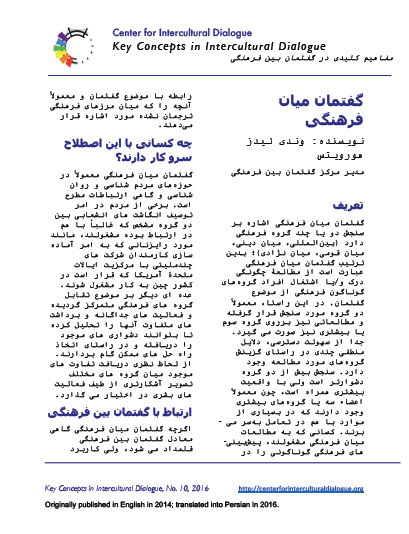
As always, all Key Concepts are available as free PDFs; just click on the thumbnail to download. Lists of Key Concepts organized chronologically by publication date and number, alphabetically by concept, and by languages into which they have been translated, are available, as is a page of acknowledgments with the names of all authors, translators, and reviewers.

KC1 Intercultural Dialogue_PersianLeeds-Hurwitz, W. (2016). Intercultural dialogue [Persian]. (R. Hajianfard, trans). Key Concepts in Intercultural Dialogue, 1. Available from:
https://centerforinterculturaldialogue.org/wp-content/uploads/2018/08/kc1-intercultural-dialogue_persian.pdf

If you are interested in translating one of the Key Concepts, please contact me for approval first because dozens are currently in process. As always, if there is a concept you think should be written up as one of the Key Concepts, whether in English or any other language, propose it. If you are new to CID, please provide a brief resume. This opportunity is open to masters students and above, on the assumption that some familiarity with academic conventions generally, and discussion of intercultural dialogue specifically, are useful.

Wendy Leeds-Hurwitz, Director
Center for Intercultural Dialogue


Creative Commons License
This work is licensed under a Creative Commons Attribution-NonCommercial-NoDerivatives 4.0 International License.

CFP SIETAR Europa 2017

SIETAR Europa Congress 2017
Cultural Dexterity for Turbulent Times
May 22nd to 27th, 2017- Dublin, Ireland

This congress welcomes everyone whose life and work puts them at the interface of cultures, from the perspectives of economy, society and education, with the aim of reshaping intercultural discourse, questioning our current cultural paradigms and exploring new thinking to help us navigate complexity in our emerging global world.

With the aim of re-examining our cultural dimensions, understandings and paradigms, we invite submissions that question, critique, explore and refresh our cultural paradigms and theories, and simultaneously share new methods and best practices. We invite those engaged in business, training and research (including independent consultants and educational institutions) shaping the European public sphere, (NGOs, governmental organisations and institutions and private ones as well) as well as media and arts, to participate and share contributions from all disciplines and fields that deal with intercultural topics.

Track 1: Business and Organizational Challenges
Track 2: Sociopolitical Concerns
Track 3: Shaping Intercultural Professions
*Deadlines
Deadline for submission:  31 October 2016
Notice of acceptance:  15 December 2016

IACCM Academic Track:
Deadline for submission:  31 October 2016
Full paper deadline:  15 March 2017

The official SIETAR Europa Congress language is English. Submissions of proposals must be in English.

If you have any other queries, please send them to dublin2017[at]sietareu.org specifying ”QUERY” and your name in the email subject. The Congress Committee will get back to you as soon as possible.

Newcastle U Job Ad, Critical Heritages: Identities in Europe (UK)

Research Associate for Critical Heritages: performing and representing Identities in Europe
Newcastle University – Faculty of Humanities and Social Sciences – Arts & Cultures
Closes: 30th September 2016

Media, Culture, Heritage at Newcastle University wishes to appoint a talented digital heritage research associate to join the international team of the Horizon 2020 – funded project Critical Heritages: performing and representing Identities in Europe (COHERE). The successful applicant will work closely with Dr Areti Galani to explore current institutional and grass-roots digital heritage practices and the use of digital design methodologies in fostering dialogue around European heritage(s) with a variety of stakeholders and/or communities. The post holder will organise fieldwork, contribute to workshops and develop training materials and academic publications.

You will have an excellent scholarship record and wide knowledge of heritage and museum studies, digital heritage theory and practice, literature on national identity and identity construction, and media studies. You will also have strong communication skills and experience in working across disciplines and with a diverse group of people.

The post requires flexible working hours and the ability to travel to other consortium countries in Europe and Turkey.

The post is fixed term for 3 years, at 20% FTE.

For an informal conversation about this post please contact Dr Areti Galani (areti.galani[at]ncl.ac.uk)

U Leicester Job Ad: Media & Communication (UK)

Teaching Fellow in Media and Communication
University of LeicesterMedia and Communication
Closes: 27th September 2016
Fixed term contract for one year.

Our Department of Media and Communication are looking to recruit a Teaching Fellow to join their Department. Media and Communication research has just celebrated its 50th year at Leicester and the department can boast a high level of Research and Teaching Excellence in their field, ranked 8th in the 2016 Complete University Guide.

We are looking for a teaching fellow to contribute to the following areas:
• Journalism Studies
• Public Relations
• Advertising
• Media and Communication

You will also be responsible for scholarship, teaching, and administration and other activities supporting the work of the Department and developing and enhancing its reputation.

Please click here for further information and details about the position

Informal enquiries are welcome and should be made to Professor Helen Wood hw177[at]le.ac.uk.

Media Literacy Week 2016

Media Literacy Week logoNational U.S. “Media Literacy Week” Returns for Second Year
October 31 thru November 4, 2016

Media Literacy Week (#MediaLitWk) in the U.S. is being held October 31 – November 4, 2016. The mission of Media Literacy Week is to highlight the power of media literacy education and its essential role in education today. Sponsored by Trend Micro and hosted by the National Association for Media Literacy Education (NAMLE), Media Literacy Week already has the support of numerous partnering organizations and dedicated, passionate media literacy experts and practitioners across the nation. Kicking off U.S. Media Literacy Week will be the Digital Citizenship Summit on October 28 at Twitter’s San Francisco headquarters with panels and presentations highlighting the themes of “Citizenship, Literacy, and Advocacy.”

Media Literacy Week is designed to bring attention and visibility to media literacy education in the U.S. Inspired by Canada’s Media Literacy Week now in its 11th year, NAMLE is leading the efforts to create an annual media literacy week in the U.S that showcases the work of amazing media literacy educators and organizations nationwide and drives conversation that creates positive social change.

In an effort to raise national awareness of the escalating demand for media literacy education at home and in schools, affiliated Media Literacy Week partners are working with NAMLE to execute participatory events including #MediaLitWk classroom lessons, live webinars, tweet chats, screenings, PSAs and more.

Organizations and Educators Welcome to Contribute
All are welcome to participate in Media Literacy Week efforts. If you are an organization interested in being a Media Literacy Partner, email mlwpartners@namle.net. If you are a teacher interested in getting involved, email mlwteachers@namle.net. If you are interested in sponsoring, email Michelle Ciulla Lipkin, Executive Director at mciullalipkin@namle.net.

It’s up to each educator and organization to decide how they will participate, but given the proximity to the presidential election, NAMLE is encouraging the exploration of news literacy and civic engagement. For help planning, feel free to visit http://medialiteracyweek.us for tips and ideas or reach out directly to medialiteracyweek@namle.net.

About NAMLE (Host)
The National Association for Media Literacy Education (NAMLE) is a professional association for educators, academics, activists, and students with a passion for understanding how the media we use and create affect our lives and the lives of others in our communities and in the world. The NAMLE vision is to help individuals of all ages to develop the habits of inquiry and skills of expression they need to be critical thinkers, effective communicators and active citizens in today’s world. NAMLE is a member of the Council of Communication Associations, the parent organization of the Center for Intercultural Dialogue.

About Trend Micro (Sponsor)
Trend Micro Incorporated, a global leader in security software, strives to make the world safe for exchanging digital information. Built on 25 years of experience, our solutions for consumers, businesses and governments provide layered data security to protect information on mobile devices, endpoints, gateways, servers and the cloud. Trend Micro enables the smart protection of information, with innovative security technology that is simple to deploy and manage, and fits an evolving ecosystem. All of our solutions are powered by cloud-based global threat intelligence, the Trend Micro™ Smart Protection Network™ infrastructure, and are supported by more than 1,200 threat experts around the globe.

Save

Key Concept #9 Communicative Competence Translated into Portuguese

Key Concepts in ICDContinuing translations of Key Concepts in Intercultural Dialogue, today I am posting KC9: Communicative Competence, written by John Corbett and published in English in 2014, now translated into Portuguese by Maria Augusta Rodrigues Alves.

As always, all Key Concepts are available as free PDFs; just click on the thumbnail to download. Lists of Key Concepts organized chronologically by publication date and number, alphabetically by concept, and by languages into which they have been translated, are available, as is a page of acknowledgments with the names of all authors, translators, and reviewers.

KC9 Communicative Competence_PortugueseCorbett, J. (2016). Competência comunicativa (M. A. Rodrigues Alves, Trans.). Key Concepts in Intercultural Dialogue, 9. Available from:
https://centerforinterculturaldialogue.org/wp-content/uploads/2021/05/kc9-communicative-competence_portuguese-v2.pdf

If you are interested in translating one of the Key Concepts, please contact me for approval first because dozens are currently in process. As always, if there is a concept you think should be written up as one of the Key Concepts, whether in English or any other language, propose it. If you are new to CID, please provide a brief resume. This opportunity is open to masters students and above, on the assumption that some familiarity with academic conventions generally, and discussion of intercultural dialogue specifically, are useful.

Wendy Leeds-Hurwitz, Director
Center for Intercultural Dialogue


Creative Commons License
This work is licensed under a Creative Commons Attribution-NonCommercial-NoDerivatives 4.0 International License.

Spelman College on Encouraging African-American Studies to Study Abroad

Lizette Terry Study Abroad 2016 (crop)

“According to the Spelman College Gordon-Zeto Center for Global Education, which oversees the Study Abroad Office, a record-breaking 277 students traveled to 18 countries during summer 2016. All total, more than 400 Spelman students traveled to 35 countries during the 2015-2016 academic year compared to 218 participants just four years ago – demonstrating sustained growth of the study abroad program and underscoring the importance of global education in students’ overall educational experience.

The photo captures Lizette Terry, C’2017, and her peers during a study abroad trip to Santo Domingo, Dominican Republic.

Spelman is outpacing the national average in the number of African-American students studying abroad. A 2015 “Open Doors Report” by the Institute of International Education determined African Americans comprised just 5.6 percent of U.S. college students who participated in study abroad programs during the 2013-2014 academic year. During that same period, 20 percent of Spelman’s 2,100 students studied abroad in 43 countries, and 71 percent of the class of 2015 had a global travel experience.”

For the rest of the article, read the original here.

Soumia Bardhan Profile

ProfilesSoumia Bardhan (Ph.D., University of New Mexico) is associate professor of Communication at the University of Colorado Denver.

Operating at the intersection of intercultural communication and global communication, Bardhan uses qualitative and rhetorical approaches to explore the role of media, AI, and communication in the cultural-political transformation of Middle Eastern and South Asian societies. She investigates the complex ways diverse rhetorical dynamics and discursive practices of Islam shape MENA (Middle East and North Africa) politics and how Western actors—scholars, publics, and policy makers—might respond to such discourses. Through her research, Bardhan aims to a) minimize stereotypes and advance dialogue and understanding between Muslim and non-Muslim communities, b) explore how culture and communication affect democratic institutions globally, and b) identify extremist discourses and imminent threats to then help shape foreign policy and global security strategies. Due to the global emphasis of her work, Bardhan is also invested in contributing to the internationalization of the communication discipline.

Bardhan teaches courses related to intercultural communication; intercultural and transnational rhetoric; religion, culture, and communication; communication theories; history and philosophy of communication studies; AI and human communication; qualitative research methodologies; and directs global study programs in Spain, France, Morocco, and India. As a certified mediator, she also teaches mediation (creative dispute resolution) courses. Bardhan is recipient of several curriculum development awards, including University of Notre Dame’s Global Religion and Research Initiative grant. CU Denver College of Liberal Arts and Sciences recognized her with the 2025 Excellence in Teaching award.

Bardhan was named Henry Luce Foundation’s Sacred Writes Public Scholarship on Religion fellow (2023-2024), CU Denver’s ThinqStudio fellow (2022-2024), Big 12 Faculty fellow (2017-2018), and is Association of College and University Educators (ACUE) fellow. She serves as director on the board of the International Communication Association (ICA) and chair of its Membership and Internationalization Committee; she was chair of ICA’s Intercultural Communication Division (2019-2021). She served on the National Communication Association’s Task Force on Fostering International Collaborations in research, teaching, and service (2015-2019). She served on the editorial board of Journal of International and Intercultural Communication (2018-2021) and is associate editor of Frontiers in Intercultural Communication (2020-present). Bardhan currently serves as interim director of International Studies at CU Denver.

Selected publications:

Book:

Turner, P. K., Bardhan, S., Holden, T. Q., & Mutua, E. M. (Eds.). (2019). Internationalizing the communication curriculum in an age of globalization: Why, what, and how. New York: Routledge.

Articles and chapters:

Bardhan, S., Chen, Y., AlSumait F. Y., Lee, P.,  & Wang, H. L. (2024). Pluriversal possibilities for the Euro/U.S.-centric intercultural communication field? Review of the GCC States and Taiwan. Annals of the International Communication Association. DOI: 10.1080/23808985.2024.2324153

Evans, E., & Bardhan, S. (2023). Adult Third Culture Kids and sojourner intercultural communication: Exploring belonging through a multilevel approach. International Journal of Intercultural Relations, 96.

Bardhan, S. (2022). Rhetoric and intercultural communication. In Moy, P. (Ed.), Oxford Bibliographies in Communication. New York: Oxford University Press.

Bardhan, S. (2022). #egyptian and #tunisiangirl: The (micro)politics of self-presentation on Instagram. International Journal of Communication, 16, 681-99.

Bardhan, S., & Cutter, D. (2021). Recruiting foreign warriors: Function of moral and temporal tropes in the Islamic State’s “Dabiq”. Rhetoric and Public Affairs, 24, 483-520.

Bardhan, S. & Foss, K. (2020). Revolutionary graffiti and Cairene women: Performing agency through gaze aversion. In Charrad, M & Stephan, R. (Eds.), Women rising: Resistance, revolution, and reform in the Arab Spring and beyond. New York: New York University Press.

Bardhan, S. (2019). Internationalizing the communication curriculum: Benefits to stakeholders. In Turner, P. K., Bardhan, S., Holden, T. Q., & Mutua, E. M. (Eds.), Internationalizing the communication curriculum in an age of globalization (pp. 11-20). New York: Routledge.

Bardhan, S., Colvin, J., Croucher, S., O’Keefe, M., & Dong, Q. (2019). Intercultural communication: A 17-year analysis of the state of the discipline. In Turner, P. K., Bardhan, S., Holden, T. Q., & Mutua, E. M. (Eds.), Internationalizing the communication curriculum in an age of globalization (pp. 23-35). New York: Routledge.

Bardhan, S. (2018). Affordances of websites for counterpublicity and international communication: Case of the Egyptian Muslim Brotherhood. Georgetown Journal of International Affairs, 19, 3-11.

Bardhan, S. (2018). The Egyptian Muslim Brotherhood and ‘Ikhwanweb’: Deliberative ethic/voice in a counterpublic’s rhetoric? Journal of Public Deliberation, 4(1), Article 5.

Bardhan, S. (2017). Rhetorical approaches to communication and culture. In J. Nussbaum (Ed.), Oxford Research Encyclopedia of Communication. Oxford University Press.

Bardhan, S. & Wood, R. (2015). The role of culture in civil society promotion in the Middle East: A case study approach with technology for social networking. Digest of Middle East Studies, 24(1), 111-138.

Bardhan, S. (2014). Egypt, Islamists, and the Internet: The Muslim Brotherhood and its rhetoric of dialectics in ‘Ikhwanweb’. Digest of Middle East Studies, 23(2), 235-261.