CID Poster #3: Intercultural Dialogue (reprise)

CID Posters(We are reprising the series of posters, because it has been several years since they were originally created, and they are much too wonderful to let them not be noticed by newcomers to the site!)

This is the third of the posters designed by Linda J. de Wit, then in her role as CID intern. The quote by Peter Praxmarer does not come from a publication, but from a Skype conversation we had on April 25, 2017. I was struck by what he said, and how nicely it summed up the concept of intercultural dialogue, and requested permission to turn the definition into a poster, and he graciously agreed. In terms of visual design, Linda indicated “art” by the picture frame, and “science” by the design in the background. Hopefully this definition will find a wide audience, because I think it does a better and more concise job of explaining intercultural dialogue than other definitions I’ve seen.
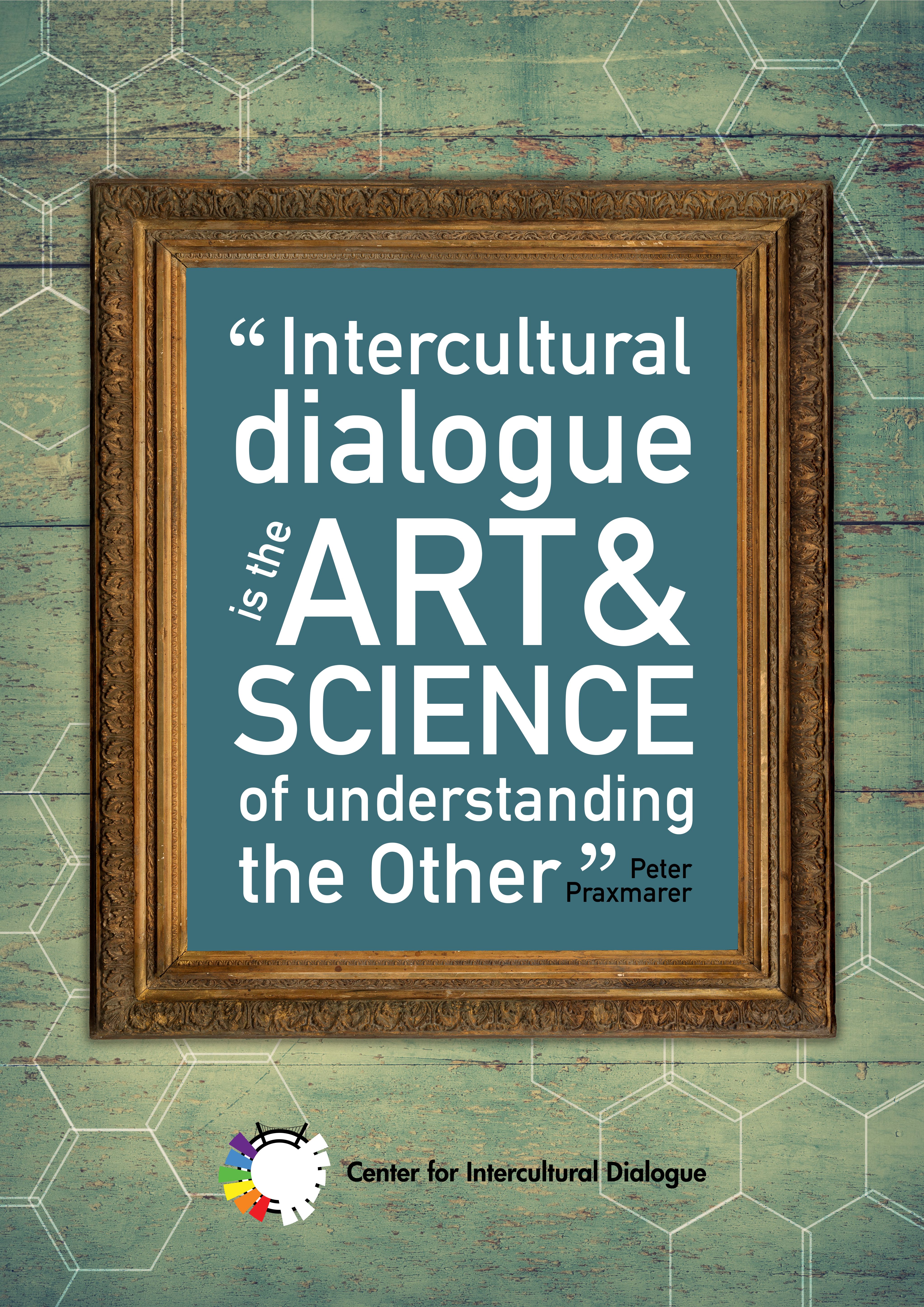
Intercultural Dialogue definition

Just in case anyone wants to cite this poster, the following would be the recommended format:

Center for Intercultural Dialogue. (2017). Intercultural Dialogue. CID Posters, 3. Available from:
https://centerforinterculturaldialogue.org/wp-content/uploads/2017/07/art-and-science.png

As with other series, CID Posters are available for free on the site; just click on the thumbnail to download a printable PDF. They may be downloaded, printed, and shared as is, without changes, without cost, so long as there is acknowledgment of the source.

As with other series, if you wish to contribute an original contribution, please send an email before starting any work to receive approval, to minimize inadvertent duplication, and to learn about technical requirements. As is the case with other CID Publications, posters should be created initially in English. Given that translations of the Key Concepts in Intercultural Dialogue have received so many views, anyone who wishes to translate their own poster into another language (or two) is invited to provide that as well. If you want to volunteer to translate someone else’s poster into a language in which you are fluent, send in a note before starting, to receive approval and to confirm no one else is working on the same one.

Wendy Leeds-Hurwitz
Director, Center for Intercultural Dialogue
intercult.dialogue AT gmail.com


Creative Commons License
This work is licensed under a Creative Commons Attribution-NonCommercial-NoDerivatives 4.0 International License.
U Penn: Global Communication Postdoc 2022 (USA)

PostdocsPostdoctoral fellowship, Center for Advanced Research in Global Communication, Annenberg School for Communication, University of Pennsylvania, Philadelphia, PA. Deadline extended: February 15, 2022.

The Center for Advanced Research in Global Communication (CARGC) produces and promotes scholarly research on global communication and public life. As an institute for advanced study dedicated to global media studies, they revisit enduring questions and engage pressing matters in geopolitics and communication. Our vision of “inclusive globalization” recognizes plurality and inequality in global media, politics, and culture. Their translocal approach fuses multidisciplinary “area studies” knowledge with theory and methodology in the humanities and social sciences. This synthesis of deep expertise and interdisciplinary inquiry stimulates critical conversations about entrenched and emerging communicative structures, practices, flows, and struggles. They explore new ways of understanding and explaining the world, including public scholarship, algorithmic culture, the arts, multi-modal scholarship, and digital archives. With a core commitment to the development of early career scholars worldwide, CARGC hosts postdoctoral, doctoral, undergraduate, and faculty fellows who collaborate in research groups, author CARGC Press publications, and organize talks, lectures, symposia, conferences, and summer institutes.

CFP ECREA 2022: Rethink Impact (Denmark)

ConferencesCall for papers:  9th European Communication Conference: Rethink Impact, 19-22 October 2022, Aarhus University, Aarhus, Denmark. Deadline: 17 January 2022.

The European Communication Research and Education Association (ECREA), the Department of Media and Journalism Studies at Aarhus University (AU) and the Danish School of Media and Journalism (DMJX) are happy to announce that the theme for the 9th European Communication Conference (ECC) will be “Rethink Impact.”

Impact raises fundamental questions on whether – or to what extent – university research and education should directly contribute to social, economic and political demands and be driven by agendas external to the academy. Is it possible to conduct critical research that is publicly funded? Are there models of academic collaboration with society that are not adequately described by current impact assessments? Are funders determining what impact research ought to have? Is there another way of doing impact, as impact ‘from below’, serving the needs of common spaces and grassroots communities? What is the impact of scholars working in the field of communication and external stakeholders, historically and in the present? Why is the long-term contribution of higher education often overlooked in impact discussions? What would an adequate assessment of impact look like in the field of media and communication research, respecting different work cultures, disciplinary orientations and methodologies?

By inviting researchers to ‘rethink impact’ the organisers are wishing to further discussions about both the more traditional ways of thinking about impact as well as some of the more subtle and long-term ways in which researchers and educators in media and communication make a difference contribute to society. Discussions about impact draw on different cultural, social and political histories and ambitions, dealing with contemporary funding and employment structures and incentives, as much as they relate to the place and recognition of scholarship in wider societal and global developments. Rethinking Impact raises fundamental questions about the identity and autonomy of media and communications researchers as an interdisciplinary field of research at the centre of current debates of societal transformation.

Jinhyun Cho Profile

ProfilesJinhyun Cho (Ph.D. Macquarie University, 2016) is a Senior Lecturer in the Department of Linguistics at Macquarie University in Sydney, Australia.

Jinhyun specializes in translation and interpreting and sociolinguistics with a focus on gender, intercultural communication, and language ideologies. Jinhyun’s research brings together interpreting and sociolinguistics to examine hitherto taken-for-granted cultural and linguistic phenomena through the unique prism of interpreters as social agents. By focusing on a shift in understanding away from the traditional mechanical view of interpreters as “translation machines” to a perspective which sees interpreters as social actors, she has been able to capture significant insights into the dynamics of dominant ideologies and societal power structures and their influences on linguistic and cultural practices in diverse socio-historical contexts.

Jinhyun has a particular passion for social justice, diversity and inclusion and currently serves on the editorial board of Multilingua.

Selected publications

Cho, J. (2022). Intercultural communication in interpreting: Power and choices. London, UK: Routledge, Taylor and Francis Group.

Cho, J. (2021). Constructing a white mask through English: The misrecognized self in Orientalism. International Journal of the Sociology of Language, 271, 17-34. https://doi.org/10.1515/ijsl-2020-0037

Cho, J. (2021). “That’s not how we speak”: Interpreting monolingual ideologies in courtrooms. Griffith Law Review, 1-21. https://doi.org/10.1080/10383441.2021.1932234

Cho, J. (2017). English language ideologies in Korea: Interpreting the past and present. Cham, Switzerland: Springer Nature.

Cho, J. (2017). Why do interpreters need to be beautiful? Aesthetic labour of language workers. Gender and Language, 11(4), 482-506. https://doi.org/10.1558/genl.31618


Work for CID:

Jinhyun Cho wrote the guest post Intercultural communication in interpreting: Power and choices.

Hope College: International/Intercultural Comm (USA)

“Job

Assistant Professor of International and Intercultural Communication, Hope College, Holland, Michigan, USA. Deadline: 10 January 2022.

The Department of Communication at Hope College seeks applicants for a tenure-track position at the level of assistant professor beginning fall 2022. The successful candidate will contribute to teaching and research in the area of international, intercultural, intergroup, and global communication. The area is one of the concentrations for the majors and minors in the department.

The successful candidate is expected to have a scholarly research program that examines international/intercultural communication from political, economic, interpersonal, organizational, and/or mediated perspectives. We are open to a variety of methodological approaches, including quantitative, qualitative, cultural, and rhetorical methods. Scholars who are experienced in collaborating with undergraduate students on research are encouraged to apply.

U Leeds: Intercultural Studies (UK)

“JobTwo positions as Lecturer in Intercultural Studies, School of Languages, Cultures and Societies, University of Leeds, England, UK. Deadline: 10 January 2022.

They have additional positions in Cultural and Media Studies; Film Studies; Sociology and Social Policy; Education; Politics and International Studies; Digital Humanities, and more, all as part of the same effort to hire new staff to fit their new goals in developing “a major, 10-year project to transform the educational experience of its students to ensure that regardless of their background all develop the knowledge and skills required for them to succeed and make a positive impact in the world. Partnership, excellence in student education, digital innovation, and shared endeavour by our community are key elements of the project.”

Taos Institute: Dialogic and Collaborative Practices in Challenging Times

Applied ICDDialogic and Collaborative Practices in Challenging Times, Taos Institute (Online), February 24-26, 2022 (3 hours/day).

Dialogic and Collaborative Practices in Challenging Times
February 24-26, 2022
12:00 – 3:00 pm EST (New York time)
3-day online seminar with Sheila McNamee and Harlene Anderson

In this intensive, 9-hour Zoom seminar spread over 3 days (3 hours each day), Harlene and Sheila will introduce, discuss, and provide opportunities to put constructionist theory to practice. Given the challenges we confront globally, discussion will center on exploring the practical implications of social construction while giving ample space for us to collaborate in an effort to put these ideas into practice. Special attention will be given to participants’ own projects and professional contexts. We will provide ample time for sharing and interacting.

This workshop will be useful for those familiar with social construction and relational practice as well as those new or unfamiliar with these ideas. This is an opportunity to be in conversation with others who are working in or who want to work in relational ways. It is a chance to forge connections that might help us sustain relational practices. Readings and other resource materials will be provided prior to the course.

CID Poster #2: Key Concepts as the World (reprise)

CID Posters(We are reprising the series of posters, because it has been several years since they were originally created, and they are much too wonderful to let them not be noticed by newcomers to the site!)

This is the second of the posters designed by Linda J. de Wit, then in her role as CID intern. This poster names all of the 81 Key Concepts in Intercultural Dialogue published to the site by the time this was created, bringing them together into a representation of the world.

Key Concepts poster

Just in case anyone wants to cite this poster, the following would be the recommended format:

Center for Intercultural Dialogue. (2017). Key Concepts in Intercultural Dialogue. CID Posters, 2. Available from:
https://centerforinterculturaldialogue.org/2017/07/07/cid-poster-2-key…pts-as-the-world/

As with other series, CID Posters are available for free on the site; just click on the thumbnail to download a printable PDF. They may be downloaded, printed, and shared as is, without changes, without cost, so long as there is acknowledgment of the source.

As with other series, if you wish to contribute an original contribution, please send an email before starting any work to receive approval, to minimize inadvertent duplication, and to learn about technical requirements. As is the case with other CID Publications, posters should be created initially in English. Given that translations of the Key Concepts in Intercultural Dialogue have received so many views, anyone who wishes to translate their own poster into another language (or two) is invited to provide that as well. If you want to volunteer to translate someone else’s poster into a language in which you are fluent, send in a note before starting, to receive approval and to confirm no one else is working on the same one.

Wendy Leeds-Hurwitz
Director, Center for Intercultural Dialogue
intercult.dialogue AT gmail.com


Creative Commons License
This work is licensed under a Creative Commons Attribution-NonCommercial-NoDerivatives 4.0 International License.

CFP Taiwan Studies in Application (USA)

Conferences

Call for proposals: NATSA: Taiwan Studies in Application, July 8-10, 2022, George Washington University, Washington, DC, USA. Deadline: 31 December 2021.

The North American Taiwan Studies Association (NATSA) invites proposals for their 27th annual conference, with the theme Taiwan Studies in Application. Both academics and practitioners are invited. They solicit submissions actively engaging with the following set of questions:

1. New directions in Taiwan studies
In what ways are Taiwan, science, practice, and politics connected in your profession(s)?
Anchored in Taiwan studies, what further work needs to be done to deepen meaningful connections between people and the planet?
How can your proposal contribute to future advancements or new perspectives in your profession(s)?
How will your research proposal facilitate productive dialogues or interactions between academics and practitioners in your profession(s)?

2. Marginalization in and of Taiwan studies
With the conference theme in mind, what topics are currently marginalized in Taiwan studies?
Why do researchers and practitioners need to pay attention to the topics you specify?
How can researchers and practitioners do more to address the marginalization of these topics?
How can Taiwan studies collaborate with other minorities across the globe?

3. Reflections on the binary between researchers and practitioners
How do researchers and practitioners interact with each other in your profession(s)?
How does the researcher-practitioner binary affect those works requiring both research skills and social activism in your profession(s)?
What are some structural factors that shape and reinforce the researcher-practitioner binary?
How do you make sense of your own positionality and identity amidst the dynamics mentioned above?
What does it mean to you to engage with Taiwan in your profession(s)?

KC77 Negotiation Translated into Arabic

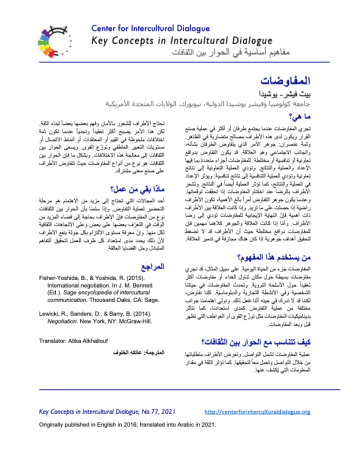
Key Concepts in ICDContinuing translations of Key Concepts in Intercultural Dialogue, today I am posting KC77: Negotiation, which Beth Fisher-Yoshida wrote for publication in English in 2016, and which Atika Alkhallouf has now translated into Arabic.

As always, all Key Concepts are available as free PDFs; just click on the thumbnail to download. Lists of Key Concepts organized chronologically by publication date and number, alphabetically by concept, and by languages into which they have been translated, are available, as is a page of acknowledgments with the names of all authors, translators, and reviewers.KC77 Negltiation_ArabicFisher-Yoshida, B. (2021). Negotiation [Arabic]. (A. Alkhallouf, Trans). Key Concepts in Intercultural Dialogue, 77. Retrieved from:
https://centerforinterculturaldialogue.org/wp-content/uploads/2021/12/kc77-negotiation_arabic.pdf

If you are interested in translating one of the Key Concepts, please contact me for approval first because dozens are currently in process. As always, if there is a concept you think should be written up as one of the Key Concepts, whether in English or any other language, propose it. If you are new to CID, please provide a brief resume. This opportunity is open to masters students and above, on the assumption that some familiarity with academic conventions generally, and discussion of intercultural dialogue specifically, are useful.

Wendy Leeds-Hurwitz, Director
Center for Intercultural Dialogue


Creative Commons License
This work is licensed under a Creative Commons Attribution-NonCommercial-NoDerivatives 4.0 International License.