Using Sports to Start Intercultural Dialogues

Applied ICD

Within the framework of the Sport for One Humanity initiative, established by Turkish Airlines and supported by the United Nations Alliance of Civilizations (UNAOC), the representatives of selected civil society organizations working on grassroots sport-based projects participated in a five-day capacity building workshop in Madrid, Spain.

By supporting innovative sports-based interventions that foster a culture of peace, mutual understanding, and cooperation, ‘Sport for One Humanity’ affirms the need for intercultural dialogue and diversity in developing solutions to global challenges.

Representing organizations based in Cameroon, India, Kenya, the Republic of North Macedonia, Mexico, the Philippines, Uganda, and Vietnam, the participants were selected from among 600 applications from 83 countries following an intensive competitive process. The series of trainings focused on a diverse range of topics to bolster the organizations’ capacities and enhance their impact, including project design and implementation, monitoring and evaluation, communications and advocacy, as well as resource mobilization, partnerships, and fundraising.

UNAOC Youth Solidarity Fund 2023

Grants
Youth Solidarity Fund, United Nations Alliance of Civilizations, New York, NY, USA. Deadline: 14 May 2023.

Through a competitive evaluation process, Youth Solidarity Fund (YSF) will award seed funding of up to USD 25,000 for the implementation of outstanding and impactful projects that use intercultural and interfaith dialogue and are aligned with the mandate and mission of UNAOC.  The YSF only supports projects that are entirely developed and managed by youth, for the benefit of the whole society, especially youth. The YSF supports youth-led organizations that foster peaceful and inclusive societies. UNAOC additionally offers capacity-building support to help youth-led organizations strengthen the implementation of their projects.

The age definition used by UNAOC to characterize youth is an individual between the ages of 18 and 35. While the projects target mainly young people, they have an impact on entire communities, often involving religious or political leaders, policy-makers, educational institutions and media organizations.

Cosmopolitanism in a Postdigital, Postmigrant Europe, and Beyond (Germany but Online)

ConferencesInvitation to participate in Cosmopolitanism in a Postdigital, Postmigrant Europe, and Beyond, Researching Digital Interculturality Co-operatively (ReDICo), 27 June – 7 July 2023, Germany but online.

In this upcoming conference, participants are invited to engage with the undeniable fact that migration and digitalization are deeply intertwined with our daily reality and have greatly left their mark on society and influenced perspectives on cosmopolitanism. Organizers are looking forward to a lively discussion. Among others, Prof. emer. Gerard Delanty (University of Sussex) and Prof. Naika Foroutan (DeZIM Berlin) have confirmed their participation. The planned program can be found here; that document will be regularly updated, and additional information added to the folder. The conference will take place on Zoom and is free of charge. The conference language is English. Registration is possible from now on until the day of the event via email. Please use “Registration” as the subject line.

IGNM: Ensembles & Composers Exchange Project (Austria/Slovenia)

“Collaborative

Call for Scores: Ensembles & Composers Exchange Project, Internationale Gesellschaft für Neue Musik (IGNM), Vienna, Austria. Deadline: 15 May 2023.

The focus of the project is the artistic exchange between Slovenian and Austrian composers as well as international composers living in Austria and Slovenia of younger generation. Two young ensembles from both countries are invited to take part in the project – between feathers (AT) and Trio Tempestoso (SI). The project aims to promote young talents and strengthen intercultural dialogue.

Conditions: Slovenian and Austrian composers as well as composers of other nationalities living in Slovenia and Austria are invited to submit their existing works for any combination (from duo to septet) of the following instruments: flute, clarinet, percussion, 2 x accordion, voice, violoncello. Applying composers must be born in 1988 or younger.


KC105 Acculturation Translated into Turkish

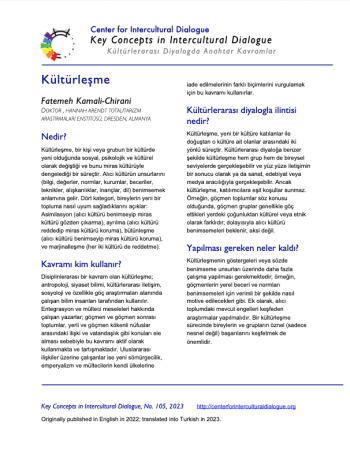
Key Concepts in ICDContinuing translations of Key Concepts in Intercultural Dialogue, today I am posting KC105: Acculturation, which Fatemeh Kamali-Chirani wrote for publication last year, and which İçten Duygu Özbek has now translated into Turkish.

As always, all Key Concepts are available as free PDFs; just click on the thumbnail to download. Lists organized chronologically by publication date and numberalphabetically by concept in English, and by languages into which they have been translated, are available, as is a page of acknowledgments with the names of all authors, translators, and reviewers.

KC105 Acculturation_TurkishKamali-Chirani, F. (2023). Acculturation [Turkish] (İ. D. Özbek, Trans.). Key Concepts in Intercultural Dialogue, 105. Available from: https://centerforinterculturaldialogue.org/wp-content/uploads/2023/04/kc105-acculturation_turkish.pdf

The Center for Intercultural Dialogue publishes a series of short briefs describing Key Concepts in Intercultural Dialogue. Different people, working in different countries and disciplines, use different vocabulary to describe their interests, yet these terms overlap. Our goal is to provide some of the assumptions and history attached to each concept for those unfamiliar with it. As there are other concepts you would like to see included, send an email to the series editor, Wendy Leeds-Hurwitz. If there are concepts you would like to prepare, provide a brief explanation of why you think the concept is central to the study of intercultural dialogue, and why you are the obvious person to write up that concept.


Creative Commons License
This work is licensed under a Creative Commons Attribution-NonCommercial-NoDerivatives 4.0 International License.

U Ca’ Foscari: Sociology of Culture & Communication (Italy)

“JobNontenured Assistant Professor of Sociology of Culture and Communication, Università Ca’ Foscari, Venice, Italy. Deadline: 27 April 2023.

Ca’ Foscari is looking for a researcher of Sociology of Culture and Communication, capable of inspiring students to become game-changers in their own fields and to make a genuine difference in the world. The researcher will contribute to the I-CLAIM project “Improving the Living and Labour Conditions of Irregularized Migrant Households in Europe”.

The researcher will conduct the following activities:

    • a study on the living and working conditions that characterize irregular and precarious migrant labor in the area of domestic and agricultural work in Italy;

    • a study on the legislative and policy framework that contributes to the conditions of irregularity and exploitation of migrant people in Italy;

    • and a collaboration with national stakeholders in the production of innovative policy proposals for this area.

A didactic commitment of the researcher is also expected for teaching “Sociological Theories I”.

This position is at the Department of Philosophy and Cultural Heritage, whose aim is to provide students with the knowledge to develop those interpretive, critical, analytical and communication skills that are necessary to understand and navigate the complexities of life in the 21st century.


UNESCO: Programme Specialist in Education (France)

“JobProgramme Specialist in Education, UNESCO, Paris, France. Deadline: 28 April 2023.

Under the overall authority of the Assistant Director-General for Education and the direct supervision of the Director of the Future of Learning and Innovation team, the incumbent will be responsible for the Education Research and Foresight programme. Serving as a think tank to reimagine education and leverage knowledge for just and sustainable futures, the Future of Learning and Innovation team comprises three strands of work:

(1) Education research and foresight which aims to shape global policy debate on the future of education;

(2) Technologies and learning which aims to steer human-centered digital transformations in education, and

(3) Knowledge and innovation which aims to encourage interdisciplinary research through university networks.

The incumbent will lead the Education, Research and Foresight programme in close cooperation with the Division’s other two strands of work. Building on a continuous review of research production, an analysis of both global education policy and emerging megatrends, as well as consultations with various constituencies, the Education research and foresight programme reinforces UNESCO’s observatory function in education. Through more synergetic research and foresight, the programme activities aim to strengthen UNESCO’s capacity to guide, inform and lead the global debate on the future of education.

Australian National U: Human Migrational & Mobility (Australia)

“JobResearch Fellow, Human Migration and Mobility, The Migration Hub, Australian National University, Canberra, Australia. Deadline: 23 April 2023.

They are seeking a Research Fellow to make research, teaching and service contributions to the School, College and University, particularly in relation to Professor Alan Gamlen’s four-year Future Fellowship research program, and to help drive the establishment of the Migration Hub. The Future Fellowship program is entitled ‘Mobility Shocks’, and focuses on the disruptions to human migration and mobility caused by the Covid-19 Pandemic.

This role will work closely with Professor Gamlen and the Hub team. You will be responsible for compiling the latest Australian migration data from a range of sources and analysing it using cutting-edge statistical and computational research methods, as well as developing geospational data visualisation tools to make the findings of the ‘Mobility Shocks’ project accessible and interpretable for a range of audiences. You will coordinate an annual course on migration, including all teaching, assessment and student support responsibilities.

Facilitated Dialogue: An Emerging Field of Museum Practice

Applied ICD

Foteini Venieri. (25 February 2022). Facilitated dialogue: An emerging field of museum practiceEXARC, 2022/1.

Overall, the data collected showed that the project highlighted the importance of intercultural coexistence and communication.

In 2020, Barbara Kirshenblatt-Gimblett argued that a museum should be understood as a forum rather than a temple (in Badior, 2020). Venieri takes this as a starting point, and studied ways in which several types of museums could serve to facilitate dialogue. She found that “Recently, science and history museums are initiating facilitated dialogue-based programming to address a variety of present-day issues that affect society at large and/or local communities. As the field of facilitated dialogue-based programmes develops, questions around the aims, techniques, and challenges of such initiatives in museums emerge. This paper explores the theory and practice of facilitated dialogue in science, and history museums as well as its implications for the museum field.”

Badior, Daria. (14 July 2020). Barbara Kirshenblatt-Gimblett: “A 21st century museum is a forum not a temple”. LB.ua.

CIDOB: Programa Talent Global 2023 (Spain)

Fellowships

Programa Talent Global Junior Visiting Fellowships, Barcelona Centre for International Affairs (CIDOB), Barcelona, Spain. Deadline: 30 June 2023.

The Banco Sabadell Foundation and CIDOB (Barcelona Center for International Affairs) launch the third edition of the Programa Talent Global with the aim of promoting quality research by young researchers, through a paid research stay and two awards for applied research. The “Junior Visiting Fellowship” seeks a young researcher of up to 30 years old who has demonstrated their research capacities to join CIDOB’s research team for a six-month paid research stay.

Themes
– Technological revolutions and their impact on international relations
– Challenges in sustainable development, climate change and global inequality
– New global geopolitical dynamics
– Geoeconomics and trade relations
– Gender and international relations