Gustolab International 3 Job Ads (Italy)

Gustolab International Institute for Food Studies is growing internationally with two new programs in Vietnam and Japan and is expanding its staff with three new positions.

To apply, please send your CV along with a cover letter to Sonia Massari by December 5, 2016.
The email’s subject should be: ‘Open positions 2017’.

Position 1: Wellness and Safety advisor (in Rome, Italy)
Please note that this position requires 4 hours/week in the office and 24/7 availability by phone to troubleshoot emergencies.
This position will start in January 2017.

Required qualifications:
Preferred BA, but currently enrolled graduate students are welcome.
Fluency in the English and Italian languages.
Italian cultural fluency.
Be outgoing, dynamic, flexible.
Excellent knowledge and familiarity of the city of Rome.
EU citizen or in possession of Italian working papers.

Position 2: Study Abroad, Operational Manager (Italy)
Position 3: Study Abroad activities coordinator (Italy)
These positions will start in the spring or summer of 2017

Required qualifications:
Preferred MA (international studies, international affairs, education, foreign language) and undergraduate teaching experience. PhD degree and research experience is a plus.
Language fluency in English and Italian (knowledge of the Japanese or Spanish language is a plus).
Italian cultural fluency.
Basic accounting knowledge preferred.
Experience with overseas study programs (study abroad programs).
Excellent computer skills (especially Word, Excel, web platforms).
In-depth understanding of the US academic world such as learning objectives and outcomes, requirements, grading system, and assessments.
Excellent communication and problem solving skills, strong work ethic, interpersonal and customer service skills.
Outgoing, dynamic, flexible.
EU citizen or in possession of Italian working papers

Patrick Shaou-Whea Dodge Profile

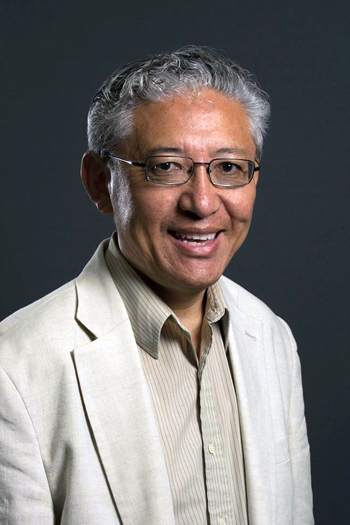
ProfilesPatrick Shaou-Whea Dodge is an Associate Professor Clinical Track and past Associate Program Chair at the University of Colorado Denver’s International College in Beijing.

Patrick Dodge He was a member of the NCA’s Task Force to Foster International Collaborations in the Age of Globalization and worked with the Communication University of China to co-organize the 2016 and 2018 NCA-CUC co-sponsored biennial conferences on, “Communication, Media, and Governance in the Age of Globalization.” In 2019 he worked with Shenzhen University (SZU) to co-organize the NCA-SZU 2019 Shenzhen Forum on “Communication Innovation, New Media, and Digital Journalism.”

His research interests include culture and communication, intercultural communication, and transcultural understanding, driven by a desire for more U.S.-China cross-cultural alliances.  His current research on “China/Chinese Dream” discourse has led to extensive travel throughout China in search of “harmony” and “dreams.” His work has been published in journals such as the Chinese Journal of Communication, the Journal of International & Intercultural Communication, Intercultural Communication Studies, and Women & Language.

Patrick was the 2018 inaugural fellow for the NCA-CUC Visiting Fellows Program for Communication and Media Research. He is also the 2018-2020 Association for Chinese Communication Studies’ (ACCS) Vice-President Elect, and will serve as the ACCS President in 2021-2023.

Patrick has taught Communication courses in Beijing since 2007. His mixed ethnic background (Chinese/Taiwanese-American and European-American) has fueled his passion to learn more about China, Chinese culture and communication, and Sino-U.S. communication in the age of globalization.

Selected Publications:

Dodge, P. S-W. (Forthcoming: 2020). Communication Convergence in Contemporary China: International Perspectives on Politics, Platforms, & Participation. Editor of monograph for publication in English and Chinese (Michigan State University Press & Communication University of China Press). The monograph consists of edited essays first presented at the 2016 CUC-NCA Summer Conference on “Communication, Media, and Governance in the Age of Globalization,” Beijing, China.

Hartnett, S. J., Dodge, P. S-W., & Keränen, L. (2019) “Postcolonial Remembering in Taiwan: 228 and Transitional Justice as “The End of Fear.”” Journal of International & Intercultural Communication. DOI: 10.1080/17513057.2019.1614206

Dodge, P. S-W. & Keränen, L. (2018) “Sixty Years of “Peaceful Liberation” at the Tibet Museum in Lhasa: Triumphant Modernization at the Rooftop of the World.” Chinese Journal of Communication. Volume 11, Issue 3. DOI: 10.1080/17544750.2018.1470543

Dodge, P. S.-W. (2017). Contesting the façade of harmony through art and the Internet in China. In S. Hartnett, L. Keränen, & D. Conley (Eds.), Imagining China: Rhetorics of nationalism in the age of globalization. Ann Arbor: Michigan State University Press.

Bean, H. & Dodge, P. S-W (2017). “Reconfiguring Public Relations with China.” Public Relations Inquiry, 6: 1, 99-114.

Ng, P. L. & Dodge, P. S-W (2015) . “Situating English as a Lingua Franca in Context: Narratives From Japanese and Chinese Classrooms.” Intercultural Communication Studies. 24: 3, 50-64.

Keränen, L., Dodge, P. S.-W., & Conley, D. (2015). Modernizing traditions on the roof of the world: Displaying ‘liberation’ and ‘occupation’ in three Tibet museums. Journal of Curatorial Studies, 4(1), 78-106.

Dodge, P. S.-W. (2014). Finding “the line” in Beijing: Classrooms as liminal space. In P. Ng & E. Boucher (Eds.), Local contextual influences on teaching: Narrative insights from ESL/EFL professionals. Newcastle upon Tyne: Cambridge Scholars.

Dodge, P. S.-W., & Suter, E. A. (2008). It’s okay to have a girl: Patronymy and China’s one child policy. Women and Language, 31, 1, 13-22.

Key Concept #5: Intercultural Communication Translated into Spanish

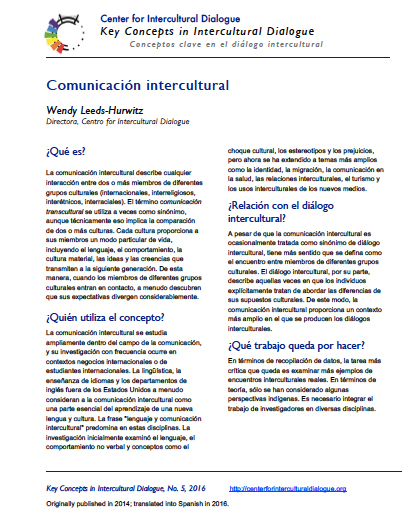
Key Concepts in ICDContinuing translations of Key Concepts in Intercultural Dialogue, today I am posting KC5: Intercultural Communication, which I wrote and first published in English in 2014, and which Shirley Saenz has now translated into Spanish.

As always, all Key Concepts are available as free PDFs; just click on the thumbnail to download. Lists of Key Concepts organized chronologically by publication date and number, alphabetically by concept, and by languages into which they have been translated, are available, as is a page of acknowledgments with the names of all authors, translators, and reviewers.

KC5 Intercultural Communication_SpanishLeeds-Hurwitz, W. (2016). Comunicación intercultural. (S. Saenz, trans). Key Concepts in Intercultural Dialogue, 5. Available from:
https://centerforinterculturaldialogue.org/wp-content/uploads/2016/11/kc5-intercultural-communication_spanish.pdf

If you are interested in translating one of the Key Concepts, please contact me for approval first because dozens are currently in process. As always, if there is a concept you think should be written up as one of the Key Concepts, whether in English or any other language, propose it. If you are new to CID, please provide a brief resume. This opportunity is open to masters students and above, on the assumption that some familiarity with academic conventions generally, and discussion of intercultural dialogue specifically, are useful.

Wendy Leeds-Hurwitz, Director
Center for Intercultural Dialogue


Creative Commons License
This work is licensed under a Creative Commons Attribution-NonCommercial-NoDerivatives 4.0 International License.

Save

Masters in Intercultural Communication at USI (Switzerland)

Applications invited for the 8th edition of the Master of Advanced Studies in Intercultural Communication (MIC) offered by the University of Italian Switzerland (USI) in Lugano. MIC is a part-time postgraduate program for professionals engaged in managing operational or strategic situations in a multicultural context and in managing multicultural human resources. The Master is organized in 9 intensive weeks of courses spread 6 to 8 weeks apart from March 2017 to September 2018 in order to allow participants to pursue their professional activity:
· 6 weeks of classes will be held at USI’s Executive Center in Lugano;
·       1 week of classes will be held at Université Sidi Mohamed Ben Abdellah in Fès, Morocco;
·       1 week of classes will take place in Lausanne, at the Swiss Institute for Comparative Law (ISDC). This will include visits to selected Swiss federal institutions in Bern and international organizations in Geneva;
·       1 week of courses will take place at Kasetsart University in Bangkok, Thailand.

The deadline for applications is December 31, 2016. There is a limited number of scholarships available. The official language of the Masters is English.

For information about pre-requisites, admission and fees, and a brochure, candidates can visit the MIC website.

Roskilde U 2 Job Ads (Denmark)

Position 1:
The Department of Communication and Arts (DCA), Roskilde University, invites applications for a position as Professor with Special Responsibilities (MSO) of Communication from 1 March 2017 or as soon as possible thereafter. The position as professor (MSO) is limited to a period of 5 years.

The Department of Communication and Arts is an innovative and interdisciplinary university environment, characterised by diversity with respect to theory, method and area of study in research and education. The department produces knowledge that contributes to critical research and reflexive practice in relation to development and change in society, including public institutions, private organizations, NGOs, and cultural and media institutions. In Communication Studies, research and teaching cover a plurarity of theoretical traditions (for example, sociocultural, critical, rhetorical,  phenomenological and pragmatic traditions) and empirical areas of study (for example, dialogic and participatory, digital, intercultural, organizational, political, science, strategic and visual communication).

For this position, we invite outstanding candidates, with demonstrated research excellence, and a proven commitment to developing and applying critical ways to theorise and empirically research one of the following two areas:
*Intercultural Communication
*Organisational Communication

Responsibilities and tasks, Qualifications, and Assessment:
See Further particulars below
Only applications in English are accepted.
Questions: For further information about the position, please contact Head of Studies Ib Tunby, ibtunby[at]ruc.dk.

Terms of employment:
The position will be filled according to the Agreement between the Danish Ministry of Finance and the Danish Confederation of Professional Associations (AC). The position is covered by the Protocol on Job Structure.

Commencing salary will be for professor (MSO) minimum DKK 534.788 per year (1st April 2016 level) plus pension contribution (17,1 %).

The professorship with special responsibilities (MSO) is a category where the appointment is limited to a -year period. On the expiry of the professorship period, the appointee is ensured employment and remuneration as an associate professor.

Read more about the recruitment process at Roskilde University here.

Application:
To apply for the position go to RUCs homepage: www.ruc.dk/en/job/vip/.  Please open the relevant job advertisement and click on the button “Apply for vacancy here”, which is found below the job advertisement.

Applications must include:
*Cover letter
*CV with documentation of education.
*Teaching portfolio (read more about teaching portfolio at Roskilde University here.)
*A complete list of publications.
*Co-author declaration.
*A maximum of 7 relevant scientific works that you want included in the assessment.
*A brief description (2-3 pages of your plans for development of the academic field in regard to both research and education, including a short description of how you view your qualifications in relation.
*A short description stating your most important scientific work relevant to the position and your contribution to such work (2-3 A4 pages)
*Documentation of additional research qualifications, including
–    experience in research management or other managerial functions
–    track record in fundraising

Please submit your application no later than 1 December, 2016. Material received after this date will not be taken into consideration.

Roskilde University welcomes applications from suitably qualified candidates regardless of age, gender, race, religion or ethnic background.

Click here for Further Particulars

***

Position 2
The Department of Communication and Arts (DCA), Roskilde University, invites applications for a position as Professor of Strategic Communication from 1 March 2017, or as soon as possible thereafter.

For this position, we invite outstanding candidates in the field of strategic communication within the wider field of communication and organisation studies. Applicants should have a track record of research excellence and a commitment to the development of critical ways of theorising and empirically researching relations between media and communication technologies and the social world, with a focus on strategic communication challenges faced by organisations, including public institutions, private businesses, governments, NGOs, and campaign/ad hoc organisations.

CFP Rhetoric and Peace Studies

Call for Papers for volume 10, n° 1(19)/ 2017
ESSACHESS – Journal for Communication Studies

Rhetoric and Peace at Crossroads: Public and Civic Discourse, Culture and Communication Perspectives

Guest editors:
Dr. Noemi Marin, Professor, School of Communication and Multimedia Studies, Florida Atlantic University, USA (nmarin@fau.edu)

Dr. Lara  Martin Lengel, Department of Communication, School of Media and Communication,  Bowling Green State University, USA (lengell@bgsu.edu)

This special issue examines rhetorical and/or cultural-critical perspectives on peace, non-violence, and the role of civic discourse in contemporary times. The issue intends to cover scholarship that focuses mainly on the last 30 years, including the historic period following 1989 that created a democratization of discourse throughout the world, yet engaged even more peace and conflict as paradigmatic perspectives on migration, terrorism, communism, and political and social change. Accordingly, some areas of scholarship pertinent to this special issue are: geopolitics and discourse of peace; historical public arguments for non-violence; theoretical approaches to communication and conflict as cultures of peace; migration and its peace-related consequences in the 21st century; nationalism as cultural or political paradigm of national identity; international contexts for rhetoric of peace, to name a few. Of note that this issue intends to present an interdisciplinary set of scholarly articles open to all disciplines such as but not limited to political communication, rhetorical studies, intercultural and/or international communication, and peace and conflict studies.

Important Deadlines
December 20, 2016: submission of the proposal in the form of an abstract of maximum 2 pages. The proposal must include a list of recent references;
January 5, 2017: acceptance of the proposal;
April 30, 2017: full paper submission;
June 15, 2017: full paper acceptance.

Full papers should be between 6,000-8,000 words in length. Papers can be submitted in English or French. The abstracts should be in English and French, max. 2 pages followed by 5 keywords. Please provide the full names, affiliations, and e-mail addresses of all authors, indicating the contact author. Papers, and any queries, should be sent to: ESSACHESS.

Authors of the accepted papers will be notified by e-mail. The journal will be published in July 2017.

Key Concept #3: Intercultural Competence Translated into Spanish

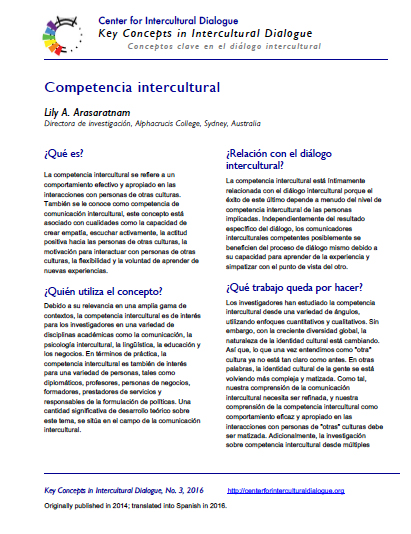
Key Concepts in ICDContinuing with translations of the Key Concepts in Intercultural Dialogue, today I am posting  KC3: Intercultural Competence, which Lily A. Arasaratnam wrote and first published in English in 2014, which Shirley Saenz has now translated into Spanish. As always, all Key Concepts are available as free PDFs; just click on the thumbnail to download. Lists of Key Concepts organized chronologically by publication date and number, alphabetically by concept, and by languages into which they have been translated, are available, as is a page of acknowledgments with the names of all authors, translators, and reviewers.

KC3 Intercultural Competence_SpanishArasaratnam, L. (2016). Competencia intercultural. (S. Saenz, Trans). Key Concepts in Intercultural Dialogue, 3. Available from:
https://centerforinterculturaldialogue.org/wp-content/uploads/2016/11/kc3-intercultural-competence_spanish.pdf

If you are interested in translating one of the Key Concepts, please contact me for approval first because dozens are currently in process. As always, if there is a concept you think should be written up as one of the Key Concepts, whether in English or any other language, propose it. If you are new to CID, please provide a brief resume. This opportunity is open to masters students and above, on the assumption that some familiarity with academic conventions generally, and discussion of intercultural dialogue specifically, are useful.

Wendy Leeds-Hurwitz, Director
Center for Intercultural Dialogue


Creative Commons License
This work is licensed under a Creative Commons Attribution-NonCommercial-NoDerivatives 4.0 International License.

National Communication Association 2016

This slideshow requires JavaScript.

I participated in the National Communication Association convention in Philadelphia, November 10-13, 2016. I was a panelist for ‘Catching Ourselves in the Act’ Revisited: Taking Stock of the Past(s) and Future(s) of Communication Social Construction. The panel chair was Patricia Covarrubias; other panelists were Brenda Allen, Kevin Barge, Theresa Castor, Gloria Galanes, and Liliana Castañeda de Rossmann – pictured in the slideshow on my right. We discussed what has happened in the 10 years since the ‘Catching Ourselves in the Act’ conference on social construction theory, held in Albuquerque, NM. That event used an uncommon design, and was one of the influences on the format of the NCA Summer Conference on Intercultural Dialogue in Istanbul in 2009, the event which led to the creation of this Center for Intercultural Dialogue.

This conference was replete with such echoes of past events. I saw several of those who were at that Istanbul conference (including Erla S. Kristjánsdóttir – in the slideshow on my left, Jolanta Drzwiecka, and Eddah Mutua), or at the Macau Roundtable on Intercultural Dialogue in Asia (Todd Sandel, Sunny Lie, and Richard Buttny). Villanova University held a social event for past, present, and future Harron Chairs, and as their 2013 chair, I was invited, and got to see many of my colleagues from that campus (including Maurice Hall, Sherry Bowen, Heidi Rose, and Bryan Crable) as well as Marianela Nunez, who has managed to turn her MA thesis into a full-time job! I also caught up with several of CID’s advisory board members (Donal Carbaugh and Todd Sandel again), and saw many scholars who have researcher profiles on this site (John Baldwin, Yea-Wen Chen, Sara DeTurk, Gonen Dori-Hacohen, Tenzin Dorjee, Don Ellis, Beth Haslett, Ron Jackson, Trudy Milburn, Bob Shuter, Miriam Sobre-Denton, and Yael Warshel among them). One of the results of my conversations is that additional scholars have agreed to write new Key Concepts in Intercultural Dialogue, or translate those already published in English, and these will start appearing over the next few months. Another result came out of discussion at the International and Intercultural Communication Division business meeting, and will result in a new series for CID – details to be announced shortly.

On the way from Vermont to Philadelphia, I stopped in New York to connect with Casey Man Kong Lum, and was given a guided tour of Chinatown, with a focus on food (he just co-edited Urban foodways and communication: Ethnographic studies in intangible cultural food heritages around the world, a book for which I wrote a chapter). In addition, he recently worked with the Museum of Food and Drink (MOFAD) on a project called MOFAD City, contributing to a filmed tour of Manhattan’s Chinatown (clip shown above). While in New York, I finally saw Spanish architect Santiago Calatrava’s Oculus, the new transit hub at the World Trade Center, so a photo of that is provided in the slide show as well (a world tour planned around visits to Calatrava buildings would be a joy, given their beauty – I’ve already seen his work in Lyon, Lisbon, Dublin, Liège, Buenos Aires, Tenerife, and of course, my former home of Milwaukee). Given the emphasis on food as a form of communication in New York, it was easy to maintain that focus to find excellent multicultural restaurants in Philadelphia, and I enjoyed Afghani, Cuban, Indian, Japanese-French fusion, and Thai meals during my stay.

Wendy Leeds-Hurwitz, Director
Center for Intercultural Dialogue


Tenzin Dorjee Profile

ProfilesTenzin Dorjee (Ph.D., University of California, Santa Barbara) is Associate Professor at the Department of Human Communication Studies, California State University, Fullerton (CSUF). His primary teaching and research interests are in intergroup, intercultural, intergenerational communication, identity issues, peace building, and conflict resolution.
Tenzin Dorjee photo

He has authored and co-authored  peer-reviewed articles and chapters on Tibetan culture, identity, and communication, nonviolence and middle way approaches to Sino-Tibetan conflict, intergenerational communication context, and others. He was awarded Faculty Teacher-Scholar Award in 2011, Faculty Scholarly and Creative Activity in 2013, Annual Author Award in 2014, Faculty Recognition Service: Extraordinary and Sustained Service in 2015, and Faculty Scholarly and Creative Activity in 2016  by CSU Fullerton.  He is also a published author of articles and translated works of Tibetan Buddhism and culture into English.  He worked as a translator at the Library of Tibetan Works and Archives, Dharamsala, India, for over 13 years.  He is also a published author of articles and  translated works of Tibetan Buddhism and culture into English. He had the honor to translate for many pre-eminent Tibetan Buddhist Professors including His Holiness the Dalai Lama in India and North America. He is a former  Member-At –Large in the Executive Council of the Western States Communication Association (WSCA), Chair of WSCA’s Distinguished Teaching Award Committee, Basic Course Director of the Department of Human Communication Studies, CSUF, and Vice President and President of the Tibetan  Association of Southern California. He has served on the Dalai Lama Trust Graduate Scholarship Selection Committee and Restorative Schools Vision Project, Sacramento.  In the summer of 2013, he volunteered over two months at the Office of His Holiness the Dalai Lama in Dharamsala and in the summer of 2016, he volunteered teaching intercultural communication, teaching pedagogy, and research methodology at the College for Higher Tibetan Studies, Sarah, India, and the Dalai Lama Institute for Higher Education, Bengaluru, India.. During his summer sojourns in India, he also gave series of invited talks on a wide range of intercultural themes such as such as Tibetan culture and  identity,  and , translation  methodology at many Tibetan institutions including the Tibet Policy Institute, Central Tibetan Administration Staff, Library of Tibetan Works and Archives,  Institute of Buddhist Dialectics,  and Tibetan Astro-Medical College, Dharamsala, India.

Selected publications:

Dorjee, T. (2015)  Communication accommodation theory. In J. Bennett, The Sage encyclopedia of intercultural competence (pp. 103-107). Thousand Oaks, CA: Sage.

Dorjee, T. (2015)  Identity and  intergroup communication. In J. Bennett, The Sage encyclopedia of intercultural competence (pp. 410-414). Thousand Oaks, CA: Sage.

Dorjee, T. (2005). Transmitting cultural identity from generation to generation in Tibetan diaspora. In W. Leeds-Hurwitz (Ed.), From generation to generation: Maintaining cultural identity over time (pp. 227-253). Cresskill, NJ: Hampton Press.

Key Concept #5: Intercultural Communication Translated into Persian

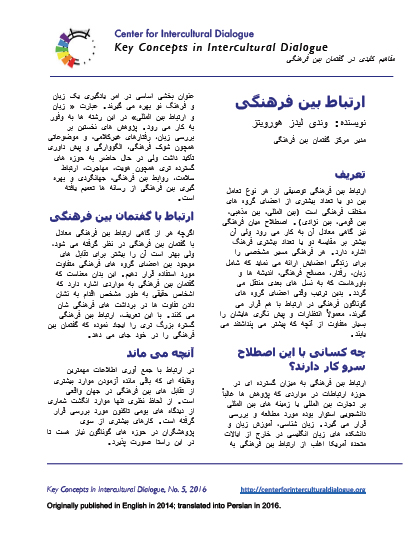
Key Concepts in ICDContinuing translations of Key Concepts in Intercultural Dialogue, today I am posting KC5: Intercultural Communication, which I wrote and first published in English in 2014, which Ramin Hajianfard has now translated into Persian.

As always, all Key Concepts are available as free PDFs; just click on the thumbnail to download. Lists of Key Concepts organized chronologically by publication date and number, alphabetically by concept, and by languages into which they have been translated, are available, as is a page of acknowledgments with the names of all authors, translators, and reviewers.

KC5: ICC__PersianLeeds-Hurwitz, W. (2016). Intercultural communication [Persian]. (R. Hajianfard, Trans). Key Concepts in Intercultural Dialogue, 5. Available from:
https://centerforinterculturaldialogue.org/wp-content/uploads/2018/08/kc5-icc_persian-revised.pdf

If you are interested in translating one of the Key Concepts, please contact me for approval first because dozens are currently in process. As always, if there is a concept you think should be written up as one of the Key Concepts, whether in English or any other language, propose it. If you are new to CID, please provide a brief resume. This opportunity is open to masters students and above, on the assumption that some familiarity with academic conventions generally, and discussion of intercultural dialogue specifically, are useful.

Wendy Leeds-Hurwitz, Director
Center for Intercultural Dialogue


Creative Commons License
This work is licensed under a Creative Commons Attribution-NonCommercial-NoDerivatives 4.0 International License.