
Harron Chair @ Villanova U for 2017

The Fall 2017 Harron Family Endowed Chair in Communication at Villanova University

The Department of Communication at Villanova University invites applications for the annual Harron Family Endowed Chair in Communication. The Department seeks a senior colleague whose scholarship, regardless of specialization or methodological orientation, has made a significant contribution to the discipline of Communication. This visiting, one-semester appointment is for the Fall of 2017. University-sponsored housing will be provided for the duration of the appointment. The responsibilities of the position include teaching one undergraduate and one graduate course related to his/her area of expertise, delivering a lecture to the Villanova community during the semester in residence, and mentoring faculty and students in the Communication Department. In addition to the salary generated by the Endowment and University-sponsored housing, The Harron Family Endowed Chair in Communication is eligible to receive graduate assistant support and to apply for a grant of up to $10,000 from the Waterhouse Family Institute for the Study of Communication and Society. This visiting position may be used to supplement sabbatical leave, but the Department encourages all interested, qualified candidates to apply.

THE CURRENT HARRON CHAIR
This year, the Department of Communication at Villanova University welcomed Dr. Bruce Henderson as the 2016 Harron Family Endowed Chair in Communication.

APPLICATION PROCESS
To be considered for The Harron Family Chair, applicants should hold the rank of Associate or Full Professor of Communication or a closely related field, and have a national/international reputation for distinguished scholarship. In addition to an extensive, successful research program, candidates should demonstrate a strong teaching record and a willingness to contribute to the intellectual life of Villanova’s Department of Communication.  A complete application will include:
–       a letter stating the candidate’s interest and qualifications, as well as indication of availability, housing needs, area(s) of expertise, and potential courses and research projects the candidate would pursue during the appointment;
–       a current curriculum vitae;
–       the names and full contact information for two personal references.
Electronic versions of these materials may be sent to http://jobs.villanova.edu   Review of applications will begin December 16, 2016, and will continue until the 2017 Harron Family Chair is selected.

ABOUT THE HARRON FAMILY AND THE DEPARTMENT
The Harron family has been associated with the field of communication since the turn of the twenty-first century. Through the endowment of scholarships for students demonstrating academic achievement and financial need and support of the University’s highly regarded One Book Villanova program, the Harron family has also been a leader in philanthropic efforts at Villanova University.  The Harron Family Endowed Chair in Communication honors the Harron family’s accomplishments in the field of communication, their philanthropic legacy, and the Department’s commitment to excellence in communication education, scholarship, and practice.

The Department of Communication is the largest undergraduate major at Villanova, and has a thriving M.A. program with an excellent track record of sending students to Ph.D. programs. The strength of our programs is due to our Department’s emphasis upon intellectual rigor, the teacher-scholar model, and strong collegiality. Villanova University is a Roman Catholic university sponsored by the Augustinian order, located in the ethnically, racially, and culturally diverse Philadelphia metropolitan region. An AA/EEO employer, the Communication Department values dynamic and diverse faculty members who are committed to teaching, scholarship, and service—and who can contribute to the University’s conversation regarding truth, community, values, and social justice.

NOTE: Wendy Leeds-Hurwitz, Director of the Center for Intercultural Dialogue, was Harron Chair in 2013-14, and can also answer questions about the position.

Gulf University for Science & Technology 3 Job Ads (Kuwait)

Three Open-Rank Positions: Digital Media Production/Emerging Media/Strategic Communication at Gulf University for Science and Technology

The Gulf University for Science and Technology is Kuwait’s first private, American-model university with a current enrollment of approximately 3,600 students. GUST currently offers programs in the Arts and Sciences, as well as Business—including an MBA.

The Department of Mass Communication and Media (MCM) invites applications for three open-rank, full-time positions. All candidates are expected to hold a PhD in a relevant field by the time of application and have a demonstrated record of scholarly achievement. Research interests in the MENA region are welcomed but not expected.

Position 1: Media Production/Broadcast Specialist
The ideal candidate will have a mix of academic, professional and technical expertise in the areas of broadcasting and digital media production. Experience in radio or television broadcast production preferred. Teaching responsibilities include fundamentals of broadcasting, field production courses and mass media management. Additional skills such as cinematography, editing, audio production or digital storytelling an asset. The candidate will play a leadership role in the evolution of our current broadcasting concentration into a broader emphasis on multimedia production on set, on location, and online.

Position 2: Emerging Media
Candidate sought with expertise on the social impacts of digital media, as well as the effective application and evaluation of social media tools. Specialized interest in digital media production, strategic communication, media regulation or visual communication would complement both the current and future curriculum. Teaching expectations include media theory, social media planning and evaluation, writing for the media and general mass communication courses in line with the candidate’s background and interests.

Position 3: Strategic Communication

Candidate sought with expertise in strategic communication, international/intercultural public relations or other related areas. Interest in or experience with community engagement and social responsibility is highly desirable. Teaching expectations include a range of PR courses, as well as communication campaigns, advertising, integrated marketing communication, persuasive writing or political communication. Those with professional experience are especially welcome.

The Department of Mass Communication and Media offers a B.A. degree with concentrations in public relations and advertising, visual communication, and radio/TV broadcasting. There are approximately 500 majors overall with the largest majority concentrating in PR. The MCM department prides itself on an active and collegial academic environment with a strong commitment to experiential learning. The department expects its first American accreditation by Fall 2017. All instruction is in English.

GUST offers generous salaries and an excellent package, including housing and transportation allowances, educational allowances for dependents, private medical and dental plans, as well as annual return airfare home. Kuwait is also a tax-free country. Interested applicants are requested to visit our vacancies page and fill out the online form for the corresponding position. Then upload supporting documents, including a cover letter, CV, and the names and contact information for at least three references. A confirmation of the submission will be sent immediately.

Review of applications begins in December 2016 and will continue until the positions are filled.

U North Dakota Job Ad: International/Intercultural

UNIVERSITY OF NORTH DAKOTA COLLEGE OF ARTS AND SCIENCES
Communication Program, Assistant Professor, position #00016076

Position Description:
The Communication Program of the University of North Dakota seeks a tenure-track Assistant Professor with theoretical and practical foundations in International/Intercultural Communication. The completed PhD is required by start date of 08/16/17. This position is contingent on the availability of funding. The Communication Program provides instruction for large segments of the University’s undergraduate students through the Essential Studies system. We are the largest B.A. in the College with over 400 undergraduate majors, as well as a PhD Program in International/Intercultural Communication. Teaching is expected at both the undergraduate and graduate level, and a leadership role in international aspects of the Program are expected as a service component. Progress towards a robust research program is expected of all tenure-track faculty members, including consistent peer-reviewed scholarly journal publication and proposals for internal/external funding. Salary is competitive and commensurate with experience.

Qualifications:
Qualified applicants must have an earned doctorate in an appropriate field (required by start date of 08/16/17).
Additional qualifications include the ability to teach undergraduate and graduate coursework, to effectively utilize required technology necessary for the position, to conduct research and publish scholarly work according to Communication Program tenure and promotion requirements, to provide service to the Program and the University through committee and other work, and the ability to travel to academic conferences and symposia to present research findings.

Additional Desirable Qualifications:
Successful candidates should possess a high degree of creativity, problem solving and interpersonal communication skills. A familiarity with distance education technology and an interest in teaching with advanced technology is recommended. The willingness to pursue professional development and complete scholarly activities is required. We seek candidates with the ability to develop a robust research agenda, to develop and implement innovative and pedagogically-sound teaching, and those with the ability to interact with departmental and university faculty in a highly professional and collegial manner.

Program Description:
The Communication Program at the University of North Dakota is a unique, multi-disciplinary program offering an undergraduate degree and minor as well as graduate programs. Over 400 undergraduate communication students have an opportunity to study closely with faculty across the broad range of communication areas and to prepare themselves for both careers and citizenship. In addition, students can be active in campus and community life through numerous student organizations and opportunities available through the classroom. The Communication Program offers a Bachelors of Arts in Communication with tracks in Strategic Communication and Digital Journalism, a Bachelors of Arts Online Program, and a Doctoral Degree in Communication with a focus on International/Intercultural Communication.

The University of North Dakota is a comprehensive research university located in Grand Forks, a city on the Red River of the North, which separates North Dakota and Minnesota. Grand Forks is a community known for excellent schools that are consistently ranked among the best in the nation. Grand Forks offers an outstanding quality of life because of its vibrant economy and wealth of community and cultural amenities. The successful candidate will enjoy excellent employee benefits and a supportive work environment. Salaries are competitive.

Application:
Interested applicants should submit a letter detailing the specific interest in this position and highlighting relevant experience, a curriculum vitae, a statement of teaching philosophy, and three references to Timothy J. Pasch, Ph.D; Chair, Communication Program, Merrifield Hall Room 218, 276 Centennial Drive Stop 7209, Grand Forks, ND 58202-8380; or electronically as a single PDF file to timothy.pasch[at]email.und.edu Applications must be received by 01/31/2017, with full consideration given to applications received before 12/15/2016. This position is subject to a criminal history record check.

The University of North Dakota is an Affirmative Action/Equal Opportunity Employer. All qualified applicants will receive consideration for employment without regard to race, color, religion, sex, sexual orientation, gender identity or national origin. Women, minorities, veterans and individuals with disabilities are encouraged to apply. Applicants are invited to provide information regarding their gender, race and/or ethnicity, veteran’s status and disability status on this form. This information will remain confidential and separate from your application.

U Macau Job Ad: Full Professor of Communication (China)

Full Professor of Communication

The University of Macau (UM) is the flagship public university in Macao, which gives it a unique advantage when pursuing the goal of becoming a world-class university with regional characteristics. English is its working language. In recent years, the university has made great progress in various areas, gaining increasing international recognition for its teaching, research, and community service. To better support higher education development in Macao and to meet society’s ever-increasing demand for high-quality professionals, the university relocated in August 2014 to a new campus of approximately 1.09 square kilometres. With a state-of-the-art campus, the implementation of Asia’s largest residential college system, the establishment of new faculties and well-equipped laboratories, the increasing numbers of students and faculty members recruited from around the world, UM possesses great potential and provides exciting new possibilities for professional development.

The Department of Communication of the Faculty of Social Sciences invites applications for the position of Full Professor of Communication.

The specific area of appointment is open. This new position is intended to complement and strengthen existing departmental emphases. We are seeking the best candidate from the fields of communication, media studies, public relations, journalism, cultural studies and/or cognate areas, who can contribute to departmental research, teaching and graduate supervision. The ideal candidate will take on a leadership role in the department, and may eventually be asked to serve as Department Head.

The Department of Communication currently offers broad-based curricula leading to Bachelor’s and Master’s degrees covering various areas of communication studies (communication theory, intercultural communication, organisational communication, communication skills),  vocationally-oriented public communication  (public relations, advertising, event planning); media studies and journalism  (journalism writing and publication, mass media, new media, digital culture); creative industries (video production, photography, animation); and cultural studies (cultural and critical theory, cinema, popular culture). The Department also has an active and successful PhD programme.

Information about the Department of Communication is available at the University website. For academic enquiries, please contact FSS.Comm@umac.mo.

Qualifications
Candidates must hold a PhD in a relevant field and should have a distinguished record of research and publication at an international level, as well as a demonstrable record of excellence in teaching, including post-graduate supervision. While candidates must be fluent in English, ability to speak Chinese may be considered an asset, though it is not a prerequisite for the appointment.

The selected candidate is expected to assume duty in August 2017.

Position and Remuneration
Remuneration and appointment rank offered will be competitive and commensurate with the successful applicants’ academic qualification, current position and professional experience. The current local maximum income tax rate is 12% but is effectively around 5% – 7% after various discretionary exemptions.

Application Procedure
Applicants should visit http://www.umac.mo/vacancy for more details, and apply ONLINE at Jobs@UM(https://isw.umac.mo/recruitment) (Ref. No.: FSS/DCOM/FP/2017). Review of applications will commence on 30 November 2016 and continue until the position is filled. Applicants may consider their applications not successful if they were not invited for an interview within 3 months of application.

Human Resources Office
University of Macau, Av. da Universidade, Taipa, Macau, China
Website: https://isw.umac.mo/recruitment;  Email: vacancy@umac.mo
Tel: +853 8822 4057;  Fax: +853 8822 2412

The effective position and salary index are subject to the Personnel Statute of the University of Macau in force. The University of Macau reserves the right not to appoint a candidate. Applicants with less qualification and experience can be offered lower positions under special circumstances.

***Personal data provided by applicants will be kept confidential and used for recruitment purpose only***
** Under the equal condition of qualifications and experience, priority will be given to Macao permanent residents**


Ghent U PHD Support: Sociolinguistics (Belgium)

MULTIPLES (Research Centre for Multilingual Practices and Language Learning in Society) seeks to recruit a PhD candidate to work on a project titled “Language and employability. A sociolinguistic ethnography of the activation of migrant job seekers in Flanders”, financed by the Special Research Fund at Ghent University.

Project description
The research is situated in the domain of sociolinguistics. The project proposes an ethnographic analysis of the activation trajectories in which migrant job seekers are inserted in Flemish Belgium. The project’s goal is to acquire insight in the role of language in the different stages of these trajectories, focusing on the relation between small-scale interactional practices, policy requirements and public macro-discourses on integration, linguistic diversity and work. The project will analyze the implementation of language policies in daily institutional practice, the logics that underpin these policies, the ways in which counselors, teachers and job seekers negotiate these policies, and the eventual outcomes of these policies for the different actors involved. Data will be collected through conducting participant observation in the Flemish employment agency and its partner organizations, interviewing counselors, teachers and job seekers and collecting policy documents.

Your profile
–       master’s degree in linguistics, communication, anthropology or a related discipline, obtained with good grades before the start of the project
–       good social and communicative skills
–       capacity for independent research
–       willingness to carry out ethnographic fieldwork
–       excellent competence in Dutch
–       good academic skills in English

Your tasks
–       collecting and analyzing ethnographic data
–       preparing a PhD on the basis of the project
–       preparing individual and joint publications for national and international scientific journals
–       presenting research at national and international conferences

We offer: a 48-month PhD position at Ghent University (Research Centre MULTIPLES & Department of Translation, Interpreting and Communication), starting 1 January 2017.

How to apply
Applicants must submit the following documents:
–       a motivation letter, curriculum vitae and copy of the master’s degree, merged into one PDF document
–       a piece of writing (e.g. a student paper) in English or in Dutch which demonstrates the applicant’s academic competences

Applications are to be sent by e-mail to prof. dr. Sarah Van Hoof (sarah.vanhoof[at]ugent.be). The deadline for application is 5 December 2016, 23:59 (CET).

More information
For inquiries, please contact Sarah Van Hoof (sarah.vanhoof[at]ugent.be).

CFP Human Rights Memory

Call for Papers: Special Issue on Human Rights Memory
Guest edited by Susana Kaiser, University of San Francisco
Popular Communication: The International Journal of Media and Culture

What is to be remembered, and what forgotten? Who takes ownership of memories or presents credentials to speak authoritatively about the past—e.g. the direct victims of human rights abuses, or society at large? We can link the emergence, growth, and proliferation of memory studies to post-violent environments and processes by which communities must come to terms with human rights violations and traumatic events. The aftermath of dictatorships, genocide, wars, massacres, forced migrations, the effects of environmental destruction, as well as the legacy of discrimination based on class, race, ethnicity, gender, and sexual orientation are problems of pressing concern to scholars working in critical traditions. The duty to remember human rights abuses and the need to re-focus on memory at the service of justice occupy central stage of this special issue.

Communication and media are interlinked with human rights matters and engaged with memory processes. This engagement is evinced in strategies geared toward keeping records of abuses, encouraging intervention to stop them, and using memories as tools to search for truth and justice. This special issue aims to contribute to the body of literature in what we label “human rights memory” and to narrow the gap in research about audiences/publics and media production processes. We are interested in research articles in an array of cultural productions, ranging from television series to artworks. We welcome submissions which highlight the processes by which people interact with, interpret, appropriate, consume, and use these productions, as well as those which elucidate how creative memory-writing—such as the activities of camera persons and museum guides—can work in practice. We seek to complement research centering on textual analysis, authorial intent, and expectations about the potential effect on audiences/ publics and will look for empirical support in studies that show the concrete impact of these initiatives while also illustrating their producers’ creativity and commitment to achieve specific goals.

The focus is global and multi-disciplinary. We are interested in innovative methodological approaches and theoretical frameworks that can contribute to the development of empirically grounded theory. We welcome submissions analyzing the richness of popular communication in matters of memory and human rights (civil, political, economic, social, and cultural). We invite contributions focusing on grassroots and mainstream popular communication, including traditional formats (theater, film, print, television, radio), new media (social, digital, screen media, video games, mobile phones), the arts (photography, exhibits, museums, memorials, public shrines, music, concerts, performances, fashion, graphic/comic books, cartoons), sports tournaments, and demonstrations. Topics may also include, but are not limited to:
–       Theoretical and methodological approaches useful for researching human rights memory audiences/publics and production processes, and especially, approaches highlighting conflicts between dominant/ hegemonic memories and those of the groups contesting them.
–       Audiences/publics’ decoding and use of productions promoting official memories and/or advancing counter-memory(ies).
–       Communication strategies developed by activists that have been effective tools for educating, broadening the human rights memory public sphere, generating action, and opening dialogical spaces (local, global, diasporic).
–       Tactics for accessing and impacting heterogeneous publics/audiences, and for securing resources for production, distribution, and exhibition (e.g., funding, technology, know-how).
–       Production processes documenting and writing memories of ongoing human rights violations (e.g. digital witnessing of major current crises). Production teams’ participation in human rights memory processes, including the role played by artists, writers, actors, technicians—the “above” and “below-the-line” crews. Profiles of producers (e.g., filmmakers, musicians, bloggers, Wikipedians).

The deadline for submissions is December 15, 2016. Papers should be no longer than 7,000 words (all inclusive). Papers should be submitted using ScholarOne. Full instructions for authors, including APA 6th Edition style guidelines, can be found at the same page.

CFP Middle East Dialogue 2017 (Washington, DC)

Call for Proposals Now Open:
Middle East Dialogue 2017: A New Collective Vision
Friday, March 10, 2017
Held at the historic Whittemore House, Washington DC
RSVP
Call for Proposals – 2017
Middle East Dialogue 2017 Preliminary program 

The Middle East Dialogue is for policy makers, scholars, business and social leaders, to discuss current issues. Its purpose is to promote multidisciplinary conversation about topics that include, but are not limited to education initiatives, social, economic and political reforms, nuclear proliferation, interfaith dialogue, women’s gains and challenges, peace initiatives, and potential areas of conflict. We welcome a spectrum of political and religious persuasions to discuss issues in a spirit of tolerance and free discourse.

The early conference registration fee for speakers is $200 and $250 for conference attendees, due by February 28th, unless previous arrangements have been made*. Late registration fee will be $300 payable and mailed to:
Policy Studies Organization
1527 New Hampshire Ave., NW
Washington, DC 20036
* Arrangements can be made to waive the registration fee on a case by case basis. For more information, please contact Development and Programs Associate, Roza Kessaci. Continuous refreshments, breakfast, and lunch, will be available for all those in attendance. There is no fee for students and guests of the PSO and its sponsors.

The Forum is co-chaired by Prof. Mohammed M. Aman of the University of Wisconsin-Milwaukee and the Editor-in-Chief of Digest of Middle East Studies (DOMES),and Prof. Paul Rich, President of the Policy Studies Organization. It is sponsored by the Policy Studies Organization, The University of Wisconsin, MilwaukeeAmerican Public UniversityDOMES, the Next Century Foundation, and the Capital Communications Group. Other sponsors are invited and will be added.

LINKS:
Call for Proposals – MED2017
Final Program – MED2016

CFP International Association for Media & History (Paris)

July 10-13, 2017 – PARIS, FRANCE
International Association for Media & History (IAMHIST)

Hosted by the Centre for Interdisciplinary Research and Analysis of the Media (CARISM) and the French Press Institute, Panthéon-Assas University, Paris (France), the conference marks the 40th anniversary of IAMHIST as well as the 80th anniversary of the French Press Institute.

THEME:
MEDIA AND HISTORY: CRIME, VIOLENCE AND JUSTICE is the main topic of the conference and a special section will also deal with international and comparative approaches to media history. Workshops for younger scholars will be organized.

The relations between media and the acts or representations of crime, violence and justice are evolving through history. The openness of this call for papers is voluntary chosen in order to receive diverse and critical proposals dealing with this broad topic. Most of the time, it is through media that we encounter conflicts and violence; from news formats to fictional accounts; from traditional media such as newspapers, film, radio and television to ‘newer’ interactive media. Such media coverage is very frequently linked to debates on law and order. How can an open society react to crime and violence? Often, the relationship between conflict and crime and their representation can cause various conflicts.

First, media can become tools of propaganda, war and discrimination. They are then not only ways to communicate information but they are also part of performativity and action.  Second, media can become a target of violence themselves, whether or not in totalitarian states or countries where the freedom of speech is restricted. Third, in each historical context, ‘new’ media inventions can produce an atmosphere of fear and violent contest or censorship, especially when they disturb existing (political) power patterns or structures. Fourth, media and communication technologies are also an essential part of social movements and political activism by offering spaces of visibility and instruments of contestation aimed at social change that can lead to situations of conflict and confrontations within the public sphere.

These various relations of media to crime, violence and justice are not new. Numerous scholars work or have worked on this topic by focusing on media and law, politics, journalism, media activism, war, (cultural) diplomacy or likewise the narration and mediatization of war, conflicts, punishment, violence, crime and justice. The latter are not only an essential part of news and the journalistic, political agenda, but they are also essential when it comes to fictional formats such as film or television series. Depending on historical, political and cultural premises, the signification and definition of crime and violence in media and law texts ask the question of the circulation and understanding of these concepts in society. This conference aims to (re)think the historical relations between media, crime, violence and justice also in order to offer new insights into more recent forms of this very complex interplay.

TOPICS:
Scholars and practitioners from various disciplines and approaches (history – media and communication studies – law – politics, gender, queer and feminist studies – sociology – anthropology – economy etc.) are welcome to submit papers and panel proposals that deal critically with the following topics:

Historical representation/mediatization/definitions of crime, violence and justice in news or informational formats, film, documentaries, television drama or radio plays
Historical approaches to media events related to crime, violence and justice
The production and reception of news and fiction dealing with crime, violence and justice
Media historical approaches to symbolic and physical violence
The crime scene, the criminal and the victims in news and fiction
Historical (media-) constructions of the judge, the lawyer or secret service agents
‘New’ media inventions as aggregators of fear, conflict or censorship
The historical role of media and technologies in social and political protest, movements and activism, leading sometimes to conflicts and violence
The historical (international) relations of legal public entities, diplomacy, the police and the military with journalists and media institutions
Media as targets of violence and crime
The role of media archives for the historiography and memory of crime, violence and justice
Media, history and criminology
The history of cybercrime
Legal actions attacking or protecting media content and their producers or audiences/users
There is also one special area dedicated to the question of international approaches to media history. Panel and paper proposals in this field are warmly welcome. The idea is to have space for epistemological, theoretical, practical and also comparative discussions on how media history is thought and experienced in different cultural areas: what kinds of archives are accessible, in creation or needed, the place of media history in academia etc.

SUBMITTING A PAPER OR PANEL PROPOSALS:
Please send your proposal to the iamhist2017[at]gmail.com until December 15th by inserting your text directly in the body of the mail or by attaching a WORD-file. PDF documents will NOT be accepted. Members of the scientific committee will peer-review the proposals anonymously.

Panel proposals: three paper presentations for each panel (a general outline of max. 400 words and a 500 words-abstract with title for each paper, a short biography)

Individual paper proposals: a title, an abstract of 500 words, a short biography

Proposals for presentations of artistic or (multi-)media projects are also welcomed.

SCHEDULE:
September 15th: Launch call for abstracts for papers and panels
December 15th, 2016: Last day to submit abstracts for papers and panels
February 15th, 2017: notification of panel and abstract decisions
End of February, 2017: registration period begins

REGISTRATION:
Registration fees for conference speakers and participants
iamhist members (students): 130 Euros
iamhist members:  150 Euros

The fees include breakfast (TuesdayThursday), coffee breaks, lunch, the Monday evening reception and the conference package.

Registration fees for non Iamhist members:
students: 165 Euros
others:  195 Euros

The fees include a one-year iamhist membership , breakfast Tuesday – Thursday, breaks, lunch, the  Monday evening reception and the conference package.

Contact Info:
Please send your proposal to the iamhist2017@gmail.com until December 15th by inserting your text directly in the body of the mail or by attaching a WORD-file. PDF documents will NOT be accepted. Members of the scientific committee will peer-review the proposals anonymously.

Cagli Project: Study Abroad in Italy 2017

Gonzaga University has announced that the Cagli Project is now available to advanced undergraduates as well as graduate students from any university.  This will be the 14th year of the Intercultural Communication and International Media Project in Cagli, Italy. Students can earn up to six graduate or undergraduate credits in communication and leadership in this cultural immersion project that stresses media convergence.  Come and discover the “real” Italy.  Recently one of their projects was featured in the American Journalism Review .

The program includes instruction in language and culture as well as photo, video, web design, writing and blogging.  Class begins in Florence and moves to historical Cagli in the Apennine Mountains.  The program also includes a day trip Assisi, the beautiful Renaissance city of Urbino, and there is free “weekend travel” to beautiful beaches or other Italian cities. Dates are June 17 – July 3, 2017.  The program has won several awards.

Openings are limited
– Early application deadline (first priority) is December 1, 2016.
– Application deadline, January 15, 2017.
– Deposit deadline: February 1, 2017.

Contact for additional information: Professor John S. Caputo, Department of Communication & Leadership Studies, Walter Ong, S.J. Scholar, Gonzaga University: caputo[at]gonzaga.edu

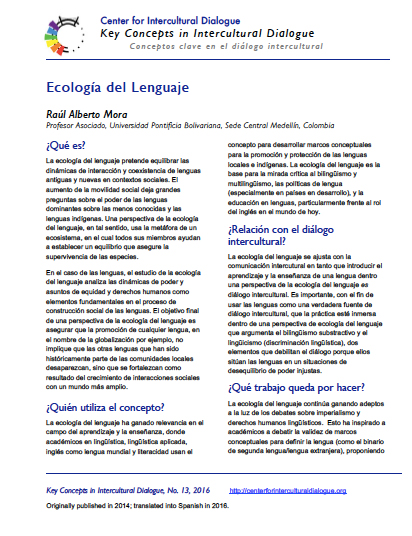
Key Concept #13 Language Ecology Translated into Spanish

Key Concepts in ICDContinuing translations of Key Concepts in Intercultural Dialogue, today I am posting KC#13: Language Ecology, which Raul Alberto Mora wrote and first published in English in 2014, and which Claudia Cañas has now translated into Spanish.

As always, all Key Concepts are available as free PDFs; just click on the thumbnail to download. Lists of Key Concepts organized chronologically by publication date and number, alphabetically by concept, and by languages into which they have been translated, are available, as is a page of acknowledgments with the names of all authors, translators, and reviewers.

Key Concept #13 Language Ecology_SpanishMora, R. A. (2016). Ecología del lenguaje. (C. Cañas Trans). Key Concepts in Intercultural Dialogue, 13. Available from:
https://centerforinterculturaldialogue.org/wp-content/uploads/2016/11/kc13-language-ecology_spanish.pdf

If you are interested in translating one of the Key Concepts, please contact me for approval first because dozens are currently in process. As always, if there is a concept you think should be written up as one of the Key Concepts, whether in English or any other language, propose it. If you are new to CID, please provide a brief resume. This opportunity is open to masters students and above, on the assumption that some familiarity with academic conventions generally, and discussion of intercultural dialogue specifically, are useful.

Wendy Leeds-Hurwitz, Director
Center for Intercultural Dialogue


Creative Commons License
This work is licensed under a Creative Commons Attribution-NonCommercial-NoDerivatives 4.0 International License.