9th Congress IAIR Bergen (Norway) 2015

The 9th Biennial Congress of the International Academy for Intercultural Research

Realizing the potential of Cultural Diversity in the society and at the workplace

There is hardly any large society that is presently ethnically homogenous as a result of domestic and international migration. The foreign-populations of many societies are increasing at unprecedented rates. For instance, it has been estimated that by 2050, 85% of Australia‘s population growth will be either from overseas migration or from native born Australians who have at least one foreign-born parent. Europe will need 80 million immigrants by 2030, while the US, Japan and Canada will need 35 million, 17 million, and 11 million immigrants by 2030, respectively (Saunders, 2010).

The aging population of the world, particularly in Western industrialized countries, and unemployment and economic stagnation in many countries, will put pressure on the economies of Western industrialized countries in the form of increased migration, bringing people of different ethnic and cultural backgrounds together in ways that have never been seen before.

These demographic changes have wide range of implications for the governance of nation-building including employment, health, education, housing, economics, politics, culture, intergroup relationships and so forth.  Depending on which angle one takes, the results can be either positive or negative.  Unfortunately, events such as the terror attacks in major European cities including Madrid (2004), in London (2005) and in Oslo/Utøya (Norway, 2011) together with the Danish cartoon drawings of Mohammed are some negative instances of intercultural relations.  European leaders have not fared any better when they incite skepticism by suggesting that multiculturalism has been a failure. These pessimistic statements undermine and diminish the positive aspects of cultural diversity.

It is within this context that this conference is organized, with the theme – Realizing the potential of cultural diversity.

Realizing the potential of cultural diversity in the workplace and society will challenge societies politically, economically, socially, legally and culturally. This challenge will require a parallel effort to achieve equity and full participation of all cultural communities in the larger society. Any discussion around the topics will require a multi-disciplinary approach.  Hence the planned conference will attract scholars from psychology, and many related fields and disciplines. Indeed the ultimate goal of this conference will be to bring to Bergen the leading scholars of the world to share research findings, engage in dialogue on how to tap into the positive sides of cultural diversity, and how employers, institutions, and governments can realize its potential. The conference will include Keynote presentations by leading scholars, symposia, individual papers, posters and round table discussions, including debates. During the past three conferences, the Academy has also devoted a whole day to a workshop – Fellows’ Day – just before the opening of the conference where the Fellows of the Academy engage in a series of discussions regarding the conference theme.

The Conference is hosted by:
Society and Workplace Diversity Research Group, Department of Psychosocial Science, University of Bergen

Administratively, the Department of Psychosocial Science is responsible for the running of the conference, but the practical activities regarding the conference will be coordinated by the Society and Workplace Diversity Research group in close collaboration with the Congress Bureau (Kongress og Kultur – KK-Bergen). While the Research Group will be responsible for the scientific side of the conference, the all practical organization will be taken care of by the Congress Bureau.

Venue:  Most of the congress program will be held at the Bjørn Christiansen Building, Christiesgate 12

SOME IMPORTANT DATES TO REMEMBER
Submission of proposals opens: March 1, 2014
1st proposal  Deadline: November 1, 2014
Accepted Decision: December 15, 2014
2nd proposal deadline: December 31, 2014
Accepted decision: February 15, 2015

Sample of thematic topics
*Cultural diversity in the society
*Cultural diversity at the work place
*Migration, Acculturation, and Adjustment
*Intercultural competence and training
*Intercultural communication

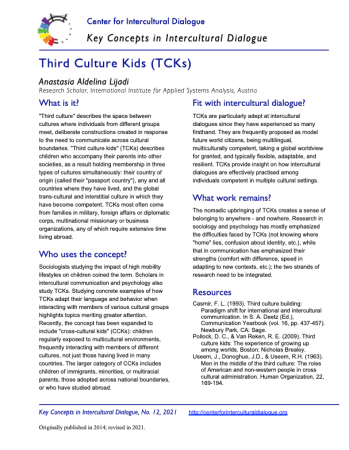
Key Concepts #12: Third Culture Kids by Anastasia Lijadi

Key Concepts in ICDThe next issue of Key Concepts in intercultural Dialogue is now available. This is KC12: Third Culture Kids by Anastasia Adelina Lijadi. As always, all Key Concepts are available as free PDFs; just click on the thumbnail to download.Lists organized  chronologically by publication date and numberalphabetically by concept in English, and by languages into which they have been translated, are available, as is a page of acknowledgments with the names of all authors, translators, and reviewers.

KC12 TCKs_v2Lijadi, A. A. (2021). Third culture kids. Key Concepts in Intercultural Dialogue, 12. Available from: https://centerforinterculturaldialogue.org/wp-content/uploads/2021/05/kc12-tcks_v2.pdf

The Center for Intercultural Dialogue publishes a series of short briefs describing Key Concepts in intercultural Dialogue. Different people, working in different countries and disciplines, use different vocabulary to describe their interests, yet these terms overlap. Our goal is to provide some of the assumptions and history attached to each concept for those unfamiliar with it. As there are other concepts you would like to see included, send an email to the series editor, Wendy Leeds-Hurwitz. If there are concepts you would like to prepare, provide a brief explanation of why you think the concept is central to the study of intercultural dialogue, and why you are the obvious person to write up that concept.


Creative Commons License
This work is licensed under a Creative Commons Attribution-NonCommercial-NoDerivatives 4.0 International License.

Calouste Gulbenkian Prize 2014

Calouste Gulbenkian prize
The Calouste Gulbenkian Foundation has opened nominations for the CALOUSTE GULBENKIAN PRIZE until next May 15th. The Prize, worth 250.000€, will be awarded to an individual or non-profit organization, regardless of nationality, who has made a valuable and international impact to foster the universal values inherent to the human condition, respect for diversity and difference, a culture of tolerance and the conservation of the environment in man’s relationship with nature.

Consult the Prize regulations and submit your nomination online through the Prize website.

Altay A. Manço Profile

ProfilesAltay A. Manço has a doctorate in social psychology at the Université de Liège (Belgium).


Altay Manço

He has done a lot of work in the areas of educational psychology and social integration and the psycho-sociology of immigration, especially Turkish. Since 1986, he has worked as a consultant for many institutions and associations on this topics in various European countries and, more recently, in Canada. Manço has also been working with the Université de Paris V since 1998, and with the Université de Sherbrooke in Quebec. Since 1996, he has been the Science Director of the Institut de Recherche, Formation et Action sur les Migrations. IRFAM is a source body set up by stakeholders in the field as well as university researchers for social action, educational professionals, etc. As a continuing education association mandated to develop diversity in our societies, IRFAM manages the collection “Compétences interculturelles” from Éditions Harmattan (Paris) and publishes a quarterly Internet newsletter called “Diversités et Citoyennetés.”

Selected recent books

A. MANÇO et C. BARRAS. 2013. La diversité culturelle dans les PME. Accès au travail et valorisation des ressources, Paris, L’Harmattan.

A. MANÇO et C. ASCHENBROICH. 2013. Migrants solidaires, projets jumelés. Pratiques et coopérations transnationales, Paris, L’Harmattan.

A. MANÇO et P. ALEN. 2012. Appropriation du français par les migrants. Rôles des actions culturelles, Paris, L’Harmattan.

S. AMORANITIS, A. MANÇO. 2011. Migration et développement en Europe. Politiques, pratiques et acteurs, Bruxelles, EUNOMAD.

A. MANÇO et S. AMORANITIS. 2010. Migrants et développement. Politiques, pratiques et acteurs en Belgique, Paris, L’Harmattan.

S. AMORANITIS, D. CRUTZEN, A. MANÇO et al. 2010. Développer le mainstreaming de la diversité. Recueil analytique d’outils d’intervention pour la valorisation de la diversité, Liège, IRFAM.

A. MANÇO et C. BOLZMAN (éds). 2010. Transnationalités et développement. Rôles de l’interculturel, Paris, L’Harmattan.

K. HADDAD, A. MANÇO et M. ECKMANN (éds). 2009. Antagonismes communautaires et dialogues interculturels. Du constat des polarisations à la construction des cohésions, Paris, L’Harmattan.

M. SARLET et A. MANÇO (éds). 2008. Tourismes et diversités : facteurs de développement ?, Paris, L’Harmattan.

J. DEPIREUX et A. MANÇO (éds). 2008. Formations d’adultes et interculturalité. Innovations en pays francophones, Paris, L’Harmattan.

A. MANÇO (éd.). 2008. Valorisation des compétences et co-développement. Africain(e)s qualifié(e)s en immigration, Paris, L’Harmattan.

A. MANÇO. 2006. Processus identitaires et intégration. Approche psychosociale des jeunes issus de l’immigration, Paris, L’Harmattan.

A. MANÇO (Coord.). 2006. Turcs en Europe. L’heure de l’élargissement, Paris, L’Harmattan.

M. VATZ LAAROUSSI et A. MANÇO (éds). 2003.  Jeunesses, citoyennetés, violences. Réfugiés albanais en Belgique et au Québec, Paris, L’Harmattan.

D. CRUTZEN et A. MANÇO (éds). 2003. Compétences linguistiques et sociocognitives des enfants issus de migrants. Turcs et Marocains en Belgique, Paris, L’Harmattan.

A. MANÇO. 2002. Compétences interculturelles des jeunes issus de l’immigration. Perspectives théoriques et pratiques, Paris, L’Harmattan.

Selected recent bibliography in English:

A. MANÇO & P. ALEN. 2012.  Newcomers in Educational System: The Case of French-Speaking Part of Belgium. Sociology Mind, 2(1), 116-126.

A. MANÇO & S. AMORANITIS (Eds.). (2005). Recognition of Islam in European Municipalities: Actions Against Religious Discrimination. Migrations Letters, 2(3).

CFP Mobile Communication & the Asian family

Call for chapters: Mobile Communication and the Asian family – Transforming technologies, changing households
Edited by Sun Sun Lim, National University of Singapore
To be published by Springer in January 2015

This book explores how mobile communication technologies are penetrating Asia at a rapid rate, and being avidly domesticated by households in Asia. It investigates how such technologies are being incorporated into Asian families’ daily routines for work, education, entertainment and household coordination, while being appropriated for communication and the nurturance of family bonds. Even as mobile communication technology is evolving relentlessly, families in Asia are also going through a period of transformation as the region experiences unprecedented
economic growth, urbanisation and demographic shifts. Asia is therefore at the crossroads of technological transformation and social change and this book seeks to capture the mutual impact of these two contemporaneous trends through the lens of the family. I welcome research on different types of families (e.g. nuclear, blended, single-parent, multigenerational, grandparent-led etc.), from a spectrum of socio-economic profiles, that utilise a range of qualitative and quantitative methodological approaches, and which are informed by a diversity of theoretical perspectives.

*Research by emerging Asia-focused and/or Asia-based scholars whose work
has not previously been published in English is especially welcome.*

Chapter proposals are sought for topics including but not limited to the
following:
*             Influence of socio-cultural norms on families’ appropriation of mobile communication technologies
*             Time management and micro-coordination
*             Practices and negotiations pertaining to acquisition, ownership and usage of mobile communication devices and services
*             Blurring boundaries between work and family
*             Issues of (dis)empowerment, privacy and surveillance
*             Nature and quality of family interaction
*             Inter-generational differences in perceptions and usage of mobile communication
*             Parental mediation of mobile device usage

Please submit chapter proposals of up to 800 words, and brief author biographies of up to 300 words as an e-mail attachment by 15 May 2014. Authors of accepted proposals will be notified by 5 June 2014 and invited to submit a full paper to sunlim@nus.edu.sg . Manuscripts should be no more than 8,000 words, including notes and references, conform to APA style, and submitted by 30 September, 2014.  All papers will be subject to anonymous peer review following submission.

University of South Carolina Upstate job ad

Assistant Professor of Communication Studies
University of South Carolina Upstate
Requisition 007369

Nine-month tenure-track Assistant Professor position beginning August 16, 2014 to teach on the Spartanburg and/or Greenville campuses.  Seeking a faculty member who has a strong background in organizational and/or interpersonal communication with an emphasis on critically engaging issues of difference, especially within the areas of race and/or transnationalism. Ideal candidate would be equipped to teach critical approaches to Small Group Communication, Organizational Communication, Research Methods, Intercultural Communication, and Interpersonal Communication at the undergraduate level.

Required: PhD in Communication Studies; ABD in Communication Studies will be considered with degree completion required before August 15, 2014; demonstrated commitment to student-centered learning and evidence of excellence in teaching. Prefer: Three years of teaching experience at the university level and a clear, focused research agenda.

Applicants must apply online. Review of applications will begin immediately and continue until position is filled.

Contact: Dr. Benjamin Myers, Chair, Fine Arts & Communication Studies

CFP Modernity and Telephones in the non-west

Call for Papers: History of Modernity and Telephony in the non-West
CyberOrient: Online Journal of the Virtual Middle East
Guest Editor: Burçe Çelik
Submission deadline: April 30th, 2014 (Full Papers)

Aim
For the past few decades, history of modernization began to be written by focusing on how technologies as components of modernization processes change the lives of humans, their daily practices and imaginations, and the ways in which they construct and express their identities. Telephony, which functions in both public and private spheres and witnesses social and political changes in private as well as professional relations, is regarded as especially important for historical analysis. Functioning on multiple levels, social history of telephony can unearth the ways in which technologies obtain meanings and values in changing cultural contexts and the dynamics of social, political and cultural transformations. The history of modernization in the non-western societies is often studied by focusing on the projects of the rulers and on the discourses of the ruling parties that aim a social/political change in accordance with a particular Occidentalism where modernity is imagined with a model of the western modernization processes. Yet, the question of how people of these landscapes contributed to the modernization processes and how they produced their own modern practices in daily organizations, relations and experiences, did not receive enough scholarly attention.

This special issue of CyberOrient invites articles that focus on the history of modernity and telephony in the non-west that take the user perspective to the center. Topics could include the daily practices of users with telephone technology, the meaning and values that have been attributed to this technology by users, the role of telephony within
the social, cultural and political struggles of users, and the effect of the ownership or non-ownership of telephony in social, cultural and political lives of individuals and collectives. We welcome submissions from across disciplines and methodological approaches that are empirically and critically grounded.

About CyberOrient
CyberOrient is a peer-reviewed journal published by the American Anthropological Association, in collaboration with the Faculty of Arts of Charles University in Prague. The aim of the journal is to provide research and theoretical considerations on the representation of Islam and the Middle East, the very areas that used to be styled as an “Orient”, in cyberspace, as well as the impact of the internet and new media in Muslim and Middle Eastern contexts.

Submission
Articles should be submitted directly to Burçe Çelik and Vit Sisler. Articles should be between 6,000 and 8,000 words (including references), and follow the AAA style in referencing and citations. Upon acceptance, articles will be published online with free access in autumn 2014. More information can be found in the full call for papers.

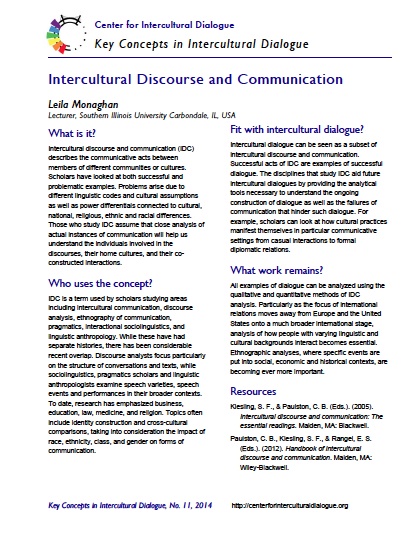
Key Concepts #11: Intercultural Discourse & Communication by Leila Monaghan

Key Concepts in ICDThe next issue of Key Concepts in intercultural Dialogue is now available. This is KC11: Intercultural Discourse & Communication by Leila Monaghan. As always, all Key Concepts are available as free PDFs; just click on the thumbnail to download.Lists organized  chronologically by publication date and numberalphabetically by concept in English, and by languages into which they have been translated, are available, as is a page of acknowledgments with the names of all authors, translators, and reviewers.

kc11-smMonaghan, L. (2014). Intercultural discourse and communication. Key Concepts in Intercultural Dialogue, 11. Available from:
https://centerforinterculturaldialogue.org/wp-content/uploads/2014/04/key-concept-intercult-discourse-comm.pdf

The Center for Intercultural Dialogue publishes a series of short briefs describing Key Concepts in intercultural Dialogue. Different people, working in different countries and disciplines, use different vocabulary to describe their interests, yet these terms overlap. Our goal is to provide some of the assumptions and history attached to each concept for those unfamiliar with it. As there are other concepts you would like to see included, send an email to the series editor, Wendy Leeds-Hurwitz. If there are concepts you would like to prepare, provide a brief explanation of why you think the concept is central to the study of intercultural dialogue, and why you are the obvious person to write up that concept.


Creative Commons License
This work is licensed under a Creative Commons Attribution-NonCommercial-NoDerivatives 4.0 International License.

John Stewart Profile

Profiles

John Stewart serves as Special Assistant to the President at the University of Dubuque in Dubuque, Iowa.

John Stewart

He was Vice President for Academic Affairs at UD from 2001-2010, and on the Communication faculty at the University of Washington in Seattle from 1969-2001. He also taught full-time at the University of Wisconsin-Stout and filled visiting professor/ lecturer positions at a number of institutions, including the University of Hawaii-Manoa, Texas A&M, Gonzaga, California State University-Fresno, Wake Forest, Hebrew University, and the Universities of Tel Aviv and Haifa.

John’s primary research interests have been the philosophy of language, the philosophy and practice of dialogue, and the philosophy and practice of interpretive research. He articulated a relational view of language in Language as Articulate Contact: Toward a Post-Semiotic Philosophy of Communication (1995) and the edited volume, Beyond the Symbol Model: Reflections on the Representational Nature of Language (1996), both published by SUNY Press. His approach to dialogue has been developed in several articles and chapters, including “Foundations of Dialogic Communication,” Quarterly Journal of Speech, 65 (1978), 183-201; “Dialogue as Tensional, Ethical Practice,” with Karen Zediker, Southern Communication Journal, 65 (2000), 224-242; and “Relationships Among Philosophies of dialogue,” with K. E. Zediker and L. L. Black, in Dialogic Approaches to Communication, R. Anderson, L. A. Baxter, & K. N. Cissna (Eds.) (Sage, 2003).

John’s edited textbook, Bridges Not Walls: A Book About Interpersonal Communication is currently in its 11th edition with McGraw Hill, and his co-authored Together: Communicating Interpersonally is in its 6th edition with Oxford.

He is currently focused on revising his communication self-help book, U&ME: Communicating in Moments that Matter (Taos Institute Publications, 2013), which is available in print and e-book versions. Excerpts from, and news about U&ME are available on its Facebook site, and John’s biography, interpersonal communication blog, and information about his other publications are can be found at www.johnstewart.org.


Work for CID:
John Stewart wrote KC14: Dialogue.

CFP European Institutes for Advanced Study Fellowships

The European Institutes for Advanced Study (EURIAS) Fellowship Programme is an international researcher mobility programme offering 10-month residencies in one of the 16 participating Institutes: Berlin, Bologna, Budapest, Cambridge, Delmenhorst, Edinburgh, Freiburg, Helsinki, Jerusalem, Lyon, Marseille, Paris, Uppsala, Vienna, Wassenaar, Zürich. The Institutes for Advanced Study support the focused, self-directed work of outstanding researchers. The fellows benefit from the finest intellectual and research conditions and from the stimulating environment of a multi-disciplinary and international community of first-rate scholars.

EURIAS Fellowships are mainly offered in the fields of the humanities and social sciences but may also be granted to scholars in life and exact sciences, provided that their proposed research project does not require laboratory facilities and that it interfaces with humanities and social sciences. The diversity of the 16 participating IAS offers a wide range of possible research contexts in Europe for worldwide scholars. Applicants may select up to three IAS outside their country of nationality or residence as possible host institutions.

The Programme welcomes applications worldwide from promising young scholars as well as from leading senior researchers. The EURIAS selection process has proven to be highly competitive. To match the Programme standards, applicants have to submit a solid and innovative research proposal, to demonstrate the ability to forge beyond disciplinary specialisation, to show an international commitment as well as quality publications in high-impact venues.

For the 2015-2016 academic year, EURIAS offers 44 fellowships (22 junior and 22 senior positions).

All IAS have agreed on common standards, including the provision of a living allowance (in the range of € 26,000 for a junior fellow and € 38,000 for a senior fellow), accommodation (or a mobility allowance), a research budget, plus coverage of travel expenses.

APPLICATION
– Applications are submitted online via www.eurias-fp.eu, where, you will find detailed information regarding the content of the application, eligibility criteria, selection procedure.
The deadline for applications is June 5th, 2014, 12 PM (noon) GMT. Late applications will not be considered.

SELECTION PROCEDURE
– Scientific assessment by two international referees
– Pre-selection by the EURIAS international Scientific Committee
– Final selection by the IAS Academic Boards
– Publication of results: January 2015

For further information on the Programme, please consult our website: www.eurias-fp.eu
For further information on the IAS and their specific working conditions: www.eurias-fp.eu/ias