University of Otago 2014

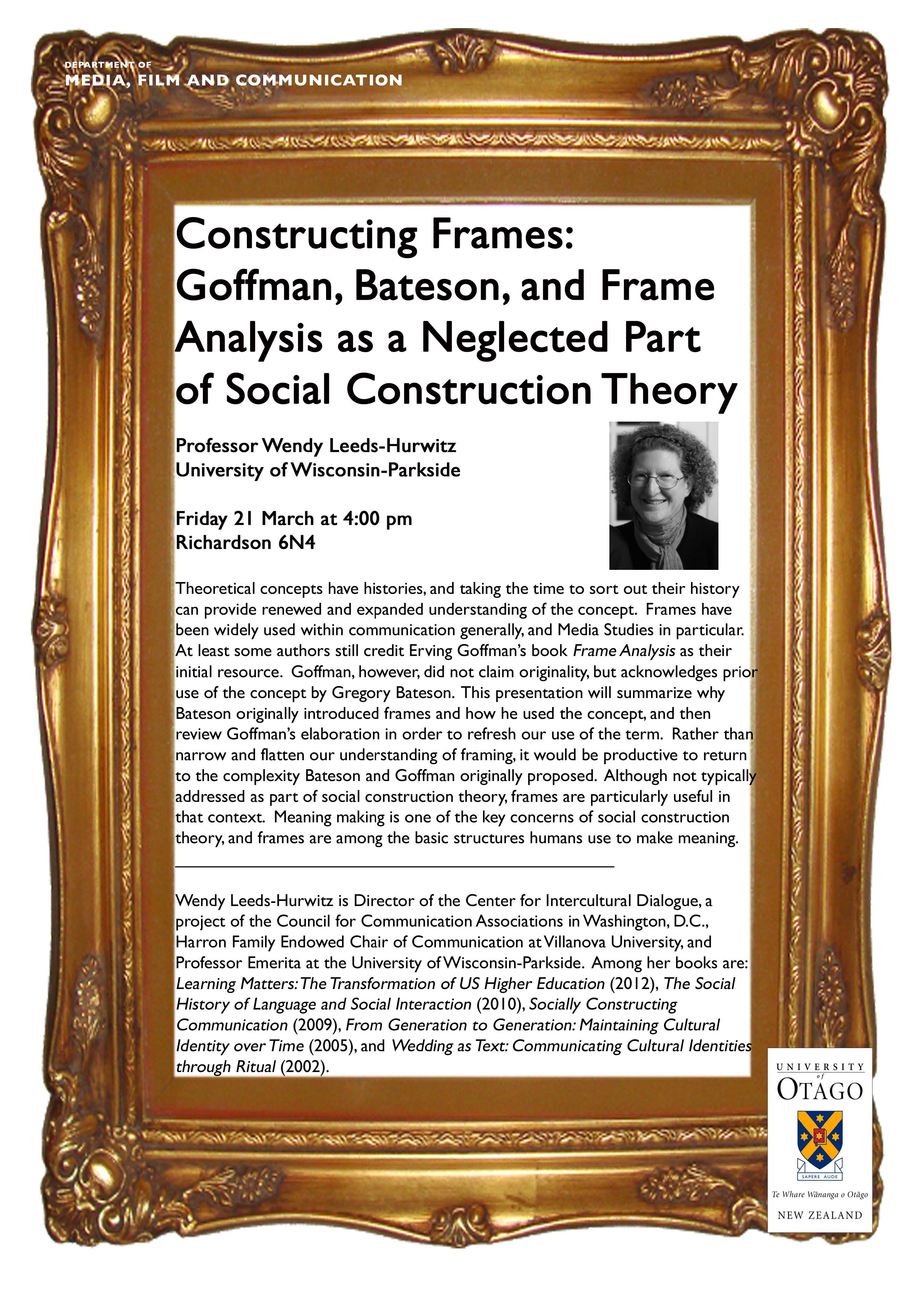
Constructing Frames flyerOn March 21, 2014 I presented “Constructing frames: Goffman, Bateson, and frame analysis as a neglected part of social construction theory” at the University of Otago, in Dunedin, New Zealand. This was my second talk at Otago (description of the first was posted in 2012). Last time I was hosted by the Department of Languages and Cultures; this time by Media, Film and Communication.

Despite meeting late on a Friday afternoon, there was a large crowd, so local dedication to scholarly conversations is impressive. A personal first for me was having someone, in this case Rosemary Overell, tweet about my talk as it was occurring.

The fact that faculty and graduate students from across the campus attended on a Friday afternoon was even more impressive. In addition to multiple members of the Media, Film and Communication department, I talked to people from Theatre Studies, Sociology, Anthropology, Tourism, German, the Higher Education Development Centre, Applied Sciences, the Centre for Science Communication, and several other parts of the university.
Leeds-Hurwitz, Bourk
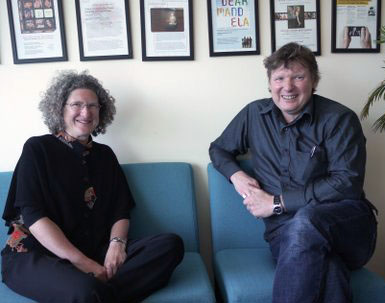
Wendy Leeds-Hurwitz and Michael Bourk

My thanks to my host, Michael Bourk, who organized the event, to Vijay Devadas, Head of Department, who supported it with a generous reception and dinner, and to department staff members Maureen and Paulette for managing the details. In the days before and after the talk, I met with several graduate students and faculty members about a variety of other subjects, ranging from intercultural communication to ethnographic methods. I look forward to continued conversations on these and other topics, and hope to have the chance to visit the University of Otago again in the future.

Wendy Leeds-Hurwitz, Director
Center for Intercultural Dialogue

Key Concepts in Intercultural Dialogue #5: Intercultural Communication by Wendy Leeds-Hurwitz

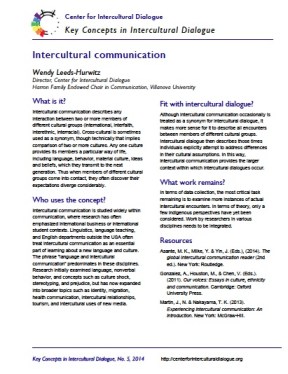
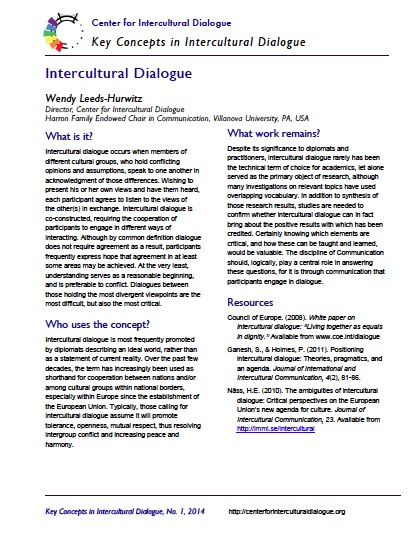
Key Concepts in ICDThe fifth issue of Key Concepts in intercultural Dialogue is now available. This is KC5: Intercultural Communication by Wendy Leeds-Hurwitz. As always, all Key Concepts are available as free PDFs; just click on the thumbnail to download. Lists organized  chronologically by publication date and numberalphabetically by concept in English, and by languages into which they have been translated, are available, as is a page of acknowledgments with the names of all authors, translators, and reviewers.

KC4-sm

Leeds-Hurwitz, W. (2014). Intercultural communication. Key Concepts in Intercultural Dialogue, 5. Available from:
https://centerforinterculturaldialogue.org/wp-content/uploads/2014/03/key-concept-intercultural-comm.pdf

The Center for Intercultural Dialogue is publishing a series of short briefs describing Key Concepts in intercultural Dialogue. The logic is that different people, working in different countries and disciplines, use different vocabulary to describe their interests, yet these terms overlap. Our goal is to provide some of the assumptions and history attached to each concept for those unfamiliar with it. As there are other concepts you would like to see included, send an email to the series editor, Wendy Leeds-Hurwitz. If there are concepts you would like to prepare, provide a brief explanation of why you think the concept is central to the study of intercultural dialogue, and why you are the obvious person to write up that concept.


Creative Commons License
This work is licensed under a Creative Commons Attribution-NonCommercial-NoDerivatives 4.0 International License.

CID has 1000 Subscribers!

About CIDAccording to the Center for Intercultural Dialogue’s website, we have just crossed the 1000 mark!

CID at 1000 subscribers

This number includes those who have signed up through WordPress for email notification each time a new post appears, as well as those who follow us through Facebook, Twitter, or Google +. WordPress cannot track those who have joined the CID LinkedIn group (which currently stands at 112), or who find CID through YouTube or Pinterest, so the actual number of subscribers is actually even higher. It took 3 1/2 years to get to this point, but presumably it will take a lot less time to get to 2000!

As the number of followers has increased, CID’s email has increased as well. We try to answer all emails within a few days, and to post relevant information within a week.

We very much appreciate your support.

Wendy Leeds-Hurwitz, Director
Center for Intercultural Dialogue
CID is on Wikipedia

About CIDIn case there has been any doubt, the Center for Intercultural Dialogue definitely exists – and we know this because now there is a Wikipedia entry saying so!

CID Wikipedia entry

This was created as one response to the National Communication Association’s call for increased entries on communication-related topics by communication specialists. (Details may be found on the NCA Wikipedia Initiative page.) For those who have not yet created an article on Wikipedia, the official standards are quite stringent about what is sufficiently “notable” to merit an article. (Of course, that doesn’t mean all articles currently posted meet those standards.) And there is an elaborate formal system to learn in order to participate in the site. But in today’s world, there is a sense in which any serious endeavor should be represented there, so it seemed worthwhile creating an article.

Minh Cao gets credit for taking the time to first learn the guidelines, and post the first draft. For those who have not yet created articles, a warning: this took 3 drafts over 2 months, and help from 4 different editors at Wikipedia, before approval was granted for a substantially shorter article than originally envisioned. Apparently such delay and critique are common.

Wendy Leeds-Hurwitz, Director
Center for Intercultural Dialogue

Key Concepts in Intercultural Dialogue #1

Key Concepts in ICDYou may have already noticed that the menu bar on the site has a new entry: publications. Starting today, the Center for Intercultural Dialogue is initiating a series of short briefs describing Key Concepts in intercultural Dialogue. The logic is that different people, working in different countries and disciplines, use different vocabulary to describe their interests, yet these terms overlap. It should be useful to sort out some of the assumptions and history attached to each concept for those unfamiliar with it. Key Concepts will be made available as PDFs on the CID website and may be downloaded for free. The first few concepts will be intercultural dialogue, cosmopolitanism, intercultural competence, and coordinated management of meaning. As you think of other concepts you would like to see included, send an email to the series editor, Wendy Leeds-Hurwitz. If there are concepts you would like to prepare, provide an explanation of why you think the concept is central to the study of intercultural dialogue.

The first key concept described is, for obvious reasons, Intercultural Dialogue. Click on the thumbnail to download the PDF.KC1-sm


NOTE for students: As these will be written by academics, they may be used as resources in academic papers (unless your professor in a particular course tells you otherwise). The citation format in APA would be:

Leeds-Hurwitz, W. (2014). Intercultural dialogue. Key Concepts in Intercultural Dialogue, 1. Available from: https://centerforinterculturaldialogue.org/wp-content/uploads/2014/02/key-concept-intercultural-dialogue1.pdf

NOTE: After publishing dozens of key concepts and translations, lists organized chronologically by publication date and numberalphabetically by concept in English, and by languages into which they have been translated, have been created, and a page of acknowledgments with the names of all authors, translators, and reviewers.


Creative Commons License
This work is licensed under a Creative Commons Attribution-NonCommercial-NoDerivatives 4.0 International License.

Sydney 2014

On the way between the US and New Zealand, I was able to stop in Sydney, Australia for a week. Being there permitted me to connect with two people I’d never met but only talked to via email, and one I had not seen in over a decade. Between the three, there was a wide range of interests and career stages.

Lily A. Arasaratnam is Senior Lecturer in Intercultural Communication and Program Director for an MA program at Alphacrucis College in Parramatta, just outside Sydney. I “met” Lily when we both participated in an online dialogue about intercultural communication for the Journal of International and Intercultural Communication which will shortly be published. Her primary research specialization is intercultural communication competence. She is an intercultural expert both because of her PhD and her personal experience: born in Sri Lanka, raised in the Maldives, with US degrees, and now living in Australia, she lives many of the dualities others only try to understand.

Olga Kozar is currently completing her PhD in Applied Linguistics at Macquarie University in Sydney. Her research is on private one-on-one English as a second language lessons conducted via videoconferencing tools such as Skype, especially when learners and teachers have different cultural backgrounds. In her spare time she runs such a language school – with about 1000 students! She was quite helpful in providing technology-related ideas, given that she’s become such an expert. I was delighted to discover that she and Christine Develotte, a colleague from Lyon, France, who does similar work with teaching French online and who I introduced her to via email, have now met in person as well.

Penman, Leeds-Hurwitz
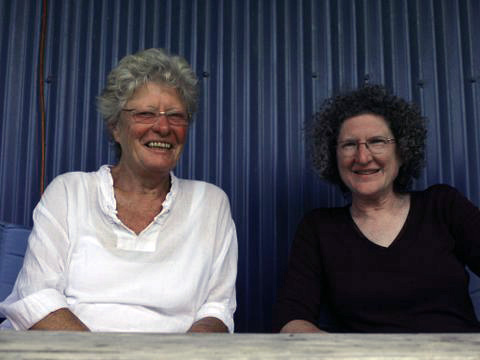
Robyn Penman, Wendy Leeds-Hurwitz

I was introduced to Robyn Penman by Barnett Pearce so long ago we don’t remember when it would have been; it was a pleasure to have a chance to catch up on the past decade. Currently active with the CMM Institute, formerly with the Communication Research Institute of Australia, Robyn is a pioneering communication scholar, widely respected both for her ability to state theory clearly (as in her early Communication Processes and Relationships, or the more recent Reconstructing Communication) and to apply that theory to practical communication problems (as in Designing Information for People, a co-edited volume). Robyn suggested that, given my current efforts to connect international scholars, my name should now be changed to Ariadne, for her association with webs and weaving.

I look forward to continuing the conversations with all these scholars.

Wendy Leeds-Hurwitz, Director
Center for Intercultural Dialogue

Save

CID and Social Media

About CIDIn addition to the Facebook group page developed several years ago, the Center for Intercultural Dialogue now has a social media presence that includes LinkedIn, Twitter, Pinterest, YouTube, and Google+.

social media logos

Nearly all of this activity is due to the efforts of Minh Cao, Assistant to the Director.  Minh also learned the required format to post on Wikipedia – an entry on CID is currently under review and will be described in a post once it is public. [UPDATE: CID is now on Wikipedia as well!]

Several colleagues have asked why a broad social media presence is valuable (and whether it is worth the considerable time it takes). The short answer is that social media permit CID to meet interculturalists on whatever platform they choose to spend their time. A further question might be: are so many people really using social media today? The answer to that comes from the Pew Internet and American Life Project which just posted their Social Media Update for 2013. They conclude:

Some 73% of online adults now use a social networking site of some kind. Facebook is the dominant social networking platform in the number of users, but a striking number of users are now diversifying onto other platforms. Some 42% of online adults now use multiple social networking sites.

Substantial thanks are due to Minh for making the CID accessible across multiple platforms in 2013. The goal for 2014 will be to determine what content best fits each of these contexts, and to expand the impact of the CID as a result.

Wendy Leeds-Hurwitz, Director
Center for Intercultural Dialogue
Recommended UNESCO Documents for Interculturalists

UNESCO sees intercultural dialogue as a central topic, and publishes frequently on related issues. In addition to the Intercultural Competences booklet that I worked on last year, which has had hundreds and hundreds of downloads from this site alone, several other publications may be of interest to intercultural scholars.

A Common Framework for the Ethics of the 21st Century

A New Cultural Policy Agenda for Development and Mutual Understanding

Asian-Arab Philosophical Dialogues on Globalization, Democracy and Human Rights

Cultural Diversity and Transversal Values: East-West Dialogue on Spiritual and Secular Dynamics

Exploring Synergies between Faith Values and Education for Sustainable Development

What UNESCO for the Future? Forum of Reflexion

World Social Science Report 2010: Knowledge Divides

My thanks to Yoshitaka Miike for these suggestions!

Wendy Leeds-Hurwitz, Director
Center for Intercultural Dialogue
Save

CID has a LinkedIn Group

About CIDThe Center for Intercultural Dialogue recently started a LinkedIn group, thanks to the efforts of Minh Cao, Assistant to the Director.
CID LinkedIn group

The purpose of this group is to permit conversations among those who share interests in intercultural dialogue. It is open to conversations among members not only on intercultural dialogue as a narrow focus, but also on a broad range of topics related to international or intercultural communication, dialogue, or international collaborative research more generally. This website is not a convenient place to hold conversations, so the LinkedIn group is designed to fill that gap.

Examples of appropriate topics:
* Asking for help in locating resources on a subject
* Asking for contacts in a particular country
* Questioning how others respond to particular intercultural problems
* Asking opinions about a topic of general interest
* Posting an academic job, so long as it has to do with intercultural or dialogue topics, or if it is outside the US (if it meets the latter requirements but is non-academic, it may still be fine; if you post it and we don’t think it fits, we’ll delete it) – but post jobs under the job tab or they will be moved there

CID Agreement with Waterhouse Family Institute

About CIDAs one result of my semester at Villanova University, the Center for Intercultural Dialogue has now signed a memorandum of understanding with the Waterhouse Family Institute.
This slideshow requires JavaScript.


The Waterhouse Family Institute (WFI) is founded on the principle that the study and practice of communication is inherently connected to issues of ethics and social justice, and that properly understood, communication is central to the creation of positive social change. WFI is housed within Villanova University’s Department of Communication in the College of Liberal Arts and Sciences.

Dr. Bryan Crable is the Director of the WFI. Basically what this understanding means is that we will cooperate on, and seek joint grant funding for, several projects. More information will be posted to both websites as our discussions lead to specific activities.

Wendy Leeds-Hurwitz, Director
Center for Intercultural Dialogue