The ‘Problem’ of Intercultural Weddings

On October 21, 2014, I presented “Ambiguity as the Solution to the “Problem” of Intercultural Weddings,” at Royal Roads University, located in Victoria, BC, Canada, as one of two talks during a fall trip there to meet with students and faculty in their Master of Arts in International and Intercultural Communication (MAIIC). (Further information about that visit has already been posted to this site.) A videotape of excerpts from that talk is now available on the Center for Intercultural Dialogue’s YouTube channel. My thanks to the faculty for the invitation to visit, and to the technology department for videotaping the event.

Wendy Leeds-Hurwitz, Director
Center for Intercultural Dialogue

NCA 2014 in Chicago

This slideshow requires JavaScript.

The National Communication Association 100th convention was held in Chicago November 20-23, 2014. I organized a panel entitled “Intellectual Genealogy: Documenting Invisible Colleges in the Age of Digital Communication” with Theresa Castor, Robert Craig, Jay Leighter, Jefferson Pooley, Michelle Scollo and Leah Wingard. In addition, I presented two papers. “Taking a (Meta)Communication Perspective to Intercultural Dialogue” (discussing the Key Concepts in Intercultural Dialogue) was part of the panel organized by Richard Buttny resulting from the Macau conference in spring, with Todd Sandel and Sunny Lie (from that event) and the added participation of Don Ellis; Cynthia Gordon was chair. “Bringing Intercultural Dialogue to the Center” was part of a panel of past chairs of the International and Intercultural Communication Division, organized by Alberto Gonzalez, and titled “Past Challenges, Present Victories.” A photo from that event is attached; the participants were (bottom row, from left): Mary Jane Collier, Wendy Leeds-Hurwitz, Young Yun Kim, Yolanta Drzewiecka, and (top row, from left): Benjamin Broome, Carley Dodd, Donal Carbaugh, and Alberto Gonzalez.

In addition, I met with several of the CID advisory board members (Donal Carbaugh, Todd Sandel, and Charles Self). And, as is always the great benefit of large conventions such as this, I caught up with literally dozens of people I know. Far too many to name, this group included not only everyone on any of my panels, but graduate school peers and former colleagues; large numbers of professional colleagues from various contexts, including prior conferences large and small; NCA officers past, present, and future; and even a colleague met in China attending his first NCA. I also caught up with my Villanova University colleagues from  last year, this year’s Harron Chair (Raymie McKerrow), several people considering applying for next year, and a former graduate student who was presenting a paper prepared for my seminar in Social Construction Theory. Perhaps my favorite part of going to such conventions is that I also always meet lots of new people. Unfortunately, only one other photo will have to represent all these connections: the second photo above shows me with Jing Yin  and Yoshitaka Miike.

Wendy Leeds-Hurwitz, Director
Center for Intercultural Dialogue

CID in The Washington Post

About CIDI was contacted a few days ago by a reporter at the The Washington Post, who asked me to discuss the comments made by Airbnb about their impact on intercultural relations. She did a fair job of representing what I said. See for yourself:

Dewey, Caitlin. (2014, November 24). How Airbnb promotes world peace. The Washington Post.

If you’ve stayed in Airbnb yourself and want to join the conversation, add a comment below.

Wendy Leeds-Hurwitz, Director
Center for Intercultural Dialogue

Royal Roads University visit

This slideshow requires JavaScript.

On October 14, 2014 I presented “Intercultural Weddings and the Simultaneous Display of Multiple Identities” and on October 21, “Ambiguity as a Solution to the “Problem” of Intercultural Weddings,” both for Royal Roads University, located in Victoria, BC, Canada. The first talk was to the on-campus students in their Master of Arts in International and Intercultural Communication (MAIIC), as well as a group of visiting students from China, while the second was to the online students in MAIIC, present for their brief campus residency. RRU has the only masters program for intercultural communication in Canada, so this was a particularly appropriate campus for me to visit.

My thanks to all concerned: Dr. Matthew Heinz, Dean of the Faculty of Social and Applied Sciences, as well as a professor in the School of Communication and Culture and an intercultural communication scholar; Dr. Juana Du, director of the on-campus MAIIC; Dr. Zhenyi Li, director of the online MAIIC and founder of the degree; and Dr. Julia Jahansoozi, one of the faculty members in the program. In the near future, I will be posting researcher profiles as department members have time to send me information. In the meantime, it was fascinating to discover that I know scholars in common with all four as a result of my travels over the last few years, from the US, Hong Kong, Finland, and Estonia!

A few of the students will be completing various projects for CID over the next few months, and will have profiles posted for them as well. Their efforts will result in an expanded set of databases on intercultural topics, and better visual designs for the materials the CID produces.

RRU is housed on a particularly beautiful campus, including Hatley Castle (widely recognizable even to me as the site of the X-men films as well as other films and tv shows), a traditional Japanese garden, and peacocks wandering freely across the grounds. A few photos are included in this post of not only one of the talks but also the campus.

Wendy Leeds-Hurwitz, Director
Center for Intercultural Dialogue

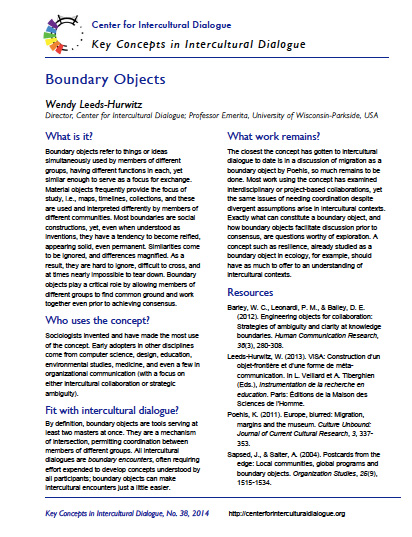
Key Concept #38: Boundary Objects by Wendy Leeds-Hurwitz

Key Concepts in ICDThe next issue of Key Concepts in intercultural Dialogue is now available. This is KC38: Boundary Objects by Wendy Leeds-Hurwitz. As always, all Key Concepts are available as free PDFs; just click on the thumbnail to download. Lists organized  chronologically by publication date and numberalphabetically by concept in English, and by languages into which they have been translated, are available, as is a page of acknowledgments with the names of all authors, translators, and reviewers.

kc38-sm

Leeds-Hurwitz, W. (2014). Boundary object. Key Concepts in Intercultural Dialogue, 38. Available from:
https://centerforinterculturaldialogue.org/wp-content/uploads/2014/10/key-concept-boundary-objects.pdf

The Center for Intercultural Dialogue publishes a series of short briefs describing Key Concepts in intercultural Dialogue. Different people, working in different countries and disciplines, use different vocabulary to describe their interests, yet these terms overlap. Our goal is to provide some of the assumptions and history attached to each concept for those unfamiliar with it. As there are other concepts you would like to see included, send an email to the series editor, Wendy Leeds-Hurwitz. If there are concepts you would like to prepare, provide a brief explanation of why you think the concept is central to the study of intercultural dialogue, and why you are the obvious person to write up that concept.


Creative Commons License
This work is licensed under a Creative Commons Attribution-NonCommercial-NoDerivatives 4.0 International License.

Key Concept #25: Metacommunication by Wendy Leeds-Hurwitz

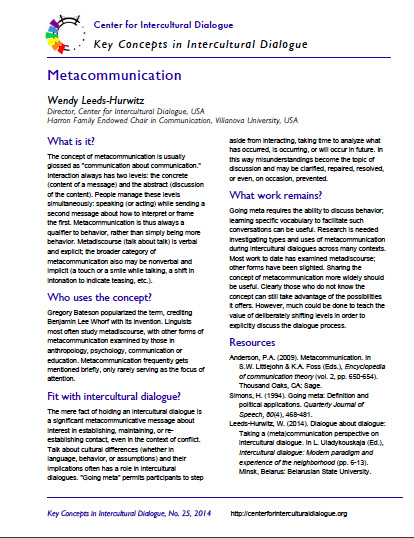
Key Concepts in ICDThe next issue of Key Concepts in intercultural Dialogue is now available. This is KC25: Metacommunication by Wendy Leeds-Hurwitz. As always, all Key Concepts are available as free PDFs; just click on the thumbnail to download. Lists organized  chronologically by publication date and numberalphabetically by concept in English, and by languages into which they have been translated, are available, as is a page of acknowledgments with the names of all authors, translators, and reviewers.

kc25-sm

Leeds-Hurwitz, W. (2014). Metacommunication. Key Concepts in Intercultural Dialogue, 25. Available from:
https://centerforinterculturaldialogue.org/wp-content/uploads/2014/07/key-concept-metacomm.pdf

The Center for Intercultural Dialogue publishes a series of short briefs describing Key Concepts in intercultural Dialogue. Different people, working in different countries and disciplines, use different vocabulary to describe their interests, yet these terms overlap. Our goal is to provide some of the assumptions and history attached to each concept for those unfamiliar with it. As there are other concepts you would like to see included, send an email to the series editor, Wendy Leeds-Hurwitz. If there are concepts you would like to prepare, provide a brief explanation of why you think the concept is central to the study of intercultural dialogue, and why you are the obvious person to write up that concept.


Creative Commons License
This work is licensed under a Creative Commons Attribution-NonCommercial-NoDerivatives 4.0 International License.

Università della Svizzera italiana 2014

WLH and PraxmarerFrom May 20-30, 2014, I had a wonderful invitation to stay in Cimo, Switzerland (a village just outside Lugano), with Peter Praxmarer, the executive director of the European Master in Intercultural Communication (EMICC), which is coordinated through the Università della Svizzera italiana (known in English as the University of Lugano). He also collaborates with, and teaches for, the Master of Advanced Studies in Intercultural Communication (MIC), as well as a number of other European universities.

My goal was to learn more about the EMICC, an intensive and international semester-long study of intercultural communication jointly offered by ten European universities since 2002. This program is a model of international collaboration for graduate education, and an innovative form of what in the USA is called “study abroad,” ensuring that students not only learn about intercultural communication at a theoretical level, but also practice it. We were able to discuss not only some of the logistics of this program, but also shared interests in intercultural communication more generally, as well as inventing future possibilities for collaboration.

While in Lugano, I was able to connect also with Prof. Bertil Cottier, Director of the Institute for Public Communication at USI. Trained as a lawyer, one of his current interests is in data protection and new technologies. As it turns out, the Institute will be conducting a search for a faculty member specializing in intercultural communication shortly – keep an eye on this website for the details.

I also met with Alexandra Stang, a graduate student at the University of Duisburg-Essen (in Germany) currently studying the Intercultural Campus platform, “an international university network created for intercultural learning.” She was in town to interview Peter Praxmarer, and took the opportunity to interview me as well.

Wendy Leeds-Hurwitz, Director
Center for Intercultural Dialogue

The Netherlands 2014

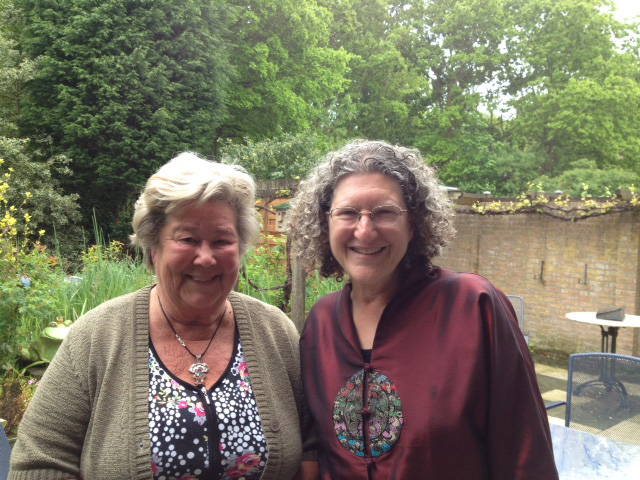
Marieke de Mooij, Wendy Leeds-HurwitzOne of the great pleasures of directing the Center for Intercultural Dialogue is meeting people in person who I have only “met” previously online. A few days ago, I had the opportunity to meet Marieke de Mooij in person, at her home in The Netherlands. She graciously invited me and my 3 traveling companions to visit, fed us an excellent traditional lunch including a wide variety of smoked fishes and other seafood, and recommended which small towns to visit on the drive to and from Amsterdam.
A long-time consultant in cross-cultural communication, Marieke’s books on global marketing and advertising are used around the world. We talked generally about overlaps in our research interests, and especially about her newest book,  Human and Mediated Communication around the World: A Comprehensive Review and Analysis (Springer, 2014). One of her goals in the book is to recombine interaction and media as parts of the study of communication; another is to take a truly global perspective.

My thanks to Yoshi Miike for introducing us last fall!

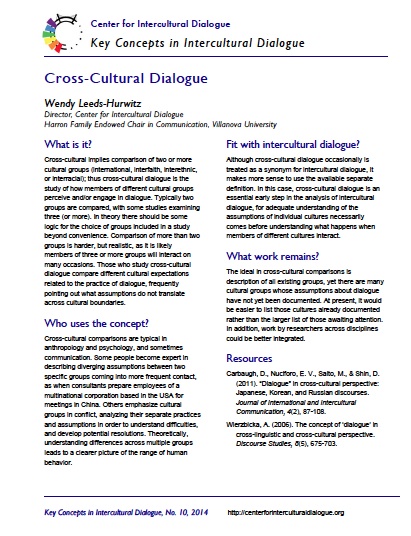
Key Concepts #10: Cross-Cultural Dialogue by Wendy Leeds-Hurwitz

Key Concepts in ICDThe next issue of Key Concepts in intercultural Dialogue is now available. This is KC10: Cross-Cultural Dialogue by Wendy Leeds-Hurwitz. As always, all Key Concepts are available as free PDFs; just click on the thumbnail to download.Lists organized  chronologically by publication date and numberalphabetically by concept in English, and by languages into which they have been translated, are available, as is a page of acknowledgments with the names of all authors, translators, and reviewers.

KC10-sm

Leeds-Hurwitz, W. (2014). Cross-cultural dialogue. Key Concepts in Intercultural Dialogue, 10. Available from:
https://centerforinterculturaldialogue.org/wp-content/uploads/2014/04/key-concept-cross-cultural-dialogue.pdf

The Center for Intercultural Dialogue publishes a series of short briefs describing Key Concepts in intercultural Dialogue. Different people, working in different countries and disciplines, use different vocabulary to describe their interests, yet these terms overlap. Our goal is to provide some of the assumptions and history attached to each concept for those unfamiliar with it. As there are other concepts you would like to see included, send an email to the series editor, Wendy Leeds-Hurwitz. If there are concepts you would like to prepare, provide a brief explanation of why you think the concept is central to the study of intercultural dialogue, and why you are the obvious person to write up that concept.


Creative Commons License
This work is licensed under a Creative Commons Attribution-NonCommercial-NoDerivatives 4.0 International License.

New Intercultural Dialogue book out

Intercultural dialogue: Modern paradigm and experience of the neighborhood has just been published as an ebook, and is available for free (just click on the thumbnail below if you want a copy). The editor is Liubou Uladykouskaja, Director of the Institution Intercultural Dialogue in Minsk, Belarus.

ICD-Belarus-coverIn the original Cyrillic, the citation would be:

Міжкультурны дыялог: сучасная парадыгма і во­пыт су­cедства : зб. навук. арт. / склад. і навук. рэд.Л. Уладыкоўская. – Мінск : ДIКСТ БДУ, 2014.


This collection includes selected materials from the international scientific conference of the same name organized by the Polish Institute in Minsk, the State Institute of Management and Social Technologies of the Belarusian State University, the Institution “Intercultural Dialogue” (held in Minsk on May 24, 2013) , as well as scientific developments of foreign authors. The articles discuss various aspects and modern concepts of intercultural dialogue and the basis of its research methodology. Chapters are written in Belarusian, Polish, English and Russian; the authors are from the US, Belarus, Poland, and Ukraine.

The one chapter in English is by the CID Director, Wendy Leeds-Hurwitz, based on a paper delivered at the World Forum on Intercultural Dialogue in Baku, Azerbaijan in 2011. In English, that citation would be:

Leeds-Hurwitz, W. (2014). Dialogue about dialogue: Taking a (meta)communication perspective on intercultural dialogue. In L. Uladykouskaja (Ed.), Intercultural dialogue: Modern paradigm and experience of the neighborhood (pp. 6-13). Minsk, Belarus: Belarusian State University.