Universität für Weiterbildung Krems: 3 Positions in Migration/Globalization (Germany)

“Job

Multiple positions related to migration and globalisation, Universität für Weiterbildung Krems, Germany. Deadline: varies by position. 

Senior Scientist (postdoc), Department of Migration and Globalisation. Deadline 30 September 2024.

This search is for a Post-Doctoral Researcher interested in conducting independent research on ethical issues related to migration policy making. The topic should fit broadly within the thematic scope of the project The Ethics of Migration Policy Dilemmas. Candidates should submit a brief outline in their application defining the topic they want to research about and explaining in which way their topic relates to the aims of the Dilemmas project. In particular, they welcome applications by researchers that have recently finished their PhD and who want to use the time to publish one or two articles out of (or as a follow-up to) their dissertation work, as well as to prepare a new research proposal for external funding (for example by the Austrian Science Fund’s ESPRIT program, the Austrian Academy of Sciences’ APART program, or the European Union’s Marie Curie program).

Early Stage Researcher (PhD Student), Department of Migration and Globalisation. Deadline: 25 September 2024.

This position begins with a two-month Visiting Research Fellowship dedicated for drafting a PhD Proposal. Upon successful evaluation, it transitions into a three-year fixed position within the ERC Starting Grant project “MixedRivals”, funded by the EU. The PhD candidate will play a pivotal role in the MixedRivals project, primarily focusing on the data collection related to de facto (forced) migration policies, supporting qualitative interviews, and assisting with survey design and analysis. This position offers a unique opportunity to engage in cutting-edge research at the intersection of (forced) migration and conflict studies.

Project Research Associate, Research Lab Sustainable Cultural Heritage. Deadline: 1 October 2024.

The research associate will have the following tasks: to conduct research in the field of historical textiles and bookbinding techniques, focusing on conservation methods; develop and refine research charters, transitioning these into an electronic format; manage and safeguard research data, contributing directly to ongoing conservation projects; writing scientific texts and presenting the results; gain specialized expertise through research work, which will significantly enhance future career prospects; and participate in project coordination and management tasks as required.

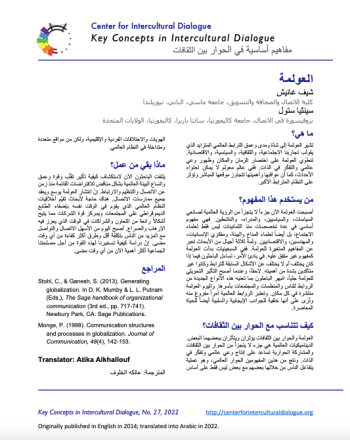
KC27 Globalization Translated into Arabic

Key Concepts in ICDContinuing translations of Key Concepts in Intercultural Dialogue, today I am posting KC 27: Globalization, which Shiv Ganesh and Cynthia Stohl wrote for publication in English in 2014, and which Atika Alkhallouf has now translated into Arabic.

As always, all Key Concepts are available as free PDFs; just click on the thumbnail to download. Lists of Key Concepts organized chronologically by publication date and number, alphabetically by concept, and by languages into which they have been translated, are available, as is a page of acknowledgments with the names of all authors, translators, and reviewers.

KC27 Globalization_ArabicGanesh, S., & Stohl, C. (2022). Globalization [Arabic]. (A. Alkhallouf, Trans.). Key Concepts in Intercultural Dialogue, 27. Retrieved from: https://centerforinterculturaldialogue.org/wp-content/uploads/2022/02/kc27-globalization_arabic.pdf

If you are interested in translating one of the Key Concepts, please contact me for approval first because dozens are currently in process. As always, if there is a concept you think should be written up as one of the Key Concepts, whether in English or any other language, propose it. If you are new to CID, please provide a brief resume. This opportunity is open to masters students and above, on the assumption that some familiarity with academic conventions generally, and discussion of intercultural dialogue specifically, are useful.

Wendy Leeds-Hurwitz, Director
Center for Intercultural Dialogue


Creative Commons License
This work is licensed under a Creative Commons Attribution-NonCommercial-NoDerivatives 4.0 International License.

KC27 Globalization Translated into Turkish

Key Concepts in ICDContinuing translations of Key Concepts in Intercultural Dialogue, today I am posting KC 27: Globalization, which Shiv Ganesh and Cynthia Stohl wrote for publication in English in 2014, and which Candost Aydın has now translated into Turkish.

As always, all Key Concepts are available as free PDFs; just click on the thumbnail to download. Lists of Key Concepts organized chronologically by publication date and number, alphabetically by concept, and by languages into which they have been translated, are available, as is a page of acknowledgments with the names of all authors, translators, and reviewers.

KC27 Globalization_TurkishGanesh, S., & Stohl, C. (2022). Globalization [Turkish]. (C. Aydın, Trans.). Key Concepts in Intercultural Dialogue, 27. Retrieved from: https://centerforinterculturaldialogue.org/wp-content/uploads/2021/12/kc27-globalization_turkish.pdf

If you are interested in translating one of the Key Concepts, please contact me for approval first because dozens are currently in process. As always, if there is a concept you think should be written up as one of the Key Concepts, whether in English or any other language, propose it. If you are new to CID, please provide a brief resume. This opportunity is open to masters students and above, on the assumption that some familiarity with academic conventions generally, and discussion of intercultural dialogue specifically, are useful.

Wendy Leeds-Hurwitz, Director
Center for Intercultural Dialogue


Creative Commons License
This work is licensed under a Creative Commons Attribution-NonCommercial-NoDerivatives 4.0 International License.

KC27 Globalization Translated into German

Key Concepts in ICDContinuing translations of Key Concepts in Intercultural Dialogue, today I am posting KC#27: Globalization, which Shiv Ganesh and Cynthia Stohl wrote for publication in English in 2014, and which Marlena Pompino has now translated into German.

KC27 Globalization_GermanAs always, all Key Concepts are available as free PDFs; just click on the thumbnail to download. Lists of Key Concepts organized chronologically by publication date and number, alphabetically by concept, and by languages into which they have been translated, are available, as is a page of acknowledgments with the names of all authors, translators, and reviewers.

Ganesh, S., & Stohl, C. (2018). Globalisierung. (M. Pompino, Trans.). Key Concepts in Intercultural Dialogue, 27. Retrieved from: https://centerforinterculturaldialogue.org/wp-content/uploads/2021/04/kc27-globalization_german.pdf

If you are interested in translating one of the Key Concepts, please contact me for approval first because dozens are currently in process. As always, if there is a concept you think should be written up as one of the Key Concepts, whether in English or any other language, propose it. If you are new to CID, please provide a brief resume. This opportunity is open to masters students and above, on the assumption that some familiarity with academic conventions generally, and discussion of intercultural dialogue specifically, are useful.

Wendy Leeds-Hurwitz, Director
Center for Intercultural Dialogue


Creative Commons License
This work is licensed under a Creative Commons Attribution-NonCommercial-NoDerivatives 4.0 International License.

KC27 Globalization Translated into Greek

Key Concepts in ICDContinuing translations of Key Concepts in Intercultural Dialogue, today I am posting KC#27: Globalization, which Shiv Ganesh and Cynthia Stohl wrote for publication in English in 2014, and which Anastasia Karakitsou has now translated into Greek.

As always, all Key Concepts are available as free PDFs; just click on the thumbnail to download. Lists of Key Concepts organized chronologically by publication date and number, alphabetically by concept, and by languages into which they have been translated, are available, as is a page of acknowledgments with the names of all authors, translators, and reviewers.

KC27 Globalization_GreekGanesh, S., & Stohl, C. (2018). Globalization [Greek]. (A. Karakitsou, trans). Key Concepts in Intercultural Dialogue, 27. Retrieved from:
https://centerforinterculturaldialogue.org/wp-content/uploads/2018/03/kc27-globalization_greek.pdf

If you are interested in translating one of the Key Concepts, please contact me for approval first because dozens are currently in process. As always, if there is a concept you think should be written up as one of the Key Concepts, whether in English or any other language, propose it. If you are new to CID, please provide a brief resume. This opportunity is open to masters students and above, on the assumption that some familiarity with academic conventions generally, and discussion of intercultural dialogue specifically, are useful.

Wendy Leeds-Hurwitz, Director
Center for Intercultural Dialogue


Creative Commons License
This work is licensed under a Creative Commons Attribution-NonCommercial-NoDerivatives 4.0 International License.

CFP Bringing International Perspectives to the Communication Curriculum

Publication OpportunitiesSpecial Issue Call for Papers
Eunkyong (Esther) Lee Yook, George Mason University, Paaige K. Turner, National Communication Association (Co-Guest Editors) of Bringing International Perspectives to the Communication Curriculum in an Era of Globalization for The Journal of Intercultural Communication Research (JICR)

This Special Issue of The Journal of Intercultural Communication Research (JICR) invites papers that advance internationalization of the communicaton curriculum and/or global education experiences through the application and integration of communication theory and research.  The goal is to disseminate instructional approaches, ideas, and activities that bring a global perspective to the communication curricuum, and to generate an on-going discussion about the pedagogy of internationalization for intercultural competence in an era of globalization.

According to the International Association of Universities, an increasing interdependence among nations as well as intensified mobility of goods, ideas and people has had the effect of making internationalization more of an institutional imperative .  Responding to this mandate, universities around the world have begun to participate in the higher education internationalization process in diverse ways, including expanded recruitment of international students, study-abroad programs, dual/joint degrees, and the development of international branch campuses.  In the United States, international students will more than double from three to over seven million annually from 2000 to 2025 (Banks et al. 2007; Haddad 2006).  Conversely, the United States and other nations recently have experienced a surge in nationalism that will challenge internationalization efforts by universities and faculty (e.g., Brexit, US/Mexico Border Wall) in all disciplines.

Given the trend towards globalization and its resulting internationalization of our campuses, it is timely to: 1) review the current limitations of the communication curriculum and revise it appropriately to adjust to the new global environment, and 2) integrate the knowledge and skills of the communication discipline with other curriculum to support the development of global citizens in all countries.

For this special issue we seek articles and teaching cases that reconceptualize communication curriculum (macro, meso, or micro levels) and/or ground global education experiences in communication theory and research.  We seek projects that accomplish one of the following:
–       internationalize assignments, courses or sub disciplines in communication (e.g., interpersonal communication, organizational communication).
–       bring communication theory or research to other disciplines to advance internationalization efforts (e.g., intercultural communication and history)
–       Integrate communication theory or research into a study-abroad experience
–       Integrate communication theory or research into domestic, global educational experiences.

Manuscripts may have one of two foci.  The first is a review and application of communication theory and literature to a curriculum or subject area in or outside of the communication discipline to support internationalization (3,500 – 4,000 words).  The second is a detailed presentation of pedagogical activities that demonstrate a use of communication theory or literature that brings a global perspective to a class, unit activity, or semester activity (2,000 – 3,000 words). All manuscripts must demonstrate a substantive connection to communication theory and research while articulating a clear pedagogical practice and impact on social or curriculum goals.

Abstracts of 250 – 300 words should be submitted by July 1, 2017 to Esther Yook.  Selected authors will receive an invitation to submit full manuscripts for consideration by August 1, 2017.   Completed manuscripts are due November 1, 2017.  Contact co-guest editor Paaige K. Turner or Esther Yook with questions.

Supported by the National Communication Association Task Force on Facilitating International Collaborations.

Save

Save

Save

Key Concept #27: Globalization Translated into Chinese

Key Concepts in ICDContinuing translations of Key Concepts in Intercultural Dialogue, today I am posting KC#27: Globalization, first published in English in 2014, which Min He has now translated into Simplified Chinese.

As always, all Key Concepts are available as free PDFs; just click on the thumbnail to download. Lists of Key Concepts organized chronologically by publication date and number, alphabetically by concept, and by languages into which they have been translated, are available, as is a page of acknowledgments with the names of all authors, translators, and reviewers.

KC27 Globalization_Chinese-simGanesh, S., & Stohl, C. (2017). Globalization [Simplified Chinese]. (M. He, Trans). Key Concepts in Intercultural Dialogue, 27. Available from:
https://centerforinterculturaldialogue.org/wp-content/uploads/2017/03/kc27-globalization_chinese-sim.pdf

If you are interested in translating one of the Key Concepts, please contact me for approval first because dozens are currently in process. As always, if there is a concept you think should be written up as one of the Key Concepts, whether in English or any other language, propose it. If you are new to CID, please provide a brief resume. This opportunity is open to masters students and above, on the assumption that some familiarity with academic conventions generally, and discussion of intercultural dialogue specifically, are useful.

Wendy Leeds-Hurwitz, Director
Center for Intercultural Dialogue


Creative Commons License
This work is licensed under a Creative Commons Attribution-NonCommercial-NoDerivatives 4.0 International License.

CFP: Multilingualism and Journalism in the Era of Convergence

CFP: Multilingualism and Journalism in the Era of Convergence
Edited by Lucile Davier (University of Geneva) and Kyle Conway (University of Ottawa)

Technological convergence, or the blurring of lines between formerly distinct media, has had a tremendous impact on the work journalists do. For one thing, it has contributed to the processes of globalization that have brought people into greater contact with cultural others. For another, it has made it possible for an ever smaller group of corporations to control an ever larger share of the media. As a result, journalists must become proficient with more aspects of production (combining video, text, and images) while reporting on a wider range of people and cultures and responding to the economic pressures that come with the concentration of media ownership.

This book will look at the ways journalists are making sense of and adapting to this changing environment. It will focus on those moments when they gather information in languages that their audiences do not speak. It will ask, what technologies do they use as they collect information, transform it into a story, and disseminate it to their readers, viewers, and listeners? It will examine questions of translation in the broadest possible sense-from the re-expression of bits of speech or text in a different language, to the rewriting of partial or complete news stories, to the explanation of how members of a foreign cultural community interpret an object or event.

The editors would like to invite submissions from a range of disciplines such as communication, translation studies, and sociology. Potential questions authors might address include (but are not limited to):

Platforms:
– In what contexts do journalists indicate that a source spoke or wrote in a different language?
– What modes of translation (e.g., subtitling, voice-over, etc.) do journalists use?
– Do journalists favour different modes of re-expression on different platforms?
– What strategies do they adopt for cross-platform or multimodal distribution?
– How do they adapt the same news story for multiple formats?
– Do ideas of newsworthiness vary depending on the platform?

Social implications:
– How visible are multilingual contexts for audiences?
– Do convergence phenomena contribute to the globalization or the localization of news?
– What are the implications of journalists’ practices for how audiences perceive cultural others?

To propose a chapter, please send an abstract to multilingualism.convergence@gmail.com. Abstracts should be 500 words long and submitted as .odt, .doc, .docx, or .rtf files. Proposal deadline: January 15, 2017. Initial acceptances sent: February 15, 2017. Deadline for full articles (6,000-8,000 words): May 31, 2017.

CFP IAICS Culture, Communication – Hong Kong 2015

IAICS-2015 Call for Submission

The 21st International Conference of the International Association for Intercultural Communication Studies (IAICS) cum The 11th Biennual International Conference of the China Association for Intercultural
Communication (CAFIC)

Conference Theme: Culture, Communication, and Hybridity in an Age of Globalization
Conference Time: July 15-18, 2015
Conference Venue: The Hong Kong Polytechnic University, Hong Kong

Topic areas are broadly defined as, but not limited to, the following:
Advertising and marketing across cultures
Bilingual and multilingual communication
Bilingual education
Comparative literature
Conflict, mediation and negotiation across Cultures
Corporate culture and management
Crisis/risk communication
Cross-cultural adaptation
Cross-cultural interaction
Culture and diplomacy
Digital communication across cultures
Ethnic studies
Gender issues and communication
Glocalization
Group/Organizational communication
Health communication
Intercultural communication competence
Intercultural communication and politics
Intercultural and multilingual education
Intercultural pragmatics
Interethnic communication and relations
Interpersonal communication and relations
Language and cultural hybridity
Language planning and policy
Media and transcultural communication
Multiple cultures and interculturality
Philosophy and human behavior patterns
Psychological communication studies
Public opinions and public policy
Public relations
Rhetorical communication
Second language education
Social media and communication
Sustainability and globalization
Transculturality in global context
Translation studies
Verbal and nonverbal communication

Guidelines for Submissions
Categories: Abstract, panel proposals, and workshop proposals may be
accepted.
1. Abstract, 150-250 words in English, including positions,
affiliations, email addresses and mailing addresses for all authors.
2. Panel proposals reflecting the conference theme may be submitted. All
panel proposals should provide a 100-word rationale and a 100-200 word
abstract of each panelist’s paper; include affiliation and email
addresses for each panelist.
3. Workshop proposals relevant to the conference theme may be submitted.
Proposals should be 3-5 pages in length, single spaced.

Deadline: Please submit abstracts by January 11, 2015, and panel/workshop proposals and roundtable discussion sessions by February 1, 2015.

Conference Working Languages: English and Chinese
Conference host: Department of Chinese and Bilingual Studies, The Hong Kong Polytechnic University

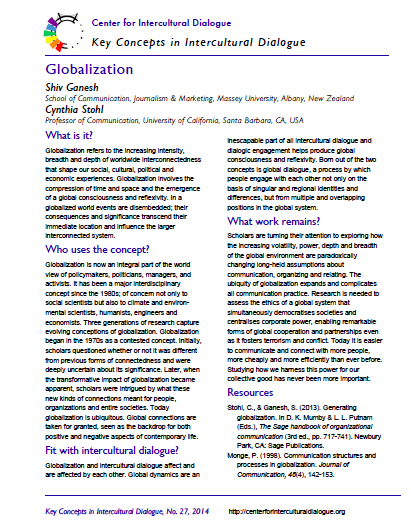
Key Concept #27: Globalization by Shiv Ganesh and Cynthia Stohl

Key Concepts in ICDThe next issue of Key Concepts in intercultural Dialogue is now available. This is KC27: Globalization by Shiv Ganesh and Cynthia Stohl. As always, all Key Concepts are available as free PDFs; just click on the thumbnail to download. Lists organized  chronologically by publication date and numberalphabetically by concept in English, and by languages into which they have been translated, are available, as is a page of acknowledgments with the names of all authors, translators, and reviewers.

kc27-smGanesh, S., & Stohl, C. (2014). Globalization. Key Concepts in Intercultural Dialogue, 27. Available from:
https://centerforinterculturaldialogue.org/wp-content/uploads/2014/08/key-concept-globalization.pdf

The Center for Intercultural Dialogue publishes a series of short briefs describing Key Concepts in intercultural Dialogue. Different people, working in different countries and disciplines, use different vocabulary to describe their interests, yet these terms overlap. Our goal is to provide some of the assumptions and history attached to each concept for those unfamiliar with it. As there are other concepts you would like to see included, send an email to the series editor, Wendy Leeds-Hurwitz. If there are concepts you would like to prepare, provide a brief explanation of why you think the concept is central to the study of intercultural dialogue, and why you are the obvious person to write up that concept.


Creative Commons License
This work is licensed under a Creative Commons Attribution-NonCommercial-NoDerivatives 4.0 International License.