CFP Studies on Discourse/Society (Spain) 2014

1st International Symposium EDiSo 2014 ‐ Studies on Discourse and Society
Seville, Spain, 15‐16 May, 2014
Sponsor: Asociación de Estudios Sobre Discurso y Sociedad

The 1st EDiSo Symposium includes the following three types of work sessions which are open for participation:
• Seminars: Designed mainly for senior or junior researchers interested in presenting their research outcomes
and exchanging ideas with colleagues who hold similar interests.
• Workshops: Designed mainly for junior researchers or those with research in progress who wish to participate in practical sessions about research methodology and to obtain feedback on their work.
• Posters: Designed for sharing research results, research in progress, or studies in the early stages that could benefit from open discussion with other researchers.

Submit the proposal according to instructions available at the portal before 30 March, 2014.

Save

Fernand Braudel fellowships to France

Fernand Braudel – IFER Fellowships
Call for applications March 2014

Fernand Braudel-IFER (International Fellowships for Experienced Researchers) Programme supported by the European Commission (Marie Curie Action Programme – COFUND – FP7). The Foundation Maison des sciences de l’homme and the partners of the programme offer postdoctoral fellowships in the humanities and social sciences for a period of nine months.

Programme

This programme is open to applicants from all countries, belonging to a foreign research centre, who wish to undertake a research residency in France.

These post-doctoral research stays are designed to enable researchers to carry out a research project in a host laboratory, integrate scientific networks in France and other European countries and build lasting partnerships between their home institution and the host institution. Applicant’s projects should match the areas of research of these institutions.

All social and human sciences are eligible. An interdisciplinary approach to research topics is encouraged.

Candidates must apply to specific fellowships, offered by several research institutions and “Laboratories of excellence” (Labex) who are partners of the programme.

Online application platform will be open on March 3 2014
Deadline for submission : April 3 2014

Please read carefully the eligibility criteria and the application procedure before applying online.


CID has 1000 Subscribers!

About CIDAccording to the Center for Intercultural Dialogue’s website, we have just crossed the 1000 mark!

CID at 1000 subscribers

This number includes those who have signed up through WordPress for email notification each time a new post appears, as well as those who follow us through Facebook, Twitter, or Google +. WordPress cannot track those who have joined the CID LinkedIn group (which currently stands at 112), or who find CID through YouTube or Pinterest, so the actual number of subscribers is actually even higher. It took 3 1/2 years to get to this point, but presumably it will take a lot less time to get to 2000!

As the number of followers has increased, CID’s email has increased as well. We try to answer all emails within a few days, and to post relevant information within a week.

We very much appreciate your support.

Wendy Leeds-Hurwitz, Director
Center for Intercultural Dialogue

Study abroad Nicaragua with Humboldt State U

Communication Summer in Nicaragua Study Abroad Program
June-July 2014-June 1-29: online; June 30-July 29: in Nicaragua

Deadline for applications:  April 1, 2014

The Communication Department at Humboldt State University (California) is offering a unique opportunity to study intercultural communication and language development in Managua, Nicaragua.  This eight-unit program consists of two courses.  Four weeks of readings, online activities, and online assessments will prepare students for travel and study abroad in Nicaragua.

The home site will be at the Universidad Americana (UAM) in Managua.  We will engage in field experiences around Nicaragua to learn about the complexity of the culture and develop skills in communicating in Spanish.  

COMM 480, 4 semester units: Communication and Language Development
COMM 322, 4 semester units: Intercultural Communication
Both of these courses fulfill requirements in the Communication major and minor at Humboldt State University. The two courses will be taught in English.

For more information, please visit the Study Abroad website or contact:  Dr. Armeda Reitzel.

Save

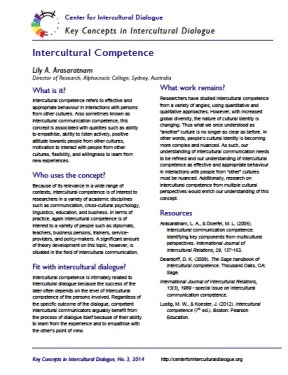
Key Concepts in Intercultural Dialogue #3: Intercultural Competence by Lily A. Arasaratnam

Key Concepts in ICDThe third issue of Key Concepts in intercultural Dialogue is now available. This is KC3: Intercultural Competence by Lily A. Arasaratnam. As always, all Key Concepts are available as free PDFs; just click on the thumbnail to download. Lists organized  chronologically by publication date and numberalphabetically by concept in English, and by languages into which they have been translated, are available, as is a page of acknowledgments with the names of all authors, translators, and reviewers.

Intercultural competence

Arasaratnam, L. (2014). Intercultural competence. Key Concepts in Intercultural Dialogue, 3. Available from:
https://centerforinterculturaldialogue.org/wp-content/uploads/2014/02/key-concept-intercultural-competence.pdf

The Center for Intercultural Dialogue is publishing a series of short briefs describing Key Concepts in intercultural Dialogue. The logic is that different people, working in different countries and disciplines, use different vocabulary to describe their interests, yet these terms overlap. Our goal is to provide some of the assumptions and history attached to each concept for those unfamiliar with it. As there are other concepts you would like to see included, send an email to the series editor, Wendy Leeds-Hurwitz. If there are concepts you would like to prepare, provide a brief explanation of why you think the concept is central to the study of intercultural dialogue, and why you are the obvious person to write up that concept.


Creative Commons License
This work is licensed under a Creative Commons Attribution-NonCommercial-NoDerivatives 4.0 International License.

Digital Arts & Humanities PhD scholarships U Coll Cork (Ireland)

University College Cork invites applications for the first round of scholarships in the four-year structured PhD programme in Digital Arts and Humanities (DAH) co-ordinated with an all-Irish university consortium. Candidates will pursue their individual research agendas within the program, based on projects developed from proposals which they provide during the application process.  Deadline for early acceptance: 15 March 2014. Course details available. Tuition waivers are available to Non-EU candidates.

What is DAH?
The ever-evolving developments in computing and their performative and analytical implications have brought about a quantum leap in arts and humanities research and practice. Digital Arts and Humanities is a field of study, research, teaching, and invention at the intersection of computing and information management with the arts and humanities. The DAH Structured PhD programme has developed a research platform, structures, partnerships and innovation models by which fourth-level researchers can engage with a wide range of stakeholders in order to contribute to the developing digital arts and humanities community world-wide, as participants and as leaders.  Currently the program includes a vibrant community of 50 researchers throughout Ireland.

Programme Structure
Candidates will complete core, training and career development modules, including main modules shared across the consortium and others institutionally-based. The overall aim of the taught modules are threefold: 1) to introduce students to the history and theoretical issues in digital arts/humanities; 2) to provide the skills needed to apply advanced computational and information management paradigms to humanities/arts research; 3) to provide an enabling framework for students to develop generic and transferable skills to carry out their final research projects/dissertations.

Year 1 of the four-year programme includes core and optional graduate education modules delivered in Cork, Dublin, Galway and Maynooth. These modules provide a grounding in essential research skills and transferable skills together with access to specialist topics. In years 2 and 3 work on PhD research projects is supplemented with access to elective modules. Year 3 features practical placements in industry, academic research environments or cultural institutions.

University College Cork has a strong track record in Digital Humanities and has been a pioneer in the development of digital tools for language study and historiography. The College is strong in all disciplines of the Humanities, with a particular concentration on Irish and European studies. The Digital Arts and Humanities program currently has 46 students from around the globe, studying topics ranging from Renaissance networking to eighteenth-century country houses, from modern performance art to Irish diaspora music performers in the USA and their stories. Details about some typical projects available.

CFP Paris Institute for Advanced Studies 2015-16

Call for applications
Paris Institute for Advanced Studies (Paris IAS)
Academic year 2015-2016

The Paris Institute for Advanced Studies welcomes applications from all over the world from established scholars and scientists in the fields of the humanities, the social sciences and related fields for periods of five or nine months, respectively. The Paris IAS will host twenty international guest researchers for 2014-2015 to work freely on the project of their choice, to benefit from the scientific environment of the Institute, and to create contacts with researchers in the academic institutions of Greater Paris.

Deadline for applications: April 30, 2014

Applicants may request residencies for the following periods:
1 September 2015 to 31 January 2016 (5 months)
or 1 October 2015 to 30 June 2016 (9 months)
or 1 February to 30 June 2016 (5 months)

See the call for application online

CFP ICTs, Governance & Peacebuilding in Africa

Call for chapter proposals: ICTs, Governance & Peacebuilding in Africa

New information technologies (ICTs) such as mobile phones hold great potential to affect peacebuilding, statebuilding, governance, transparency, and accountability in Africa. ICTs ubiquity and ability to interact with older media enables citizens to experiment with innovative ways of influencing politics.  Despite strong assertions in the existing research regarding the usefulness of ICTs (and media more generally) in political and post-conflict transition, governance, and development, there is very little understanding of how people and communities in Africa actually use these ICTs, and how these uses contribute to governance and peacebuilding.

The Annenberg School for Communication at the University of Pennsylvania and the Programme in Comparative Media Law and Policy at the University of Oxford are currently seeking papers for a forthcoming workshop and an edited volume. Authors are asked to provide critical analyses of how the public uses, makes sense of, and engages with ICTs, and the relationship between ICTs, the public, and governance or peacebuilding. Strong preference will be given to chapters that provide empirical evidence for the arguments put forth. Analyses should be applicable to Africa, and chapters focused on Eastern Africa are especially welcome. Academics from African universities are particularly encouraged to apply.

Funding will be provided for successful authors to attend the workshop, which will be held either in New York, USA or Oxford, UK in June or July 2014.

For chapters incorporating empirical research, we are particularly interested in qualitative methodologies (case studies, ethnography, interviews, etc.) but all approaches are acceptable.

Contributions may focus on, but are not limited to:

• The use of crowd-sourcing in conflict-affected regions • The role of ICTs in accountability or transparency initiatives • Local perspectives on citizen ‘voice’ and the use of ICTs • The use of ICTs in transitional justice processes • The intersection or merging of old and new technologies to impact peacebuilding or governance • ICT innovation at the grassroots level

Abstracts (max. 2000 words) and author biography (max. 100 words) are due by March 6, 2014.

Please send abstracts, as well as any questions, to Libby Morgan.

Notification of selected authors: March 20, 2014
Deadline for submission of rough papers in APA format: June 15, 2014
Deadline for submission of final papers in APA format (6,000-8,000
words): August 15, 2014

This book is being funded by a grant from the Carnegie Corporation of New York and is part of a multi-year research project on ICTs, Statebuilding and Peacebuilding in Eastern Africa.

Intercultural Innovation Award 2014

The BMW Group and the United Nations Alliance of Civilizations (UNAOC) have started, under the  Intercultural Innovation Award , their annual search for grass-root organizations engaged in innovative cross-cultural work.

Ten organizations with grassroots projects that promote intercultural understanding in new and sustainable ways will be awarded funding and strategic support by the BMW Group and the UNAOC. To be considered, organizations must apply online by Wednesday, 30 April, 2014 at 5:00 pm New York City time.

The top ten finalists will be invited to present their projects at the 6th UNAOC Global Forum in August 2014 in Bali, Indonesia. A total of 100,500 USD is offered to the awardees, of which 40,000 USD goes to the winning project.

Venice Academy of Human Rights 2014

Venice Academy of Human Rights 2014 – “Judicial Legitimacy and the Rule of Law”
7-16 July 2014

Online applications are accepted until 4 May 2014. The Academy offers an “early bird” registration with a reduced participation fee until 15 March 2014.

Key Facts
Participants: Academics, practitioners, PhD/JSD and master students
Type of courses: Lectures, seminars, workshops and discussion sessions
Number of hours: up to 35 hours of courses
Location: Monastery of San Nicolò, Venice – Lido, Italy
Fees: 500 EUR (early bird until 15 March), 600 EUR (16 March – 4 May 2014)

Venice Academy of Human Rights
The Venice Academy of Human Rights is an international programme of excellence for human rights education, research and debate. It forms part of the European Inter-University Centre for Human Rights and Democratisation (EIUC). The Academy offers interdisciplinary thematic programmes open to academics, practitioners, doctoral and master students with an advanced knowledge of human rights. Participants attend morning lectures, participate in discussion sessions and workshops and can exchange views, ideas and arguments with leading international scholars and experts. This includes the opportunity for a number of participants to present and discuss their own “work in progress” such as drafts of articles, chapters of books or doctoral theses and receive comments from faculty members (including P. Alston, A. Føllesdal, G. Ulfstein and J. Waldron) and peers. At the end of the programme, participants receive a Certificate of Attendance issued by the Venice Academy of Human Rights.