CFP IMéRA (France) residencies

IMéRA (Institute for Advanced Study of Aix-Marseille University) is issuing calls for applications for residencies in 2015 and 2016

*Call for individual applications opened to scientists and artists, for residence schemes scheduled between 23 February 2015 and 13 July 2016 (duration 5 or 10 months);
*Call for team applications opened to scientists and artists, for residence schemes scheduled between 23 February 2015 and 13 July 2016 (duration 2, 3 or 4 weeks) ;
*In connection with the LabexMed programme, call for individual applications opened to scientists for residence schemes scheduled between 15 September 2014 and 17 July 2015 (duration 5 or 10 months).

IMéRA residence proposals are open to researchers (senior and junior) of all origins in terms of nationality and disciplines. IMéRA will consider applicants from the Mediterranean rims in a particularly favourable way.

Deadline : April 7, 2013

Applications can only be submitted on IMéRA’s website.

IMéRA (Mediterranean Institute for Advanced Research) is an Université d’Aix-Marseille [Aix-Marseille University – AMU] Foundation. As such, it is a member of Réseau Français des Instituts d’Etudes Avancées (RFIEA) [French Advanced Study Institutes Network] as well as of réseau Eurias [Eurias network] and of the European Network of University-Based Institutes.

Conf on ICTs in Education Greece 2014

International Conference on Information Communication Technologies in Education (ICICTE)
Kos, Greece-July 3rd-July 5th

This call is for papers, workshops and poster sessions examining the theoretical and practical applications of technology in education at all levels in both the public and private sectors.

If you are interested in presenting a paper, please submit your proposal online. All proposals are peer reviewed by members of the Scientific Committee.

Proposals must be submitted by February 21, 2014. Notification on whether the proposal has been accepted will be sent by February 28, 2014.

Completed manuscripts must be submitted by March 28, 2014 and will also be double-blind peer reviewed by the Scientific Committee. Comments will be forwarded to the authors, and final manuscripts, with editorial changes, must be received by April 30, 2014. Papers presented at the conference will be published in the proceedings under the title Information Communication Technologies in Education. Papers received after the deadline will not be included in the proceedings.

Papers must not exceed 10 pages (including abstract, references, tables, figures and diagrams). Papers exceeding the stated limits will be returned to the authors for revision. Please consult the Manuscript Preparation Guidelines at the conference web site before submitting the final version of your paper.

All presented papers will be considered for the ICICTE 2014 selected papers issues of Campus-Wide Information Systems and the Journal of Cyber Ethics in Education.

Tribal Liaison/Prof of Practice -U San Diego

The University of San Diego (USD) is a Roman Catholic institution committed to advancing academic excellence, expanding liberal, professional and scientific knowledge, creating a diverse and inclusive community, and preparing leaders dedicated to ethical conduct and compassionate service. USD invites applications for the position of Tribal Liaison/Professor of Practice starting August 15, 2014. This is a full- time, benefit-based, 10-month position with two integrated areas of duties: half of the position serves as the University’s Tribal Liaison, supervised by the Associate Provost for Inclusion & Diversity; half as Professor of Practice, supervised by the Dean of the College of Arts & Sciences and the appropriate Department Chair.

The Tribal Liaison responsibilities include linking the University and its resources to the many tribal communities in its service area. Federally-recognized American Indian Tribes are considered sovereign nations, which underscores the need for appropriate interpretation of law and cultural protocol. Key responsibilities are becoming the campus expert in University and Tribal protocol issues, and developing and implementing programs, activities and networks that connect the University to urban- and reservation- based American Indian communities. The Tribal Liaison will advise on and implement best practices for the recruitment and retention of American Indian students, staff, and faculty at USD, function as a liaison between the campus community and American Indians and Tribal Nations in the larger San Diego County area and beyond, and work to build collaborative relationships among those entities. The Tribal Liaison will provide guidance and assistance to administrators, faculty and staff regarding tribal events, issues, educational needs, and protocol.

The Professor of Practice position is a non-tenure track instructional appointment in the College of Arts & Sciences. Responsibilities include: 1) teaching four courses per academic year; 2) holding one office hour per week per course taught; 3) performing departmental and/or college service duties as needed. Teaching duties include: designing syllabi and selecting instructional materials in coordination with the Chair; leading lectures and discussions, preparing and grading examinations, mentoring students in office hours, and assigning final grades.

A Master’s degree or equivalent in an academic discipline, with expertise in American Indian Studies, Ethnic Studies, or a relevant field required. A Doctoral or terminal degree preferred. This is a 10-month assignment paid over 12 months. For a full description of the position, qualifications, and other information, visit the University of San Diego Human Resources jobs website and reference job number IRC#12831. Inquiries should be directed to Esteban del Rio, Ph.D., Associate Provost, Inclusion & Diversity.

TO APPLY, complete BOTH of the following:
• Search IRC#12831 and choose the “Apply Now” button on the jobs website and follow instructions. If you have any questions or difficulties regarding the website, please contact the Employment Services Team.

• Submit via email:
1) a cover letter that includes relevant teaching experience, research, and direct experience working with and in American Indian communities;
2) resume/vita;
3) sample syllabi; and
4) have three reference letters submitted directly by your recommenders.

Review of applications begins February 28, 2014. Priority will be given to those who apply before that date. Applications will be reviewed until the position is filled.

USD is an Equal Opportunity employer, and is especially interested in candidates who can contribute to the diversity and excellence of our academic community.

The University of San Diego offers domestic partner benefits.

Huang Kuo Profile

Profiles

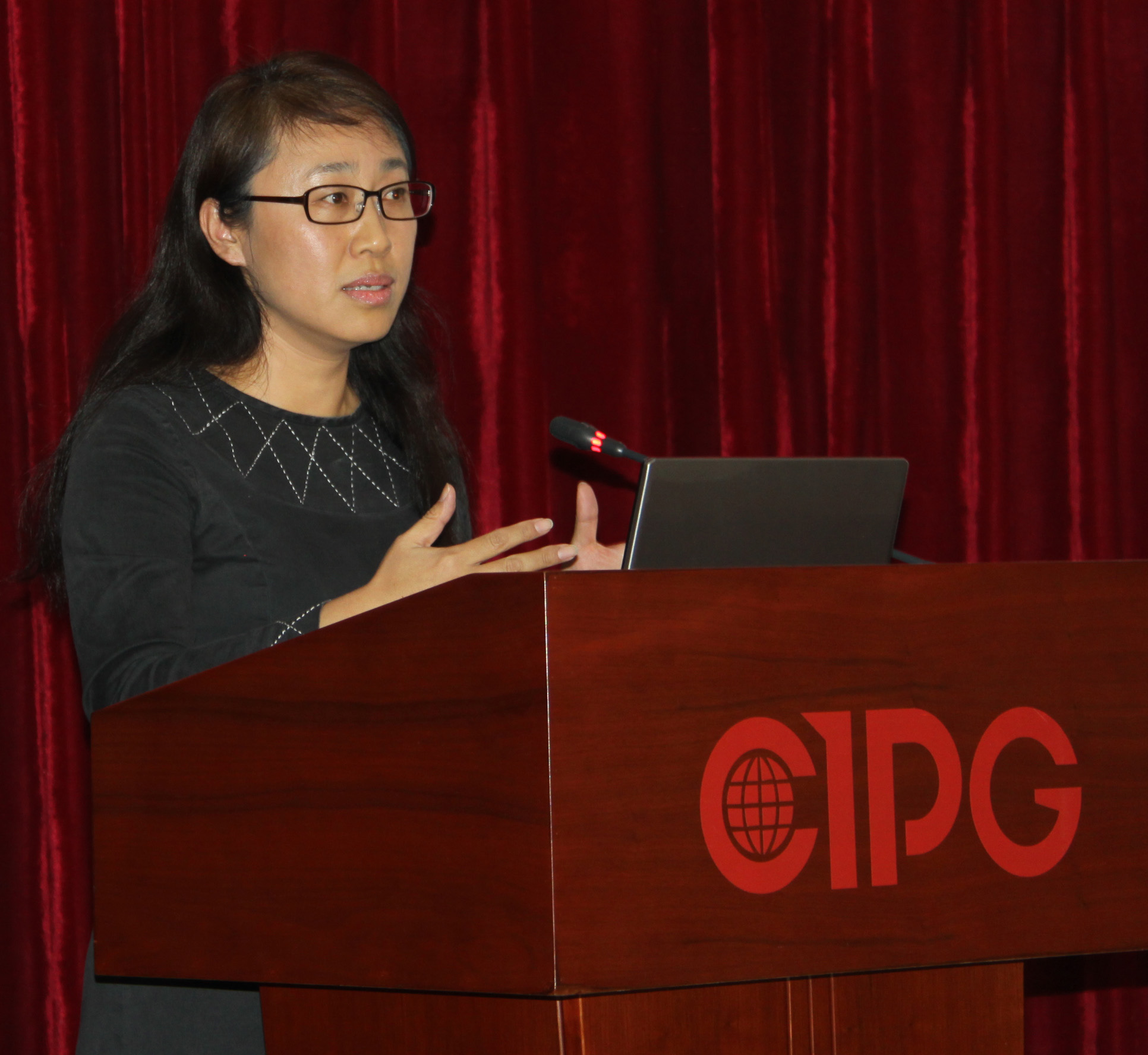
Dr. Huang Kuo is an Associate Professor at English Service of China Radio International (Beijing).
Huang Kuo

Before joining CRI, Dr. Huang worked as Associate Professor at the Center for International Communication Studies, China International Publishing Group (Beijing), Associate Professor at Heilongjiang University (China), Lecturer and Tutor in Macquarie University (Australia), and Lecturer in Beijing Normal University, Zhuhai campus (China).

She has a PhD in Music, Media, Culture and Communication Studies from Macquarie University, Australia, and MA in Communication from Westminster University, UK. Her research interests include international communications, audience studies, and new media. She has published many papers for journals and book chapters, and authored the books Chinese Boxes: Reality TV and Audience Participation (2014) and Multimedia Technology: How It Changes Classroom and Communication (2008).

Representative publications:

Huang, K. (2014). Chinese Boxes: Reality TV and Audience Participation. Lambert Academic Publishing.

Huang, K. (2014). Renewal of International Communication in the Context of Big Data Processing [大数据背景下国际传播的战略思考] in Zhengrong Hu et al (Eds.) Blue Book of International Communication: Annual Report on the Development of China’s International Communication (2014) (pp. 254-260). Beijing: Social Sciences Academic Press.

Huang, K. (2013). Participative Chinese audiences: A Case Study of the Reality Show Switching Spaces. Studies in Communication Sciences, 13(2), 117–128.

Jiang, F., & Huang, K. (2013). Community Media in China: Communication, Digitalization, and Relocation. Journal of International Communication 19(1), 59-68.

Huang, K. (2013). A Functional Approach towards Political Communication in Social Media—A Case Study of 2012 US Election [社交媒体的政治传播功能研究——以2012年美国大选的社交媒体战略为例]. International Communications [对外传播].1, pp.48-50.

Huang, K. (2012). How Family Factors Influence Teenagers in Internet Adoption [家庭因素对青少年互联网使用的影响] in Wenge LI et al (Eds.) Annual Report on the New Media Use by Minors in China 2011-2012, Blue Book of Teenagers [青少年蓝皮书:中国未成年人新媒体运用报2011-2012] (pp. 50-71). Beijing: Social Sciences Academic Press.

Huang, K. (2012). On Strategy Transformation of Western Media in International Communication [西方媒体国际传播战略转型的趋势及启示]. International Communications [对外传播], 7, 35-37.

Huang, K., & Jiang, F. (2012). How New Media Subvert and Reconstruct Chinese ‘Quan-Shi’ Culture [新媒体对中国“权势”文化的颠覆与重构], Exploration and Free Views [探索与争鸣], 7.

Huang, K., & Jiang, F. (2011). Transnational Media Corporations and National Culture as a Security Concern in China. In V. Bajc & W. de Lint (Eds.), Security and Everyday Life (pp. 212-235). New York: Routledge.

Huang, K. (2009). Multimedia Technology: How It Changes Classroom and Communication. VDM Verlag Dr. Müller Aktiengesellschaft & Co. KG.

Huang, K., & Chitty, N. (2009). Selling Participation to Audiences in China. Global Media Journal—Canadian Edition, 2(1), 123-147.

Huang, K., & Jiang, F. (2009). Understanding Diaspora Cultures in the Context of Globalization. International Journal of the Humanities, 7 (10), 115-130.


Work for CID:

Huang Kuo was one of the participants in the Roundtable on Intercultural Dialogue in Asia, co-sponsored by CID.

Jiang Fei Profile

ProfilesDr. Jiang Fei is Dean of the School of International Journalism and Communication at the Beijing Foreign Studies University. He has a Ph.D. from the Department of Literature, Media & Communication studies from Sichuan University (Chengdu, China).

Jiang Fei

Previously he was Professor at the Institute of Journalism and Communication, Chinese Academy of Social Sciences, where he also served as  Director of the Department of Communication Studies, and Director of the Global Media and Communication Research Center. He is also the Secretary General of the Communication Association of China (CAC), and associate editor for the Journal of China Media Report Overseas.

Prof. Jiang has taught at several universities in China and has given invited lectures at the Chinese University of Hong Kong, Taiwan National Chengchi University, and Lugano University (Switzerland). He was visiting scholar at Stockholm University (Sweden), Toronto University (Canada), University of British Columbia (Canada), Royal Roads University (Canada), Macquarie University (Australia) and the Annenberg School for Communications, University of Pennsylvania (USA). His research interests include communication theory, new media and intercultural communication studies, cultural studies, and post-colonial theory. He has published many papers for journals and book chapters, and authored three books on intercultural communication.

Books

Jiang, F. (2011). Communication and Culture [传播与文化]. Beijing: Chinese Communication University Press.

Jiang, F. (2005). Intercultural Communication in the Post-colonial Context [跨文化传播的后殖民语境]. Beijing: China Renmin University Press.

Jiang, F. (Ed.). (2005). Transnational Media in China [海外传媒在中国]. Beijing: CFLACPC (China Federation of Literary and Art Circles Publishing Corporation).

Representative Book Chapters and Journal Articles

Jiang, F. (2013). On the three waves of China’s communication studies: A commemoration of the 30th anniversary of Schramm’s visit to China & China’s communication studies in post-Schramm times. Studies in Communication Sciences, 13(2), 107–116.

Jiang, F. (2013, coauthored), Strategic Studies on International Media Development and the Enlightenment to China [国际主流媒体发展战略研究及其对中国国际传播的启示], Modern Communication [现代传播]. Issue 2.

Jiang, F. (2012). An Intercultural Communication Study from China’s Perspective [跨文化传播研究的中国视角]. In A. Fung (Ed.), The Imagination of Chinese Communication [华人传播想像](pp.137-194). Hong Kong: The Chinese University of Hong Kong Press.

Jiang, F. (2012, coauthored). Reviewing Chinese Communication Studies 2011 [2011年传播学研究综述]. In Tang Xujun (Ed.), China Journalism and Communication Annual [中国新闻与传播年鉴]. Beijing: Social Science Academic Press.

Jiang, F. (2011, coauthored). Transnational Media Corporations and National Culture as a Security Concern in China. In V. Bajc & W. de Lint (Ed.), Security and Everyday Life (pp. 212-235). New York: Routledge.

Jiang, F. (2009, coauthored). Understanding Diaspora Cultures in the Context of Globalization. International Journal of the Humanities, 7(10), 115-130.


Work for CID:

Jiang Fei was one of the participants in the Roundtable on Intercultural Dialogue in Asia, co-sponsored by CID.
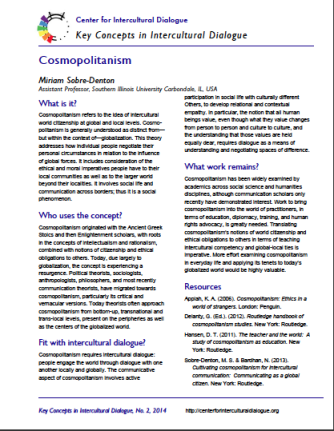
Key Concepts in Intercultural Dialogue #2: Cosmopolitanism by Miriam Sobre-Denton

Key Concepts in ICDThe second issue of Key Concepts in intercultural Dialogue is now available. This is KC2: Cosmopolitanism by Miriam Sobre-Denton. As always, all Key Concepts are available as free PDFs; just click on the thumbnail to download. Lists organized  chronologically by publication date and numberalphabetically by concept in English, and by languages into which they have been translated, are available, as is a page of acknowledgments with the names of all authors, translators, and reviewers.

CosmopolitanismSobre-Denton, M. (2014). Cosmopolitanism. Key Concepts in Intercultural Dialogue, 2. Available from:
https://centerforinterculturaldialogue.org/wp-content/uploads/2014/02/key-concept-cosmopolitanism.pdf

The Center for Intercultural Dialogue is publishing a series of short briefs describing Key Concepts in intercultural Dialogue. The logic is that different people, working in different countries and disciplines, use different vocabulary to describe their interests, yet these terms overlap. Our goal is to provide some of the assumptions and history attached to each concept for those unfamiliar with it. As there are other concepts you would like to see included, send an email to the series editor, Wendy Leeds-Hurwitz. If there are concepts you would like to prepare, provide a brief explanation of why you think the concept is central to the study of intercultural dialogue, and why you are the obvious person to write up that concept.


Creative Commons License
This work is licensed under a Creative Commons Attribution-NonCommercial-NoDerivatives 4.0 International License.

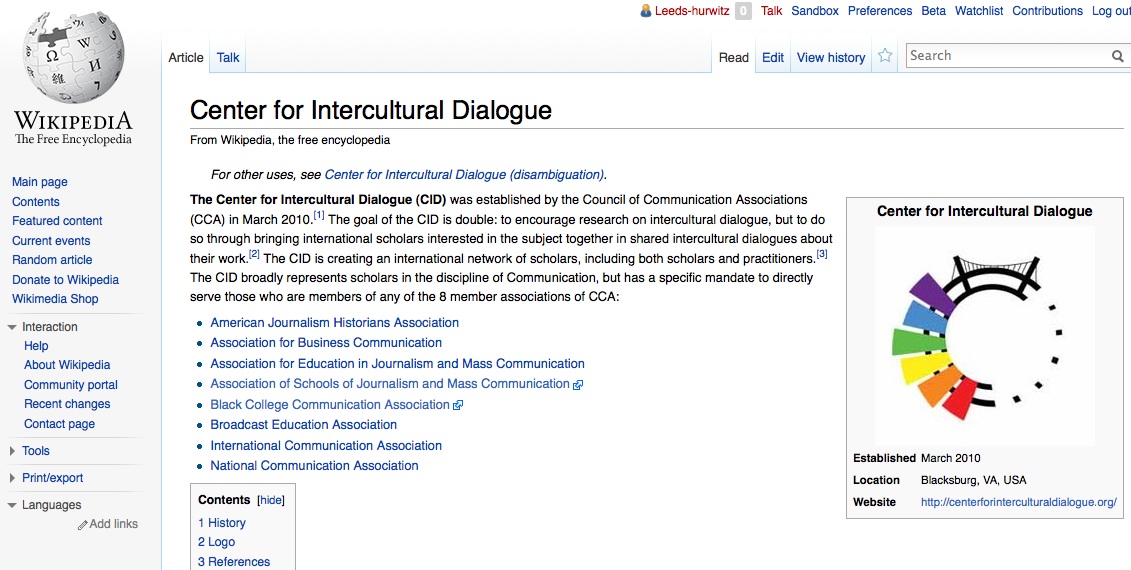
CID is on Wikipedia

About CIDIn case there has been any doubt, the Center for Intercultural Dialogue definitely exists – and we know this because now there is a Wikipedia entry saying so!

CID Wikipedia entry

This was created as one response to the National Communication Association’s call for increased entries on communication-related topics by communication specialists. (Details may be found on the NCA Wikipedia Initiative page.) For those who have not yet created an article on Wikipedia, the official standards are quite stringent about what is sufficiently “notable” to merit an article. (Of course, that doesn’t mean all articles currently posted meet those standards.) And there is an elaborate formal system to learn in order to participate in the site. But in today’s world, there is a sense in which any serious endeavor should be represented there, so it seemed worthwhile creating an article.

Minh Cao gets credit for taking the time to first learn the guidelines, and post the first draft. For those who have not yet created articles, a warning: this took 3 drafts over 2 months, and help from 4 different editors at Wikipedia, before approval was granted for a substantially shorter article than originally envisioned. Apparently such delay and critique are common.

Wendy Leeds-Hurwitz, Director
Center for Intercultural Dialogue

Why Cosmopolitanism?

Guest PostsWhy Cosmopolitanism? Guest post by Miriam Sobre-Denton.

Ah, cosmopolitanism.  The first time I found you, I was taking a class on global and transnational ethnography with Dr. Takeyuki Tsuda.  I read an article by Ulf Hannerz titled Cosmopolitans and Locals in World Culture.  He has since retracted many of the things he wrote in this article.  And yet, for the first time, I felt that I had read an intercultural theory (in an anthropology class, no less) that actually applied to my life.  So much of the work I’d done up until this point examined intercultural theories that provided dichotomies.  You were EITHER individualist OR collectivist.  When you travel, you EITHER make friends from your home culture OR your host culture.  You are EITHER a patriot OR an interculturalist.  Profoundly unsatisfying to me, as my experiences often hinged on dialectical tensions and dialogical experiences—those moments that exist between the both/and, rather than the either/or.  Cosmopolitanism was the first theory I’d ever read that said you could be BOTH rooted AND rootless; BOTH local AND global; that maybe you would be the most comfortable with others who experienced similar tensions, who live in spaces of in-between-ness.

And then the backlash set in.  Cosmopolitanism, you were not what I thought you were!  Cosmopolitanism, I was informed, really isn’t a theory of both/and.  This is a theory of exclusivity, of the ‘class consciousness of frequent travelers’; sure there was a sense of both/and-ness, but only for those privileged enough to be able to engage in voluntary sojourns that inevitably involve Western imperialism and cultural commodification.  Why would anyone want to study this concept? I was interrogated about the inherent violence that cosmopolitanism—particularly in its Kantian and previously Greco-Roman Stoic iterations.  This is a theory of global citizenship only accessible to those who have the privilege of being citizens in that kind of world.

And yet, cosmopolitanism, you continued to proliferate, to grow in breadth and depth.  From when I first learned the term in 2006, to the present day (2014), cosmopolitanism theorists flocked to you, across disciplines ranging from sociology and political economy to religious studies and linguistics.  Everyone was coming to the party—which also involved directly addressing the critiques of elitism and western imperialism brought with such ferocity by its opponents.  Forms of vernacular, non-Western, non-elite and critical cosmopolitanism, which have actually been around since its nascence in places like ancient China in the philosophies of Mo Tzu and Mencius, as well as being promoted by the African philosophy of Maat, are resurfacing in work by such scholars as Pnina Werbner, George Delanty and Walter Mignolo.

In intercultural communication, we are, to extend the metaphor, late to your party.  Intercultural communication scholars, particularly those who embrace critical and postcolonial approaches, are only now beginning to accept that this cosmopolitanism a term that is growing in strength, rather than waning.  As the world shrinks and difference becomes something that can no longer be hidden from (if it ever could), cosmopolitanism in its critical and vernacular forms has reemerged as a theory for our time, which insists not that we should all embrace each others’ many and varied values, but rather that we should understand that we all have values, and all hold those values dear to ourselves and the people and things we love.  This kind of dialogic empathy requires hope as an approach to non-binary thinking.  Cosmopolitanism is not a project that can be forced upon people; instead, it must be voluntarily embraced as an ethic of care for the world, from those next door to those across the ocean.   My colleague Dr. Nilanjana Bardhan and I have recently published a book titled Cultivating Cosmopolitanism for Intercultural Communication:  Communicating as Global Citizens, in which we propose cosmopolitanism’s use for our discipline as a space of hopeful dialogue to move from either/or to a space of both/and.  Cosmopolitanism, you may not be the answer, but you certainly deserve to be a part of both the discipline the dialogue.

Download the entire post as a PDF.

CFP Gerbner conf on Comm & Conflict

Call for Papers

The George Gerbner Conference on Communication, Conflict, and Aggression May 30-31, 2014 in Budapest, Hungary

Inspired by the life and work of Budapest native and renowned Communication and Media scholar Dr. George Gerbner (1919-2005), the Budapest College of Communication and Business invites scholars, researchers, practitioners, students, and other interested parties to submit paper and panel proposals for presentation at the George Gerbner Conference on Communication, Conflict, and Aggression. This conference will take place from Friday, May 30 to Saturday, May 31, 2014 in Budapest, Hungary. The goal of the conference is to bring together individuals with a common interest in aggressive communication, antisocial behavior, and conflict so as to foster international relationships that lead to research collaboration and knowledge exchange. The inaugural Gerbner Conference, held in May 2010, and the subsequent conferences in 2012 and 2013, featured presentations by scholars from 14 countries over 4 continents.

This international conference will focus on aggressive communication and behavior, conflict, and other types of antisocial communication and behavior across contexts. Specific topics include, but are not limited to: media violence, media coverage of crime and violence, violence in advertising, political violence, workplace violence and aggression, unethical leadership, aggression in instructional settings, war rhetoric, peace and conflict communication, verbal aggression, crime, oppression, injustice, incivility, assertiveness, argumentativeness, disagreement, bullying, indirect aggression, psychological abuse, anger, frustration, hostility, deception, child abuse, spousal abuse, domestic violence, youth violence, school violence, gang violence, sexual violence, discrimination, conflict styles, conflict resolution, the origins, causes, and predictors of aggression, and the management and prevention of aggression.

Interested individuals are invited to submit an abstract (in English) of 200 to 500 words describing their individual presentation or panel idea to Rebecca Chory by March 07, 2014. Decisions regarding the acceptance of papers and panels for presentation at the conference will be made by April 01, 2014. Completed papers should be sent to Rebecca Chory by May 12, 2014. With the authors’ permission, top papers will be published in the journal Kommunikáció, Média, Gazdaság (Communication, Media, Economics), which is published by the Budapest College of Communication and Business, or in an edited book. One scholar will also be honored with the Gerbner Award. The conference registration fee is expected to be approximately 50 Euros.

Co-organizers of the conference are Dr. Jolán Róka, Vice Rector for Research and International Relations at the Budapest College of Communication and Business, and Dr. Rebecca M. Chory, Professor of Communication Studies at West Virginia University and 2009 Fulbright Scholar at the Budapest College of Communication and Business. For more information, please contact Jolán Róka or Rebecca Chory.

KU Leuven (Belgium) faculty job ads

KU Leuven in Belgium is advertising 6 faculty positions in Media and Communication:

Journalism Studies – Ref. ZAP-2013-322
Full-time – Leuven
The Faculty of Social Sciences is looking for a full-time (Tenure Track/associate/full) professor in the domain of Journalism Studies.
Mediaculture – Ref. ZAP-2013-321
Full-time – Leuven
The Faculty of Social Sciences is looking for a full-time (Tenure Track/associate/full) professor in the domain of Mass Communication Research.
ICT & Human-Centered Design (20%) – Ref. ZAP-2013-309
Part-time – Leuven
The Faculty of Social Sciences is looking for a part-time (20%) (assistant/associate/full) professor (appointment of limited duration) in the domain of ICT & Human-Centered Design.
Media and Social Change – Ref. ZAP-2013-307
Full-time – Leuven
The Faculty of Social Sciences is looking for a full-time (Tenure Track/associate/full) professor in the domain of Mass Communication Research.
Digital Humanities: Human-Media Interaction – Ref. ZAP-2013-308
Full-time – Leuven
The Faculty of Social Sciences is looking for a full-time (Tenure Track/associate/full) professor in the domain of human-media interaction.
Film- and television studies (50%) – Ref. ZAP-2013-310
Part-time – Leuven

The Faculty of Social Sciences is looking for a part-time (50%)(Tenure Track/associate/full) professor in the domain of Film and Television Studies.

Most of the application deadlines are March 13, 2014.