Website Consultant UNU-GCM (Barcelona)

Website Consultant

UNU-GCM seeks a part-time Website Consultant to maintain and update its websites. The ideal candidate is highly efficient and works well in a fast-paced and professional team environment, dealing effectively with the organization’s technical demands. The right individual for this role will be a motivated and energetic consultant, who takes initiative, enjoys finding solutions to a varying number of challenges, is detail-oriented, and takes pride in his/her work. S/He must be fluent in English, with a good command of Spanish and Catalan. Web programming, graphic design, skilled communication and database administration are all elements of this position.

Download the full details here:  icon Vacancy Announcement – Website Consultant (391.44 kB)

Communications Consultant UNU-GCM (Barcelona)

Communications Consultant

UNU-GCM seeks a part-time Communications Consultant. The ideal candidate is highly efficient and works well in a fast-paced and professional team environment, dealing effectively with the organization’s communication. The right individual for this role will be a motivated and energetic Communications consultant, who takes initiative, enjoys finding solutions to a varying number of challenges, is detail-oriented, and takes pride in his/her work. S/He must be fluent in English, with a good command of Spanish and Catalan. The ability to build strong links with mainstream media and press in Catalonia, elsewhere in Spain and more internationally, is an important element of this position, as is the ability to project the work of UNU-GCM internationally. Familiarity with social media is also required.

Download the full details here:  icon Vacancy Announcement – Communications Consultant (388.63 kB)

Migration Post-doc UNU-GCM (Barcelona)

Visiting Researchers Programme

UNU-GCM is currently offering THREE places of three months each to post-doctoral researchers in the Humanities and Social Sciences with expertise in the area of statelessness and transcontinental migration. Their Visiting Researchers Programme gives qualified researchers an opportunity to research topics related to the ongoing research programme on Statelessness and Transcontinental Migration, and to participate in UNU-GCM activities. Visiting Researchers will be expected to reside in Barcelona and work from our office in the Sant Pau Art Nouveau Site in Barcelona.

Download the full details here:  icon Visiting Researchers Programme (UNU – GCM) (135.92 kB)

Anthropocene Campus Berlin 2014

ANTHROPOCENE CAMPUS
November 14–22, 2014
Haus der Kulturen der Welt, Berlin
Call for Applications
deadline: April 30, 2014

Encouraging new forms of transdisciplinary discourse and research the anthropocene project 2013/14 at Haus der Kulturen der Welt, Berlin (HKW) aims to investigate the manifold implications of the Anthropocene hypothesis for cultures of knowledge. If indeed humankind has become the dominant biogeophysical force, effecting changes on a planetary scale, how can the arts, sciences and humanities contribute to a critical awareness, understanding and responsible co-shaping of these transformations? How can creative and problem-oriented modes of knowledge production and educational practices be developed?

The anthropocene curriculum addresses these questions by way of a cross-disciplinary experiment in higher education. Initiated by HKW and the Max Planck Institute for the History of Science, Berlin (MPIWG) the project has brought together a group of 27 renowned university teachers from science, the humanities, and art & design. They are collaboratively developing a set of topics relevant to the Anthropocene in an attempt to encourage the integration of cross-disciplinary thinking, mutual learning, and civic commitment in the curricula of universities and research institutions.

This exemplary curriculum will be put into teaching practice at the anthropocene campus taking place november 14-22, 2014 at HKW in Berlin. One hundred international participants will be given the opportunity to engage in this curricular experiment, contributing their own perspectives and expertise. The campus provides a transdisciplinary co-learning space for young scholars from a wide range of disciplinary, academic, and professional backgrounds and opens up a forum for exploring the scopes, scales, and designs of Anthropocene relevant knowledge. The anthropocene campus will be a central component of a series of public events at HKW–including lectures, workshops, exhibitions, screenings, and artistic events – by which the two-year anthropocene project will come to its close.

Applicants should be strongly committed to interdisciplinary collaboration and demonstrate a broad interest in Anthropocene related research questions. Active participation is expected both during the Campus as well as in pre- and postwork to be assigned by the instructors.

An essential part of the output of the anthropocene curriculum will be the collaborative production of an anthropocene coursebook. The online platform will serve as central tool for the development and communication of syllabi, coursework, and the coursebook, and provide a long-time discussion space for all participants.

More information on the background of this project, seminar contents, the instructors, selection criteria and the application procedure can be found here.

Applicants
The call primarily addresses doctoral students (or equivalent) from a wide range of disciplinary backgrounds in the sciences, humanities, engineering, design, and the arts. However, excellent final-year master’s degree candidates as well as postdocs are also encouraged to apply. Moreover, the call extends to researchers and actors from outside of academia, including research oriented institutions from civil society, the arts and politics (e.g. think-tanks, NGOs).

Working language
The working language will be English.

Procedure
All applications must be made using the online application form on our website:
anthropocene-curriculum.org, and submitted no later than April 30, 2014. Applicants must submit a CV, a brief description of their interest in the Anthropocene–as well as the anthropocene curriculum project in particular–and name a reference person.

Acceptance
Letters will be sent out until May 30, 2014. Registration for the campus begins on June 16, 2014 on the website, where participants will have the opportunity to choose their individual course from among the series of seminars.

Registration & funding
The registration fee of € 100 covers meals and accommodation. The participants are expected to procure their own travel funding. A very limited number of need-based travel grants can be provided. Please indicate and specify your necessity in the application form.

Contact
For further questions or information contact us.

The Anthropocene Curriculum is part of the Anthropocene Project. The Anthropocene Project is an initiative of Haus der Kulturen der Welt in cooperation with the Max Planck Society, Deutsches Museum, the Rachel Carson Center for Environment and Society, Munich and the Institute for Advanced Sustainability Studies, Potsdam.

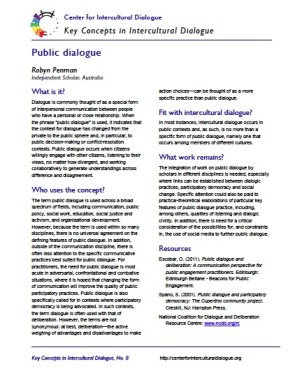
Key Concepts #8: Public Dialogue by Robyn Penman

Key Concepts in ICDThe next issue of Key Concepts in intercultural Dialogue is now available. This is KC8: Public Dialogue by Robyn Penman. As always, all Key Concepts are available as free PDFs; just click on the thumbnail to download. Lists organized  chronologically by publication date and numberalphabetically by concept in English, and by languages into which they have been translated, are available, as is a page of acknowledgments with the names of all authors, translators, and reviewers.

KC8-sm

Penman, R. (2014). Public dialogue. Key Concepts in Intercultural Dialogue, 8. Available from:
https://centerforinterculturaldialogue.org/wp-content/uploads/2014/03/key-concept-public-dialogue.pdf

The Center for Intercultural Dialogue is publishing a series of short briefs describing Key Concepts in intercultural Dialogue. The logic is that different people, working in different countries and disciplines, use different vocabulary to describe their interests, yet these terms overlap. Our goal is to provide some of the assumptions and history attached to each concept for those unfamiliar with it. As there are other concepts you would like to see included, send an email to the series editor, Wendy Leeds-Hurwitz. If there are concepts you would like to prepare, provide a brief explanation of why you think the concept is central to the study of intercultural dialogue, and why you are the obvious person to write up that concept.


Creative Commons License
This work is licensed under a Creative Commons Attribution-NonCommercial-NoDerivatives 4.0 International License.

St. John’s study abroad in Rome 2014

Study abroad in Rome
May-June 2014

St. John’s University in New York is currently accepting applications from undergraduate students (including those who attend other universities) for a two-week communication course on our Rome, Italy campus, to be held on May 19-June 1, 2014. The course, entitled “Mass Communication in Rome,” teaches students how to design international communications campaigns in order to “convert” audiences and/or achieve policy change on some of the most important and challenging global issues of our time – including poverty and climate change. As part of a class project developing a communications campaign for the Italian tourism ministry, we will conduct site visits to key attractions around the city. The course also takes advantage of our location in the Eternal City to include guest speakers from the United Nations and civil society groups in Rome who are working on issues related to hunger and poverty.

Students will gain deep knowledge of current policy and political challenges in order to communicate appropriately and effectively in a global context. They will learn and apply the full array of traditional and emerging communications tactics in developing their own global communications campaigns on key international issues. Students will learn how to identify and capitalize on local advantages while tailoring their communications messages and strategies to diverse cultures.

The course is taught by Kara Alaimo, an Assistant Professor at St. John’s University who previously served as Head of Communications for a United Nations initiative and as a spokesperson in President Obama’s administration. Students book their own flights (and the course ends on June 1, leaving time to stay longer in Europe if they’d like!) The St. John’s University code for this three-credit, elective course is COM8002; students who do not attend St. John’s University should confirm with their home institutions that they will grant credit for the class. The cost of the class is $1,990 plus tuition. This fee includes room, board, and local activities.

For more information on the class, click here and choose the third tab (Italy: Communications).
Applications are being accepted on the Global Studies website.

Please contact the professor, Kara Alaimo, with any questions.

CFP Comm and Social Justice

Communication and Social Justice:
Call for Book Manuscripts

Social justice is a powerful political and ideological concept in the 21st century; it has become an increasingly central idea for those trying to gain a fuller understanding of national and international grassroots politics. An implicit assumption of a social justice perspective is that the integrity of any community is violated when some of its members are systematically deprived of their dignity or equality. This assumption often leads to research whose findings are not comfortable for the status quo: governments, institutions, and disciplines.

Troubador’s Communication and Social Justice book series maintains that the relevance of scholarship should be judged by the degree to which scholarship advances social democratic values, and that these values must advance by way of valid research that provides honest critique and redescription of those institutions that promote and reify poverty, hierarchy, and/or social inequality. Books in the series recognize that concern for underprivileged and underresourced groups is becoming an increasingly important topic about which to theorize and for which to develop interventions. The goal of this series is to explore the theoretical and practical ways that communication scholars can reconceptualize national and international societies so as to enable inclusive and equitable communities to emerge; to seek to construct communities that protect individual freedom while insuring equality and dignity for everyone. Specifically, this series takes the position that potential contributors are intellectual laborers who view their professional commitments as indistinguishable from their social and political identifications. From varying perspectives, each book published in the series will illustrate the vitality of engaged scholarship and the claim that a scholarship of social justice is not incompatible with more traditional “ivy tower” research. A fundamental assumption of the books is that there is no worthier end for measuring social utility than the abolishment of social injustice.

Other books in the series include:
*Kevin J. Callahan, Demonstration Culture: European Socialism and the Second International
*Debbie S. Dougherty, The Reluctant Farmer: An Exploration of Work, Social Class, and the Production of Food
*Amos Kiewe, Confronting Anti-Semitism: Seeking an End to Hateful Rhetoric
*Shane Ralston,  Pragmatic Environmentalism: Toward a Rhetoric of Eco-Justice
*Amardo Rodriguez, Revisioning Diversity in Communication Studies
*Philip C. Wander, Shadow Songs: Reflections on Rhetoric, Culture, & Human Survival

For information on how to submit a manuscript proposal, please contract series editor Omar Swartz or visit the online site for the Troubador book series on social justice.

Dept Chair U Mass Boston job ad

Tenured Associate or Full Professor (Department Chairperson)
Communication Department
University of Massachusetts Boston

The University of Massachusetts Boston welcomes applications for a tenured Associate or Full Professor to serve as Department Chairperson beginning January 25, 2015. The department and undergraduate major is housed in the College of Liberal Arts. Launched in the spring of 2013, the program has already grown to over 230 majors and 30 minors. We are looking for a capable, enthusiastic leader with a track record of managing department growth, in terms of both enrollment and in the recruiting and retention of new faculty.

Minimum Qualifications:
Candidates should possess an earned PhD in Communication and a research program that intersects with our current strengths in media, interpersonal, health, or intercultural communication. Previous administrative experience at the level of chair or program director is desired. Opportunities for interdisciplinary research collaboration may exist between this position and the CLA Departments of Psychology or Sociology, McCormack Graduate School of Public Policy, and/or College of Nursing and Health Sciences, depending on areas of research expertise and interest. Department chairs are expected to teach one course per semester.

Please submit a cover letter, C.V., research statement, and evidence of teaching effectiveness. Three letters of recommendation can be sent to Martin Hansen. Review of applications will begin on April 4, 2014, and continue until a suitable candidate is hired. All materials must be submitted electronically; hard copy applications will not be considered.

UMass Boston provides equal employment opportunities (EEO) to all employees and applicants for employment. UMass Boston extends full benefits to all employees, spouses/ same-sex domestic partners, and dependent children.

University of Otago 2014

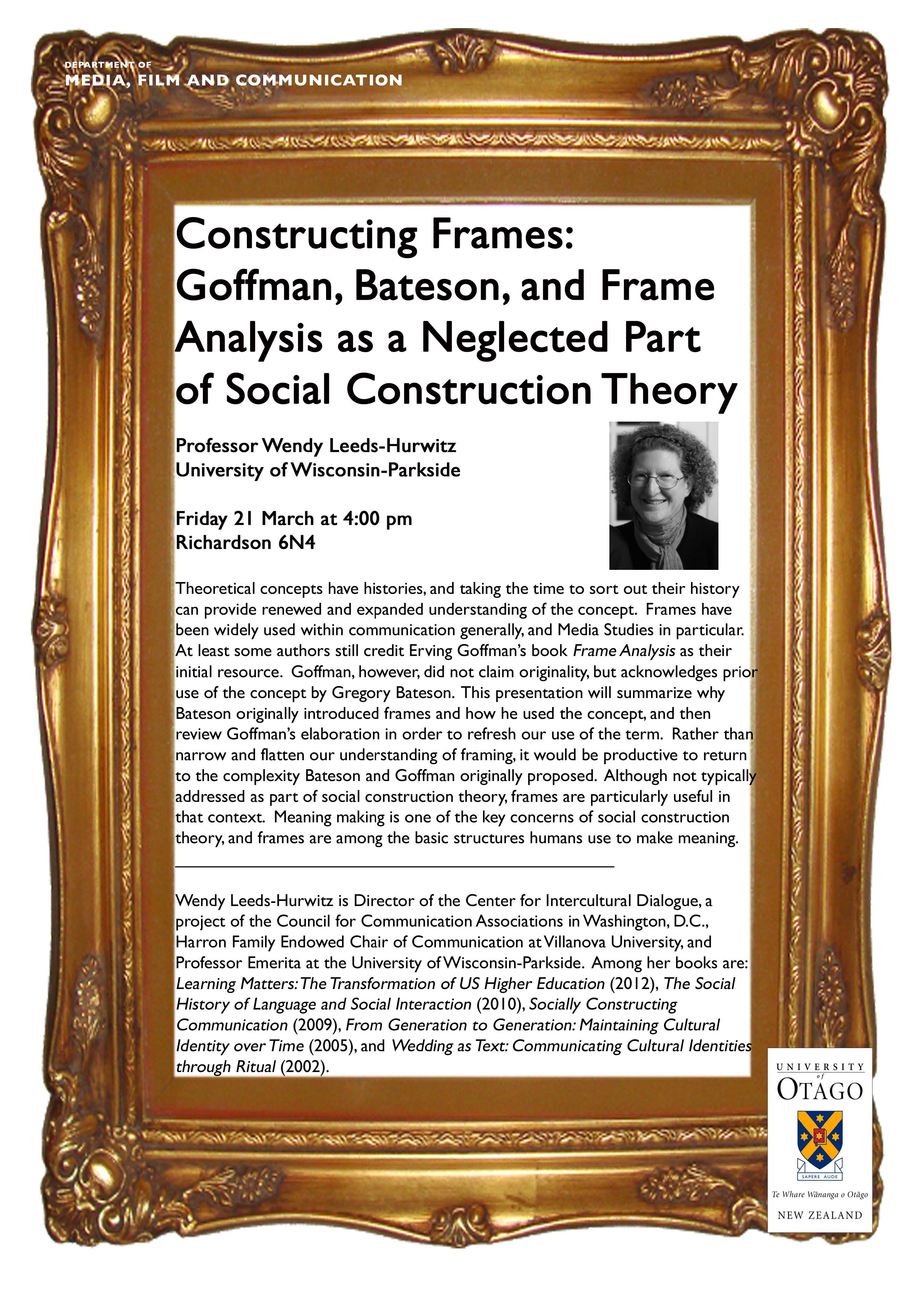
Constructing Frames flyerOn March 21, 2014 I presented “Constructing frames: Goffman, Bateson, and frame analysis as a neglected part of social construction theory” at the University of Otago, in Dunedin, New Zealand. This was my second talk at Otago (description of the first was posted in 2012). Last time I was hosted by the Department of Languages and Cultures; this time by Media, Film and Communication.

Despite meeting late on a Friday afternoon, there was a large crowd, so local dedication to scholarly conversations is impressive. A personal first for me was having someone, in this case Rosemary Overell, tweet about my talk as it was occurring.

The fact that faculty and graduate students from across the campus attended on a Friday afternoon was even more impressive. In addition to multiple members of the Media, Film and Communication department, I talked to people from Theatre Studies, Sociology, Anthropology, Tourism, German, the Higher Education Development Centre, Applied Sciences, the Centre for Science Communication, and several other parts of the university.

Leeds-Hurwitz, Bourk
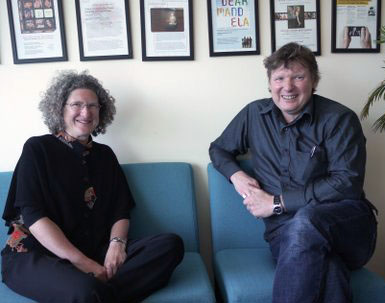
Wendy Leeds-Hurwitz and Michael Bourk

My thanks to my host, Michael Bourk, who organized the event, to Vijay Devadas, Head of Department, who supported it with a generous reception and dinner, and to department staff members Maureen and Paulette for managing the details. In the days before and after the talk, I met with several graduate students and faculty members about a variety of other subjects, ranging from intercultural communication to ethnographic methods. I look forward to continued conversations on these and other topics, and hope to have the chance to visit the University of Otago again in the future.

Wendy Leeds-Hurwitz, Director
Center for Intercultural Dialogue

Int’l Conference on Communication and Media Malaysia 2014

The International Conference on Communication and Media (i-COME’14)
October 18-20, 2014, Langkawi, MALAYSIA
Email: icome@uum.edu.my

CALL FOR PAPERS
In conjunction with the 30th anniversary of Universiti Utara Malaysia, we proudly invite you to the International Conference on Communication and Media (i-COME’14) organized by Communication Department, School of Multimedia Technology and Communication, UUM. This conference is scheduled to take place from 18 – 20 October, 2014 at the Holiday Villa Beach Hotel and Resort, Langkawi, Malaysia.

i-COME’14 aims to provide a multinational platform where the latest issues in communication and media can be presented and discussed in a friendly environment with the aim to learn from each other. The theme of the conference is Communication, Empowerment and Governance: The 21st Century Enigma.

PUBLICATION AND INDEXING
This conference is featured by blind review of papers. The conference proceedings will be published by Procedia – Social and Behavioural Sciences (Elsevier) with ISBN/ISSN number and will be indexed in SCOPUS and published by Elsevier (upon approval by Elsevier).

TOPIC OF INTEREST
The key communication and media issues to be addressed by the conference are in relation (but not limited) to:
(a) Organizational Communication: Corporate communication, Power and politics in organizations, Communication for organizational change, Communication management, Public relations;
(b) Communication for Social Change: Health communication, Communication and media, Gender and communication, Governance and empowerment of women, Campaign;
(c) Intercultural Communication: Issues in international and intercultural communication, Barriers in intercultural communication, Negotiating across cultures, Empowerment and governance across cultures;
(d) Political Communication: Communication policies and regulations, Communication law, Empowerment and governance in the information society, Leadership, Ethics in campaign, Ethics in speech;
(e) New Media: New media and culture, Media industry trends and dynamics, Ethics and cyber society, Media challenges and opportunities, Creativity, innovation and users, Government, regulations and new media;
(f) Language and Communication: Media and Language, Role of language, Visual and Linguistics, Critical literacy, Language and advertising, Language and rhetoric, Language and social interaction.
(For full list of issues, please visit our website here)

SUBMISSION
Authors are invited to submit papers for the conference through the i-COME’14 online management system. Submissions must be original and should not have been published previously or be under consideration for publication while being evaluated for this conference. Any questions can, be forwarded to the secretariat via icome@uum.edu.my

IMPORTANT DATES
Paper Submission Deadline   31 March 2014
Acceptance Notification to Authors   30 April 2014
Deadline for Revised/Final Version   30 May 2014
Early Bird Registration Deadline   15 August 2014
Registration Deadline   1 October 2014

Registration is now open via our website:  http://www.i-comeuum.com .
Please forward all inquiries to: icome@uum.edu.my