
Raúl A. Mora Profile

ProfilesDr. Raúl Alberto Mora is at present an Assistant Professor in the School Education and Pedagogy Graduate Program at Universidad Pontificia Bolivariana (UPB), in Medellín, Colombia, where he also coordinates the MA in Learning and Teaching Processes in Second Languages (ML2).
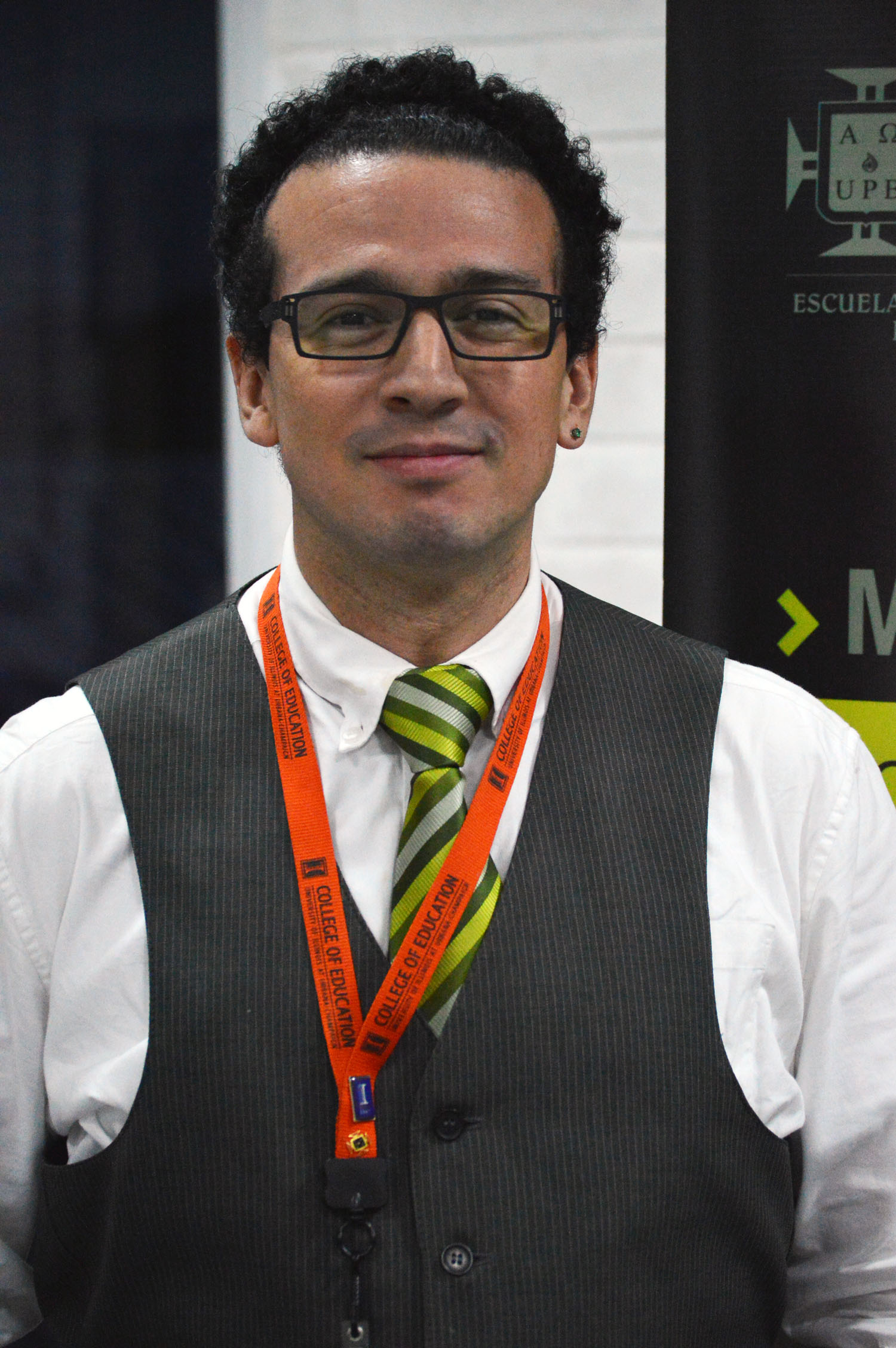
Raul Alberto Mora Velez

He is also a faculty affiliate at the PhD in Social Sciences at UPB and the PhD in Education at Universidad Distrital in Bogotá. Dr. Mora’s current teaching duties include preservice language courses and graduate-level seminars on research and literacies in second language contexts. He holds a PhD in Language and Literacy and an MA in Teacher Education, both from the University of Illinois at Urbana-Champaign. He was a Fulbright Scholar and belongs to the Honor Society of Phi Kappa Phi.

He has written peer-reviewed articles and book chapters on issues of language teaching, literacy, and qualitative research. He has presented conference papers (both on site and virtually) and has participated as plenary speaker in Colombia, Argentina, Spain, India, Vietnam, the United States, and Russia. In addition, he has been a guest lecturer at different universities in Colombia and Spain. He is at present an Editorial Board member for the Journal of Adolescent & Adult Literacy, where he also serves as Editor for the Advocacy/Policy Department section. Other editorial duties include the International Review Board for the HETL Review and the Editorial Boards for PROFILE and HOW Journals in Colombia. Dr. Mora also sits on the Advisory Committee for the Colombian Fulbright Commission and has been an educational adviser for the Colombian Ministry of Education.

His research work features membership in the Language and Culture Research Group at UPB and the Teacher Education Research Group at Universidad Distrital. He also chairs the Student Research Group on Second Language (SRG-L2) at UPB. A qualitative researcher by choice and training, he has specialized in the education of novice researchers at the undergraduate and graduate levels. Most of his research includes ethnographic approaches and action research, interspersed with elements of case study research, narrative inquiry, and discourse analysis.

His current research agenda covers the fields of alternative literacies, critical discourse analysis, world languages, socio-cultural theory, and issues of bilingualism and multiculturalism. His research on literacies include the analysis of English literacies in urban spaces of Medellín, Colombia, the description of English literacies in virtual gaming communities in the city, and the development of frameworks to discuss the evolution of the notion of literacy in languages other than English. His work on world languages includes the development of conceptual frameworks that defy the traditional binary of second/foreign language and respond to the language ecologies present in today’s world. Recent studies on critical discourse have analyzed the social imaginaries of teachers in advertisements for online courses and the idea of the trickster in Colombian comedy. His most recent work on Socio-cultural theory has analyzed media and the situation of teacher education in Colombia through the use of Pierre Bourdieu’s social frameworks. Finally, his work on bilingualism and multiculturalism (most of it in tandem with his wife, Dr. Polina Golovátina-Mora) intends to look at the multiple dimensions of bilingualism to give it a stronger social dimension.

You can check Dr. Mora’s website for more details about his academic interests, teaching, and research endeavors, as well as his Academia.edu profile.


Work for CID:

Raúl Alberto Mora wrote KC13: Language EcologyKC21: Reflexivity, KC36: Counter-Narrative, KC42: Conscientização, KC45: Testimonio, and co-authored KC19: Multiculturalism. He has also reviewed translations into Spanish.

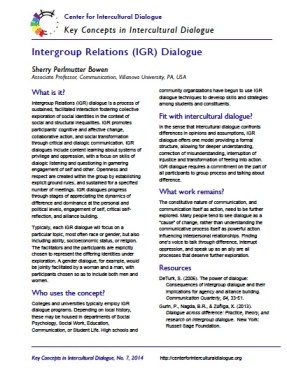
Key Concepts #7: IGR Dialogue by Sherry Perlmutter Bowen

Key Concepts in ICDThe next issue of Key Concepts in intercultural Dialogue is now available. This is KC7: Intergroup Relations (IGR) Dialogue by Sherry Perlmutter Bowen. As always, all Key Concepts are available as free PDFs; just click on the thumbnail to download. Lists organized  chronologically by publication date and numberalphabetically by concept in English, and by languages into which they have been translated, are available, as is a page of acknowledgments with the names of all authors, translators, and reviewers.

KC7-sm

Bowen, S. P. (2014). Intergroup relations (IGR) dialogue. Key Concepts in Intercultural Dialogue, 7. Available from:
https://centerforinterculturaldialogue.org/wp-content/uploads/2014/03/key-concept-igr.pdf

The Center for Intercultural Dialogue is publishing a series of short briefs describing Key Concepts in intercultural Dialogue. The logic is that different people, working in different countries and disciplines, use different vocabulary to describe their interests, yet these terms overlap. Our goal is to provide some of the assumptions and history attached to each concept for those unfamiliar with it. As there are other concepts you would like to see included, send an email to the series editor, Wendy Leeds-Hurwitz. If there are concepts you would like to prepare, provide a brief explanation of why you think the concept is central to the study of intercultural dialogue, and why you are the obvious person to write up that concept.


Creative Commons License
This work is licensed under a Creative Commons Attribution-NonCommercial-NoDerivatives 4.0 International License.

Project for Advanced Research in Global Communication

PARGC 2014 Symposium
The Revolutionary Public Sphere: Contention, Communication and Culture in the Arab Uprisings

The Project for Advanced Research in Global Communication is proud to present the Inaugural PARGC Symposium:
The Revolutionary Public Sphere: Contention, Communication and Culture in the Arab Uprisings
Thursday, April 10, 2014
Annenberg School for Communication
University of Pennsylvania
Philadelphia, PA

The popular rebellions that have swept Arab countries since December 2010 have spawned an active field of insurrectionary cultural production. Scholars from around the world will gather at the Annenberg School for PARGC’s inaugural symposium. Putting primary sources in dialogue with theory, we seek to understand aesthetic experimentation and stylistic innovation in this revolutionary public sphere. Together, we will strive to shed light on the ways in which various revolutionary and counter-revolutionary activists and regimes have attracted, upheld, and directed popular attention to themselves and to their opponents. Our exploration of contention, communication and culture in the Arab uprisings will yield conceptual tools to understand revolutionary public spheres at large.

Speakers & Topics:
Yakein Abdelmagid (Duke University): Independent music production in Cairo
Omar Al-Ghazzi (University of Pennsylvania): The symbol of Omar al-Mukhtar in the Libyan uprising
Anahi Alviso-Marino (Université Paris-1 Panthéon-Sorbonne): Contentious politics and street art in Yemen
Walter Armbrust (University of Oxford): Egypt’s June 30th rebellion as social drama
Donatella Della Ratta (University of Pennsylvania): Syrian internet memes and the politics of cultural (re)production
Tarek El-Ariss (University of Texas, Austin): Literary writing and violence in the Arab Spring
Nouri Gana (University of California, Los Angeles): Rap music in the Tunisian revolution
Nour Halabi (University of Pennsylvania): Hezbollah logos and carnivalesque humor in revolutionary times
Adel Iskandar (Georgetown University): The politics of memes in revolutionary Egypt
Marc Owen Jones (University of Durham): Satire and social media in the Bahrain uprising
Amal Khalaf (Serpentine Galleries): The Pearl Roundabout and public space in Bahrain
Shayna Silverstein (University of Pennsylvania): Syrian revolutionary music and the politics of memory
Jakob Skovgaard-Petersen (University of Copenhagen): Revolutionary and Islamic content in Ramadan musalsalat (long TV drama)
Leila Tayeb (Northwestern University): Utopian impulses in Libyan revolutionary performances
Edward Ziter (New York University): The anecdotal in Syrian oppositional theatre

Contact:
Marina Krikorian
Project Coordinator
Project for Advanced Research in Global Communication
The Annenberg School for Communication
University of Pennsylvania

Casey Man Kong Lum Profile

ProfilesCasey Man Kong Lum (Ph.D., NYU) is Professor Emeritus at William Paterson University (New Jersey, USA), where he was the Founding Director of the M.A. in Professional Communication Program (2007-2012).

Casey Man Kong LumCasey is also an Adjunct Professor in the Department of Teaching and Learning, Steinhardt School of Culture, Education, and Human Development, and in the Division of Applied Undergraduate Studies, School of Professional Studies, New York University.
His research intersects among media ecology, food studies, urban foodways as intangible cultural heritage, urban communication, transnational communication in the diaspora, global media, the Chinese American experience, intercultural education and communication, multilingual education, the intellectual history of communication scholarship, etc. Casey has had extensive experience in intercultural consultancy and study abroad programs (e.g., global food cultures; media and globalization; intercultural communication and education).

Sample publications:

Books:

林文刚编:《媒介环境学:思想沿革与多维视野》, 第二版,何道宽译,北京:中国大百科全书出版社,2019 年。[The is the second simplified Chinese translation edition of Lum (2006) by the Encyclopedia of China Publishing House, Beijing.]

Lum, C. M. K., & de Ferrière le Vayer, M. (Eds.). (2016). Urban foodways and communication: Ethnographic studies in intangible cultural food heritages around the world. Lanham, MD: Rowman & Littlefield.

Lum, C. M. K. (2006). (Ed.). Perspectives on culture, technology, and communication: The media ecology tradition. Cresskill, NJ: Hampton Press. [Winner, Lewis Mumford Award for Outstanding Scholarship in the Ecology of Technics, The Media Ecology Association, 2006]. This book has been translated and published in simplified Chinese by Peking University Press in Beijing, China (2007); in Korean by Hannarae Publishing Company in Seoul, South Korea (2008); in traditional Chinese by Chu Liu Publishing Company in Taipei, Taiwan (2010).

Lum, C. M. K. (1996). In search of a voice: Karaoke and the construction of identity in Chinese America. Foreword by N. Postman. London: Routledge.

Articles and Book Chapters:

Lum, C. M. K. (2024, May 27). What can and should we learn from these dark and tragic histories? Associate Director’s Activities. Center for Intercultural Dialogue.

Lum, C. M. K. (2023, Sep 11). Culturally responsive teaching and intercultural dialogue. Associate Director’s Activities, Center for Intercultural Dialogue.

Li, M. W., & Lum, C. M. K. (2022). The vector of media and the media turn of communication theory research: Comments on the Media Ecology Translation Book Series (in Chinese). Chinese Journal of Journalism & Communication, 44(12), 156-169. [Original in Chinese] 李明伟 林文刚, 媒介矢量与传播学理论研究的媒介转向——兼评 “媒介环境学译丛”, 《国际新闻界》, 2022年 (44卷12期): 156-169。

Lum, C.  M. K. (2019). Media ecology and media education: Reflections on media literacy in a globalized communication ecology [in Chinese]. Chinese Journal of Journalism and Communication, 41(4), 89-108. 林文刚: 媒介环境学和媒体教育: 反思全球化传播生态中的媒体素养, 《国际新闻界》, 2019年4月 (41卷 4期): 89-108.

Lum, C. M. K. (2018). Developing intercultural competence in the language classroom. In J. Liontas (Ed.) (Vol Ed.: S. Nero). The TESOL Encyclopedia of English Language Teaching, Vol. VI (pp. 3545-3550). Oxford, UK: Wiley. DOI: 10.1002/9781118784235.eelt0282

Lum, C. M. K. (2015). Regionalism and communication: Voices from the Chinese diaspora. In A. Gonzalez & Y.-W. Chen (Eds.), Our voices: Essays in culture, ethnicity, and communication (pp. 327-334, 6th ed.). New York: Oxford University Press.

Lum, C. M. K. (2014). Media ecology: Contexts, concepts, and currents. In R. Fortner & M. Fackler (Eds.), The handbook in media and mass communication theory (pp. 137-153, Vol. 1). Hoboken, NJ: Wiley-Blackwell. (Winner: The 2016 Walter Benjamin Award for Outstanding Article in the Field of Media Ecology.)

Lum, C. M. K. (2013). Understanding urban foodways and communicative cities: A taste of Hong Kong’s yumcha culture as urban communication. In S. Drucker, V. Gallenger, & M. Matsaganis (Eds.), The urban communication reader III: Communicative cities and urban communication in the 21st century (pp. 53-76). New York: Peter Lang.

Lum, C. M. K. (2006). Communicating Chinese heritage in America: A study of bicultural education across generations. In W. Leeds-Hurwitz (Ed.), From generation to generation: Maintaining cultural identity over rime (pp. 75-98). Cresskill, NJ: Hampton Press.

Lum, C. M. K., & Haratonik, P. L. (2011). A comparative study of Xintiandi in Shanghai and South Street Seaport in New York City [in Chinese]. In F. Sun & J. Yang (Eds.), Tales of two cities: Urban culture in Shanghai and New York City (pp. 44-57). Shanghai, China: Truth & Wisdom Press and Shanghai People’s Publishing.

Currently on the Board of Directors of the Urban Communication Foundation, Casey has been actively serving the profession in various leadership capacities, such as:

Casey serves as a reviewer and on the editorial board of a number of refereed journals. He is a long-time resident of New York City.


Work for CID:

Casey Lum wrote KC35: Media Ecology. He currently serves as CID Associate Director. In that capacity, he began and currently edits the series Voices from the Field. See Associate Director’s activities posts for descriptions of stops in various cities and conversations with individual scholars.

CFP Social media in the classroom

Social Media in the Classroom
Edited by: Hana Noor Al-Deen, Ph.D.
Chapter Proposal deadline: 31 March 2014

Proposals for book chapters are invited that address Social Media in the Classroom. The focus of this book lies on the usage of the prominent social media such as Facebook, Twitter, and YouTube as tools in teaching advertising, public relations, journalism, and health communication at the college (undergraduate and graduate) level. The book seeks to provide a bridge between the theoretical foundation and the application of these tools. Original research is required and all methodological approaches are acceptable. The length of the chapter should consist of 7000-7500 words including assignments and references.

PROPOSAL GUIDELINES:
Submit a 200-300 word abstract for consideration as a chapter in this proposed book and it should be accompanied by a bio as well as a tentative title. The abstract should give a clear sense of (a) the focus of the chapter, (b) the scope of the research, (c) the teaching methodology, (d) the type of social media that are used in such classes, (e) the subject of teaching, (f) the assignments (about one-third of the chapter), and (g) the academic level of the class. Please note that the chapter should also include intro, literature review, discussion, and references following the APA 6th ed. Feel free to include any additional information that you deem necessary to enhance your submission. The abstract and bio need to be submitted in (MS Word) as attachments. Individuals whose chapter proposals are accepted will be notified within two weeks and they need to submit the completed draft of the chapter by 30 June 2014.

Perhaps it is worthwhile to mention that this Noor Al-Deen’s third book on social media. The first two books “Social Media Usage and Impact” and “Social Media and Strategic Communications” were published by Lexington Books (2011 & 2012) and Palgrave Macmillan (2013) respectively.

Communication Conference of the Americas 2014

Call for Papers: Communication Conference of the Americas

The 10th Communication Conference of the Americas (sponsored by FELAFACS and NCA) is to be held in Chicago on Wednesday, Nov. 19, 2014.  We are organizing it as a preconference within the 100th National Communication Association Annual Convention.

This one-day conference will allow communication scholars from Latin America, the United States, and Canada to cultivate the international connections and create new international connections to share their projects, perspectives and experiences teaching communication in school and business settings in the Americas.

Proposal Requirements:
Those interested in presenting in this conference may submit a 2-3-page abstract (summary) proposal of the topic to be presented. The deadline for submissions is April 30, 2014 (11:59 pm Pacific Time).  The authors of accepted proposals will send a copy of their 10-page articles by November 14, 2014.  Papers will be presented in a panel format and each panelist will have 10 minutes to present.  Proposals for the conference can be submitted in English, Portuguese, or Spanish.

Panels 1 and 2:  Best Teaching Practices of Communication in UNIVERSITIES in the Americas and the Iberian Peninsula

Proposals for these panels can address issues related to innovative teaching strategies used in the way we teach communication courses at universities in the Americas and the Iberian Peninsula. The innovative teaching strategies may be related to any of the different areas of communication: interpersonal, organizational, media (journalism, radio, tv, etc.) or digital media communication: Facebook, Myspace, Twitter, Blogs, Podcasts, etc.  Preference will be given to the pedagogical strategies that have a global focus.

Panels 3 and 4: Best Training Practices of Communication in ORGANIZATIONS AND BUSINESSES in the Americas and the Iberian Peninsula

Proposals for these panels can address issues related to innovative training strategies used in the way we teach seminars /workshops of communication in organizations and businesses in the Americas and the Iberian Peninsula. The innovative training strategy may be related to any of the different areas of communication workshops we give in organizations/businesses: managerial communication, employee – supervisor communication, communication in teamwork, customer communication , public relations, media communication (journalism , radio, tv, etc.) or communication in social networks: Facebook, Myspace, Twitter, Blogs, Podcasts, etc. Preference will be given to the andragogical (adult learning) strategies that have a global focus.

Please send proposals in English to: Dr. Luis Felipe Gómez, San José State University, San José, California. USA. Please send proposals in Spanish to: Dr. Agrivalca Canelón.  Universidad de la Sabana, Bogotá, Colombia.

Please send proposals in Portuguese to: Dr. Ricardo Carniel Bugs, Universitat Autónoma de Barcelona (UAB), Barcelona, España.

Please email Dr. Felipe Gómez or Dr. Federico Varona any additional inquiries about this conference.

Int’l scholars wanted: Society for History of Technology

Call for Nominations for International Scholars
Society for the History of Technology (SHOT), 2014

Each year the Society for the History of Technology designates up to four International Scholars for a two-year term. One of the goals of the International Scholars program is to foster an international network of scholars in the history of technology that will benefit all members of the Society. We particularly welcome applications from or nominations of scholars from Africa, Asia and Latin America. Graduate students, post-docs, and visiting scholars who are living and working in North America are not eligible to become International Scholars; however, they are eligible to apply once they return to their home countries.

Benefits and Support
International Scholars shall receive regular SHOT membership at no cost during their two-year term. At each annual meeting, SHOT will host a special gathering to welcome current International Scholars, introduce them to SHOT officers, and discuss with them SHOT’s international outreach and the international intellectual dimensions of our field.

International Scholars will participate in an email discussion list of all current International Scholars and the Internationalization Committee. Through the list International Scholars can seek support in writing paper abstracts for SHOT’s annual meeting and other activities in their task as ambassadors for the Society.

Conditions
As a condition of appointment, SHOT requires International Scholars to submit at least one paper proposal for SHOT’s annual meeting during their two-year term. While paper proposals from International Scholars will not automatically be accepted for the annual meeting, SHOT encourages the program committee to give these proposals special consideration.

SHOT also requires International Scholars to submit a travel grant application for each of the two SHOT annual meetings during the two years of their appointment. International Scholars receive highest priority for SHOT funding. Travel grant funds will help pay for travel expenses for International Scholars to attend the annual meeting and for basic conference registration, although not for lodging. For more information, please check the SHOT Travel Grant information page, available by link from either the SHOT annual meeting web page or the SHOT awards web page.

To inform the SHOT community about the state and developments of the history of technology in their regions, progress in disseminating information about the Society and stimulating scholarly activities in the history of technology, International Scholars commit themselves to at least one publication in the SHOT Newsletter or on the SHOT website.

Application
To nominate yourself or someone else as an International Scholar, please send a letter and a brief curriculum vitae to EACH member of the Internationalization Committee and to SHOT Secretary David Lucsko (shotsec [at] auburn [dot] edu). In the letter, please describe your goals in becoming a SHOT International Scholar, address the current state of history of technology in your home country and home institution, state how your position as a SHOT International Scholar will benefit the study of history of technology in your home country, and suggest what insights your research can bring to the SHOT community The deadline of 2014 nominations is April 15. New candidates will be selected and announced by the beginning of June. For more information about the application procedures, please visit our website.

2014 SHOT Internationalization Committee
Itty Abraham           (seaai [at] nus [dot] edu [dot] sg)
Sulfikar Amir           (SULFIKAR [at] ntu [dot] edu [dot] sg)
Francesca Bray     (francesca.bray [at] ed [dot] ac [dot] uk)
Yulia Frumer           (yfrumer [at] jhu [dot] edu)
Adam Lucas           (alucas [at] uow [dot] edu [dot] au)
Honghong Tinn       (hhtinn [at] gmail [dot] com)

CFP Comm Strategies in Human Development (Russia)

VII International Russian Communication Association Conference
COMMUNICATION STRATEGIES IN HUMAN DEVELOPMENT
(COMMUNICATION-2014)
16-18 September 2014

The prevailing tendency in modern Communication Studies is the search for break-through solutions in human development, the analysis of new possibilities in the formation of human consciousness and social behaviour. The success of one person or a social institution is impossible without the strategic development and improvement of the communication process, in which an individual or a community act as its participants. The aim of the biannual Russian Communication Association (RCA) International Conference held together with our partners is to combine the efforts of scholars from different countries, fields of study, research centres and schools of thought for the further multiparadigm development of Communication Studies.

The international partners and information sponsors of the conference are the Eurasian Communication Association of North America (ECANA), the National Communication Association (NCA), the International Communication Association (ICA), the European Communication Research and Education Association (ECREA), the Polish Communication Association (Polskie Towarzystwo Komunikacji Spo³ecznej, PTKS), the International Federation of Communication Associations (IFCA), the World Complexity Science Academy (WCSA), the Russian Association for Film and Media Education, and the Kazakhstan Communication Association.

Major Areas of Research
– Philosophy of communication
– Methods of communication research
– Speech communication
– Interpersonal communication
– Organizational communication
– Political communication
– Mass communication
– Intercultural communication
– Computer-mediated communication
– Pedagogical communication
– Legal communication
– Health communication
– Gender communication
– Communication education
– Communicative design
– Media education

Deadline for submissions: 30 April 2014

To learn more about this conference and the call for papers, CLICK HERE.

Key Concepts #6: Intercultural Capital by Andreas Pöllmann

Key Concepts in ICDThe next issue of Key Concepts in intercultural Dialogue is now available. This is KC6: Intercultural Capital by Andreas Pöllmann. As always, all Key Concepts are available as free PDFs; just click on the thumbnail to download. Lists organized  chronologically by publication date and numberalphabetically by concept in English, and by languages into which they have been translated, are available, as is a page of acknowledgments with the names of all authors, translators, and reviewers.

Key Concept 6

Pöllmann, A. (2014). Intercultural capital. Key Concepts in Intercultural Dialogue, 6. Available from:
https://centerforinterculturaldialogue.org/wp-content/uploads/2014/03/key-concept-intercultural-capital1.pdf

The Center for Intercultural Dialogue is publishing a series of short briefs describing Key Concepts in intercultural Dialogue. The logic is that different people, working in different countries and disciplines, use different vocabulary to describe their interests, yet these terms overlap. Our goal is to provide some of the assumptions and history attached to each concept for those unfamiliar with it. As there are other concepts you would like to see included, send an email to the series editor, Wendy Leeds-Hurwitz. If there are concepts you would like to prepare, provide a brief explanation of why you think the concept is central to the study of intercultural dialogue, and why you are the obvious person to write up that concept.


Creative Commons License
This work is licensed under a Creative Commons Attribution-NonCommercial-NoDerivatives 4.0 International License.

CA Series in Public Anthropology Competition

INTERNATIONAL PUBLISHING COMPETITION CALIFORNIA SERIES IN PUBLIC ANTHROPOLOGY

The California Series in Public Anthropology encourages scholars in a range of disciplines to discuss major public issues in ways that help the broader public understand and address them. Two presidents (Mikhail Gorbachev and Bill Clinton) as well as three Nobel Laureates (Amartya Sen, Jody Williams, and Mikhail Gorbachev) have contributed to the Series either through books or forewords. Its list includes such prominent authors as Paul Farmer co-founder of Partners in Health, Kolokotrones University Professor at Harvard and United Nations Deputy Special Envoy to Haiti.

Each year the Series highlights a particular problem in its international competitive call for manuscripts. The focus this year will be on INEQUALITY IN AMERICA.

We are particularly interested in authors who convey both the problems engendered by inequality as well as ways for addressing it. Prospective authors might ask themselves: How they can make their study “come alive” to a range of readers. They might, for example, focus on the lives of a few, select individuals tracing the problems they face and how, to the best of their abilities, they cope with them. Prospective authors might examine a specific institution and how, in various ways, it perpetuates inequality. Or authors might describe a particular group that seeks to address a facet of the problem. There is no restriction on how prospective authors address the topic of Inequality in America – only an insistence that it be presented in a way that attracts a range of readers into thinking thoughtfully about the issue (or issues) raised. The book’s primary intended audiences tend to be college students as well as the general public.

The University of California Press in association with the Center for a Public Anthropology will review proposals for publication independent of whether the manuscripts themselves have been completed. The proposals can describe work the author wishes to undertake in the near future or work that is currently underway. The proposals submitted to the competition should be 3-4,000 words long and describe both the overall work as well as a general summary of what is (or will be) in each chapter. We expect the completed, publishable manuscripts to be between 200-250 pages (or 60,000-80,000 words) excluding footnotes and references. Examples of the types of analyses we are looking for might be:

In Search of Respect: Selling Crack in El Barrio by Philippe Bourgois
Nickeled and Dimed: On (Not) Getting By in America by Barbara Ehrenreich,
Someplace Like America: Tales From the New Great Depression by Dale Maharidge
Fire in the Ashes: Twenty-Five Years Among the Poorest Children in America by Jonathan Kozol
There Are No Children Here: The Story of Two Boys Growing Up in the Other America by Alex Kotlowitz

We are interested in establishing committed, supportive relationships with authors that insures their books are not only published but are well publicized and recognized both within and beyond the academy. We are committed to insuring the success of winning proposals.

DEADLINE FOR SUBMISSIONS IS MARCH 17, 2014 Submissions should be emailed with the relevant material enclosed as attachments. They can also be sent to: Book Series, 707 Kaha Street, Kailua, HI. Questions regarding the competitions should be directed to Dr. Rob Borofsky.

All entries will be judged by the Co-Editors of the California Series in Public Anthropology: Rob Borofsky (Center for a Public Anthropology & Hawaii Pacific University) and Naomi Schneider (University of California Press).