Why Cosmopolitanism?

Guest PostsWhy Cosmopolitanism? Guest post by Miriam Sobre-Denton.

Ah, cosmopolitanism.  The first time I found you, I was taking a class on global and transnational ethnography with Dr. Takeyuki Tsuda.  I read an article by Ulf Hannerz titled Cosmopolitans and Locals in World Culture.  He has since retracted many of the things he wrote in this article.  And yet, for the first time, I felt that I had read an intercultural theory (in an anthropology class, no less) that actually applied to my life.  So much of the work I’d done up until this point examined intercultural theories that provided dichotomies.  You were EITHER individualist OR collectivist.  When you travel, you EITHER make friends from your home culture OR your host culture.  You are EITHER a patriot OR an interculturalist.  Profoundly unsatisfying to me, as my experiences often hinged on dialectical tensions and dialogical experiences—those moments that exist between the both/and, rather than the either/or.  Cosmopolitanism was the first theory I’d ever read that said you could be BOTH rooted AND rootless; BOTH local AND global; that maybe you would be the most comfortable with others who experienced similar tensions, who live in spaces of in-between-ness.

And then the backlash set in.  Cosmopolitanism, you were not what I thought you were!  Cosmopolitanism, I was informed, really isn’t a theory of both/and.  This is a theory of exclusivity, of the ‘class consciousness of frequent travelers’; sure there was a sense of both/and-ness, but only for those privileged enough to be able to engage in voluntary sojourns that inevitably involve Western imperialism and cultural commodification.  Why would anyone want to study this concept? I was interrogated about the inherent violence that cosmopolitanism—particularly in its Kantian and previously Greco-Roman Stoic iterations.  This is a theory of global citizenship only accessible to those who have the privilege of being citizens in that kind of world.

And yet, cosmopolitanism, you continued to proliferate, to grow in breadth and depth.  From when I first learned the term in 2006, to the present day (2014), cosmopolitanism theorists flocked to you, across disciplines ranging from sociology and political economy to religious studies and linguistics.  Everyone was coming to the party—which also involved directly addressing the critiques of elitism and western imperialism brought with such ferocity by its opponents.  Forms of vernacular, non-Western, non-elite and critical cosmopolitanism, which have actually been around since its nascence in places like ancient China in the philosophies of Mo Tzu and Mencius, as well as being promoted by the African philosophy of Maat, are resurfacing in work by such scholars as Pnina Werbner, George Delanty and Walter Mignolo.

In intercultural communication, we are, to extend the metaphor, late to your party.  Intercultural communication scholars, particularly those who embrace critical and postcolonial approaches, are only now beginning to accept that this cosmopolitanism a term that is growing in strength, rather than waning.  As the world shrinks and difference becomes something that can no longer be hidden from (if it ever could), cosmopolitanism in its critical and vernacular forms has reemerged as a theory for our time, which insists not that we should all embrace each others’ many and varied values, but rather that we should understand that we all have values, and all hold those values dear to ourselves and the people and things we love.  This kind of dialogic empathy requires hope as an approach to non-binary thinking.  Cosmopolitanism is not a project that can be forced upon people; instead, it must be voluntarily embraced as an ethic of care for the world, from those next door to those across the ocean.   My colleague Dr. Nilanjana Bardhan and I have recently published a book titled Cultivating Cosmopolitanism for Intercultural Communication:  Communicating as Global Citizens, in which we propose cosmopolitanism’s use for our discipline as a space of hopeful dialogue to move from either/or to a space of both/and.  Cosmopolitanism, you may not be the answer, but you certainly deserve to be a part of both the discipline the dialogue.

Download the entire post as a PDF.

CFP Gerbner conf on Comm & Conflict

Call for Papers

The George Gerbner Conference on Communication, Conflict, and Aggression May 30-31, 2014 in Budapest, Hungary

Inspired by the life and work of Budapest native and renowned Communication and Media scholar Dr. George Gerbner (1919-2005), the Budapest College of Communication and Business invites scholars, researchers, practitioners, students, and other interested parties to submit paper and panel proposals for presentation at the George Gerbner Conference on Communication, Conflict, and Aggression. This conference will take place from Friday, May 30 to Saturday, May 31, 2014 in Budapest, Hungary. The goal of the conference is to bring together individuals with a common interest in aggressive communication, antisocial behavior, and conflict so as to foster international relationships that lead to research collaboration and knowledge exchange. The inaugural Gerbner Conference, held in May 2010, and the subsequent conferences in 2012 and 2013, featured presentations by scholars from 14 countries over 4 continents.

This international conference will focus on aggressive communication and behavior, conflict, and other types of antisocial communication and behavior across contexts. Specific topics include, but are not limited to: media violence, media coverage of crime and violence, violence in advertising, political violence, workplace violence and aggression, unethical leadership, aggression in instructional settings, war rhetoric, peace and conflict communication, verbal aggression, crime, oppression, injustice, incivility, assertiveness, argumentativeness, disagreement, bullying, indirect aggression, psychological abuse, anger, frustration, hostility, deception, child abuse, spousal abuse, domestic violence, youth violence, school violence, gang violence, sexual violence, discrimination, conflict styles, conflict resolution, the origins, causes, and predictors of aggression, and the management and prevention of aggression.

Interested individuals are invited to submit an abstract (in English) of 200 to 500 words describing their individual presentation or panel idea to Rebecca Chory by March 07, 2014. Decisions regarding the acceptance of papers and panels for presentation at the conference will be made by April 01, 2014. Completed papers should be sent to Rebecca Chory by May 12, 2014. With the authors’ permission, top papers will be published in the journal Kommunikáció, Média, Gazdaság (Communication, Media, Economics), which is published by the Budapest College of Communication and Business, or in an edited book. One scholar will also be honored with the Gerbner Award. The conference registration fee is expected to be approximately 50 Euros.

Co-organizers of the conference are Dr. Jolán Róka, Vice Rector for Research and International Relations at the Budapest College of Communication and Business, and Dr. Rebecca M. Chory, Professor of Communication Studies at West Virginia University and 2009 Fulbright Scholar at the Budapest College of Communication and Business. For more information, please contact Jolán Róka or Rebecca Chory.

KU Leuven (Belgium) faculty job ads

KU Leuven in Belgium is advertising 6 faculty positions in Media and Communication:

Journalism Studies – Ref. ZAP-2013-322
Full-time – Leuven
The Faculty of Social Sciences is looking for a full-time (Tenure Track/associate/full) professor in the domain of Journalism Studies.
Mediaculture – Ref. ZAP-2013-321
Full-time – Leuven
The Faculty of Social Sciences is looking for a full-time (Tenure Track/associate/full) professor in the domain of Mass Communication Research.
ICT & Human-Centered Design (20%) – Ref. ZAP-2013-309
Part-time – Leuven
The Faculty of Social Sciences is looking for a part-time (20%) (assistant/associate/full) professor (appointment of limited duration) in the domain of ICT & Human-Centered Design.
Media and Social Change – Ref. ZAP-2013-307
Full-time – Leuven
The Faculty of Social Sciences is looking for a full-time (Tenure Track/associate/full) professor in the domain of Mass Communication Research.
Digital Humanities: Human-Media Interaction – Ref. ZAP-2013-308
Full-time – Leuven
The Faculty of Social Sciences is looking for a full-time (Tenure Track/associate/full) professor in the domain of human-media interaction.
Film- and television studies (50%) – Ref. ZAP-2013-310
Part-time – Leuven

The Faculty of Social Sciences is looking for a part-time (50%)(Tenure Track/associate/full) professor in the domain of Film and Television Studies.

Most of the application deadlines are March 13, 2014.

Study Abroad Turkey 2014 East Stroudsburg U

East Stroudsburg University of Pennsylvania Study Abroad Turkey Program – Summer 2014

July 14 – August 11, 2014, @ Anadolu University, Eskisehir, Turkey.
Visits include Istanbul, Ankara & Bursa (or Cappadocia)
Program Cost: $2200 plus tuition

Application procedure for non-ESU & visiting students
Tuition rates

Please contact Michael Laffey, Manager, International Study Programs

Class and Workshop
CMST 348 Media Criticism (3 credits): This course develops a variety of methods for analyzing both the functions and the products of mass media. After examining the cultural contexts in which the media operate, the course will establish important critical methods and offer opportunities to apply these methods in critical practice. This course particularly will address and investigate the media and politics relationship especially around the case of the political activism of summer 2013 in Turkey. Prerequisite for the course can be waived if needed. Class is capped for 12 students.

Turkish faculty participation in potential workshops and lectures on media: history, legal and political issues, broadcasting: development of the industry, social and cultural issues, etc.

Anadolu University will be holding summer sessions at the time. So many students will be on campus including other international guests. There will be other students studying different subjects from the USA visiting AU as well.

Planned dates July 14 – August 11, 2014
July 14: Flight to Istanbul
July 15: Trip to Eskisehir (Anadolu University) – Bus or Train
July 16-18: Orientation and Introductions (Eskisehir attractions) July 19-20: First Weekend (Aizanoi and Midas City) – Bus Aizanoi
July 21-25: Classes Start
July 26-27: Second Weekend (Gordion and Ankara) -Bus or Train
July 28-Aug.1: Classes Continue
Aug.2-3: Third Weekend (Bursa or Cappadocia) – Bus Aug. 4-7: Classes End August 8-10 Istanbul Visit – Bus or Train I
August 11: Flight to JFK

Potential visits in Eskisehir:
Radyo A (University Radio)
TRT Okul (National education channel – includes participating a TV program) Cultural and Historic sites Meeting with social, cultural and political leaders

Lodging Options in Eskisehir
a. Aparts (Apartments for two people) -this is the most likely option.
b. Staying with families
c. Staying with students

Budget (included in the program cost of $2200) Note: Tuition is not included * Airfare * Istanbul Hostel * Istanbul Food * Istanbul Extra (includes transportation, attractions etc.) * Eskisehir Lodging * Eskisehir Food * Eskisehir Extra (includes transportation, attractions etc.)

Jobs and Internships-EPLO listing

The European Peacebuilding Liaison Office (EPLO) based in Brussels, Belgium, lists all jobs and internships of their member organizations on one page of their site. For anyone interested in working internationally (some of their positions are based in Asia or Africa as well as Europe), this can be a great resource. As of today, they are listing positions in mediation in Tripoli, conflict resolution in Sub-Saharan Africa, program officer in Nepal, development officer in Brussels, communications officer in Abidjan, and more.

Key Concepts in Intercultural Dialogue #1

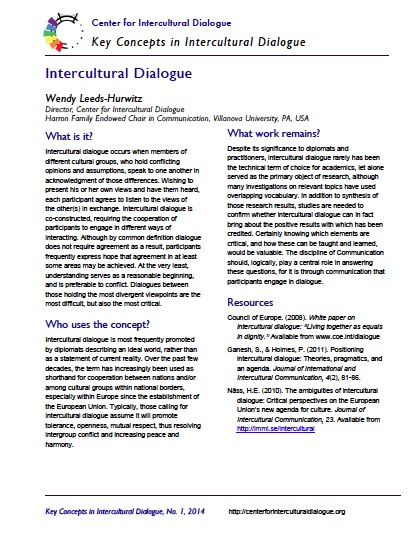
Key Concepts in ICDYou may have already noticed that the menu bar on the site has a new entry: publications. Starting today, the Center for Intercultural Dialogue is initiating a series of short briefs describing Key Concepts in intercultural Dialogue. The logic is that different people, working in different countries and disciplines, use different vocabulary to describe their interests, yet these terms overlap. It should be useful to sort out some of the assumptions and history attached to each concept for those unfamiliar with it. Key Concepts will be made available as PDFs on the CID website and may be downloaded for free. The first few concepts will be intercultural dialogue, cosmopolitanism, intercultural competence, and coordinated management of meaning. As you think of other concepts you would like to see included, send an email to the series editor, Wendy Leeds-Hurwitz. If there are concepts you would like to prepare, provide an explanation of why you think the concept is central to the study of intercultural dialogue.

The first key concept described is, for obvious reasons, Intercultural Dialogue. Click on the thumbnail to download the PDF.KC1-sm


NOTE for students: As these will be written by academics, they may be used as resources in academic papers (unless your professor in a particular course tells you otherwise). The citation format in APA would be:

Leeds-Hurwitz, W. (2014). Intercultural dialogue. Key Concepts in Intercultural Dialogue, 1. Available from: https://centerforinterculturaldialogue.org/wp-content/uploads/2014/02/key-concept-intercultural-dialogue1.pdf

NOTE: After publishing dozens of key concepts and translations, lists organized chronologically by publication date and numberalphabetically by concept in English, and by languages into which they have been translated, have been created, and a page of acknowledgments with the names of all authors, translators, and reviewers.


Creative Commons License
This work is licensed under a Creative Commons Attribution-NonCommercial-NoDerivatives 4.0 International License.

More ABC Micro Grants available!

UPDATE May 12, 2014: This round of micro grants has been completed – see the results. As further micro grants become available, they will be described on the website.


The Center for Intercultural Dialogue will distribute micro grants for intercultural dialogue from a pool of $5000 made available by the Association for Business Communication. These micro grants are intended to support either or both of the two types of activities described in the mission of the Center: study of intercultural dialogues by Communication scholars, and/or participation in intercultural dialogue through academic interactions between Communication scholars based in different countries, or different linguistic and cultural regions. Thus, you do not have to be studying intercultural dialogue as your topic – putting intercultural dialogue into practice through collaborative research is also eligible for funding. These grants are sufficient to provide seed funding only: no more than $1000 maximum can be awarded to any one individual. The goal is to encourage international, intercultural, interlingual collaborative research by giving enough funding to offset the cost of airfare only, while providing opportunity (and cause) for matching grants from universities. Past experience shows that even these small grants help researchers obtain matching funds from their departments, or administration.

ABC logo
If you already have multiple international connections, this grant is not for you – obviously you don’t need it. But if you are at a small college, or if you are a new scholar, or have not yet established significant international connections related to research, or if your university has recently cut back its budget for travel, you are the intended audience for this competition. If you have been reading publications by an international scholar on a topic of potential relevance to your own research, consider a short trip to discuss ways to collaborate on a future project. If you do not know who has been doing relevant work, check the sources you’ve been reading lately, ask your colleagues, and/or think about who you know from graduate school or who you have met (or heard present an intriguing paper) at a conference. Find someone with similar interests but who takes a different theoretical or methodological stance by virtue of being based in a different cultural context.

The intention is to support the development of new intercultural, professional connections. Thus continuing collaborations are ineligible. Those based in the US are expected to propose travel outside the country. International scholars currently living outside their country of origin are asked to establish a new affiliation in a different region rather than proposing a return to their homeland. We recognize that much interesting work can be done within a country between cultural groups, however this grant program focuses on connecting researchers who are not yet connected, across cultural regions that are typically disconnected. This rationale of cross-cultural connection must be explicit in the project description.

The ABC Micro Grants Application requires applicants to describe their project, provide a brief resume, a short note from their department chair documenting their current status, and one from the host scholar expressing interest in holding conversations related to research. The deadline is April 15, 2014. Membership in ABC is required, but they have decided to consider this a recruitment opportunity, meaning that you may join and be eligible immediately.

The National Communication Association set aside similar funding for micro grants in 2012-13. Those projects have already been completed, and have been described in sufficient detail that they may serve as models for this year’s applications.

Contact the Center’s Director, Wendy Leeds-Hurwitz, with questions.

Study Abroad in Italy with Gonzaga U

Graduate Study Abroad Program: The Cagli Project

One of the “best buys” in Graduate Study Abroad programs is our 17-day Award Winning Cagli Project, a multi-media cultural immersion project for graduating seniors and graduate students.  Begin in Renaissance Florence and then move into the Medieval market city of Cagli on the ancient Via Flaminia where you will get to know and understand the “real Italy.”  Enjoy life on the Piazza Matteoti with its quaint shops, gelateria, coffee bars and restaurants. Have classes in the Scuola d’Arte.  Many meals are shared group experiences.  Enjoy the precious opera house and the mountain springs.  Wake up to church bells, and enjoy the weekly festivals including Venerde and the Cagli beerfest.

Get to know Italians as you earn six credits learning conversational Italian, intercultural competence, photography, and profile writing. Earn the Emphasis in Intercultural and International Communication. Make friends for a lifetime in this truly transformational experience. There is still time for enrollment; see details.

Also, there are also two $300 scholarships made available by benefactors to the Gonzaga-in-Cagli Program.  The application for the scholarship is on the website.
Regular financial aid can be used for these classes.

For details contact Dr. Caputo.

CFP JIIC issue Partnering for Social Change

Call for Special Issue: Partnering for Social Change? Rethinking Intercultural Partnerships in Nonprofit Contexts, for Journal of International and Intercultural Communication

Special Issue Guest Editors: Yea-Wen Chen, Ohio University; Brandi Lawless, University of San Francisco; and Alberto González, Bowling Green State University

Communication scholars have recently directed attention to cultural discourses and nonprofit and voluntary organizations. At the same time, much more needs to be understood about how nonprofit and voluntary organizations constitute (inter)cultural sites, how they work with diverse memberships, stakeholders, publics, and partners, and how they organize for social change. We have chosen the broad term nonprofit organization to encompass not only registered tax-exempt 501(c)(3) organizations but also voluntary, community-based, non-governmental, civil society, and people’s organizations.

Nonprofit organizations are rich contexts for examining issues of identity, structure, institution, relationship, discourse, and power, which are of great interest to intercultural communication scholars. However, scholars have just begun to explore the intersection between intercultural communication and nonprofit relationship building (e.g., partnership, alliance, coalition building, etc.). This special issue serves as a critical space to rethink the challenges and limitations and opportunities of intercultural nonprofit partnership and also re-imagine new possibilities of relating across difference to promote social change.

This special issue invites research that is directed by three central questions: a) How are intercultural partnerships constituted, formed, maintained, negotiated, and practiced in the work of nonprofit organizations?; b) How do nonprofits navigate, negotiate, and mediate the competing dynamics of social structures, identity politics, and power relations as sites of intercultural practices?; c) How do nonprofit partners (e.g., practitioners, communities, funders, scholar, policy-makers, etc.) negotiate their intersecting cultural identities in ways that sustain, reproduce, or resist existing power relations?

All research methodologies are welcome. Papers that emphasize applied case studies, relationships between scholars and practitioners, theorization of culture within nonprofit organizations, social justice issues and examinations of power disparities are preferred. Joint submissions co-authored by nonprofit practitioners and scholars are especially welcome.

Submitting your manuscript: Please submit electronically an extended proposal between 500-600 words (excluding references) by March 15, 2014.  Authors should submit proposals using the journal’s website (www.tandf.co.uk/rjii) and follow instructions for online submission. Please select ‘special forum paper’ to describe the type of submission. JIIC now follows APA 6th edition guidelines. Proposals will undergo a blind review process, and a selection will be shortlisted for development into approximately 3000-word essays. Shortlisted authors must commit to a timeline for revision, resubmission and publication, with full manuscripts to be submitted by August 15, 2014. Final acceptance is contingent upon satisfactory revisions. Questions should be directed to Dr. Yea-Wen Chen.

USC post-docs

The USC Annenberg School Post-Doctoral fellowships in Digital Diversity

USC’s School of Communication at the Annenberg School for Communication and Journalism is seeking two Postdoctoral Scholars. The Annenberg School Post-Doctoral fellowships in Digital Diversity will support new scholars interested in faculty and research careers who will contribute to diversity and equal opportunity in higher education through their teaching, research and service. In particular we are interested in work at the intersection of diversity and digital informatics.

As communications media serve increasingly diverse and global constituencies, understanding of the ways in which differences in gender, class, ethnicity, national origin and other ‘fault lines” can divide us and present barriers to communication becomes even more critical. We seek candidates who are interested in a broad array of topics in the area, including barriers to adoption of digital technologies by underrepresented groups; media diversity and public policy; representation of women and minorities in the media; social networking and political empowerment; assistive and adaptive technologies for persons with disabilities; and diverse voices in user-generated content.  Candidates should have competencies in robust quantitative and qualitative techniques for mining and analysis of large data sets from media sources across multiple platforms.

Our program will offer two postdoctoral research fellowships for up to two years each (2014-2016), which will include professional development and faculty mentoring to outstanding scholars in the fields of digital diversity whose research, teaching, and service will contribute to diversity and equal opportunity.  Fellowship recipients perform research in a wide range of methodologies within the discipline of communication, with a focus on diversity within digital media.

Candidates who earned their Ph.D. after July 1, 2012 or will have their degree in hand by July 1, 2014 are eligible to apply.  The Ph.D. degree must come from an institution other than USC.   Candidates will come from diverse fields, but should also have an interest in, or a potential for, a wider contribution to the interdisciplinary field of informatics and digital knowledge.

Digital Diversity Postdoctoral Scholars will receive $50,000 per year, plus health insurance, with the possibility of receiving up to $10,000 in research and conference travel support. Postdoctoral Scholars will be expected to teach one course each year.

Applications:

Applicants are asked to submit their credentials including a letter describing their background, interests and areas of expertise, their curriculum vita or resume, three references and samples of their recent scholarly or professional work through USC’s job site.

Applications will be accepted until the positions are filled; review of applications will begin March 1st. We hope to announce the selection of postdoctoral scholars between March 15 and April 1, 2014.

The University of Southern California values diversity and is committed to equal opportunity in employment. Candidates from underrepresented groups are especially encouraged to apply.