Intercultural Harmony Grants – Musser Fund 2016

The LAURA JANE MUSSER FUND would like to promote mutual understanding and cooperation between groups and citizens of different cultural backgrounds within defined geographical areas through collaborative, cross-cultural exchange projects.  Projects must be intercultural and demonstrate intercultural exchange, rather than focused on just one culture.

PRIORITY IS PLACED ON PROJECTS THAT:
• Include members of various cultural communities working together on projects with common goals
• Build positive relationships across cultural lines
• Engender intercultural harmony, tolerance, understanding, and respect
• Enhance intercultural communication, rather than cultural isolation, while at the same time celebrating and honoring the unique qualities of each culture

PROJECTS MUST DEMONSTRATE:
• Need in the community for the intercultural exchange project
• Grassroots endorsement by participants across cultural lines, as well as their active participation in planning and implementation of the project
• The ability of the organization to address the challenges of working across the cultural barriers identified by the project
• Tangible benefits in the larger community

LIMITS OF GEOGRAPHY:
Only programs in Colorado, Hawaii, Michigan, Minnesota, and Wyoming may apply.

OUTCOMES SHOULD INCLUDE:
A demonstration of intercultural exchange between cultures
• Increased comfort in interaction between the groups and individual citizens addressed by the project
• Harmonious shared use of public space and community facilities
• Continued cooperation by the participants or communities addressed by the project

WHAT THE PROGRAM WILL COVER:
New programs or projects within their first three years
• The planning and implementation phase of a project
• Grants are typically in the $8,000-$25,000 range

WHO CAN APPLY:
• Nonprofit 501(c)(3) organizations
• Organizations located within one of the eligible states listed above

HOW TO APPLY:
Proposals will be accepted starting September 19, 2016 and must be submitted online by October 19, 2016. Funding decisions will be announced by February 2017.

To apply online please click here.

Archana Shrivastava Profile

ProfilesDr. Archana Shrivastava is Associate Professor & Head of the Business Communication Area at Birla Institute of Management Technology, India.

Archana ShrivastavaHaving worked at various universities and colleges, she has 19 years of research, teaching and training experience. Dr. Shrivastava earned her Ph.D. and M.A. in English literature from Dr. Hari Singh Gour University, Sagar in M.P. She is a Thomas certified professional and can perform Personal Profile Analysis (PPA) and Human Job Analysis (HJA). She is trained to teach “Business English Certificate Course and is also an active member of the Association for Business Communication, Communication Institute of Greece, and Eastern Communication Association.
Her current research and publications are in the areas of cross-cultural communication, leadership, team building, skill development. She has participated and presented papers in various conferences both in India and abroad. She has authored numerous case studies and research papers published in journals like IVEY, Emerald,  and Case Centre (European Case Clearing House). She is a recipient of a travel grant awarded by AICTE in 2015 to present her research at Columbia University in New York. She is the recipient of the best paper award in 2017 at the conference in Oxford University, and in 2018 in the international conference at Teri University.

Dr. Shrivastava has more than 19 years of academic experience to teach/train a variety of courses including: Business Communication, Soft Skills, Business Etiquette, Handling Interviews, Presentation Skills, Nonverbal Communication, Audience Analysis, Crisis Communication, Conflict Management, Negotiation Skills, Intercultural Communication, and Empathic Listening. She has been conducting trainings and Management Development Programmes (MDPs) for senior executives of several renowned  organizations and PSUs in India, including NTPC, NHPC, GAIL, IFFCO, and Power Grid. She has also been mentoring and developing students in the area of Soft Skills, especially People Skills.

Selected Publications

Shrivastava A. (2018). Using connectivism theory and technology for knowledge creation in cross-cultural communication. Research in Learning Technology, 26.

Shrivastava, A. (2018). A small initiative in the journey of making leaders with the help of authentic leadership model. Kybernetes47(10), 1956-1972.

Shrivastavam, A., Midha, M., & Vama, R. (2017). Employability skills: A comparative study of students from metro and two tier cities in India. FOCUS: The International Journal of Management, 12(2), 51-58.

Shrivastava, A., & Midha, M. (2016) Transactional style inventory: A tool to enhance interpersonal effectiveness. International Journal on Leadership, 4(2).

Shrivastava, A., & Srivastava A. (2016). Measuring communication competence and effectiveness of ASHAs (accredited social health activist) in their leadership role at rural settings of Uttar Pradesh (India). Leadership in Health Services, 29(1), 69-81.

Shrivastava, A., & Bindra, A. (2015). Re-designing organizational communication model of Akosha: An online consumer forum in India to resolve consumer complaints. The Case Centre, Reference no. 315-033-1.

Shrivastava, A. (2014). Active empathic listening as a tool for better communication. International Journal of Marketing and Business Communication, 3(3/4), 13-18.

Shrivastava, A. (2014). Sustainable development and inclusive growth model for improving organic agriculture in India: A case study on communication and awareness strategies of Morarka Foundation. The Case Centre, Reference number 914-017-1.


Work for CID:
Archana Shrivastava has served as a reviewer for translations into Hindi.

CFP Mediated Intercultural Communication in a Digital Age

CFP: Mediated Intercultural Communication in a Digital Age
Editors: Ahmet Atay, College of Wooster & Margaret D’Silva, University of Louisville

Profound changes in global communication, particularly social media, are leading us to re-examine our notions of culture, communication, audience, and identity. This book aims to bridge the gaps between intercultural communication and traditional and new media scholarship.

Media texts, social media platforms, global applications, and cyber culture play a paramount role in intercultural communication, particularly in the context of globalization.  Beyond traditional media, social media are particularly relevant to facilitating intercultural communication. Global social network sites such Facebook or Twitter, online gaming sites, online courses, global blogs, and all of the applications that appear in smart phones, tablets or computer devices are part of a very complicated and multi-faceted digital culture that moves beyond the borders of nation-states.

These social media platforms allow global communities to emerge; immigrants, diasporic bodies, and cosmopolitans can communicate and connect across the globe. They also allow members of traditionally oppressed groups to find their voices, cultivate communities, create homes away from home, and construct their cultural identities and narratives. Digitalized social movements around the world, identity performances of diasporic queer bodies, and long-distance relationships between partners and family members are some examples. This cyber culture centers around communication between people who are culturally, nationally, and linguistically similar or radically different. Therefore, studying traditional and social media in relation to intercultural communication is extremely crucial and timely.

This call invites abstracts for an edited book that takes qualitative, interpretive, and critical and cultural perspectives in examining the reciprocal relationship between media and intercultural communication. The book’s interrelated goals are to:

– 1-Examine how media, social media in particular, influence and contribute to intercultural communication.

– 2-Analyze the complex and multidimensional relationship between culture and media in the context of globalization.

-3-Understand how media, particularly social media, construct identities and enable or disable individuals to express their cultural identities.

-4-Analyze how globalization as a cultural and political process impacts mediated and intercultural communication.

– 5-Look at different contemporary issues relevant to intercultural communication and social media scholarship such as immigration, diaspora, social movements, religion and spirituality, democracy, and intercultural/ international relationships, from a media perspective.

– 6-Examine both negative and positive influences of media, particularly social media, on intercultural communication.

Potential topics include, but are not limited to:
1-Theorizing mediated intercultural communication
2- Social media and cultural identity
3- Social media and intercultural relationships
4- Media and online courses in the context of globalization
5- Cyber intercultural communities
6- Social media and global social movements
7- Immigrant media
8- Media and intercultural representations

Abstracts are due by September, 20, 2016, with a word length of no more than 500 words, along with pertinent references, contact information, and a short biographic blurb of 300 words. Full-length manuscripts are due on April 1, 2017, with a word length of no more than 5,000-7,000 words and in APA style, including references, endnotes, and so forth. Please mail your abstracts as Word documents to Ahmet Atay (aatay[at]wooster.edu) for an initial review.

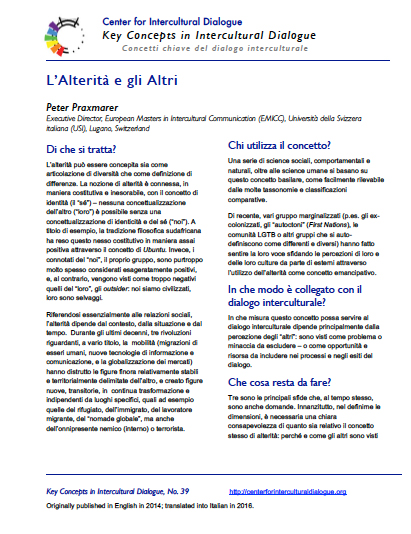
Key Concept #39: Otherness Translated into Italian

Key Concepts in ICDContinuing translations of Key Concepts in Intercultural Dialogue, today I am posting KC#39: Otherness and The Other(s), originally written by Peter Praxmarer for publication in English in 2014, now translated with the help of Paola Giorgis into Italian. While translating, he has taken the opportunity to slightly revise and update the original English version as well.

As always, all Key Concepts are available as free PDFs; just click on the thumbnail to download. Lists of Key Concepts organized chronologically by publication date and number, alphabetically by concept, and by languages into which they have been translated, are available, as is a page of acknowledgments with the names of all authors, translators, and reviewers.

KC39 Otherness_ItalianPraxmarer, P. (2016). L’Alterità e gli Altri. Key Concepts in Intercultural Dialogue, 39. (P. Praxmarer & P. Giorgis, Trans.). Available from:
https://centerforinterculturaldialogue.org/wp-content/uploads/2016/08/kc39-otherness-italian1.pdf

If you are interested in translating one of the Key Concepts, please contact me for approval first because dozens are currently in process. As always, if there is a concept you think should be written up as one of the Key Concepts, whether in English or any other language, propose it. If you are new to CID, please provide a brief resume. This opportunity is open to masters students and above, on the assumption that some familiarity with academic conventions generally, and discussion of intercultural dialogue specifically, are useful.

Wendy Leeds-Hurwitz, Director
Center for Intercultural Dialogue
intercult.dialogue[at]gmail.com


Creative Commons License
This work is licensed under a Creative Commons Attribution-NonCommercial-NoDerivatives 4.0 International License.

Eleanor Roosevelt Fund Award

Eleanor Roosevelt Fund Award

Nominate an extraordinary person, project, or organization — or yourself — in recognition of notable contributions to equality for women and girls.

Nominations for the 2017 award will be accepted August 1 – November 15, 2016.

Established in 1989, the Eleanor Roosevelt Fund Award honors an individual, project, organization, or institution for outstanding contributions to equality and education for women and girls. The award is given for a broad range of activities including classroom teaching, education and research, and legal and legislative work in equality for women and girls. While the award focuses on education, the recipient need not be an educator.

U Massachusetts Job Ad: Global Digital Media

The Department of Communication at the University of Massachusetts Amherst seeks a Global Digital Media scholar with a preferred focus on the Global South. The rank will be at the Assistant or Associate Professor level. We seek a colleague whose work complements and extends the critical traditions in the department, which include political economy, cultural studies, technology studies, and post-colonial approaches. Preference will be given to candidates whose research and teaching focus on the role of new and emerging digital technologies, especially in Africa, Latin America, or the Middle East. Additionally, the Department is interested in candidates who have demonstrated ability to contribute to the inclusive excellence and diversity mission of the department, college and university in research, teaching, and/or outreach.  The position will begin Sept. 1, 2017 and will include responsibilities for teaching and supervision at the undergraduate and graduate levels. The ability to collaborate on and eventually lead interdisciplinary, grant-funded projects is desirable.

Review of applications will begin on October 25, 2016 and will continue until the position is filled. Applications should include a letter of interest, a CV, evidence of teaching effectiveness, and one article-length example of research. All materials should be submitted through the Interview Exchange website.

In addition, candidates should arrange to have three letters of reference submitted separately to commdigitalmedia2016[at]umass.edu. A completed PhD in Communication or closely allied field is required by the start of the appointment.

The university is committed to active recruitment of a diverse faculty and student body. The University of Massachusetts Amherst is an Affirmative Action/Equal Opportunity Employer of women, minorities, protected veterans, and individuals with disabilities and encourages applications from these and other protected group members. Because broad diversity is essential to an inclusive climate and critical to the University’s goals of achieving excellence in all areas, we will holistically assess the many qualifications of each applicant and favorably consider an individual’s record working with students and colleagues with broadly diverse perspectives, experiences, and backgrounds in educational, research or other work activities. We will also favorably consider experience overcoming or helping others overcome barriers to an academic degree and career.

CFP Intangible culture: Migrants’ contribution to (global) cultural heritage (Sydney)

SIETAR AUSTRALASIA in co-operation with the University of Sydney Business School are holding a conference with the theme: Intangible culture: Migrants’ contribution to (global) cultural heritage in Sydney on November 24-25, 2016.

Standard presentation (20 minutes)
The presentations will be 20 minutes with 10 minutes of question time.

Interactive training/teaching workshop – exchanging best practices (30-60 minutes)
There will be workshop opportunities on any of these topics below or on other topics submitted (and approved). Workshops will run for 30-60 minutes. These workshops will be a practical way to explore these topics and concepts.

Panel discussions (45 minutes)
We aim to have panel discussions on the topics below. Please submit a panel proposal involving at least two panels.

Topics for abstract and workshops
Our aim is to explore how migrants have contributed to the creation of intangible and tangible cultural heritage in Australia and globally. Below are some suggestions for workshop, panel and presentation topics. We are open to variety of other topics dealing with culture, multiculturism and intercultural relations.
Global perspectives
• Global leadership
• Global cultural society
• Cohabiting in a global world
• Peace, human rights, and multiculturalism
• Intercultural capacity building
• Multicultural education
• Intercultural training
• Constructing multicultural identity
• Religion and multiculturalism
• Sustaining diversity
• Hybrid cultural identity
• Cultural heritage: intangible and tangible.
• Superdiversity
• Symbols and multiculturalism
• Creation of new national identity.
• Mainstream and other issues
• Refugees- self initiated expats, and other new groups of intercultural sojourners
• Community and national identity
• Multiculturalism in the work-place
• Multiculturalism and the local culture
• Indigenous and minority groups
• Community and national identity
• Multiculturalism and business

Conference Fees
Waged: $450 AUD
Waged Early-Bird Registration: $400 AUD
Unwaged and Students: $350 AUD
Unwaged and Students Early Bird: $300 AUD
Waged SIETAR Member: $340 AUD*
Unwaged and Students SIETAR Member: $280 AUD*
* SIETAR Membership is $90.00 AUD for waged and $50.00 AUD for unwaged

Conference venue
The University of Sydney Business School, CBD Campus Level 17, 133 Castlereagh Street, Sydney NSW 2000.

Dialogue across Differences: Public Conversations Project Workshop

Dialogue Across Differences: An Introduction to Reflective Structured Dialogue
September 16, 2016, Watertown, MA
May 16, 2017<, Cambridge, MA

25 years ago, Public Conversations Project created a unique approach to dialogue that promoted connection and curiosity between those who saw one another as the enemy. Our approach has transformed conflicts across the country and the world – but its principles are widely applicable for everyday conversation. An intentional communication process can help individuals, organizations and communities build trust, enhance resilience for addressing future challenging issues, and have constructive conversations with those they otherwise “wouldn’t be caught dead with.”

Learning Objectives:
• Learn basic theory and practice of Public Conversations’ relationship-centered approach to better communication and dialogue.
• Achieve shared, clear, and mutually understood purpose in a conversation.
• Design a framework for a constructive conversation that will encourage people to participate fully, listen actively, and enhance empathy.
• Stimulate self-discovery and curiosity about the “other” through questions that promote connection, curiosity and caring.

Results:
As a result of this workshop, you will be equipped to:
• Communicate with self-confidence about difficult or divisive topics.
• Break destructive communication habits like avoidance, silence, or reactive responses, enabling those in a conversation to feel truly listened to.
• Design conversations, dialogues, or meetings with clear purpose, full participation, and a structure for moving forward.
• Employ effective and satisfying communication exercises in a broad range of personal and professional settings.

Who might participate:
• Executives in the nonprofit, public, or private sectors interested in shifting the culture of communication in their workplace.
• Managers seeking to lead more constructive conversations with a divided, frustrated, or distracted team.
• Clergy looking to broach a challenging concept with their congregation or internal leadership.
• Consultants in strategic communications, strategic planning, or organizational development exploring new ways to improve client relations.
• Administrators seeking to encourage collaboration between departments.

Accreditation:
This workshop is approved for 6 clock hours for national certified counselors, Massachusetts licensed mental health counselors, MA licensed marriage and family therapists, and New Hampshire pastoral psychotherapists. Credits are accepted by the NH Board of Mental Health Practice for all licensed NH mental health professionals. For more information, please see our workshop policies. Public Conversations Project is an NBCC-Approved Continuing Education Provider (ACEP™) and may offer NBCC-approved clock hours for events that meet NBCC requirements. The ACEP solely is responsible for all aspects of the program.

For more information, please contact training[at]publicconversations.org

Public Deliberation & Dialogue at ICA

ICA 2016This summer at the International Communication Association’s conference in Fukuoka, Japan, twenty communication scholars and students gathered for a preconference on Pubic Deliberation and Dialogue: Building an International Network of Research, Pedagogy, and Service. The group included faculty and students working in Denmark, Finland, Israel, Japan, Malaysia, Norway, and USA. The gathering was designed to build a stronger international network by sharing ideas on public deliberation and dialogue in the areas of teaching, research, and service.

The preconference started with short 3-5 minute presentations from each participant. Invited to share their broad interests, a specific project, or questions they’d like to explore, each person introduced their work while also establishing our shared interest in deliberation and dialogue in media coverage, social media, classrooms, campuses, communities, and legislatures. These presentations planted the seeds of collaboration between participants while also raising issues and values that would be discussed in small groups.

In the first small group session, participants explored a range of research areas, including the need for theorizing the function of incivility and storytelling in deliberation as well as the importance of local cultures when studying deliberative characteristics such as politeness and rationality. Participants also discussed ways to give voice to underrepresented groups and to cultivate deliberative faith across cultures. In the second session, participants considered the opportunities and the challenges of conducting engaged work. Conversations on this topic revolved around the question of identity – “How do we engage authentically as a researcher, teacher, and community member?” The small group session ended with the exchange of ideas on ways to enhance intercultural dialogue through faculty-led study abroad trips and to develop deliberative skills in communication courses across different cultures.

The final part of the preconference looked at how a network on dialogue and deliberation consisting of scholars from around the world could be formed. There was a discussion on how to create supportive and informative relationships and linkages to others outside the network who may contribute to or benefit from the network. There was interest in having a range of academic disciplines, nationalities, concepts that differ across disciplines and cultures and taking into account common interests and common goals as well as what resources its members will want to exchange. Dialogue and deliberation to address regional challenges would be an interesting area to pursue: identifying challenges and opportunities facing regions, examining dialogue and deliberation research and aspirations in different parts of the world, exploring ways in which dialogue and deliberation can be deployed and coordinated to support shared interests, increasing understanding of emerging trends and new models, and creating opportunities to strengthen and leverage links and networks.

The co-chairs of the preconference were:
Soo-Hye Han, Kansas State University
Azirah Hashim, University of Malaya; Executive Director, Asia-Europe Institute (AEI)
Leah Sprain, University of Colorado, Boulder
Tim Steffensmeier, Kansas State University

For further information about the new network, contact Tim Steffensmeier, steffy[at]ksu.edu

Save

Tim Steffensmeier Profile

ProfilesTim Steffensmeier is an associate professor and director of the Leadership Communication doctoral program at the Staley School of Leadership Studies at Kansas State University. This is a joint appointment as director of research at the Kansas Leadership Center based in Wichita, KS.

Tim Steffensmeier Tim’s publications focus on public deliberation, rhetoric, and civic leadership. This research has been grant funded by the National Science Foundation, Kettering Foundation, and Interactivity Foundation. Steffensmeier is a former department head of Communication Studies at Kansas State University (2012-2017) and served as editor for the Journal of Public Deliberation. Tim has a Ph.D. from the University of Texas, Austin in Communication Studies/Rhetoric. His expertise includes consulting experience with companies and communities on leadership development and communication.

His publications include:

PytlikZillig, L. M., Steffensmeier, T., Campbell Hibbs, A., Champion, B., Hunt, E. D., Harrington, J., Jr., Spears, J., Umphlett, N., Bruning, R., & Kahl, D. (2013). Fostering climate change education in the Central Great Plains: A public engagement approach. International Journal of Sustainability, 8(1), 161-177.

Steffensmeier, T. (2010) Building a public square: An analysis of community narratives. Community Development, 41(2), 255-268.

Steffensmeier, T. & Schenck-Hamlin, W. (2009) Argument quality in public deliberations. Argumentation and Advocacy, 45(1), 21-36.