
Key Concept 22: Cultural Identity Translated into Turkish

Key Concepts in ICDContinuing translations of Key Concepts in Intercultural Dialogue, today I am posting the translation of KC22: Cultural Identity. Vivian Huseh-Hua Chen wrote this in English in 2014 and it now has been translated into Turkish by Kenan Çetinkaya.

As always, all Key Concepts are available as free PDFs; just click on the thumbnail to download. Lists of Key Concepts organized chronologically by publication date and number, alphabetically by concept, and by languages into which they have been translated, are available, as is a page of acknowledgments with the names of all authors, translators, and reviewers.
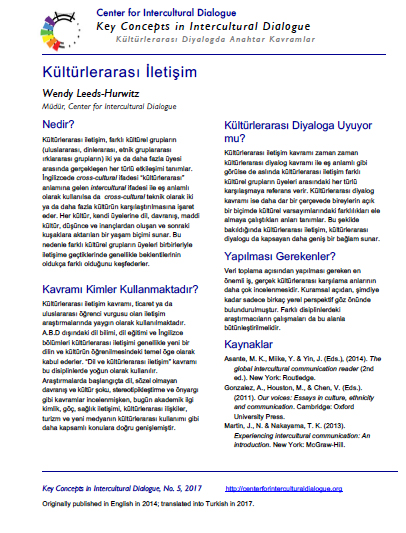
KC22 Cultural Identity_TurkishChen, V. H-H. (2017). Kültürel Kimlik. (K. Çetinkaya, Trans.) Key Concepts in Intercultural Dialogue, 22. Available from:
https://centerforinterculturaldialogue.org/wp-content/uploads/2017/01/kc22-cultural-identity_turkish.pdf

If you are interested in translating one of the Key Concepts, please contact me for approval first because dozens are currently in process. As always, if there is a concept you think should be written up as one of the Key Concepts, whether in English or any other language, propose it. If you are new to CID, please provide a brief resume. This opportunity is open to masters students and above, on the assumption that some familiarity with academic conventions generally, and discussion of intercultural dialogue specifically, are useful.

Wendy Leeds-Hurwitz, Director
Center for Intercultural Dialogue


Creative Commons License
This work is licensed under a Creative Commons Attribution-NonCommercial-NoDerivatives 4.0 International License.

CFP International Journal of Collaborative-Dialogic Practice

International Journal of Collaborative-Dialogic Practice

The International Journal of Collaborative-Dialogic Practice brings together members of a growing international community of practitioners, scholars, educators, researchers, and consultants from diverse disciplines who are interested in collaborative-dialogic practice based in postmodern-social construction assumptions. This community responds to important questions in social and human sciences such as:
*How can our practices have relevance for the people we meet in our fast changing world?
*What will this relevance accomplish? For whom? And, who determines it?

The Journal provides a bilingual forum for the exchange of ideas and practices from diverse practitioners and scholars around the world. This forum aims to help produce and promote relationally responsive-dialogic processes which generate new opportunities and new futures in our working and living together locally and globally.

Les compétences interculturelles: Enjeux, pratiques, perspectives

Special Issue LPS About a year ago, Johanna Maccioni asked if I would write an article for a special issue of the journal Les Politiques Sociales on Les compétences interculturelles: Enjeux, pratiques, perspectives [Intercultural competences: Stakes, practices and perspectives] which she was editing with Cédric Juliens. I agreed, and wrote the draft, which we discussed when we both happened to be in Paris in April. It was translated over the summer; in fall Yves Winkin helped by reviewing the entire translation with me when we were both in Victoria. The issue has just been published, and is now available. As a Belgian journal published in French, the overview provided below is in French, however abstracts of all of the articles are available in French, English and Spanish. My thanks to Johanna for the invitation which led to a model of intercultural collaboration.

Wendy Leeds-Hurwitz, Director
Center for Intercultural Dialogue


Présentation [Overview]

Lors de vagues de migrations successives, des millions de personnes ont gagné l’Occident dans la perspective d’une vie meilleure. Migrants et natifs du pays d’accueil ont alors fait l’expérience de la rencontre. Mais quand les différences culturelles sont perçues sur le mode de la hiérarchie, des rapports de force s’installent. Les travailleurs sociaux doivent-ils préconiser l’assimilation ou négocier sur fond d’interculturalité ? Et lors de cette négociation, quelles compétences les acteurs mettent-ils en jeu ? Ce numéro propose un état de la question des compétences interculturelles. Il clarifie certains enjeux identitaires, explore des pratiques actuelles et pose une réflexion pour l’avenir.

Sommaire [Table of Contents]

Présentation [Introduction] by Johanna Maccioni and  Cédric Juliens

De la possession des compétences interculturelles au dialogue interculturel : un cadre conceptuel [Putting intercultural skills and abilities at the service of dialogue: A conceptual framework] by Wendy Leeds-Hurwitz

L’interculturalisme québécois : un modèle alternatif d’intégration [Inter-culturalism in Quebec: An alternative model of integration] by Sabine Choquet

Reconnaissance : entre égalité et diversité [Recognition: Between equality and diversity] by Audrey Heine and Laurent Licata

« Islam-médicament » et « Coran-pharmacie » : du religieux comme forme de soin [“Islam the medicine, the Koran the pharmacist”: Religious practice as a form of care] by Eléonore Meriem Armanet

Enjeux de formation à la démarche interculturelle : exemple du milieu des soins [What is at stake in intercultural approaches: The example of the area of health care] by Johanna Maccioni

Le choc culturel : révélateur des difficultés des travailleurs sociaux intervenant en milieu de migrants et réfugiés [“Culture-shock”: A telling sign of the difficulties of social workers working with migrants and refugees by Margalit Cohen-Emerique

L’évaluation des compétences interculturelles [The evaluation of intercultural competences] by Anne Bartel-Radic

Les mobilités académiques comme opportunité pour les compétences interculturelles : de l’endoctrinement à l’acceptation des imaginaires [What happens when students exchange universities: The chance to be at
home in a different culture and replace received ideas with a new imaginative world] by Fred Dervin

« La première fois que j’ai vu de la neige en Belgique, je croyais que c’était du sucre. » Entretien avec l’équipe de médiatrices interculturelles du « Foyer » [“The first time I saw snow in Belgium I thought it was sugar”: A discussion with the team of female intercultural mediators at the cultural centre, Molenbeek, Brussels] by Juliens Cédric and Chikhi Hamida

« C’est à l’Eden que je songeais » [“C’est à l’Eden que je songeais”] by Frédéric Dussenne

Compétences interculturelles : entre droit à la diversité et nécessité du vivre ensemble [Intercultural competence between the right to diversity and the need to live together] by Altay Manço

Key Concept #31: Indigenous Translated into Kapampangan

Key Concepts in ICDToday sees the addition of a new language to the translations of the Key Concepts in Intercultural Dialogue.  S. Lily Mendoza wrote KC31: Indigenous in English in 2014, which she has now translated into Kapampangan. [NOTE: this translation was updated in 2020, and the original 2017 version replaced.]

As always, all Key Concepts are available as free PDFs; just click on the thumbnail to download. Lists of Key Concepts organized chronologically by publication date and number, alphabetically by concept, and by languages into which they have been translated, are available, as is a page of acknowledgments with the names of all authors, translators, and reviewers.

KC31 Indigenous_KapampanganMendoza, S. L. (2020). Katutubu. Key Concepts in Intercultural Dialogue, 31. Available from:
https://centerforinterculturaldialogue.org/wp-content/uploads/2020/10/kc31-indigenous_kapampangan_v2.pdf

If you are interested in translating one of the Key Concepts, please contact me for approval first because dozens are currently in process. As always, if there is a concept you think should be written up as one of the Key Concepts, whether in English or any other language, propose it. If you are new to CID, please provide a brief resume. This opportunity is open to masters students and above, on the assumption that some familiarity with academic conventions generally, and discussion of intercultural dialogue specifically, are useful.

Wendy Leeds-Hurwitz, Director
Center for Intercultural Dialogue


Creative Commons License
This work is licensed under a Creative Commons Attribution-NonCommercial-NoDerivatives 4.0 International License.

CIEE Job Ads: Director of Study Abroad; Student Life Director & Assistant (UK)

Director of CIEE Global Institute, London
Council on International Educational Exchange – Study Abroad
Closes: 31st January 2017
Reports To: Regional Director of Operations, Global Institutes

A nonprofit, non-governmental organization, CIEE is the world leader in international education and exchange. For 70 years CIEE has helped thousands of people gain the knowledge and skills necessary to live and work in a globally interdependent and culturally diverse world by offering the most comprehensive, relevant, and valuable exchange programs available. Serving over 300 U.S. College and University consortium members, CIEE operates sixty study centers in over forty countries that support study abroad programs for over 8,000 students annually. In addition, as the largest sponsor for U.S. Department of State J-1 Visa programs, CIEE helps nearly 25,000 international students participate in U.S. based exchange programs annually. CIEE programs and services span study abroad, teach abroad, international faculty development seminars, and inbound exchange study, work, and internship programs for today’s high school and university students, professionals, and educators.

We strive to lead a robust community of international program providers and sponsors through innovation, exemplary service and exceptional efficiency. Our success depends on having the very best professionals. CIEE is committed to recruiting and retaining the best people in the industry, particularly those who are passionate about international education, are self-starters with high levels of energy and autonomy, and are dedicated to exceed expectations in every challenge.

Responsibilities:
The Director of the CIEE Global Institute – London is responsible for the quality and success of CIEE programs offered in London, with overall responsibility for the management of all aspects of the Global Institute, ensuring the highest levels of quality and customer satisfaction. A significant feature of the work is the planning and delivery of the CIEE Open Campus program, a highly innovative study abroad concept that enables students to design a program from six to 36 weeks, in up to three different locations. This program is defined by the highest standards of educational quality, rigorous coordination between Open Campus locations, and providing access to students of diverse backgrounds. The Director works closely with a core management team who are responsible for the effective, timely, and on-budget delivery of multiple program aspects.

Skills and Experience:
Successful applicants will be seasoned professionals with at least five years’ experience in a leadership role within study abroad, international educational exchange, or a related higher education institutional setting. A Ph.D. is preferred, while a Master’s degree is required.


Student Life Director
Council on International Educational Exchange – Study Abroad
Closes: 31st January 2017
Reports To: Director, Global Institute – London

Summary of Position: The Student Life Director is responsible for design and delivery of student life programming, community and intercultural engagement activities, and establishing and enforcing procedures to maintain the health, safety, and security of the students at the Global Institute facility. The Director manages the staff of the Student Life Office (SLO) that facilitates cultural integration between students and the broader community in London and coordinates (with the Academics Department) the planning and delivery of experiential learning opportunities such as extra-curricular events, day-trips, and overnight Study Tours. The SLO staff also ensures student access to healthcare providers and establishes preventative and responsive measures and protocols to ensure residential safety and compliance with behavior requirements.

NOTE: CIEE is also advertising two related positions: Student Life Assistant and Operations Assistant, also based in London.

PhD Studentship: UNAOC/Centre for Trust, Peace & Social Relations (UK)

PhD Studentship: United Nations Alliance of Civilisations/Centre for Trust, Peace and Social Relations
Coventry University – Centre for Trust, Peace and Social Relations (CTPSR)
Closes: 20th January 2017

As part of a continuing programme of expansion of research activity in the role that intercultural relations and dialogue plays in forging (or inhibiting) social solidarity, trust and peaceful relations in diverse and changing societies, Coventry University is offering two full-time PhD studentship to well-qualified individuals, to start in May 2017.

Coventry University is offering this studentship as part of our partnership with the United Nations Alliance of Civilisations www.unaoc.org. The UNAOC promotes intercultural and interfaith dialogue amongst nations and builds bridges and understanding between different cultures and people. It promotes the development of more inclusive societies, in which diversity is experienced as an asset. Proposals are invited for a PhD research project exploring an area consistent with and developmental from the UNAOC Vision and Mission Statements.

Vision Statement: Guided by the principles of the UN Charter, the report of its High-Level Group, and the priorities of the Secretary-General, the UN Alliance of Civilizations works toward a more peaceful, more socially inclusive world, by building mutual respect among peoples of different cultural and religious identities, and highlighting the will of the world’s majority to reject extremism and embrace diversity. UNAOC will seek to operate in situations where is can contribute to broader efforts to ameliorate identity based crises and promote culturally sensitive development policies.

Mission Statement: The High-level group described UNAOC as an entity that would assist in diminishing hostility and promoting harmony among the nations. The UN Secretary-General has described it as a soft power tool for bridging divides and promoting understanding between countries or identity groups, all with a view toward preventing conflict and promoting social cohesion. UNAOC pursues its objectives through a variety of activities:
• Contacts and dialogues with stakeholders (governmental, intergovernmental and non-governmental)
• Development of targeted projects
• Advocacy, including direct public statements or appearances by the High Representative or UNAOC staff
• Interventions to defuse religious and cultural tensions by mobilizing third parties that can act as forces of moderation and understanding such as religious leaders, grassroots organizations, youth leaders and women leaders.

We welcome applications with proposals for a PhD research project that will provide new insights about the impact of UNAOC’s work. This includes the work with youth, media, non-state actors and in migration. We welcome proposals that are interdisciplinary and use innovative and participatory research methods. We are looking for proposals that challenge existing ideas and expand current thinking, offering original insights and approaches by undertaking significant and rigorous research and contribute to change within UNAOC and the context within which the research is based. It is standard practice for supervision teams to consist of three staff members. For further information about potential supervisors interests and expertise, visit the CTPSR.

The PhD studentship will be based within an appropriate Research Group in the Centre, and the PhD student will be expected to work 6 hours per week as a research assistant as and when the opportunity arises.

The full-time PhD studentships will cover UK/EU or overseas tuition fee equivalent, and an annual stipend for the duration of the studentship.

About the host Centre/Department: The Centre for Trust, Peace, and Social Relations has over 60 full-time research staff supported by a team of professional support staff. We take a multi-disciplinary approach to our work that brings together creative thinking on concerns of trust, peacebuilding, peace and reconciliation and on the contemporary challenges of societal relationships in a diverse and connected world.  Our portfolio of excellent and impactful research seeks to change lives and enhance well-being. We convene and contribute to public debates, provide effective policy guidance at local, national, regional and global levels and generate international collaborative research through our global networks.

CTPSR’s Doctoral Programme: Our Doctoral Training Centre develops independent, trained, highly-employable researchers with knowledge, expertise and skills in strategically-important research areas with real-world impact within a large, vibrant and international postgraduate community.

Candidate specification

Entry criteria for applicants to PHD (standard)
• a taught Masters degree in a relevant discipline, involving a dissertation of standard length written in English in the relevant subject area with a minimum of a merit profile: 60% overall module average and a minimum of a 60% dissertation mark
• the potential to engage in innovative research and to complete the PhD within a three-year period of study.
• a minimum of English language proficiency (IELTS overall minimum score of 7.0 with a minimum of 6.5 in each component)
In all cases the most recent and highest qualification attained will be that utilised for assessment purposes

Additional items for candidate specification
• a first or good upper second class undergraduate degree in a related social science or in the humanities and a strong interest in pursuing research in this field
• skills in quantitative and qualitative research methods

How to apply: Application form, full supporting documentation, and covering letter, plus a 2000-word proposal addressing the research theme

Duration of study: Full-Time – 3 years 6 months

Interview dates: 06 February 2017

PhD Studentship on Reframing in Mediation (Switzerland)

The Institute of Argumentation, Linguistics and Semiotics (IALS) of USI Università della Svizzera italiana invites applications for a PhD position (100%, 3 years). The PhD candidate will develop his or her dissertation within the project: “The inferential dynamics of reframing within dispute mediators’ argumentation”, funded by the Swiss National Science Foundation. This dissertation will be supervised by Prof. Sara Greco.

The research project
The selected candidate will develop his or her dissertation in the framework of a research project directed by Prof. Sara Greco; this project proposes a novel interpretation of reframing as an argumentative competence of dispute mediators. The PhD candidate will be equally expected to substantially contribute to activities related to this research project, both at the scientific and at the organizational level. The project “The inferential dynamics of reframing within dispute mediators’ argumentation” is part of a broader stream of research concerning argumentation in dispute mediation that is carried out at the IALS. Within this project, regular interaction with professional mediators in Switzerland will be required.

Place of work
Lugano. Availability to travel to other parts of Switzerland and abroad (for purposes of collaboration and research) is required.

The IALS institute represents a lively research environment for a PhD student who specializes in argumentation. Interaction with several researchers specializing on argumentation in different contexts, as well as interdisciplinary interactions with colleagues inside and outside the Faculty is an asset for a PhD candidate who wants to work on argumentation in a specific communication field such as conflict resolution. The candidate will also take part in the activities of the Laboratory for the study of Argumentation in the Contexts of the Public Sphere (LACoPS).

Requirements
• A Master (or equivalent title) in argumentation, communication, language sciences, social sciences, psychology, conflict studies, or related disciplines.
• High personal interest in the analysis of discourse and argumentation. Proven attitude for a fine-grained analysis of communicative interaction. Inclination towards the study of argumentation, discourse analysis, and the linguistic specificities of the discourse of conflict resolution.
• Interest for dispute mediation and other conflict resolution practices; nuanced understanding of the human and social value of conflict resolution.
• Fluency in English is necessary. Fluency in French is also strictly required, as the PhD candidate will conduct his or her research in collaboration with a board of experts, including academics and mediators, who are largely based in the French part of Switzerland. Knowledge of Italian will be considered an added value; in any case, it is expected that the selected candidate will learn to communicate in Italian during the PhD.
• Motivation to engage in the elaboration of a PhD dissertation. Ability to work in team and autonomy in scheduling research steps. Interest for teaching and availability to collaborate with colleagues (engage in scientific dialogue, listen and think critically) are required. The ability to establish good working relations with professional mediators will be considered an important asset.

Job description
The PhD candidate will participate in all phases of the research project. He or she will have the task of setting up a collection of data for his or her dissertation, while at the same time pursuing the goals of the project. Data collection will require interaction with professional mediators in Switzerland.

The PhD candidate will write a dissertation related to the research topic of the project. He or she will collaborate in the organization of scientific and dissemination activities related to the project. It is expected that he or she will regularly collaborate with researchers at the IALS as well as other scholars who are in the scientific board of the project.

The PhD candidate is also asked to present papers at scientific conferences, and produce publications for scientific journals.

Contract terms
The project is financed by the Swiss National Science Foundation and the PhD student will be receiving a salary according to the SNF policies.

Starting date
1st March 2017 (at the earliest). However, the position will be kept open until a suitable candidate has been found.

Application
Applications must include: a motivation letter, a complete CV, copies of university titles, an electronic version of a research work (Master thesis or other scientific publication). The latter must be accompanied by a short summary in English (1 page maximum). A support letter written by the Master thesis supervisor (or another Professor who knows the candidate well) is equally welcome.

Applications must be sent to Prof. Sara Greco in electronic format (sara.greco AT usi.ch). For any further information about this position, please contact her.

Deadline for applications
The deadline for applications is February 10, 2017; but applications will be received until the position is filled.

U York Job Ads: Linguistics (UK)

Lectureships in English Language and Linguistics
University of York – Heslington Campus
Closing date: 6 February 2017.

The Department of Language and Linguistic Science is seeking to appoint two Lecturers to contribute to research and teaching in the field of English Language and Linguistics from 1 September 2017 or as soon as possible thereafter. The posts are full-time.

You are early to mid-career linguists who are establishing, or have established, a track record of high quality research and who are also committed to excellence in teaching and supervision. You will play a full part in the research, teaching, supervision and administration of the Department, with particular responsibility for teaching and supervising in our English language and linguistics programmes. We particularly welcome applications from scholars whose research and teaching interests include one or more of the following: corpus linguistics, history of English, interactionist approaches to English, language variation and change, sociolinguistics, varieties of English.

You should be sure that you meet the Essential Criteria in the Person Specification section of the further information associated with the posts before starting an application. Informal enquiries may be made to the Head of Department (Professor Dunstan Brown) by e-mail (dunstan.brown AT york.ac.uk). For further information and to apply on-line, please visit this website.

CFP Visualizing (in) the New Media (Switzerland)

Call for Papers: Visualizing (in) the New Media

In November 2017, the Universities of Neuchâtel, Zurich and Bern in Switzerland will host the first international conference to focus specifically on visual communication in/about new media. In this regard, we invite the submission of abstracts for scholarly presentations in any of four overlapping thematic areas.

  1. Social interaction

Here, we envisage presentations that focus on the communicative uses of visual resources in the context of new media; for example: orthography and typography, graphematic design, the use of emojis (pictograms, emoticons, smilies), and/or the social-interactional uses of video, GIFs and non-moving images.

  1. Meta-discourse

Here, we envisage presentations that focus on people’s talk or writing about visual practices; for example: journalistic commentary about visual practices in new media (the use of emojis, for instance) or communicators’ discussions about their own or others’ visual practices in new media spaces.

  1. Visual ideologies

Here, we envisage presentations that focus on the visual depiction of new media in, for example, the context of commercial advertising, print or broadcast news, cinema and television narratives and/or public policy and educational settings.

  1. Industrial design

Here, we envisage presentations that focus on perspectives related to, for example, the visual-material design of technologies and apps, as well as the look or layout of screen interfaces, especially insofar as they concern the communicative (as opposed to technical) affordances of new media.

In selecting presentations, the conference team will privilege those adopting a multimodal approach to visual communication; in other words, studies that focus on visuality but attend to its interaction with other communicative modes – especially linguistic ones. We take a broad and critical approach to labels like “new”, “digital” and “mobile” as they are applied to communication technologies; we are nonetheless principally interested in more current, social, interactive media spaces such as micro-blogging, messaging, forums, gaming, video- and photo-sharing, and social networking.

The principal language of the conference will be English; however, the conference team welcome presentations and posters presented in German, French, and Italian (ideally, with slides or handouts offered in English). In such an interdisciplinary field, we also invite presenters to use their preferred style of delivery, whether it’s a read paper, an unscripted slideshow or some combination of the two.

Titles, abstracts and basic biographical information should be submitted using our online submission system available here: https://www.conftool.net/vinm2017/ . Abstracts should be between 300 and 500 words and written in the same language as the presentation or poster. If the abstract is in a language other than English, please provide a list of five keywords in English. We ask that you also indicate which of our four thematic areas (above) your paper addresses as well as if it is a presentation or a poster. The deadline for proposals is February 28th 2017 with an anticipated decision date of April 30th 2017.


Key Concept #7: Intergroup Relations (IGR) Dialogue Translated into Persian

Key Concepts in ICDContinuing translations of Key Concepts in Intercultural Dialogue, today I am posting KC7: Intergroup Relations (IGR) Dialogue, which Sherry Perlmutter Bowen wrote in English in 2014, and which Ramin Hajianfard has now translated into Persian.

As always, all Key Concepts are available as free PDFs; just click on the thumbnail to download. Lists of Key Concepts organized chronologically by publication date and number, alphabetically by concept, and by languages into which they have been translated, are available, as is a page of acknowledgments with the names of all authors, translators, and reviewers.

KC7 IGR Dialogue in PersianBowen, S. P. (2017). Intergroup relations (IGR) dialogue [Persian]. (R. Hajianfard, Trans). Key Concepts in Intercultural Dialogue, 7. Available from: https://centerforinterculturaldialogue.org/wp-content/uploads/2018/08/kc7-igr_persian-revised.pdf

If you are interested in translating one of the Key Concepts, please contact me for approval first because dozens are currently in process. As always, if there is a concept you think should be written up as one of the Key Concepts, whether in English or any other language, propose it. If you are new to CID, please provide a brief resume. This opportunity is open to masters students and above, on the assumption that some familiarity with academic conventions generally, and discussion of intercultural dialogue specifically, are useful.

Wendy Leeds-Hurwitz, Director
Center for Intercultural Dialogue


Creative Commons License
This work is licensed under a Creative Commons Attribution-NonCommercial-NoDerivatives 4.0 International License.
