Beall’s List of Predatory Publishers 2017

Jeffrey Beall, a librarian at the University of Colorado, Denver, maintains a list of potential, possible, or probable predatory scholarly open-access publishers. This is particularly important for new scholars who are not yet familiar with all the journals in their area and could inadvertently get caught in the net. He also maintains a list of journals publishing misleading metrics, naming companies that “calculate” and publish counterfeit impact factors (or some similar measure) to publishers, metrics the publishers then use in their websites and spam email to trick scholars into thinking their journals have legitimate impact factors. Finally, he is now maintaining a list of hijacked journals, those for which someone has created a counterfeit website, stealing the journal’s identity and soliciting articles submissions using the author-pays model (gold open-access).

UPDATE:
As explained by Inside Higher Ed, Beall’s List was shut down as of January 15, 2017, after this post was created, reportedly in response to “threats and politics.” However, a cached version of predatory publishers is still available, as are a cached version of the standalone journals, and a cached version of the hijacked journals.

CFP IAICS: Languages and Cultures in a Globalizing World (Macau)

The 23rd International Conference of the International Association for Intercultural Communication Studies (IAICS) Call for Papers
June 6-8, 2017
Macao Polytechnic Institute, Macao
Conference Theme: “Languages and Cultures in a Globalizing World: Diversity, Interculturality, Hybridity”

In today’s world, globalization erases boundaries and leads to increased contact among various languages and cultures. While human contact and migration have always been present throughout history, e.g., on the Silk Road, today’s media and transport capacities facilitate contact and communication to an exponentially greater extent than ever before. As a consequence, the phenomena of diversity, interculturality and hybridity are intensified. Juxtaposed to increased contact ensuing from globalization are both the positive and negative aspects of the protectionist efforts of localism. The theme of this conference seeks to examine the context of these problems within the spheres of education, language, culture, and society.

Conference Goals:
* To provide scholars, educators and practitioners from different cultural communities with opportunities to interact, network and benefit from each other’s research and expertise related to intercultural communication issues;
* To synthesize research perspectives and foster interdisciplinary scholarly dialogues for developing integrated approaches to complex problems of communication across cultures;
* To advance the methodology for intercultural communication research and disseminate practical findings to facilitate understanding across cultures;
* To foster global intercultural sensitivity and involve educators, business professionals, students and other stakeholders worldwide in the discourse about diversity and transcultural communication issues.

Topic areas are broadly defined as, but not limited to, the following:
Cosmopolitanism in culture
Intercultural communication and cosmopolitanism
Cosmopolitanism in literature
Time and space in culture/literature
Language and culture
Intercultural communication and nationality
Language and identity
Comparative culture
Cultural identity
Cultural hybridity
Interculturality in literature
Intercultural communication and interculturality
Diversity studies
Language teaching as intercultural communication
Media and interculture Internet intercultural communication
Multi cultures and interculturality
Intercultural communication competence
Culture and travel writing
Intercultural education
Cross-cultural encounters
Interculture and human resource management
Comparative poetics
Interculture and public policy
Comparative literature
Transnational enterprises and intercultural communication
Imagology
Cultural study theories
Literature and religion
Culture and diplomacy
Literature and film
Language planning and policy
Translation studies
Intercultural pragmatics

Guidelines for Submissions
* Abstract, 100-150 words in English, including positions, affiliations, email addresses and mailing addresses for all authors. Times New Roman 12 pt font size, single spaced.
* Panel proposals reflecting the conference theme may be submitted. Panel proposals should include a 100-150 word abstract of each panelist’s paper (as above) and panelists must each individually complete the registration process (as below).
* The submissions will be evaluated by peer-review. There is a cap of 300 participants in the joint conference (see “Joint Conference” and registration information below).

Deadline: Please submit abstracts and panel proposals by 28th February, 2017.

Conference Working Language: English

Joint Conference: The 23rd IAICS Conference is held in conjunction with the 6th International Conference on English, Discourse, and Intercultural Communication (EDIC), Part I (Macao), June 6th-8th, 2017, followed by 6th EDIC Part II (Xinjiang), June 9th-11th, 2017. For information on EDIC Part II (Xinjiang), please contact the Xinjiang conference organizers.

Submission to: For correct registration, please follow this two-step procedure:
(1) Register and submit abstract online at http://edic.ipm.edu.mo, then
(2) Forward the computer-generated email you receive from the online registration with your registration number to ics@stu.edu.cn

Registration Fee: Waived. However, participants should arrange their own accommodation.

Online Information: http://www.uri.edu/iaics/ ; http://edic.ipm.edu.mo/

Sample Abstract
The Development and Validation of the Intercultural Sensitivity Scale
Guo-Ming CHEN, Ph.D.
Department of Communication Studies
University of Rhode Island
Kingston, RI 02881, USA
Email: gmchen@uri.edu

The present study developed and assessed reliability and validity of a new instrument, the Intercultural Sensitivity Scale (ISS). Based on a review of the literature, 44 items thought to be important for intercultural sensitivity were generated for the purpose of analyses in this study. A sample of 414 college students rated these items and generated a 24-item final version of the instrument which contains five factors. An assessment of concurrent validity from 162 participants indicated that the ISS was significantly correlated with other related scales, including interaction attentiveness, impression rewarding, self-esteem, self-monitoring, and perspective taking. In addition, the predicted validity test from 174 participants showed that individuals with high ISS scores also scored high in intercultural effectiveness and intercultural communication attitude scales.

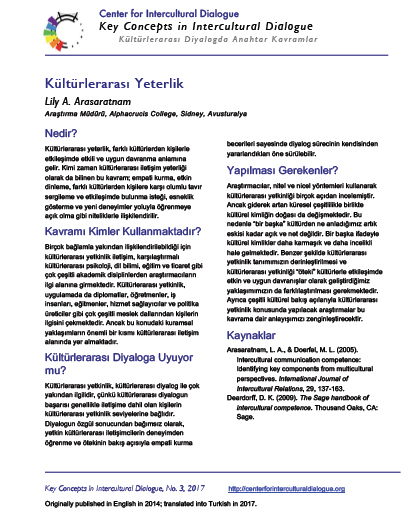
KC80: Cultural Discourse Analysis by Sunny Lie

Key Concepts in ICDThe next issue of Key Concepts in intercultural Dialogue is now available. The goal is to expand the concepts available to discussions of intercultural dialogue. Click on the thumbnail to download the PDF. Lists organized chronologically by publication date and numberalphabetically by concept in English, and by languages into which they have been translated, are available, as is a page of acknowledgments with the names of all authors, translators, and reviewers.

kc80-cultural-daLie, S. (2017). Cultural discourse analysis. Key Concepts in Intercultural Dialogue, 80. Available from:
https://centerforinterculturaldialogue.org/wp-content/uploads/2017/01/kc80-cultural-discourse-analysis2.pdf

The Center for Intercultural Dialogue publishes a series of short briefs describing Key Concepts in Intercultural Dialogue. Different people, working in different countries and disciplines, use different vocabulary to describe their interests, yet these terms overlap. Our goal is to provide some of the assumptions and history attached to each concept for those unfamiliar with it. As there are other concepts you would like to see included, send an email to the series editor, Wendy Leeds-Hurwitz. If there are concepts you would like to prepare, provide a brief explanation of why you think the concept is central to the study of intercultural dialogue, and why you are the obvious person to write up that concept.


Creative Commons License
This work is licensed under a Creative Commons Attribution-NonCommercial-NoDerivatives 4.0 International License.

UNESCO Job Ads: Associate/Programme Specialists (France)

UNESCO PROGRAMME SPECIALIST, Social and Human Sciences – Social Transformations
Primary Location: FR-Paris
Deadline: January 12, 2017

OVERVIEW OF THE FUNCTIONS OF THE POST
Under the overall authority of the Assistant Director-General, Social and Human Sciences (ADG/SHS), the guidance of the Director of Division for Social Transformations  and Intercultural Dialogue (DIR/SHS/TCD) and under the direct supervision of the Chief of the Intercultural Dialogue Section, the incumbent is responsible for ensuring the development and delivery of a variety of sectoral and cross-sectoral projects and initiatives related to Intercultural Dialogue and a Culture of Peace. He/she will implement, monitor and report on programme priorities and projects in close cooperation with relevant Field Offices.

Within this context, the incumbent will:
• Contribute to the development of Action Plans for the promotion of intercultural dialogue in the context of the International Decade for the Rapprochement of Cultures (2013-2022) : provide substantial input and advice to a broad range of stakeholders at different levels (Intergovernmental Organizations (IGOs), Non-governmental organizations (NGOs) and relevant networks/institutions), and backstopping to colleagues at Headquarters and in Field Offices.
• Implement, monitor, evaluate and report on programmes and projects and elaborate new and innovative initiatives and strategies for the promotion of intercultural dialogue and the culture of peace, notably in the areas of research, learning and capacity-building.
• Prepare statutory documents and draft decisions on key priorities identified by the governing bodies, as well as briefings, concept notes, press releases, etc; participate in the preparation of the UN Secretary-General’s annual report on Intercultural and Interreligious Dialogue and a Culture of Peace, and propose relevant themes for inclusion in UNESCO’s Mid-Term Strategy (C/4) and Quadrennial Programme and Budget (C/5).
• Organize international meetings and global fora with partners and stakeholders at different levels, including through the preparation of programme agendas, high-level statements and declarations, outreach strategies, advocacy and visibility measures, and follow-up on productions and publications;
• Undertake the identification/development of partnerships, the mobilization of extra-budgetary funding and resources and the preparation/coordination of reports to donors.

REQUIRED QUALIFICATIONS
Education
• Advanced university degree in the field of social and human sciences, humanities or in related areas. A first-level university degree in combination with two additional years of qualifying experience may be accepted in lieu of the advanced university degree.
Work Experience
• A minimum of 4 years of relevant professional experience in the field of social and human sciences, humanities or in related areas, of which at least 2 years acquired at the international level.
• Proven experience in designing and implementing programmes/projects and demonstrated expertise in the field of Intercultural Dialogue and/or a Culture of Peace.
• Experience in the organization of international conferences, meetings and events.
Skills/Competencies
• Very good knowledge and understanding of UNESCO’s mandate in the field of Intercultural Dialogue, Culture of Peace, and the International Decade for the Rapprochement of Cultures (2013-2022).
• Excellent organizational and project design skills.
• Excellent analytical skills with proven ability to undertake research, collect and synthesise information from various sources.
• Good knowledge in fund-raising and/or other resource mobilization mechanisms.
• Excellent (oral and written) communication skills, with proven ability to draft clearly and concisely.
• Capacity to establish and to maintain effective working relations and partnerships with a wide range of stakeholders (relevant institutions, inter-governmental and non-governmental organizations) at all levels.
• Excellent interpersonal skills, including ability to work effectively in a team and to maintain effective working relations within a multi-cultural environment.
• Demonstrated ability to work effectively under pressure and to meet tight deadlines.
• Good IT skills, including knowledge of standard office software.
• Excellent/very good knowledge of English or French and good knowledge of the other language.
• Work Experience: Relevant experience in the UN system or in other international development cooperation organization.

Skills/Competencies
• Knowledge of the work and general functioning of international organizations and/or the UN system, including the 2030 UN Sustainable Development Agenda.
Languages
• Knowledge of other United Nations languages (Arabic, Chinese, Russian or Spanish).


There is also a position for a UNESCO ASSOCIATE PROGRAMME SPECIALIST
in the same unit, Social and Human Sciences – Social Transformations.

Massey U Job Ad: Dean’s Chair in Communication (New Zealand)

Dean’s Chair in Communication at Massey University
School of Communication, Journalism and Marketing
Palmerston North

Massey University has an unprecedented combination of academic excellence, entrepreneurial energy and broad access. Our University is a single, unified institution comprising three differentiated campuses and distance delivery that positively impacts on the creative, economic, social, scientific, cultural and environmental health of the communities it serves. Our research is inspired by real world applications. Massey University is consistently rated as one of New Zealand’s most attractive employers in the annual Randstad awards.

Massey Business School has a proud history of excellence in research and academic programs, teaching business studies since 1972. We are accredited by AACSB, AMBA (the Association of MBAs), and are a CFA® partner school. We are ranked by QS in the top 200 for Management and Business Studies, and Communication and Media Studies. The School of Communication, Journalism & Marketing is also the only school in the Asia-Pacific region to have accreditation from the ACEJMC(Accrediting Council for Journalism and Mass Communication).

A small number of prestigious Dean’s Chairs are being created to help continue Massey Business School’s journey to excellence in impactful research. The Dean’s Chair in Communication will be the first of its kind at Massey University, and in New Zealand. The successful candidate will have a track record of research excellence and academic leadership, including publications in top communication journals, membership on editorial boards of such journals, successful PhD supervision, academic programme development, external research funding and engagement with the communication professions. While the emphasis in the position is research leadership, the successful candidate is expected to be an active contributor to the full range of activities in the School of Communication, Journalism & Marketing, including its teaching programmes, school administration, outreach to the community and profession, and contributions to the wider Massey Business School and University.

This is a permanent (tenured) Professorial appointment, with the position as Dean’s Chair being an initial term of five years, after which time a further term may be available. The School offers strong support for research and a salary level that allows for a very comfortable lifestyle in New Zealand. This position is based at the University’s original home base, Manawatū campus, in Palmerston North. Our ideal commencement date for you is mid-2017.

Applications close on 31 March 2017.

Further enquiries should be directed to: Preeti Mathew Verma Staff Recruitment & HR Advisor  p.m.verma AT massey.ac.nz

Reference number: A500-16AB

Apply online.

PhD Studentships: Centre for Trust, Peace & Social Relations (UK)

PhD Studentships: Centre for Trust, Peace and Social Relations
Coventry University

Funding for: UK Students, EU Students, International Students
Closes: 17th February 2017

As part of a continuing programme of expansion of research activity in these areas, Coventry University is offering full-time PhD studentships to well-qualified individuals, to start in September 2017.

Proposals invited

We welcome applications with proposals for PhD research projects in distinct and cross disciplinary areas related to our current research themes.

These are:
• Communities, Representation and Inclusion
• Faith and Peaceful Relations
• Global Development
• Migration, Displacement and Belonging
• Peacebuilding and Conflict Transformation
• Protective Security and Resilience
• Transnational and Maritime Security
• Trust and Workplace Relations

In addition to these broad themes, we would also welcome proposals on the following topics:
• Gender and development or health and development
• Humanitarianism in conflict & disaster
• Transitional justice
• Trust in transitional societies
• Natural resource governance
• Organised crime and the privatisation of security
• Social movements and democratisation
• Religion, peace and conflict
• Religious diversity, inter-faith dialogue or intercultural dialogue
• Faith, social policy and social justice
• Religious literacy and education
• Migration and social cohesion
• Trusting individuals and trusting institutions.

We are looking for proposals that challenge existing ideas in these areas and expand current thinking, offering original insights and approaches by undertaking significant and rigorous research. We welcome PhD proposals that link to more than one member of staff’s research interests or are in related areas. It is standard practice for supervision teams to consist of three staff members. For further information about potential supervisors interests and expertise, visit the CTPSR website.

The full-time PhD studentships will cover UK/EU or overseas tuition fee equivalent, and an annual stipend for the duration of the studentship. The fee-only scholarships will cover tuition fee ONLY.

About the host Centre/Department

The Centre for Trust, Peace, and Social Relations has over 60 full-time research staff supported by a team of professional support staff. Our staff are extremely well-connected and are called upon to contribute their expertise on the national and international stage, as advisers to governments and international bodies or at conferences worldwide.

We take a multi-disciplinary approach to our work that brings together creative thinking on concerns of trust and trust repair, peacebuilding, peace and reconciliation and on the contemporary challenges of societal relationships in a diverse and connected world. Our portfolio of excellent and impactful research seeks to change lives and enhance well-being. We convene and contribute to public debates, provide effective policy guidance at local, national, regional and global levels and generate international collaborative research through our global networks.

Candidate specification
Entry criteria for applicants to PHD (standard)
• A taught Master’s degree in a relevant discipline, involving a dissertation of standard length written in English in the relevant subject area with a minimum of a merit profile: 60% overall module average and a minimum of a 60% dissertation mark.

PLUS
• The potential to engage in innovative research and to normally complete the PhD within a three-year period of study
• A minimum of English language proficiency (IELTS overall minimum score of 7.0 with a minimum of 6.5 in each component)

In all cases the most recent and highest qualification attained will be that utilised for assessment purposes.

Additional items for candidate specification
• A first or good upper second class undergraduate degree in a related social science or in the humanities and a strong interest in pursuing research in this field.
How to apply: Application form and covering letter, plus a 2000-word proposal addressing the research theme

PhD funding award: Bursary and/or tuition fees – UK/EU/International
Start date: Sept 2017
Duration of study: Full-Time – maximum term three years 6 months
Interview dates: 06/04/2017 – 07/04/2017
Enquiries may be addressed to: Academic enquiries may be address to Professor Matt Qvortrup, Head of PhD Programmers, matt.qvortrup@coventry.ac.uk. However the Research Admissions team will process your formal application and are the main contact point for all admission and administrative related enquiries.

Postmemory & the Contemporary World (Colombia)

Call for Proposals – Postmemory and the Contemporary World
International Interdisciplinary Conference in Medellin, Colombia
April 27 and 28, 2017

Organizers: University of Gdańsk, Poland; Universidad Pontificia Bolivariana, Colombia; InMind Support, Poland

Venue: Universidad Pontificia Bolivariana, Medellin, Circular 1 No. 70-01, Bloque 7, Piso 3, Medellín, COLOMBIA, Barrio Laureles (click here for details about Medellín)

Deadline for proposals: 28 February 2017

Conference Highlights

This version of the conference intends to bring together not only disciplines but also regions and scholars who work on the similar problems on the material of different geographical reason. In addition, the conference aims to combine arts and other sciences and the other is to how memory works for peace, with a special interest in setting our work on postmemory in the current context of the Colombian peace process.

Keynote addresses in the conference will feature scholars from Colombia, Poland and Brazil specializing in topics of urban violence, memory and artistic expressions. In addition to the academic events, the program will also include two city tours.

Conference Description

Coined by Marianne Hirsch in the 1990s, the term postmemory by now entered various disciplines who search to understand how memory form our identity and how we position, articulate or just make sense of our place in the society and our relations with it. The term postmemory problematizes the concept of memory by bringing attention to the memories that are not exactly personal but that keep on shaping one’s life and one’s way of seeing the world.

In the previous editions of our memory conference, which brought together more than five hundred scholars from around the world, we looked at the relationship between memory and solidarity (“Solidarity, Memory and Identity”, 2012 and 2016), memory and dreams (“Dreams, Phantasms and Memories”, 2013), memory and forgetting (“Memory: Forgetting and Creating”, 2014), memory and nostalgia (Memory, Melancholy and Nostalgia, 2015) as well as memory and trauma (“Memory, Trauma and Recovery”, 2016).  During this year’s conference we would like to concentrate on the phenomena of postmemory and how it keeps on shaping the contemporary world.

We are interested in all aspects of postmemory: in its individual and collective dimensions, in the past and in the present-day world, and in its potential to direct the future. Whose memory is postmemory: that of generations, communities, nations or families? How is it maintained and passed on? What is the role of imagination in its creation? What is remembered and what is forgotten? Is it always the memory of traumatic experience? How can it be taught and studied? These are some of the questions that inspired the idea of the conference.

Medellín, Colombia, has been chosen as a place for this conference not by chance. Colombia is the country of the troubled past that quite successfully has been processing it on its way of recovery. The conference wants to establish and promote a dialogue between scholars, countries and continents, therefore, inviting papers of different geographic and cultural focus.

We would like to explore the phenomenon of postmemory in its multifarious manifestations: psychological, social, historical, cultural, philosophical, religious, economic, political, and many others. As usual, we also want to devote considerable attention to how these phenomenon appears in artistic practices: literature, film, theatre or visual arts. That is why we invite researchers representing various academic disciplines: anthropology, history, psychiatry, psychology, psychoanalysis, sociology, politics, philosophy, economics, law, literary studies, theatre studies, film studies, memory studies, migration studies, consciousness studies, dream studies, gender studies, postcolonial studies, medical sciences, cognitive sciences, and urban studies, to name a few.

Different forms of presentations are encouraged, including case studies, theoretical inquiries, problem-oriented arguments or comparative analyses.

We will be happy to hear from both experienced scholars and young academics at the start of their careers, as well as doctoral and graduate students. We also invite all persons interested in participating in the conference as listeners, without giving a presentation.

Overall Suggested Topics (Check the conference website for details)
• Individual experiences
• Collective experiences
III.  Remembering and Forgetting
• Representations
• Feelings and Practices
• Institutionalization
VII.  The Contemporary World
VIII.  Colombia: peace process

Submission Process

Please submit abstracts (no longer than 300 words) of your proposed 20-minute presentations, whether in English or Spanish, along with a short biographical note, by February 28. 2017 both to Prof. Wojciech Owczarski (wowczarski1 AT tlen.pl) and Prof. Polina Golovatina-Mora (postmemory2017 AT gmail.com). Confirmation of acceptance will be sent by March 1, 2017.

CFP Articulations of International Media and English

CFP: Special Issue of Journal of Communication Inquiry on “Articulations of International Media and English”

The Journal of Communication Inquiry invites submissions for the 2017 theme issue, “Articulations of International Media and English.” This issue will be devoted to the connections the global spread of English makes with media production and consumption in places where English is not the mother tongue. This includes, but is not limited to, countries where English was introduced via colonization or is treated as a foreign language. English and its global dissemination have been analyzed in terms that range from linguistic imperialism, to neoliberal hegemony, to audience uses of English to create new definitions of the local, national, and global. When approaching the spread of English from a media studies perspective, popular television shows in English, movies in English, and locally-produced English-language news and entertainment content all become objects of analysis. These contexts can include diasporic and indigenous media. JCI is seeking input from scholars in a variety of disciplines who can find ways to wed theory from the fields of media and linguistics to examine the intersections of English and media production and consumption. We strongly encourage submissions from international scholars who can provide insiders’ perspectives on the relationships between English language media and indigenous language media in places around the world.

The deadline for submitting manuscripts is 11:59 p.m. CST on February 17, 2017. All submissions will undergo peer review. Please contact JCI Managing Editor John C. Carpenter (john-c-carpenter AT uiowa.edu) with questions. Possible topics of inquiry include but are not limited to:

• How people around the world use English language media to form local, national, and global identities

• Critical examinations of the ways English media content is informed by and contributes to discourses of neoliberalism and globalization

• Is media content in English a legitimate object of study for English-speaking scholars who want to explore media environments in places where English is not the main language?

• Textual analyses that take the discourses surrounding English in both English and nonEnglish media as objects of analysis

• The ways choosing English as a language of news in countries where English is not the first language affects how journalists conceptualize and practice journalism, including in terms of imagined audience, public service, content choices, etc.

• How news organizations respond to linguistic diversity as the movement of people and languages over the world creates mobile, multilingual identities

• How power informs the relationships between English language media and non-English language media in places around the world

• How the rising use of English in different parts of the world affects Western-based news outlets that have always published in English

• How the rising use of English affects the English language press (formerly known as the expatriate press) in countries where English is not a first language

• Given that English becomes politicized in a country in proportion to the country’s level of global engagement, how a country’s language politics affect English language media production and consumption

CFP Affirming (Global) Life

Kaleidoscope: A Graduate Journal of Qualitative Communication Research welcomes submissions for our upcoming issue. Submission deadline extended to March 15, 2017

*Special Call*
Affirming (Global) Life: Overcoming Divisive Discourses, Remembering What’s at Stake, and Doing Something Now

In addition to regular submissions, this year’s issue will feature a special section devoted to scholarly discussions of discourses charged with promoting inequality and xenophobia. 2016 has been a violently tumultuous year of global upheaval that has deeply affected public dialogue about diversity. Black Lives Matter, for example, rose to prominence with protests against the killing of unarmed Black citizens in ways that prompted even the religious blog Patheos to use the word “execution” to describe one example, the shooting of Terrence Crutcher by Officer Betty Shelby (Stone). The Orlando massacre of members of the LGBTQ community at Pulse nightclub gave rise to a rhetorical struggle to contain, clarify, and expand upon arguments about the shooter’s motivations and the implications of calls for policy reactions that struck many as Islamophobic (Green) and/or perpetuating an erasure of the intersectional LGBTQ and Latinx identities of those killed (Brammer). Other examples of such discourses this year included North Carolina’s unconstitutional bathroom laws persecuting trans people; the gender wage gap and overwhelming income disparity systemically oppressing the poor and rewarding the rich; ISIS’s fundamentalist terrorism; the desperate plight of millions of refugees fleeing their war-torn countries in search of life; and the xenophobic, racist, and misogynistic rally speeches by Donald Trump, which caused spikes in violence in the nation’s schools (Costello). 2016 has shaken many of us from any complacent perch that “things are fine the way they are,” and discourse communities from academia to the Internet debate the best ways to respond. For some, this uncertainty about the best way to respond mixes with anger and one longs for a different time “before” now – for the nostalgic comfort of a bygone world that likely never existed. At other times, such concerns stimulate pragmatic hope for different circumstances, prompting proactive efforts to foster transformational changes.
People in the U.S. and around the world are becoming collectively concerned about the future we face. The forces of terrorism, racism, xenophobia, sexism, and unmindful privilege compel many persons to close themselves off from others they perceive as overwhelmingly different in one way or another. These tactics exploit one trait or practice as determining that an entire person or demographic is dangerous and expendable. In U.S. culture especially, fundamental individualism has always been less concerned with an ethics of community than with capitalism and profiteering. But people are not inherently greedy or solipsistic. We are social creatures, vulnerable and interdependent, and we’re all stuck here together. In this (extra)ordinary way, as Levinas tells us, we are always responsible for the other before our sense of self.

This special section, then, invites essays that ask how communication theory and practice can assist in transcending discourses that demonize and scapegoat difference. How can communication studies guide this transcendence and encourage the commitment, in de Beauvoir’s words to embrace our “fundamental ambiguity” as a shared condition? How can communication studies assist those who seek to deconstruct and untangle themselves from the ethnocentrism poisoning their perceptions of others? How can communication studies undo the scripts that encourage the automatic association of Muslims with terrorism, African Americans with criminality, trans* persons with pedophilia, and women with sex objects? How can communication studies foster a communication ethics that might begin with the notion that none of us are exempt from considering our participation in some of these discourses? It is time for us to begin making decisions, as Sartre said, as if each choice mattered for the whole of humanity. And our choices do matter, because as Sartre also warned, humans are a most curious animal, and the only of its kind that has the power to destroy itself.

This special editor’s call invites authors to move beyond mere critiques of communication practices by imagining concrete pragmatic actions and building connections across difference. Additional questions to consider include: How can qualitative research disrupt the forces of de facto xenophobia, racism, sexism, classism, and other systems of marginalization? For performance scholars, how can performance art be deployed to inspire postmodern global ethics of interconnection – to remind us of our enfleshed similarities and vulnerabilities, the worthiness of well-lived lives, and the possibility of crafting joint hopes for the future? From an activist perspective, what are we doing and what can we do right now in our communities to counteract the public’s growing contempt and suspicion of foreign-others? For rhetoricians, how can we dissect, dismantle, and transform pervasively xenophobic rhetoric of hate, deficiency, and fear? What would a communication-studies-informed ethics of postmodern pragmatism entail? What might this existential calling realize?

Authors should clearly mark in their cover letter that their submission is for this special call. Submissions should be no longer than 2,000 words (excluding references) and be prepared using the same citation conventions as regular submissions.

To submit a manuscript, please visit opensiuc.lib.siu.edu/kaleidoscope
Inquiries should be emailed to kalscopejrnl@gmail.com.

Kaleidoscope is a refereed, annually published print and electronic journal devoted to graduate students who develop philosophical, theoretical, and/or practical applications of qualitative, interpretive, and critical/cultural communication research. We welcome scholarship from current graduate students in Communication Studies and related cognate areas/disciplines. We especially encourage contributions that rigorously expand scholars’ understanding of a diverse range of communication phenomena.

In addition to our ongoing commitment to written scholarship, we are interested in ways scholars are exploring the possibilities of new technologies and media to present their research. Kaleidoscope welcomes scholarship forms such as video/audio/photos of staged performance, experimental performance art, or web-based artistic representations of scholarly research. Web-based scholarship should be accompanied by a word-processed artist’s statement of no more than five pages. We invite web-based content that is supplemental to manuscript-based scholarship (e.g., a manuscript discussing a staged performance could be supplemented by video footage from said performance).

Regardless of form, all submissions should represent a strong commitment to academic rigor and should advance salient scholarly discussions. Each submission deemed by the editor to be appropriate to the style and content of Kaleidoscope will receive, at minimum, anonymous assessments by two outside reviewers: (1) a faculty member and (2) an advanced Ph.D. student. For works presented in video/audio/photo form, we may not be able to guarantee author anonymity. The editor of Kaleidoscope will take reasonable action to ensure all authors receive an unbiased review. Reviewers have the option of remaining anonymous or disclosing their identities to the author via the editor.
Submissions must not be under review elsewhere or have appeared in any other published form. Manuscripts should be no longer than 25 pages (double-spaced) or 7,000 words (including notes and references) and can be prepared following MLA, APA, or Chicago style. All submissions should include an abstract of no more than 150 words and have a detached title page listing the author’s/authors’ name(s), institutional affiliation, and contact information. Authors should remove all identifying references from the manuscript. To be hosted on the Kaleidoscope website, media files should not exceed 220 MB in size. Larger files can be streamed within the Kaleidoscope website but must be hosted externally. Authors must hold rights to any content published in Kaleidoscope, and permission must be granted and documented from all participants in any performance or presentation.

Works Cited:
Brammer, John Paul. “Why it Matters that it was Latin Night at Pulse.” Slate, 14 June
2016,http://www.slate.com/blogs/outward/2016/06/14/it_was_latin_night_at_the_pulse_orlando_gay_bar_here_s_why_that_matters.html. Accessed 18 Nov. 2016.
Costello, Maureen B. Southern Poverty Law Center. “The Trump Effect: The Impact of thePresidential Campaign on our Nation’s Schools.”  https://www.splcenter.org/sites/ default/files /splc_the_trump_effect.pdf. Accessed 18 Nov. 2016.
de Beauvoir, Simone. The Ethics of Ambiguity. 1948. Open Road, 2015.
Green, Emma. “The Politics of Mass Murder.” The Atlantic, 13 June 2016, http://www.theatlantic.com/politics/archive/2016/06/orlando-political-reactions-homophobia-gun-rights-extremism/486752/. Accessed 18 Nov. 2016.
Levinas, Emmanuel. Otherwise Than Being. 1974. Duquesne University Press, 1998.
Sartre, Jean-Paul. Existentialism is a Humanism. 1946. Yale University Press, 2007.
Stone, Michael. “Tulsa Police Execute Unarmed Black Man.” Patheos, 19 Sept. 2016, http://www.patheos.com/blogs/progressivesecularhumanist/2016/09/tulsa-police-execute-unarmed-black-man/. Accessed 18 Nov. 2016.