CFP Latin American Communication Theory Today

Communication Theory Special Issue
Latin American communication theory today: charting contemporary developments and their global relevance
Guest Editors: Florencia Enghel (Stockholm U, Sweden) & Martin Becerra (U Nacional de Quilmes, Argentina)

This Special Issue aligns itself with Communication Theory’s intention to encourage “authors and editors to highlight the historical, cultural, and political contexts in which theoretical approaches are articulated” (Wilkins, 2016)1. Its goal is to address the paucity of Latin American theorization in the journal2 with a focus on state-of-the-art theoretical contributions beyond the much referred-to “Latin American tradition”3. To this purpose, we invite contributions that provide an update of the outstanding theoretical developments produced by Latin American communication scholars in the past ten years (2005-2015) and examine their relevance to the global field of communication studies.

Contributions from the Global South have been rather absent from communication journals published in English in recent years. Graham, Ojanpera and De Sabbata’s (2015) analysis of “the geography of knowledge” reveals that most submissions to SAGE journals in 2014 came from the Global North, and that most countries in the Global South had very low acceptance rates for the small amount of articles submitted4. By presenting the region’s recent theoretical production and unpacking its critical relevance to transnational debates, we expect that the Special Issue will contribute to de-westernizing communication studies (Waisbord & Mellado, 2014), and in the process expand Communication Theory‘s coverage to Latin American countries that have been absent from the journal in terms of their theoretical production and/or the affiliation of contributing authors.

The Special Issue welcomes substantial updates of the Latin American contributions to the theorization of communication and media in recent years combining rich descriptions of conceptual advances well-grounded in the wider sociopolitical contexts in which they have developed, with critical analyses of their significance to global debates.

The Special Issue invites papers that address the following questions:
1. How has communication theory developed in specific Latin American countries in the past ten years (2005-2015)?
2. Which lines of research have been in the foreground, and in which ways is their prominence linked to wider country and/or regional sociopolitical trends and events?
3. To what extent have scholarly agendas been promoted by national research systems, distinct academic units, the private sector, civil society and/or social movements?
4. To what extent have changes in media technologies impacted the development of new concepts and theories?
5. What continuities and discontinuities can be observed in comparison with the region’s theoretical production in the late twentieth century?
6. How do theorizations originated in the region in recent years engage with theoretical developments in other parts of the world?

We particularly encourage papers from communication and media scholars based in Latin America, as well as from Latin American scholars affiliated with institutions abroad.
The deadline for submission of full paper proposals is 1 March 2017.

For submission guidelines, see http://www.icahdq.org/pubs/commtheory.asp. To submit, go to https://mc.manuscriptcentral.com/comth. For queries regarding the Special Issue’s theme, please contact Florencia Enghel (florencia.enghel AT ims.su.se) and Martin Becerra (aracabecerra AT gmail.com).

Researching Translanguaging 5 day course (UK)

5-Day residential course
Researching translanguaging: key concepts, methods & issues

June 19th  – June 23rd  2017
School of Education, University of Birmingham

This free 5-day residential course is designed for researchers, including doctoral researchers, who are engaged in research on communication in multilingual contexts. It is being organised by TLANG, Translation and Translanguaging: Investigating Linguistic and Cultural Transformations in Superdiverse Wards in Four UK Cities (AH/L007096/1), a research project funded by the Arts and Humanities Reserch Council (AHRC) under its theme Translating Cultures. TLANG is a collaboration of seven universities and seven national non-university partners.  It aims to investigate how people communicate in increasingly diverse city settings, and what the implications are for policy and practice in public, private and third sector organisations. Contributions to the residential will also be made by colleagues from the University of Cape Town, also funded by AHRC (ES/M00175X/1), whose focus will be the pedagogic potential, and ideological challenges of translanguaging in multilingual contexts.

Course participants will have access to TLANG’s already established networks as well as future opportunities to take part in its assemblies, city seminars, thematic workshops and international conferences.  TLANG provides a variety of meetings for academics, professionals, activists, artists, and students to share their interest in superdiversity and multilingualism. The 5-day course will also build on previous residential courses held at the University of Birmingham in 2010/11 funded through ESRC’s  Researcher Developer Initiative (RES-046-25-004, RDI).

Researching translanguaging
Linguistic, cultural and demographic changes have been ushered in by transnational population flows, the crisis of war, the changing political and economic landscapes of different world regions, and by the advent of new technologies for social media and online communication. These conditions have created a pressing need for a programme of detailed research which makes visible the ways in which people interact – how they translanguage and translate  – in rapidly-changing social settings.

The last decade has seen the emergence of new strands of research on translanguaging and new lines of enquiry which have incorporated critical and post-structuralist perspectives from social theory and which have embraced  ethical epistemologies and research methods. Different research strategies have been employed in different kinds of sociolinguistic spaces: in local neighbourhoods, across transnational diaspora, in multilingual workplaces, complementary schools/community classes, mainstream educational settings, health care centres, sports clubs, religious gatherings, legal settings, bureaucratic encounters, in the mass media, and on the internet. Researchers have provided detailed accounts of face to face encounters in multilingual settings and in mediated, virtual interactions. They have also explored the interface between spoken and written language use and multimodality, seeking connections between local situated practices and wider social processes.

Translanguaging theorizes communicative practice as repertoire and considers how people deploy their semiotic resources within the ideological contexts in which they operate.  It includes aspects of communication not always thought of as ‘language’, including gesture, dress, posture, and so on; it is a record of mobility and experience; it includes constraints, gaps and silences as well as potentialities; and it is responsive to the places in which, and the people with whom, semiotic resources may be deployed. Because social categories do not correspond straightforwardly to identifiable linguistic forms, we need to adapt our ways of seeing to understand the plurality of repertoires, styles, registers, and genres in play as people communicate.

Translanguaging in research practice
A focus on translanguaging enables us to see how everyday practices and identities are rooted in the trajectories of the multiple communities to which individuals belong, and how they develop and transform. The deployment of diverse communicative repertoires is not only apparent in the social contexts in which we research, but is also manifestly evident in the research teams in which we work. Translanguaging is a significant dimension of research practice in some areas of social science, due to the increasing linguistic and cultural diversity of contemporary society. Furthermore, translanguaging, with its focus on communicative practice, can be studied from an interdisciplinary perspective which can raise difficult questions about what constitutes data, evidence, claim and argumentation. These collaborations across different disciplinary backgrounds, social and linguistic biographies, and professional contexts throw up key epistemological issues and questions relating to researcher identity and to asymmetries of power in the knowledge-building process. This residential will offer a forum for researchers across the social sciences who are working in multilingual settings to engage in dialogue about ways of working and to consider the issues arising from work in multilingual and interdisciplinary teams. It is also hoped that it will serve as a route into research on translanguaging for social scientists who hold a particular interest in linguistic ethnography.

The 5-day residential course at Birmingham
The 5-day course will be organised into sessions, with different themes and orienting theories. The sessions will be led by different members of the TLANG team with our international collaborators from the University of Cape Town. Delegates must commit to full attendance over the full 5 days.

Session 1: Researching translanguaging: why, what and how?
Session 2: Translanguaging as communication: a repertoire approach
Session 3: Translanguaging and superdiversity: an ideological perspective
Session 4: Translanguaging and social media;
Session 5: Translanguaging and cityscapes
Session 6 and 7: Translanguaging in educational settings
Session 8: Translanguaging and multimodality
Session 9: Translanguaging in research practice
Session 10: Translanguaging, engagement and interdisciplinarity

Organisers:
Angela Creese (a.creese AT bham.ac.uk)
Sarah Martin (s.l.martin AT bham.ac.uk)

Applications:
The number of participants is limited to 30, so early application is recommended. Application forms and further details are available on TLANGDEADLINE FOR APPLICATION IS 10TH FEBRUARY 2017. PLACES ANNOUNCED BY 10TH MARCH 2017.

CFP Children, Youth & Media in MENA & Gulf Conflict Zones

Call for Panelists for the upcoming Middle East Studies Association (MESA) Annual Meeting, Washington D.C., November 18-21, 2017

Children, Youth, and Media in Middle Eastern, North African, and Gulf Conflict Zones. This panel seeks to carve out new pathways into the subject of children, youth and media.

Abstracts are sought that critically interpret how Middle Eastern, North African, and Persian/Arabian Gulf children and youth use, play with, produce, interpret and/or are influenced by media in conflict zones. Abstracts should come from or be framed from the “voice”, or perspective of children and youth and connect how their respective media uses and practices impinge on the development of their culture, constructions of civic and national identity, intergroup attitudes, political opinions, and/or peace and conflict related practices and behaviors. To that effect, papers might examine the media uses and associated daily lives — past and/or present — of among others, Algerian, Iranian, Iraqi, Israeli, Lebanese, Libyan, Palestinian, Syrian, Tuareg, Yemini or Yezedi girls and boys. Papers that explore these areas as they relate to the lives of those among them who have been (forcibly-) migrated, are borderlands children, have been born due to the uses of rape as a weapon of war, and/or whom, through them, have become child mothers, are particularly encouraged.

Abstracts, and so papers, may conceptualize children/childhood or youth from a biological, legal, constructed, and/or subaltern perspective. They may either be modern or historical in focus. Field-based research from a variety of disciplinary, theoretical, and methodological perspectives are encouraged. Research from communication, children and youth/childhood studies, anthropology, political science, sociology, psychology, history and related disciplines are all welcome. To that effect, media analogous analyses of non-formal education, arts, music, dance, and leisure practices and spaces are invited. The goal of the panel will be to foster a critical transdisciplinary merger of these varied disciplinary approaches.

If interested, and for any questions, please email Yael Warshel at ywarshel AT gmail.com
The following information should be emailed by Feb 8, 2017:
1) your name, affiliation, and contact details.
2) a 300-400 word abstract fitting the above panel theme and MESA’s criteria for evaluating abstracts, including being, “scholarly”, and possessing “a strong, focused statement of thesis or significance, clear goals and methodology, well-organized research data, specified sources, and convincing, coherent conclusions.”

CFP Refugee Communications in the Digital Age

Call for Papers: Refugee Communications in the Digital Age
Special issue of American Behavioral Scientist
Submission deadline: February 15, 2017

This American Behavioral Scientist special issue seeks scholarly contributions in the area of refugee communications, broadly defined. The special issue will consider manuscripts from an array perspectives, disciplines and methodologies, including content analysis, discourse analysis, in-depth interviews, focus groups, and experimentation and will provide most recent data on refugee communications around the world. Each contributor will be asked to include recommendations on best practices in refugee communications, including suggestions for ways communications professionals, governmental officials and other actors can contribute to dominant discourse about refugees, which ultimately shapes public opinion and policy making.

The following are examples of the kinds of topics the editors consider relevant to this issue:
– Analysis of portrayals of refugees in both traditional or social media
– Empirical examination of the effects of media portrayals of refugees on audiences
– Communications interventions aimed at improving social outcomes for refugee populations
– Discussions of ethics and refugee communication
– Documentation of communication use by refugee populations

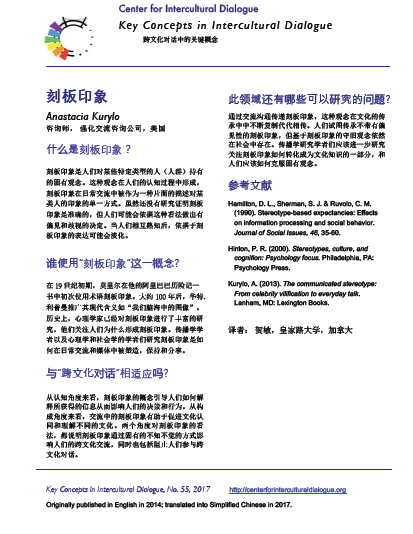
Key Concept 41: Yuan Translated into Chinese

Key Concepts in ICDContinuing translations of Key Concepts in Intercultural Dialogue, today I am posting the translation of KC41: Yuan. Hui-Ching Chang wrote this in English in 2014 and has now translated it into both Traditional Chinese and Simplified Chinese.

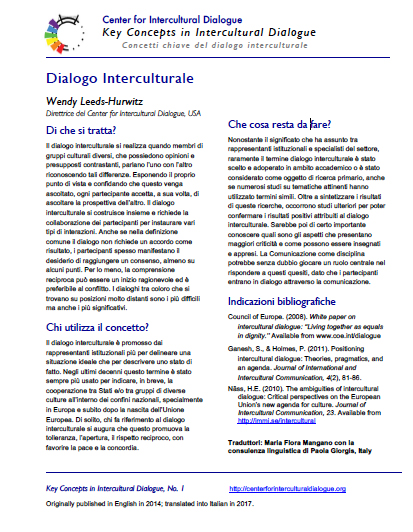
As always, all Key Concepts are available as free PDFs; just click on the thumbnail to download. Lists of Key Concepts organized chronologically by publication date and number, alphabetically by concept, and by languages into which they have been translated, are available, as is a page of acknowledgments with the names of all authors, translators, and reviewers.

KC41 Yuan_Chinese-trad
Yuan in Traditional Chinese
KC41 Yuan_Chinese Simplified
Yuan in Simplified Chinese


Chang, H.-C. (2017). Yuan [Traditional Chinese]. Key Concepts in Intercultural Dialogue, 41. Available from:
https://centerforinterculturaldialogue.org/wp-content/uploads/2017/01/kc-41-yuan_chinese-trad2.pdf

Chang, H.-C. (2017). Yuan [Simplified Chinese]. Key Concepts in Intercultural Dialogue, 41. Available from:
https://centerforinterculturaldialogue.org/wp-content/uploads/2019/10/kc-41-yuan_chinese-sim.pdf

If you are interested in translating one of the Key Concepts, please contact me for approval first because dozens are currently in process. As always, if there is a concept you think should be written up as one of the Key Concepts, whether in English or any other language, propose it. If you are new to CID, please provide a brief resume. This opportunity is open to masters students and above, on the assumption that some familiarity with academic conventions generally, and discussion of intercultural dialogue specifically, are useful.

Wendy Leeds-Hurwitz, Director
Center for Intercultural Dialogue


Creative Commons License
This work is licensed under a Creative Commons Attribution-NonCommercial-NoDerivatives 4.0 International License.

UW La Crosse Job Ad: Intercultural Communication

Assistant Professor of Intercultural-Interpersonal Communication
University of Wisconsin- La Crosse

The Department of Communication Studies at the University of Wisconsin-La Crosse invites applicants for a full-time tenure-track assistant professor position. Candidates will have an expertise in Intercultural Communication and will teach in our Interpersonal Communication emphasis area. Our department is one of the College of Liberal Studies’ largest academic units and continues to grow. Our curriculum is student-centered and emphasizes the importance of undergraduate research; as such, we seek engaging teacher-scholars  who can inspire undergraduate  students in Communication  Studies. UW-La Crosse is the ideal location for individuals who seek to integrate their teaching, scholarship, and service activities. Our department is committed to the creation of an inclusive, supportive climate for all of our members. In our continuous effort toward Inclusive Excellence, we seek collegial faculty members from a wide variety of perspectives and backgrounds who can demonstrate an understanding of and appreciation for diversity.

Candidates must have a PhD by time of appointment (August 28, 2017) in Communication Studies with a specialization in Intercultural Communication. The candidate’s research agenda might include areas of focus such as: intercultural relationship development, intercultural communication competence, social justice and identity, interracial communication, interethnic communication, or intercultural conflict. Candidates from all methodological backgrounds are welcome to apply, though special consideration will be given to candidates whose preferred methods complement our existing faculty expertise (e.g., candidates might specialize in ethnography or quantitative methods). The successful candidate will teach on a full-time, nine-month contract at the university teaching load of four courses per semester. Specific teaching responsibilities will include teaching courses in the candidate’s area of expertise, in our interpersonal communication emphasis area, in our department’s research core, as well as our General Education course. The successful candidate will have at least two years of university- level teaching experience, which can include graduate teaching experience as the instructor of record. Candidates should demonstrate a commitment to inclusive excellence and appreciation for diversity in their teaching, scholarship and service.

Application materials include: (a) a letter of application that outlines your qualifications and describes your teaching effectiveness, research agenda, and commitment to inclusivity; (b) a curriculum vitae; (c) a list of three references including each reference’s name, title, employer, complete contact information, and relationship to the applicant; and (d) one document that includes all unofficial transcripts of graduate work. ABDs should also address their progress toward a completed degree by the appointment date. Review of applications will begin February 10, 2017. Applications will be accepted until the position is filled. If you have questions about this position, please email the Search and Screen Chair, Dr. Nici Ploeger-Lyons (nploeger-lyons AT uwlax.edu).

Note: Electronic submission of application materials is required.


U London Job Ad: Lecturer in Marketing (UK)

Lecturer in Marketing
Royal Holloway, University of London – School of Management
Closes: 9th February 2017

Applications are invited for the position of Lecturer in Marketing. The successful applicant will join the Marketing subject group. Applicants will contribute to high quality research and teaching in order to consolidate and advance the School’s strong national and international standing.

We wish to appoint a scholar, educated at doctoral level, with an emerging research profile. The successful candidate will also contribute to our leading research in any one or more of the following research themes:
• Critical and historical perspectives on management
Intercultural and international perspectives on management
• Knowledge and organisational learning
• Sustainability, responsibility and ethics
• Working life

Applicants are expected to have a developing track record of good quality research outputs published in peer-reviewed outlets, and the potential to further develop this record, in one or more of the above areas. We encourage candidates with a background in quantitative research methods to apply.

This is a full-time and permanent post, available from March 2017. The post is based in Egham, Surrey where the College is situated in a beautiful, leafy campus near to Windsor Great Park and within commuting distance of London.

To arrange an informal discussion about the post, please contact Dr Sameer Hosany, Head of the Marketing Subject Group at Sameer.Hosany AT rhul.ac.uk.

To view further details of this post and to apply please visit https://jobs.royalholloway.ac.uk/. The RHUL Recruitment Team can be contacted with queries by email at: recruitment@rhul.ac.uk. Please quote the reference: 1216-379. Interview Date: Interviews will take place on Thursday 23rd February 2017

The College is committed to equality and diversity, and encourages applications from all sections of the community.

U Westminster Job Ad: Education Abroad Officer (UK)

Education Abroad Officer
University of Westminster – Education Abroad Team, London
Closes: 2nd February 2017

You will be part of the University’s successful Education Abroad Team which is responsible for the management, development and delivery of the University’s Study Abroad programmes. Your role will be multi-functional requiring you to work across all programme provision, jointly managing a large administration workload alongside a client portfolio.

You will have worked or studied abroad and possess a proven track record in the management of all aspects of international study abroad programmes. You will demonstrate a dynamic, enthusiastic and enterprising approach to your work and evidence of being able to effectively manage a busy and demanding workload, organising and delivering on conflicting priorities, while demonstrating the skills to effectively self-manage your workload and also work successfully as part of a highly motivated team.

You will contribute to the development of programmes and customer-focused systems and processes for their effective delivery, whilst managing a series of customer relationships across a broad portfolio of clients, both internal and external, and across varied levels of seniority and cultures. You will possess exceptional prioritisation and communication skills.

You will have an excellent knowledge of university administration systems and processes as well as the external study abroad market environment.

Your role will have a strong administrative focus, so it is important that you have experience in maintaining and implementing robust administration and management systems and that you possess a high level of organisational, problem-solving and IT skills.

In addition, the development of social media campaigns and the use of social media platforms, both as a marketing and communication tools, are a key skills set required to undertake this role and you will be able to demonstrate a proven track record in this area.

If you are a driven individual who is able to demonstrate a combination of robust administration skills, business acumen, a proven recruitment track record and a strong customer focus, then we would welcome an application from you. Interviews are likely to be held on: 22nd February 2017

For further information about careers and benefits at the University of Westminster, please click on the following link: http://www.westminster.ac.uk/about-us/careers-westminster/vacancies

Candidates should apply via our website at http://www.westminster.ac.uk/about-us/careers-westminster/vacancies.

A full job description and an online application form can be found under the reference number: 50014950

Administrative contact (for queries only): Recruitment@westminster.ac.uk

Please note: We are unable to accept any applications by email. All applications must be made online. CVs in isolation or incomplete application forms will also not be accepted.

U Cambridge Job Ad: Communications Manager, CRASSH (UK)

Communications Manager
University of Cambridge – Centre for Research in Arts, Social Sciences and Humanities
Closes: 1st February 2017

CRASSH invites applications for a Communications Manager to support, co-ordinate and deliver the Centre’s publicity and communications. CRASSH is one of the biggest and most active research centres in Europe with research programmes that produce over 300 research events each year, from high-profile public lectures to small, research intensive workshops. The Communications Manager is a core member of the CRASSH team, working across all programmes to define key communications objectives, aims and messages of the Centre.

The successful applicant will be educated to degree level and will be responsible for the Centre’s internal and external communications. She or he will be experienced in the uses of social media and print publicity and able to develop these to meet the needs of existing and new programmes. She or he will be editor of the CRASSH website, with overall responsibility for the content, writing copy and co-ordinating material from other content providers (academics, researchers, programme and project support staff). Experience with online and design software such as InDesign, Photoshop is required. A confident communications professional, you will represent the Centre at public events, build networks with School and central University departments, and be adept at leading and working within the CRASSH team as required.

Start date is as soon as possible. The role is funded for 12 months in the first instance with the possibility of renewal.

Once an offer of employment has been accepted, the successful candidate will be required to undergo a health assessment.

To apply online for this vacancy and to view further information about the role, please visit: http://www.jobs.cam.ac.uk/job/11791. This will take you to the role on the University’s Job Opportunities pages. There you will need to click on the ‘Apply online’ button and register an account with the University’s Web Recruitment System (if you have not already) and log in before completing the online application form.

The closing date for applications is Wednesday 1st February. Interview date tbc. If you have any questions about this vacancy or the application process, please contact jobs@crassh.cam.ac.uk

Please quote reference VM10423 on your application and in any correspondence about this vacancy.

The University values diversity and is committed to equality of opportunity.

The University has a responsibility to ensure that all employees are eligible to live and work in the UK.

Free E-Seminar: Translanguaging, Superdiversity & ESOL

2017 e-seminar: ‘Translanguaging, superdiversity and ESOL’
ESOL-Research email forum
in collaboration with The AHRC-funded ‘Translation and Translanguaging: Investigating Linguistic and Cultural and Transformation in Superdiverse Wards in Four UK Cities’

Monday 23 January 2017 – Friday 10 February 2017

The e-seminar will take as a point of departure materials that will be circulated on the ESOL-Research email forum on Monday 23 January.

Discussants:
Dermot Bryers, English for Action, London
Melanie Cooke, King’s College London
Becky Winstanley, Tower Hamlets College, London

ESOL-Research members are invited to join the seminar discussion on the ESOL-Research forum.

The ESOL-Research email forum is an online site for discussion of matters relating to the teaching and learning of English for Speakers of Other Languages who are migrants to the UK. Membership stands at 950, and comprises ESOL professionals, academics and others interested in language learning in migration contexts. It is easy to subscribe, and also to unsubscribe, to the ESOL-Research email forum. Please visit www.jiscmail.ac.uk/ESOL-Research and follow the instructions at ‘subscribe/unsubscribe’. If you have any difficulty, please contact the list manager, James Simpson, j.e.b.simpson AT education.leeds.ac.uk

The timetable for the seminar is as follows:
23 January: materials for seminar distributed to ESOL-Research members
30 January: Discussant response distributed to ESOL-Research members
31 January: seminar opens to ESOL-Research members for contributions to discussion by email
10 February: seminar closes

Any queries please contact James Simpson, TLang co-investigator, University of Leeds  j.e.b.simpson AT education.leeds.ac.uk or Sarah Martin, TLang project administrator, University of Birmingham s.l.martin AT bham.ac.uk