Key Concept #22: Cultural Identity Translated into Japanese

Key Concepts in ICDContinuing translations of Key Concepts in Intercultural Dialogue, today I am posting KC#22: Cultural identity, which Vivian Hsueh-Hua Chen wrote for publication in English in 2014, and which Akari Takenishi has now translated into Japanese.

As always, all Key Concepts are available as free PDFs; just click on the thumbnail to download. Lists of Key Concepts organized chronologically by publication date and number, alphabetically by concept, and by languages into which they have been translated, are available, as is a page of acknowledgments with the names of all authors, translators, and reviewers.

KC22 Cultural Identity_JapaneseChen, V. H.-H. (2017). Cultural identity [Japanese]. (A. Takenishi, trans). Key Concepts in Intercultural Dialogue, 22. Available from:
https://centerforinterculturaldialogue.org/wp-content/uploads/2017/08/kc22-cultural-identity_japanese.pdf

If you are interested in translating one of the Key Concepts, please contact me for approval first because dozens are currently in process. As always, if there is a concept you think should be written up as one of the Key Concepts, whether in English or any other language, propose it. If you are new to CID, please provide a brief resume. This opportunity is open to masters students and above, on the assumption that some familiarity with academic conventions generally, and discussion of intercultural dialogue specifically, are useful.

Wendy Leeds-Hurwitz, Director
Center for Intercultural Dialogue


Creative Commons License
This work is licensed under a Creative Commons Attribution-NonCommercial-NoDerivatives 4.0 International License.

ICA in Prague 2018 (Czech Republic)

ConferencesThe International Communication Association will hold its annual convention 24-27 May 2018 in Prague (Czech Republic).

Against a backdrop of evolving technologies and shifting sociocultural and political dynamics, the 2018 ICA conference theme, Voices, encourages scholars to delve more deeply into a concept inextricably linked with communication.

Examined from multiple epistemological approaches, a host of methodologies, and numerous levels of analysis, studying voice – or the plurality of voices – can illuminate the process by which it is fostered and/or constrained as well as the conditions under which it is expressed and/or stifled. More important, the study of voice can shed light on the process by which it impacts behaviors, defines relationships, influences policies, and shapes the world in which we live. In other words, the conference theme encourages the submission of scholarship that examines voice vis-à-vis various discourses, actors, processes, and outcomes.

The significance of voice is reflected in contemporary debates around domestic and transnational issues such as the environment and immigration. It also plays a critical role in numerous systems, regardless of whether these systems are bound interpersonally, organizationally, culturally, politically, or socially. Irrespective of the domain of study, the conference theme Voices encourages scholars to address key questions related to:

* Theorizing about voice
* The creation and representation of voice
* The expression of voice
* The impact of voice

Before and after each annual conference, ICA hosts pre- and postconferences. These sessions are either all-day or half-day miniconferences, intended as an extension of the main ICA conference, but separate in terms of budget, programming, and administration.

For the 2018 Prague conference, space in the hotel is limited. While we have approximately 20 slots within the hotels, ICA also accepts proposals for pre/postconferences to be held outside of the hotel and even outside of Prague. All off-site preconferences outside Prague should be held on Wednesday, 24 May, with the following day 25 May given to travelling to Prague. All on-site (in the conference hotels) preconferences will be held on Thursday, 25 May with an end time of 5pm.

All postconferences will be on Tuesday, 29 May if in the hotel or elsewhere in Prague, or Wednesday or later if outside Prague. If you choose to have an off-site conference, you may either propose a location you have already obtained in advance or you may mark on your proposal form that you wish to speak with our local host for help in determining a location.

If you are interested in planning and submitting a preconference or postconference proposal please fill out the proposal form by Thursday, 1 September 2017. More detailed instructions are within the application form. If you have questions after reading the form, please contact Jennifer Le (jleATicahdq.org).

Li Li Profile

ProfilesLi Li (Ph.D., Ohio University) is an assistant professor in the Department of Communication and Journalism at University of Wyoming.

Her areas of interest include various aspects of instructional communication and intercultural communication. Specifically, She is dedicated to contributing to the theoretical and empirical understanding of how teachers, especially diverse teachers, plan their communication to enhance various types of student learning in different settings.


Recent publications:

Qian, Y., & Li, L. (2017). Student off-task electronic multitasking predictors: Scale development and validation. Journal of the Scholarship of Teaching and Learning, 17 (2), 53-73.

Chen, Y. W., Li, L., & Lou, S. (2016). “The superhero in our hearts is Chairman Mao”: The structurating of Chinese sojourners’ conceptualizations of (super)heroes identities. The Howard Journal of Communications, 27 (3), 218-235.

Jia, M., Li, L., & Titsworth, S. (2015). Teaching as emotional work: Instructor’s empathy and students’ motives to communicate out of class. The Electronic Journal of Communication, 25 (3-4).

Li, L., & Titsworth, S. (2015). Student misbehaviors in online classrooms: Scale development and validation. The American Journal of Distance Education, 29, 41-55.

Li, L., Chen, Y. W., & Nakazawa, M. (2013). Voices of Chinese Web-TV audiences: A case of applying Uses and Gratifications theory to examine popularity of Prison Break in China. China Media Research, 9, 63-74.

Li, L., Mazer, J., & Ju, R. (2011). Resolving international teaching assistant language inadequacy through dialogue: Challenges and opportunities for clarity and credibility. Communication Education, 60, 461-478.


Work for CID:
Li Li has served as a reviewer for Simplified Chinese translations.

Key Concept #5: Intercultural Communication Translated into Ukrainian

Key Concepts in ICDContinuing translations of Key Concepts in Intercultural Dialogue, today I am posting KC#5: Intercultural communication, which I wrote for publication in English in 2014, and which Roxanna M. Senyshyn has now translated into Ukrainian.

As always, all Key Concepts are available as free PDFs; just click on the thumbnail to download. Lists of Key Concepts organized chronologically by publication date and number, alphabetically by concept, and by languages into which they have been translated, are available, as is a page of acknowledgments with the names of all authors, translators, and reviewers.

KC5 Intercultural Communication_UkrainianLeeds-Hurwitz, W. (2017). Intercultural communication [Ukrainian]. (R. M. Senyshyn, trans). Key Concepts in Intercultural Dialogue, 5. Available from:
https://centerforinterculturaldialogue.org/wp-content/uploads/2017/08/kc5-intercultural-communication_ukrainian.pdf

If you are interested in translating one of the Key Concepts, please contact me for approval first because dozens are currently in process. As always, if there is a concept you think should be written up as one of the Key Concepts, whether in English or any other language, propose it. If you are new to CID, please provide a brief resume. This opportunity is open to masters students and above, on the assumption that some familiarity with academic conventions generally, and discussion of intercultural dialogue specifically, are useful.

Wendy Leeds-Hurwitz, Director
Center for Intercultural Dialogue


Creative Commons License
This work is licensed under a Creative Commons Attribution-NonCommercial-NoDerivatives 4.0 International License.

Lancaster U Job Ad: TESOL (UK)

Job adsLecturer in TESOLLinguistics & English Language, Lancaster University. Closing Date:  15 September 2017

You will have a PhD and relevant research and teaching experience in second language teaching, second language learning and/or classroom-based research. You will join a large group of internationally renowned linguists that includes specialists in second language teaching, learning and assessment, as well as in many other areas, including: English Language study, Corpus Linguistics, Discourse Studies, Forensic Linguistics, Sociolinguistics, Sociophonetics, Cognitive Linguistics and Psycholinguistics.

You will pursue research and publications at a level appropriate for a strong submission to the next Research Excellence Framework and will be expected to supervise undergraduate and postgraduate students. You will contribute to the department’s modules and programmes in TESOL and related areas, particularly at postgraduate level.

This is a full time indefinite post beginning 1 January 2018.

U Pennsylvania 2 Job Ads: Communication & Culture

Job adsTenure and Tenure Track Professor of Communication in the Area of Communication and Culture at University of Pennsylvania

The University of Pennsylvania’s Annenberg School for Communication is seeking to fill one tenured (Associate Professor or Full Professor) and one tenure track (Assistant Professor) faculty position in the area of “communication and culture.” Preference will be given to scholars whose research and teaching include innovative approaches to the study of gender, sexuality, race, and/or ethnicity, as well as those whose work includes a global, transnational, or comparative dimension. Specific areas of focus may include but are not limited to algorithmic culture and platform studies; mobility and migration; technology and identity; and digital culture production. We are searching for candidates who address these or other issues using qualitative methods.

To receive full consideration, applications should be received by Monday, September 4, 2017.

CID Poster #6: Dialogue Defined

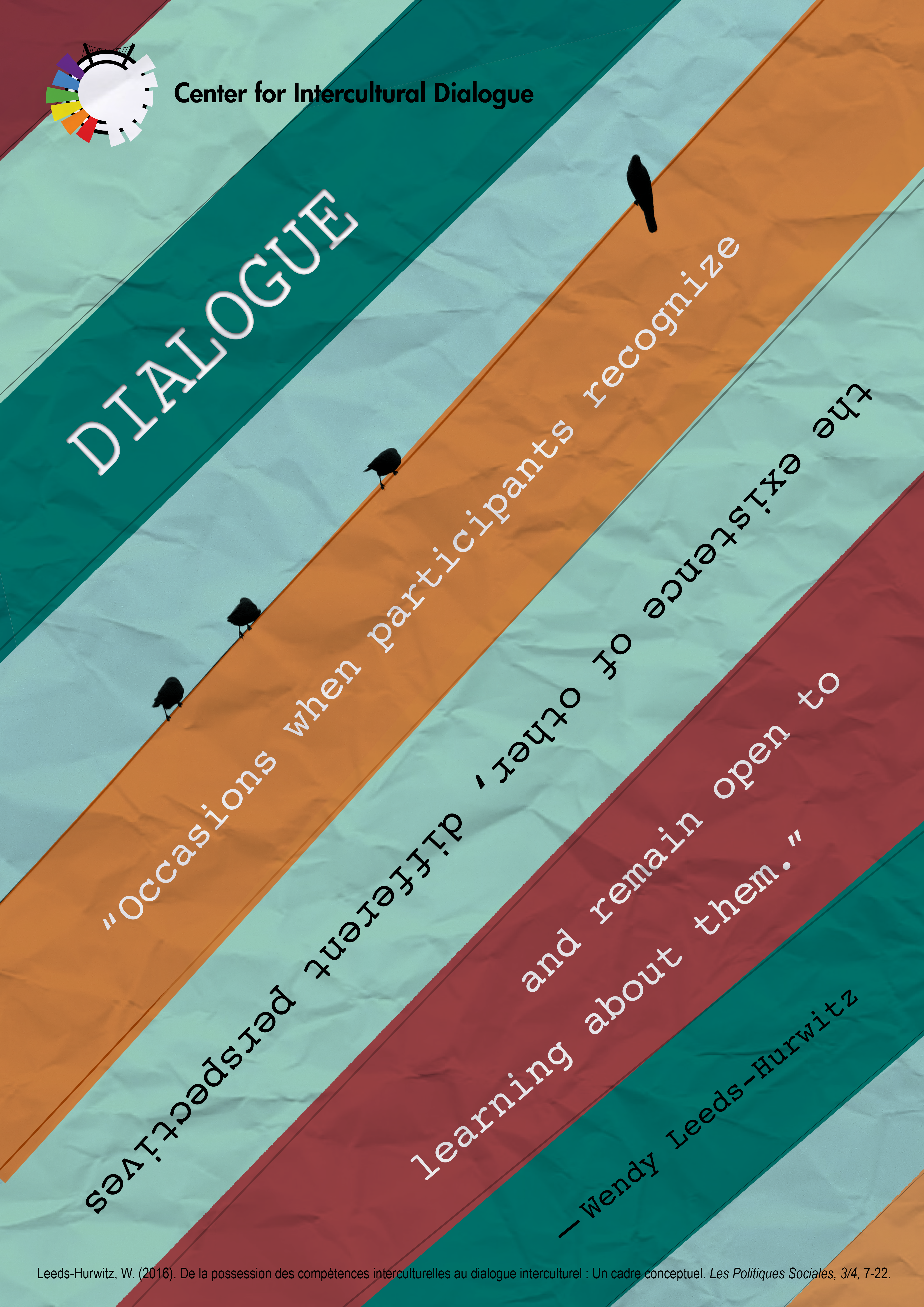
CID PostersThis is the next of the posters designed by Linda J. de Wit, in her role as CID intern. For this poster, you literally have to look from a different perspective to read the quote; the picture of birds on a wire also represents taking different perspectives. The source of the quote is:

Leeds-Hurwitz, W. (2016). De la possession des compétences interculturelles au dialogue interculturel: Un cadre conceptuel [Moving from having intercultural competencies to constructing intercultural dialogues: A conceptual framework]. Les Politiques Sociales, 3/4, 7-22.

Dialogue DefinedJust in case anyone wants to cite this poster, the following would be the recommended format:

Center for Intercultural Dialogue. (2017). Dialogue defined. CID Posters, 6. Available from:
https://centerforinterculturaldialogue.org/wp-content/uploads/2017/08/dialogue.png

As with other series, CID Posters are available for free on the site; just click on the thumbnail to download a printable PDF. They may be downloaded, printed, and shared as is, without changes, without cost, so long as there is acknowledgment of the source.

As with other series, if you wish to contribute an original contribution, please send an email before starting any work to receive approval, to minimize inadvertent duplication, and to learn about technical requirements. As is the case with other CID Publications, posters should be created initially in English. Given that translations of the Key Concepts in Intercultural Dialogue have received so many views, anyone who wishes to translate their own poster into another language (or two) is invited to provide that as well. If you want to volunteer to translate someone else’s poster into a language in which you are fluent, send in a note before starting, to receive approval and to confirm no one else is working on the same one.

Wendy Leeds-Hurwitz
Director, Center for Intercultural Dialogue
intercult.dialogue AT gmail.com


Creative Commons License
This work is licensed under a Creative Commons Attribution-NonCommercial-NoDerivatives 4.0 International License.

Key Concept #3: Intercultural Competence Translated into Ukrainian

Key Concepts in ICDContinuing translations of Key Concepts in Intercultural Dialogue, today I am posting KC#3: Intercultural competence, which Lily Arasaratnam wrote for publication in English in 2014, and which Roxanna M. Senyshyn has now translated into Ukrainian.

As always, all Key Concepts are available as free PDFs; just click on the thumbnail to download. Lists of Key Concepts organized chronologically by publication date and number, alphabetically by concept, and by languages into which they have been translated, are available, as is a page of acknowledgments with the names of all authors, translators, and reviewers.

KC3 Intercultural Competence_Ukrainian

Arasaratnam, L. A. (2017). Intercultural competence [Ukrainian]. (R. M. Senyshyn, trans). Key Concepts in Intercultural Dialogue, 3. Available from:
https://centerforinterculturaldialogue.org/wp-content/uploads/2017/07/kc3-intercultural-competence_ukrainian.pdf

If you are interested in translating one of the Key Concepts, please contact me for approval first because dozens are currently in process. As always, if there is a concept you think should be written up as one of the Key Concepts, whether in English or any other language, propose it. If you are new to CID, please provide a brief resume. This opportunity is open to masters students and above, on the assumption that some familiarity with academic conventions generally, and discussion of intercultural dialogue specifically, are useful.

Wendy Leeds-Hurwitz, Director
Center for Intercultural Dialogue


Creative Commons License
This work is licensed under a Creative Commons Attribution-NonCommercial-NoDerivatives 4.0 International License.

ICA Regional: Communications Research in the Digital Age (India)

ConferencesInternational Communication Association South Asia Regional Conference 2017: Communications Research in the Digital Age, 14 to 16 December 2017, Mumbai, INDIA, Hosted by SNDT Women’s University. Abstract due: August 31, 2017

The ICA South Asia regional conference intends to examine communications research in digital age under four parallel tracks for paper presentation:

A. Individual and Digital Exposure (IDE): What is the relationship of individual with the digital media?

B. Gender, Culture Technology (GCT): How does community and technology intersect in a given culture?

C. Digital Media Ecology (DME): Who are the stakeholders and players of digital media landscape?

D. Digital Research Methodologies (DRM): What are methodological challenges for digital media research?

We recognize that all the themes are intersecting and can be interwoven, yet we expect that you choose ONE that you think is nearest to your research/panel so that regional interest groups can be formed towards the end of the conference. By submitting abstract you are agreeing to register for the Conference. There will be workshops as well as plenary at the Conference.

Roxanna Senyshyn Profile

ProfilesRoxanna Senyshyn is Associate Professor of Applied Linguistics and Communication Arts and Sciences at Pennsylvania State University, Abington College.

Roxanna SenyshynHer teaching and research focus on intercultural communication and second language learning and teaching. Specifically, her research interests include intercultural and transformative learning in teacher education, intercultural competencies for academic and professional purposes, and ESL pedagogy and assessment with a focus on academic writing.

One strand of Dr. Senyshyn’s research examines the need to prepare both preservice and inservice teachers for working with English language learners in multilingual and multicultural classroom settings.  Through community-based scholarship, she investigates the impact of intercultural engagement and learning on different constituents. From the student perspective, she has studied the impact of intercultural learning through engagement of domestic students with their international peers in semester long projects. She has studied this influence through the lens of Mezirow’s transformative learning theory, which encourages critical reflection and examination of personal beliefs and actions to allow for a change in perspectives and behavior. She has also used transformative learning framework in a faculty professional development context as an assessment tool to investigate the impact of professional development on faculty practices surrounding teaching and learning in a linguistically and culturally diverse college classroom.

The other strand of Dr. Senyshyn’s research focuses on intercultural learning and intercultural competence development to aid in the process of adjustment and acculturation of international students. The primary focus for this scholarship has been on identifying challenges that international students experience when adjusting to both academic and social demands in U.S. colleges and universities and assessing academic support to aid these students in their successful transition. In one of her recent projects, she examined the impact of first-year seminar experience and out-of-class engagement with domestic students on international students’ intercultural competence development.

In addition to her experience in academia, Dr. Senyshyn has been a consultant for BGRS Intercultural and Language Training doing training and coaching for inbound and outbound expatriates and their families in the greater Philadelphia area (Pennsylvania, U.S.).

Selected publications:

Senyshyn, R. with Lypka, A. (2024). Voices of courage and vulnerability: Teaching English in a society at war (Ukraine 2022-2023). Sunshine TESOL Press.

Senyshyn, R. (2024). Humanizing and amplifying voices of displaced children: A narrative of an eight-year-old’s journey and integration. In T.M. Shah (Ed.), Children and youth as ‘sites of resistance’ in armed conflict (pp. 35-54). London, UK: Emerald Publishing.

Han, S. & Senyshyn, R. (2024). Dynamic intercultural learning and collaboration: transforming language teacher perspectives and practices. Journal for Multicultural Education, 18(4), 1-19.

Senyshyn, R.M. (2024). Immigrant families and communities as agents of interculturality in pre-service teacher education. In A.F. Selvi & C. Kocaman (Eds.), International perspectives on critical English language teacher education: Theory and practice (pp. 229-235). New York, NY: Bloomsbury Publishing.

Senyshyn, R. M. (2023). Translanguaging as transformation: The collaborative construction of new linguistic realities. Language and Intercultural Communication, 23(1), 140-142.

Senyshyn, R. M. (2021). Navigating linguistic and cultural identities: (Re)positioning oneself through critical awareness. In A. F. Selvi & B. Yazan (Eds.), Language teacher education for Global Englishes: A practical resource book (pp. 188-196). New York, NY: Routledge.

Senyshyn, R.M. & Martinelli, A. (2021). Learning to support and sustain cultural (and linguistic) diversity: Perspectives of preservice teachers. Journal for Multicultural Education, 15(1). 20-37.

Senyshyn, R. M. (2020). Transformative intercultural learning: Research to practice in teacher education. In C.E. Poteau (Ed.), Pedagogical approaches to intercultural competence development (151-173). Newcastle upon Tyne, UK: Cambridge Scholars Publishing.

Senyshyn, R. M. (2019). A first-year seminar course that supports the transition of international students to higher education and fosters the development of intercultural communication competence. Journal of Intercultural Communication Research, 48(2), 150–170.

Senyshyn, R. M., & Smith, P. (2019). Global awareness dialogue project: Exploring potential for faculty transformation through professional development. Journal of Transformative Education, 17(4), 318–336.

Senyshyn, R.M. (2019). A first-year seminar course that supports the transition of international students to higher education and fosters the development of intercultural communication competence. Journal of Intercultural Communication Research, 48(2), 150-170.

Senyshyn, R.M. (2019). Facilitating transformative intercultural learning. TESOL Connections, February 2019.

Senyshyn, R.M. (2018). Teaching for transformation: Converting intercultural experience of preservice teachers into intercultural learning. Intercultural Education, 29(2), 163-184.

Senyshyn, R.M. (2018). Facilitating preservice teachers’ transformation through intercultural learning: Reflections from a self-study. In J. Sharkey & M. M. Peercy (Eds.), Self-study of language and literacy teacher education practices: Culturally and linguistically diverse contexts (pp.167-184). London, UK: Emerald Group Publishing.

Chamberlin-Quinlisk, C. R. & Senyshyn, R. (2012). Language teaching and intercultural education: Making critical connections. Intercultural Education, 23, 15-23.

Senyshyn, R.M. & Chamberlin-Quinlisk, C.R. (2009).  Assessing effective partnerships in intercultural education: Transformative learning as a tool for evaluation. Communication Teacher, 23 (4), 167-178.

Senyshyn, R.M.  (2001).  Learning cross-cultural competencies: Implications for international management education.  Perspectives in Higher Education Reform.  Proceedings of the 11th Annual International Conference of Alliance of Universities for Democracy, Volume 10, Sofia, Bulgaria.

Senyshyn, R.M., Warford, M., & Zhan, J.  (2000).  Academic and non-academic issues of adjustment to American higher education.  Journal of International Education, 30(1) 17-35.


Work for CID:
Roxanna Senyshyn translated KC3: Intercultural CompetenceKC5: Intercultural Communication, and KC19: Multiculturalism into Ukrainian. She also has served as a reviewer of Ukrainian translations. She will also be participating in an expert group organized by the Center.