Key Concept #10: Cross-Cultural Dialogue Translated into Simplified Chinese

Key Concepts in ICDContinuing translations of Key Concepts in Intercultural Dialogue, today I am posting KC#10: Cross-Cultural Dialogue, which I first published in English in 2014, and which Yan Qiu has now translated into Simplified Chinese.

As always, all Key Concepts are available as free PDFs; just click on the thumbnail to download. Lists of Key Concepts organized chronologically by publication date and number, alphabetically by concept, and by languages into which they have been translated, are available, as is a page of acknowledgments with the names of all authors, translators, and reviewers.
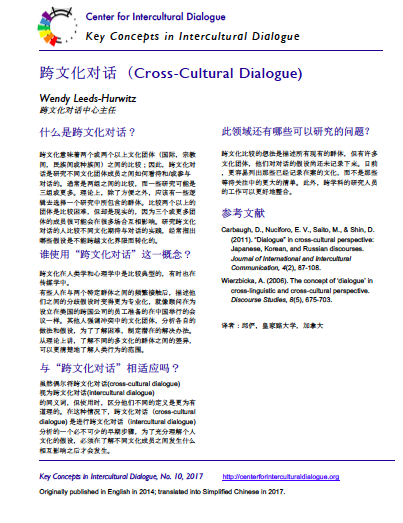
KC10 Cross-Cultural Dialogue_Chinese-simLeeds-Hurwitz, W. (2017). Cross-cultural dialogue [Simplified Chinese]. (Y. Qiu, Trans). Key Concepts in Intercultural Dialogue, 10. Available from:
https://centerforinterculturaldialogue.org/wp-content/uploads/2019/10/kc10-cross-cultural-dialogue_chinese-simplified.pdf

If you are interested in translating one of the Key Concepts, please contact me for approval first because dozens are currently in process. As always, if there is a concept you think should be written up as one of the Key Concepts, whether in English or any other language, propose it. If you are new to CID, please provide a brief resume. This opportunity is open to masters students and above, on the assumption that some familiarity with academic conventions generally, and discussion of intercultural dialogue specifically, are useful.

Wendy Leeds-Hurwitz, Director
Center for Intercultural Dialogue


Creative Commons License
This work is licensed under a Creative Commons Attribution-NonCommercial-NoDerivatives 4.0 International License.


Save

William Zard Abou Jaoude Award 2017 (Film Competition)

AwardsThe William Zard Abou Jaoude International Award is an annual award granted by the Lebanon Dialogue Initiative (LDI). It seeks to recognize promising young (18-35) non-professional creators/directors committed to exploring conflict/dispute, dialogue, peace-building, reconciliation, identity, territory, citizenship, and the like.

A distinguished jury panel will review submissions, and the winner will be invited to screen his or her short film during the 2017 LDI Forum Gala Dinner, which will take place on November 4, 2017, in Lebanon. Screenings will be attended by a diverse audience, comprising of LDI members, local and international speakers, government officials, academics, journalists, diplomats, and civil society activists as well as the general public.

The winning short film will subsequently be screened at prominent LDI events and gatherings around the world and will be used as part of the LDI communication tool.

Deadline: August 31, 2017
Entry fee: Gratis
Award: $5,000 USD

Key Concept #55: Stereotypes Translated into Latvian

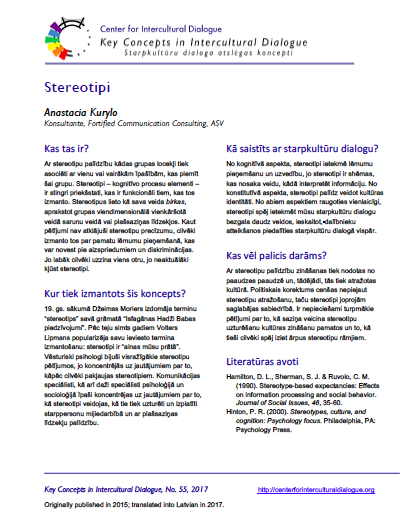
Key Concepts in ICDContinuing translations of Key Concepts in Intercultural Dialogue, today I am posting KC#55: Stereotypes, which Anastacia Kurylo wrote and first published in English in 2015, and which Inga Milēviča has now translated into Latvian. As always, all Key Concepts are available as free PDFs; just click on the thumbnail to download. Lists of Key Concepts organized chronologically by publication date and number, alphabetically by concept, and by languages into which they have been translated, are available, as is a page of acknowledgments with the names of all authors, translators, and reviewers.

KC55 Stereotypes_LatvianKurylo, A. (2017). Stereotipi. (I. Milēviča Trans). Key Concepts in Intercultural Dialogue, 55. Available from:
https://centerforinterculturaldialogue.org/wp-content/uploads/2017/06/kc55-stereotypes_latvian.pdf

If you are interested in translating one of the Key Concepts, please contact me for approval first because dozens are currently in process. As always, if there is a concept you think should be written up as one of the Key Concepts, whether in English or any other language, propose it. If you are new to CID, please provide a brief resume. This opportunity is open to masters students and above, on the assumption that some familiarity with academic conventions generally, and discussion of intercultural dialogue specifically, are useful.

Wendy Leeds-Hurwitz, Director
Center for Intercultural Dialogue


Creative Commons License
This work is licensed under a Creative Commons Attribution-NonCommercial-NoDerivatives 4.0 International License.
Save

U College London Job Ad: Global Politics (UK)

Teaching Fellow in Global Politics, University College London – UCL School of European Languages, Culture and Society – Centre for Multidisciplinary and Intercultural Inquiry (UK)

The UCL Centre for Multidisciplinary and Intercultural Inquiry invites applications for the post of Teaching Fellow in Global Politics. The successful candidate will be expected to take up the position on 1 September 2017, or as soon as possible thereafter. The post is fixed-term for 12 months.

The post holder will teach four courses or equivalent – an approximate total of 80 contact hours of teaching – at graduate level. He or she will be required to mark and assess work completed for these and, at the discretion of the Chair of CMII, other courses, assist in the preparation of timed examination papers to be taken in the summer term, supervise MA dissertations, participate in CMII PhD and MA dissertation presentations, hold office hours, attend meetings concerning the courses that he or she teaches, and complete mandatory training requirements that he or she may, in accordance with UCL policy, need to take.

The post holder will have a Postgraduate qualification or equivalent within the area of Global Politics, Comparative Politics, or International Relations.

Closing Date: 7 July 2017
Part-Time: 18.25 hours per week (50% FTE)


CFP Who Belongs? Immigrants, Refugees, Migrants

Publication OpportunitiesCall for Papers: Journal of Critical Thought and Praxis (Special Issue): Who Belongs? Immigrants, Refugees, Migrants, and Actions Towards Justice

Over the past year, both in the U.S. and Europe, far-right nationalist and white supremacist organizations have led a massive assault on the human rights of immigrants, refugees, and migrants, resulting in multiple acts of violence against individuals and communities and a general climate of fear. Notably, this assault has been supported by the most mainstream of political actors, ranging from elected officials in the U.S. who advocate for travel bans targeted at people who are Muslim and deportation raids targeted at the Latinx community to the racist and xenophobic political platforms of leading candidates for the highest of political offices in France and Austria. In this issue, we seek to engage this political landscape by asking the question: Who belongs? This question raises significant abstract issues, including: the legitimacy and construction of nationstates; theories of democratic governance and legal systems; notions of citizenship; intersections between racialized, gendered, and classed social identities; and, processes of imperialism and colonization. The question also raises significant issues that are more concrete, including: access to public resources (such as education, housing, and health care); policies and processes of “legal” documentation; activist and community mobilization; sanctuary cities; U.S. and European military intervention; the militarization of law enforcement in the U.S. and abroad; neoliberal economic policies; and, ongoing anti- and post- colonial struggles across the globe. We thus invite scholars and activists from a range of disciplinary and professional positions to submit work (research articles, conceptual essays, book reviews, and poems) that illuminates these and other issues that are central to political struggle for the rights of immigrants, refugees, and migrants.

Submission Timeline Deadline: Friday, September 1, 2017
Anticipated Publication: January 2018


Nanyang Technological U Job Ad: Language & Communication (Singapore)

Job adsLecturer (Language and Communication Centre)
Nanyang Technological University – School of Humanities (Singapore)

Young and research-intensive, Nanyang Technological University (NTU Singapore) is ranked 13th globally. It is also placed 1st amongst the world’s best young universities.

The Language and Communication Centre (LCC) offers courses in communication skills to students across the university, particularly in the disciplines of engineering, the humanities, science, and social sciences. The Centre is especially interested in employing teaching staff with a background in English for science and technology, web-based learning programmes, and the teaching of English research writing to postgraduate students across a range of disciplines.

Candidates who have the following qualifications are encouraged to apply:

  • PhD Degree in English linguistics, Applied Linguistics or Technical Communication
  • Experience in course design for discipline-specific English
  • Interest in new media and digital literacy
  • An active research agenda

Successful candidates will be expected to teach communication skills, English for academic purposes, and/or technical communication and to conduct research on related areas of inquiry. This position will be in an academic centre which is rapidly developing a strong research trajectory, and which will welcome candidates with a strong interest in research in such fields as English for Academic Purposes, Applied English Linguistics, English for Specific Purposes, multimodal education, web-based learning or a related field of English linguistics. This position may suit newly-qualified PhDs with a passion for interdisciplinary English teaching and research.   

CID Poster #1: Intercultural Communication/Competence/Dialogue

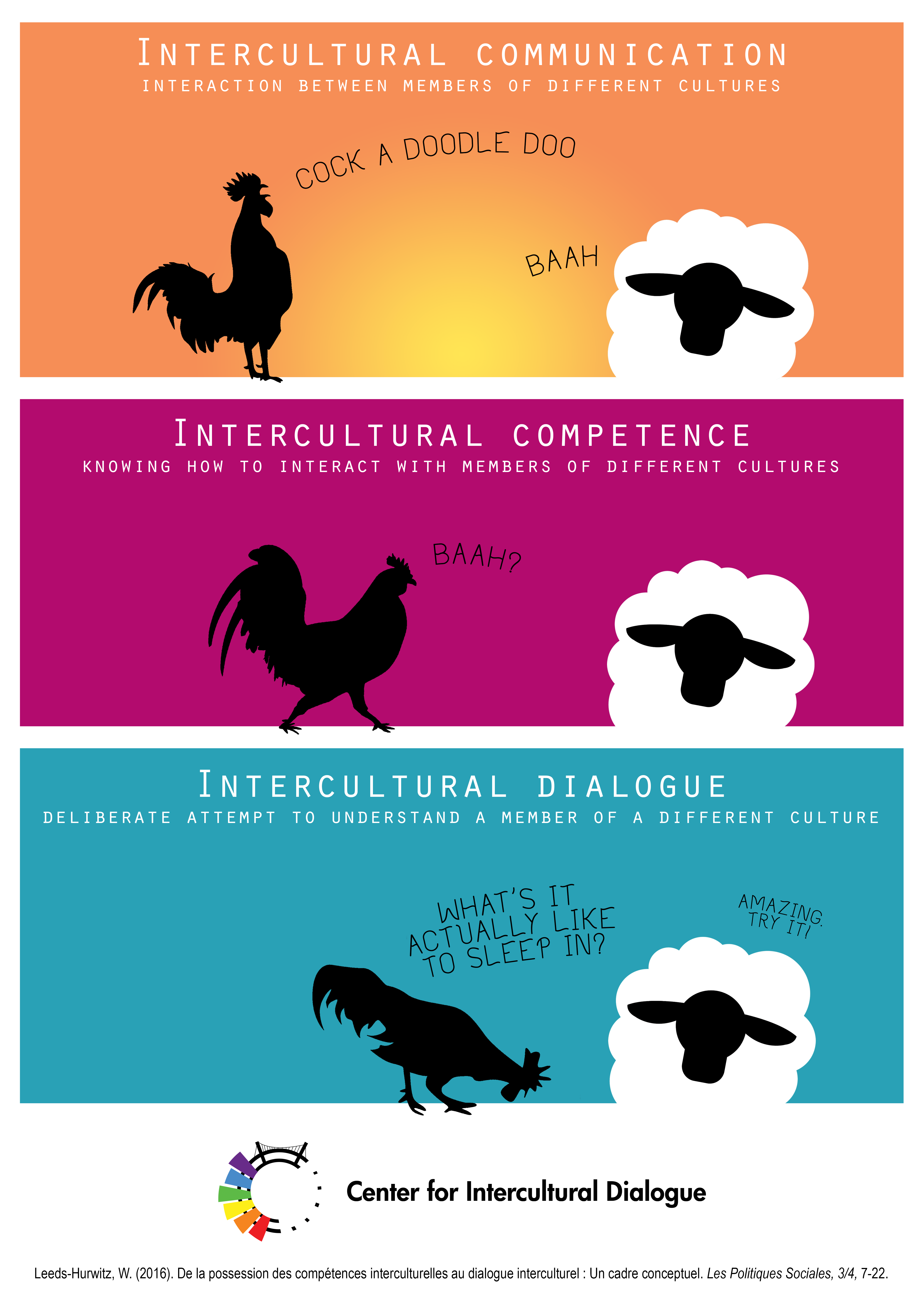
CID PostersThis is the first of the posters designed by Linda J. de Wit, in her role as CID intern. This one provides a quick and easy way to understand, and differentiate between, the concepts of “intercultural communication,” “intercultural competence,” and “intercultural dialogue,” using a rooster and a sheep to represent members of different cultures (and she notes that the animals are vector designs by vecteezy.com). The article where these explanations of these concepts (as well as lots of other concepts) were published is:

Leeds-Hurwitz, W. (2016). De la possession des compétences interculturelles au dialogue interculturel: Un cadre conceptuel [Moving from having intercultural competencies to constructing intercultural dialogues: A conceptual framework]. Les Politiques Sociales, 3/4, 7-22.

Intercultural communication/competence/dialogue

Just in case anyone wants to cite this poster, the following would be the recommended format:

Center for Intercultural Dialogue. (2017). Intercultural communication, intercultural competence, intercultural dialogue. CID Posters, 1. Available from:
https://centerforinterculturaldialogue.org/2017/06/28/cid-poster-1/

As with other series, CID Posters are available for free on the site; just click on the thumbnail to download a printable PDF. They may be downloaded, printed, and shared as is, without changes, without cost, so long as there is acknowledgment of the source.

Now that the first poster is available as a model, the series is open to submissions. If you wish to contribute an original design, please send an email before starting any work to receive approval, to minimize inadvertent duplication, and to learn about technical requirements. As is the case with other CID Publications, posters should be created initially in English. Given that translations of the Key Concepts in Intercultural Dialogue have received so many views, where specific quotes are provided, anyone who wishes to translate their own poster into another language (or two) is invited to design that as well. If you want to volunteer to translate someone else’s poster into a language in which you are fluent, send in a note before starting, to receive approval and to confirm no one else is working on the same one.

Wendy Leeds-Hurwitz
Director, Center for Intercultural Dialogue
intercult.dialogue AT gmail.com


Creative Commons License
This work is licensed under a Creative Commons Attribution-NonCommercial-NoDerivatives 4.0 International License.

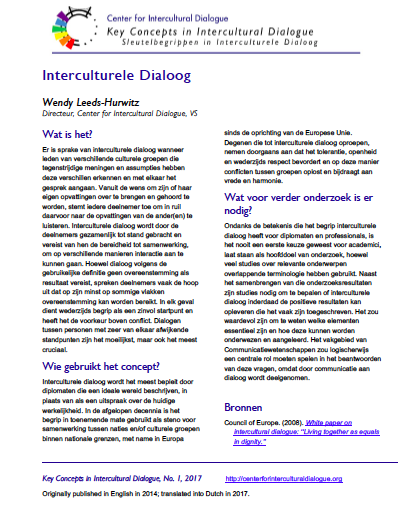
Key Concepts #1: Intercultural Dialogue Translated into Dutch

Key Concepts in ICDContinuing translations of Key Concepts in Intercultural Dialogue, today I am posting KC#1: Intercultural Dialogue, which I wrote for publication in English in 2014, and which Linda J. de Wit has now translated into Dutch.

As always, all Key Concepts are available as free PDFs; just click on the thumbnail to download. Lists of Key Concepts organized chronologically by publication date and number, alphabetically by concept, and by languages into which they have been translated, are available, as is a page of acknowledgments with the names of all authors, translators, and reviewers.

KC1 ICD_DutchLeeds-Hurwitz, W. (2017). Interculturele dialoog. (L. J. de Wit, Trans). Key Concepts in Intercultural Dialogue, 1. Available from:
https://centerforinterculturaldialogue.org/wp-content/uploads/2017/06/kc1-icd_dutch.pdf

If you are interested in translating one of the Key Concepts, please contact me for approval first because dozens are currently in process. As always, if there is a concept you think should be written up as one of the Key Concepts, whether in English or any other language, propose it. If you are new to CID, please provide a brief resume. This opportunity is open to masters students and above, on the assumption that some familiarity with academic conventions generally, and discussion of intercultural dialogue specifically, are useful.

Wendy Leeds-Hurwitz, Director
Center for Intercultural Dialogue


Creative Commons License
This work is licensed under a Creative Commons Attribution-NonCommercial-NoDerivatives 4.0 International License.

Save

Save

CFP: Culture and Communication in Negotiation and Conflict Management

Publication OpportunitiesSpecial Issue Call for Papers: Culture and Communication in Negotiation and Conflict Management, for Negotiation and Conflict Management Research. Submission Deadline: January 15, 2018. Special Issue Editor: Wendi Adair, University of Waterloo.

Culture is defined broadly as a social group with shared values and norms that are reinforced and perpetuated through the group’s institutions. Culture defined by national borders is one conceptualization; culture defined by gender, religion, lifestyles, careers, and generations are also predictors of what, how, and when someone communicates, as well as interprets, and responds. What refers to communication content: meaning the speaker conveys and meaning the listener interprets. How refers to linguistic style, nonverbal cues, context dependence, and communication medium. When refers to temporal patterns such as timing, pacing, and temporal horizons.

We invite empirical and conceptual submissions addressing culture and communication in diverse negotiation and conflict management contexts including topics such as:
–     Case studies or comparative culture analyses of negotiators’ or mediators’ communication repertoires in understudied populations (e.g., Africa, South America, religious groups);
–   Communication adjustment/adaptation, cultural interpreters, and role of language in cross-cultural negotiation and conflict resolution;
–       Qualitative analyses of linguistic or communication tools used to aid conflict resolution and negotiation in distinct cultural populations (e.g., metaphor in high context cultures, sharing circles, story-telling in hierarchical cultures);
–       Content analyses of public accounts of negotiation or conflict resolution (e.g., media coverage of land dispute, international trade, and political negotiations across culture);
–       Identification, interpretation, and management of miscommunication and misinterpretation in cross-cultural negotiation or dispute resolution;
–     Conflict management and negotiation in close relationships across cultures.

Constructing Intercultural Dialogue #8: A Flying Miracle

Constructing ICD

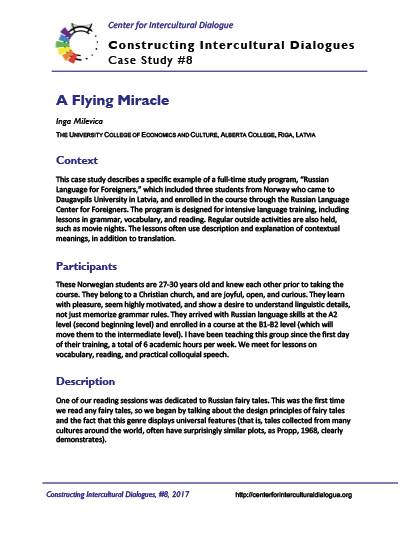
The next issue of Constructing intercultural Dialogues is now available, “A Flying Miracle” by Inga Milēviča.

As a reminder, the goal of this series is to provide concrete examples of how actual people have managed to organize and hold intercultural dialogues, so that others may be inspired to do the same. As with other CID series, these may be downloaded for free. Click on the thumbnail to download the PDF.

Constructing ICD #8Milevica, I. (2017). A flying miracle. Constructing Intercultural Dialogues, 8. Available from:
https://centerforinterculturaldialogue.org/wp-content/uploads/2017/06/constructing-icd-8.pdf

If you have a case study you would like to share, send an email to the series editor, Wendy Leeds-Hurwitz.


Creative Commons License
This work is licensed under a Creative Commons Attribution-NonCommercial-NoDerivatives 4.0 International License.