Venice Academy of Human Rights 2018 (Italy)

Applied ICDEIUC has announced the launch of its 2018 Venice Academy of Human Rights, an international and interdisciplinary programme of excellence for human rights education, research and debate. It provides an enriching forum for emerging ideas, practices and policy options in the field of human rights. The Academy hosts distinguished experts to promote critical and useful research and innovation through the exchange of current knowledge.

The 2018 Venice Academy of Human Rights will focus on “Migration, Mobility and Diversity: New Horizons for Human Rights”. EIUC is honored to welcome back Professor François Crépeau, former U.N. Special Rapporteur on the Human Rights of Migrants from 2011 to 2017, current Director of the Centre for Human Rights and Legal Pluralism at McGill University, Canada and recently appointed 2017-2018 International Francqui Professor at Université catholique de Louvain, to the Monastery of San Nicolò which he will act as the Academic and Scientific Coordinator of the Academy.

Early Bird: 11 April 2018
Registration Deadline: 23 May 2018

Global Pluralism Award 2018

AwardsThe Global Pluralism Award recognizes and supports the extraordinary achievements of organizations, individuals and governments who are tackling the challenge of living peacefully and productively with diversity. Pluralism, founded on respect for diversity, requires that human differences are protected and valued.

The Award is presented once every two years to individuals, organizations, governments and businesses of any nationality. Through their remarkable and sustained achievements, awardees contribute to building more inclusive societies in which human diversity is protected. The Award comes with financial support of $150,000 shared equally among three recipients, as well as global visibility and recognition. The nomination process closes on April 30th 2018.

KC18 Intractable Conflict Translated into Portuguese

Key Concepts in ICDContinuing translations of Key Concepts in Intercultural Dialogue, today I am posting KC#18: Intractable Conflict, which Andrew R. Smith wrote for publication in English in 2015, and which Susana Maria de Almeida Gonçalves  has now translated into Portuguese.

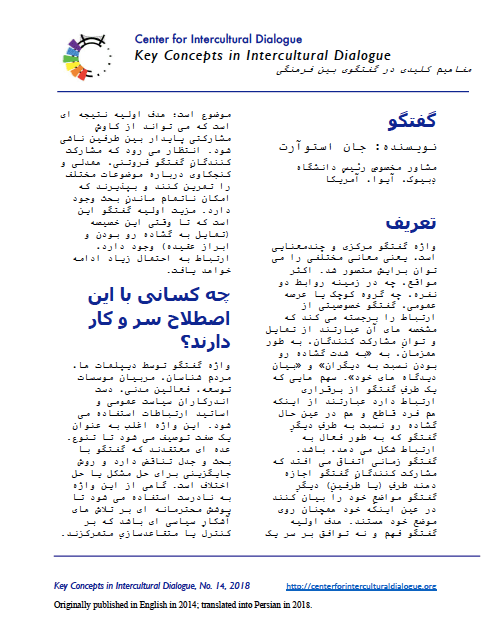
As always, all Key Concepts are available as free PDFs; just click on the thumbnail to download. Lists of Key Concepts organized chronologically by publication date and number, alphabetically by concept, and by languages into which they have been translated, are available, as is a page of acknowledgments with the names of all authors, translators, and reviewers.

KC18 Intractable Conflict_PortugueseSmith, A. R. (2018). Conflito intratável. (S. M. A. Gonçalves, trans). Key Concepts in Intercultural Dialogue, 18. Retrieved from:
https://centerforinterculturaldialogue.org/wp-content/uploads/2021/05/kc18-intractable-conflict_portuguese-v2.pdf

If you are interested in translating one of the Key Concepts, please contact me for approval first because dozens are currently in process. As always, if there is a concept you think should be written up as one of the Key Concepts, whether in English or any other language, propose it. If you are new to CID, please provide a brief resume. This opportunity is open to masters students and above, on the assumption that some familiarity with academic conventions generally, and discussion of intercultural dialogue specifically, are useful.

Wendy Leeds-Hurwitz, Director
Center for Intercultural Dialogue


Creative Commons License
This work is licensed under a Creative Commons Attribution-NonCommercial-NoDerivatives 4.0 International License.

Research Fellow: Chinese International Relations Discourses (Germany)

FellowshipsResearch Fellow on Chinese International Relations DiscoursesGIGA German Institute of Global and Area Studies – Faculty of Business, Economics and Social Sciences, Hamburg, Germany. Deadline: May 15, 2018.

Applications are invited for a part-time position (65%), with a contract of 3 years, starting 1 December 2018. The position is designed for further professional qualification as defined in § 2 WissZeitVG (Academic Fixed-Term Contract Act). The salary is commensurate with TV-AVH / TVöD EG 13.

The Research Fellow will be part of the research project “Legitimate Multipolarity” funded by the Deutsche Forschungsgemeinschaft (DFG) and coordinated by Dr. Johannes Plagemann. Prof. Dr. Amrita Narlikar and Prof. Dr. Heike Holbig complete the team. The project analyses the empirical legitimacy of international institutions in the context of multipolarity and critically examines potential solutions to legitimacy problems put forward in Chinese and Indian international relations discourses. The GIGA strongly encourages concurrent work on a doctoral degree in line with the candidate’s work in the project, which would potentially be supervised by Prof. Holbig and Prof. Narlikar. The Research Fellow would become a member of the GIGA Doctoral Programme.

The GIGA German Institute of Global and Area Studies / Leibniz-Institut für Globale und Regionale Studien is an independent social-science research institute based in Hamburg. It analyses political, social and economic developments in Africa, Asia, Latin America and the Middle East, and links this knowledge to questions of global significance. It combines region-specific analysis with innovative comparative research on accountability and participation, growth and development, peace and security, and power and ideas.

Clemson U Job Ad: Director of Education Abroad (USA)

Job adsDirector of Education Abroad, Clemson University, South Carolina. Deadline: Open until filled, but review begins April 6, 2018.

Clemson University is seeking an international education leader to join in moving the edge of innovation in education abroad programming. Located in the upstate of South Carolina within a region characterized by global industry and foreign direct investment, Clemson has recently reinvigorated its commitment to global learning and reorganized the Clemson Abroad office to provide the infrastructure to expand into new models of global engagement including internships, research and virtual exchange/COIL. This reorganization effort has led to a 34% increase over the last 4 years with approximately 1500 students traveling abroad annually through faculty-led, exchange and third-party programs that include service, work and internship opportunities. The new Director of Education Abroad will provide administrative, operational and programmatic leadership to a team of education abroad professionals within the Clemson Abroad Office.

Loughborough U PHD Studentships (UK)

FellowshipsImproving the Health of Our Online Civic Culture: A New Centre for Doctoral Training at Loughborough University. Deadline: April 27, 2018.

Established in 2018 with a £300,000 award from Loughborough University’s Adventure Research Programme, the Online Civic Culture Centre for Doctoral Training (CDT) applies cutting-edge concepts and methods from social science and information science to understand the role of social media in shaping our civic culture. Led by Professor Andrew Chadwick, it features a team of ten academic supervisors drawn from the disciplines of communication, information science, social psychology, and sociology. The CDT enables interdisciplinary teams of researchers and PhD students to work together on issues of misinformation, disinformation, and the rise of hate speech and incivility online. It develops evidence-based knowledge to mitigate the democratically-dysfunctional aspects of social media. At the same time, it identifies and promotes the positive civic engagement benefits of social media.

Across the world, we face fundamental questions about how the routine use of social media is reshaping the civic cultures of democracies. Central to the debate is whether the features of social media that enable citizens to express themselves, exchange opinions, coordinate with others, and rapidly circulate and recirculate messages also encourage the diffusion of false information, incivility, and hatred.

One of the 3 studentships seems particularly relevant to CID followers: 

The Cultivation of Hatred Online

Primary supervisor: Professor Andrew Chadwick.
Secondary supervisors: Professor Tom JacksonDr Karen LumsdenDr Cristian Tileagă.

This PhD will explore online discourse promoting misogynistic and/or racist hate speech. The research will address, for example, the rise of the so-called “alt-right” online and assess whether social media discourse cultivates deep emotional involvement from individuals and groups who promote such ideas. It will also consider the power and significance of oppositional responses, such as, for example, the #MeToo movement, Hope Not Hate, and Black Lives Matter. The project will explore the potential of methods and tools that use artificial intelligence and machine learning techniques that may be used to combat racism and/or misogyny.

CID Video Competition – FAQ

CID Video CompetitionAs people are learning of the CID Video Competition, they have been asking questions. In hopes this will help others, the questions will be posted, along with answers. As further questions are asked, they will be answered here.

WARNING: Please read the entry rules carefully! Several submissions have not met the requirements, and cannot be considered for a prize until they are revised. Make sure you submit a video file (not audio), that is between 30 seconds and 2 minutes (not 30 minutes!), with the last line “Intercultural dialogue looks like…” and upload it to the server provided (not to YouTube directly). 

NEW Clarification: When someone asks “Intercultural dialogue looks like…” in English, the “…” (read out loud as dot-dot-dot) means your job is to complete the sentence and include your answer as the last shot in the video. (So, “intercultural dialogue looks like a tiger, an ice cream cone, a braid, etc.” – choose whatever image makes sense given your video.) Please do NOT include the literal phrase “Intercultural dialogue looks like…” as the last shot in your video!


Question: Where do I submit an entry?

Answer: To submit an entry, click here.


Question: Does it matter how many people are in the video? Our idea is to film the entire class in action!

Answer: No limit to how many people are included. Do whatever works for you.


Question: How do students submit their videos? I couldn’t find a URL in the description of the competition.

Answer: The URL will be posted on April 15, 2018, the first day submissions will be accepted.


Question: Is this an international competition?

Answer: Most definitely! Students from every country are encouraged to participate. We hope for good international coverage.


Question: Is the video competition open to graduate students?

Answer: Absolutely! Students at any level of higher education, from community or technical college to undergraduates, masters or doctoral studies, are all eligible.


Question: Is the video competition open to faculty working jointly with their students?

Answer: While faculty may advise students, they may not be co-creators. The intent is to encourage students to create the videos.


Question: Is there a language requirement for the videos?

Answer: The videos will have to be in English. Permitting any other language would imply having judges who know all the several dozen languages currently represented on the site, which would be impossible. However, creating a video in another language with English subtitles should be fine. Choosing to have most of the video acted out, with minimal linguistic elements, should work as well.

CFP IADA 2018: Dialogue & Becoming (Taiwan)

ConferencesCall for Papers: Dialogue and Becoming: Technologies, Agencies, and Ways of Relating. International Association for Dialogue Analysis (IADA) Conference. Chinese Culture University, Taipei, TAIWAN. Sept. 25–28, 2018. DeadlineApril 16th, 2018.

We now live in an environment where many of our dialogues and interactions are facilitated, actualized, virtualized, augmented, or completed by and through communication technologies and online platforms. Humans go online not only to interact with other human beings, but also to interact with information and data. In many contexts, we now achieve dialogical communication by integrating technologies and information, using or creatively appropriating various platforms (e.g. Castells, 2007; Dahlberg, 2007; Fuchs & Obrist, 2010, Papacharissi, 2015).

Continue reading “CFP IADA 2018: Dialogue & Becoming (Taiwan)”

CFP Internet-Infused Romantic Interactions (Turkey)

Publication OpportunitiesCall for chapters: Internet-Infused Romantic Interactions and Dating Practices. Under Contract with: Institute of Network Cultures, Amsterdam (Expected publication date – Summer 2018). Proposal deadline: April 15, 2018.

Editors: Prof. Amir Hetsroni, College of Social Sciences and Humanities – Koç University, Istanbul, Turkey, and Meriç Tuncez, Graduate School of Social Sciences and Humanities – Koç University, Istanbul, Turkey.

An interdisciplinary book titled Internet-Infused Romantic Interactions and Dating Practices, under contract with the publishing house of the Institute of Network Cultures, Amsterdam, aims to analyze intricacies of internet-infused romantic interactions and dating practices. The proposed collection aims to include contributions from communication scholars, social scientists, computer scientists, humanities scholars and design experts whose research and practice will shed light on the romantic interplay of affect, cognition, and behavior on the internet with special attention given to social media platforms such as Tinder, Facebook, Grinder, and OkCupid. The collection would aim to offer an array of international perspectives and methodological novelties and feature a volume of scientific research and practice from a multitude of disciplines and interdisciplinary outlooks.

Continue reading “CFP Internet-Infused Romantic Interactions (Turkey)”

KC19 Multiculturalism Translated into Greek

Key Concepts in ICDContinuing translations of Key Concepts in Intercultural Dialogue, today I am posting KC#19: Multiculturalism, which Polina Golovátina-Mora and Raúl Alberto Mora wrote for publication in English in 2014, and which Anastasia Karakitsou  has now translated into Greek.

As always, all Key Concepts are available as free PDFs; just click on the thumbnail to download. Lists of Key Concepts organized chronologically by publication date and number, alphabetically by concept, and by languages into which they have been translated, are available, as is a page of acknowledgments with the names of all authors, translators, and reviewers.

KC19 Multiculturalism_GreekGolovátina-Mora, P., & Mora, R. A. (2018). Multiculturalism (Greek). (A. Karakitsou, trans). Key Concepts in Intercultural Dialogue, 19. Retrieved from: https://centerforinterculturaldialogue.org/wp-content/uploads/2018/03/kc19-multiculturalism_greek.pdf

If you are interested in translating one of the Key Concepts, please contact me for approval first because dozens are currently in process. As always, if there is a concept you think should be written up as one of the Key Concepts, whether in English or any other language, propose it. If you are new to CID, please provide a brief resume. This opportunity is open to masters students and above, on the assumption that some familiarity with academic conventions generally, and discussion of intercultural dialogue specifically, are useful.

Wendy Leeds-Hurwitz, Director
Center for Intercultural Dialogue


Creative Commons License
This work is licensed under a Creative Commons Attribution-NonCommercial-NoDerivatives 4.0 International License.