U Oxford Job Ad: Migration (UK)

“JobResearcher in Migration, Migration Observatory, University of Oxford, UK. Deadline: 17 December 2018.

The Migration Observatory at the University of Oxford is seeking to appoint a researcher with a strong interest in migration policy. We are looking for someone who is committed to communicating with non-academic audiences and who over time will become a senior member of the Migration Observatory team.

The successful candidate will be involved in a wide range of Migration Observatory activities, producing analysis to help policy audiences and practitioners understand migration policies and data. They will be responsible for developing new ideas for briefing and commentaries, conducting descriptive data analysis, meeting with stakeholders inside and outside of government, and representing a high-profile organisation in public fora. In addition to work with non-academic audiences, they will also be expected to contribute to academic journal articles and will be supported to develop a programme of academic work alongside the Migration Observatory responsibilities.

CFP Transnational Autoethnographies

“PublicationCall for Submissions: Transnational Autoethnographies: Empowering Voices of the Others. Deadline for abstracts: December 20, 2018.

Drs. Ahmet Atay (College of Wooster) and Satoshi Toyosaki (Southern Illinois University) are building a book project with the working title Transnational Autoethnographies: Empowering Voices of the Others. We value autoethnography as a collection of various inquiry processes that help us interrogate lived experiences, voices, and stories of underrepresented, oppressed, marginalized, intersectional, and transnational identities. Doing autoethnographic work from such cultural positionalities is laborious. Willing to meet such labor, we, along with chapter contributors in this anthology, explore autoethnography’s postcolonial, decolonizing, and transnational potentialities for empowering voices from the margins. This book marks and builds space for (post)colonial, diasporic, and/or transnational scholars to narrate their own lived experiences to/for/against/within today’s global hegemonic economy of knowledge and to discuss culturally diverse and creative techniques of narrating, analyzing, and interpreting their personal/cultural lived experiences. The chapter contributors would help autoethnography diversify voices; narrative techniques (i.e., aesthetics, storying, etc.); and analytic, interpretive, and critical lenses.

With this scope in mind, editors call for chapter abstracts (250-500 words) to be included in the book proposal to be submitted to an interested publisher.

The topics and approaches may include but are not limited to:
transnational autoethnographies; postcolonial autoethnographies; decolonizing autoethnography as a methodology; simultaneous navigation of privilege and marginalization while doing autoethnographies; multilingual approaches to autoethnographies; culturally diverse techniques of narrating, analyzing, and interpreting culturally diverse aesthetic and/or evocative writing; non-western narrative techniques;
academic belonging; location and dislocation; identity and home;
border-crossing as an analytical lens; writing about immigrant experiences; English hegemony; transnational autoethnography and its pedagogical potentialities; and transnational autoethnography as performance.

Please send your abstract (250-500 words/Word Document) and a short bio to Drs. Atay and Toyosaki. DEADLINES: chapter abstracts are due by December 20, 2018. By January 30, 2019, you will learn if your chapter abstract will be included in the book proposal.


The Power of Story

Applied ICDBarlow, Susanna. (31 October 2018). The power of story. The Nasiona.

“The collective story of what it means to be human and how we should treat one another is the foundation upon which our cultures, our religions, our rituals, and even our identities are predicated upon. Stories are the bedrock of civilizations and the mortar between societies. While there is much diversity among humans, it is through our shared story that we find mutual understanding and cooperation. It is also through stories that we create wars, incite violence against each other, and isolate ourselves from others’ suffering. Stories bind us to each other, and we can be bonded as easily by hatred as by love through a shared story. And when our hostility, our judgment, and misunderstandings cause us to battle each other, we still end up tethered to one another by the story of that conflict.”

CFP ESTIDIA 2019: Hybrid Dialogues (Italy)

ConferencesCall for proposals: 5th ESTIDIA Conference: Hybrid Dialogues: Transcending Binary Thinking and Moving Away from Societal Polarisations, l’Universita degli Studi di Napoli L’Orientale, Naples, Italy, 19 – 21 September 2019. Deadline: for workshop proposals, 20 December 2018; for abstracts, 25 February 2019.

The European Society for Transcultural and Interdisciplinary Dialogue (ESTIDIA) will hold their 5th Conference, Hybrid Dialogues: Transcending Binary Thinking and  Moving Away from Societal Polarizations, at the University of Naples ‘L’Orientale’ in Naples, Italy. The conference welcomes a wide variety of thematic and disciplinary approaches to hybrid dialogues in various communities of practice across time and space. This conference offers an open forum for cross-disciplinary and multi-level dialogue among researchers and practitioners interested in exploring dialogic and discursive interaction observable across communities of practices and various social-cultural contexts.


CFP Middle East Dialogue 2019 (USA)

ConferencesCall for Papers, Middle East Dialogue, March 22, 2019, Washington, DC. Deadline: January 11, 2019.

The Policy Studies Organization (PSO) and The Digest of Middle East Studies (DOMES) would like to announce the official call for proposals for the annual Middle East Dialogue 2019. The event aims to promote dialogue about current policy concerns in the Middle East, and to provide a civil space for discussion across the religious and political spectrum. The Middle East Dialogue has established an international reputation as a focal point for new research, and a forum for the exchange of opinions and different views. The Middle East Dialogue is for policy makers, scholars, business and social leaders, to discuss current issues. Its purpose is to promote multidisciplinary conversations.

KC 38 Boundary Objects Translated into Greek

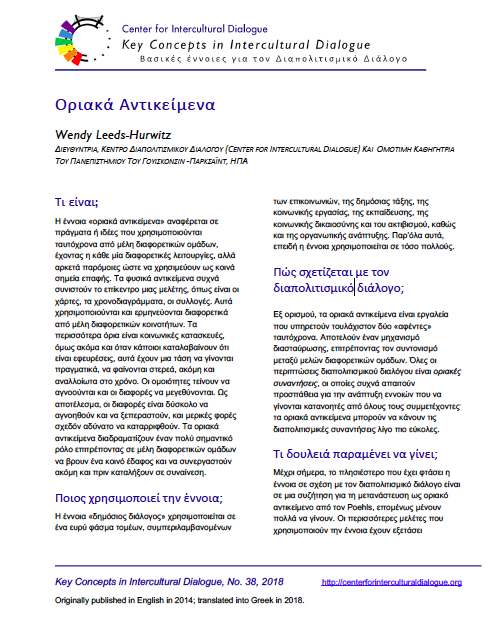
Key Concepts in ICDContinuing translations of Key Concepts in Intercultural Dialogue, today I am posting KC#38: Boundary Objects, which I wrote for publication in English in 2014, and which Anastasia Karakitsou has now translated into Greek.

As always, all Key Concepts are available as free PDFs; just click on the thumbnail to download. Lists of Key Concepts organized chronologically by publication date and number, alphabetically by concept, and by languages into which they have been translated, are available, as is a page of acknowledgments with the names of all authors, translators, and reviewers.

KC38 Boundary Objects_GreekLeeds-Hurwitz, W. (2018). Boundary objects [Greek]. (A. Karakitsou, trans). Key Concepts in Intercultural Dialogue, 38. Available from:
https://centerforinterculturaldialogue.org/wp-content/uploads/2018/11/kc38-boundary-objects_greek.pdf

If you are interested in translating one of the Key Concepts, please contact me for approval first because dozens are currently in process. As always, if there is a concept you think should be written up as one of the Key Concepts, whether in English or any other language, propose it. If you are new to CID, please provide a brief resume. This opportunity is open to masters students and above, on the assumption that some familiarity with academic conventions generally, and discussion of intercultural dialogue specifically, are useful.

Wendy Leeds-Hurwitz, Director
Center for Intercultural Dialogue


Creative Commons License
This work is licensed under a Creative Commons Attribution-NonCommercial-NoDerivatives 4.0 International License.

Nazarbayev U Job Ad: Multilingual Education (Kazakhstan)

Job adsAssociate Professor Positions in Multilingual Education, Graduate School of Education, Nazarbayev University, Kazakhstan. Deadline: 31 December 2018.

Nazarbayev University Graduate School of Education (NUGSE) invites applicants to join the international faculty to share in a vision of becoming a world-class center for postgraduate teaching and research in education. Due to expansion, NUGSE is recruiting for faculty members in Multilingual Education at Associate Professor level. The position start date is August 1, 2019.

The successful candidate will possess a doctoral degree in Applied Linguistics, Bilingual Education, Educational Policy, or a closely related field, and expertise in teaching and research related to one or more of the following areas: language development or acquisition in bilinguals/additional language learners; curriculum and assessment for multilingual contexts; content-based instructional strategies (e.g. CBI, CLIL); multiliteracies; language policy; sociolinguistics; plurilingualism; or language education for young learners.

Durham U Job Ads: Education (UK)

Job adsAssistant/Associate Professor in Education, School of Education, Durham University, UK. Deadline: 2 January 2019.

Professor in Education, School of Education, Durham University, UK. Deadline: 2 January 2019.

For both positions, applicants must demonstrate research excellence related to one or more of Durham’s thematic research clusters: Assessment, Monitoring and Educational Effectiveness; Evidence for Education policy and Practice, Higher and Further Education; Educational Psychology; Intercultural Communication and Education; Pedagogy and Curriculum.

IIASA Science Communication Fellowship (Austria)

FellowshipsThe International Institute for Applied Systems Analysis (IIASA) is currently accepting applications for its summer 2019 Science Communication Fellowship. Deadline: 11 January 2019.

The fellowship starts on 27 May and ends on 30 August. The fellowship covers the cost of travel to and from Vienna and the awardee’s home country at the beginning and end of the fellowship, as well as a modest stipend to offset living expenses during the period of the fellowship.

The science communication fellow will gain experience in communicating complex systems science for a general audience through a variety of platforms including blogs, website content, video, and articles for our magazine, Options. The successful candidate will work in the IIASA Communications Department, assisting with a variety of tasks including editorial work, web publishing, media relations, event coverage, multimedia, social media, and other communication activities. The fellow will also work closely with participants in the IIASA Young Scientists Summer Program (YSSP), producing several pieces of work covering research from the program.

China Studies Institute Faculty Fellowship (China)

FellowshipsChina Studies Institute Zhi-Xing China Academic Impact Fellowship, June 8-28, 2019, Shanghai, Xi’an, Beijing, China. Deadline: December 21, 2018.

The China Studies Institute (CSI) Zhi-Xing China Academic Impact Fellowship Program allows faculty to learn from scholars, business leaders, and education administrators about Chinese civilization, history, language, business and education.

CSI offers college and university faculty members with limited or without prior experience in Chinese studies to learn about China, both past and present. The institute encourages participants to develop strategies for incorporating Chinese studies into courses on their campuses. The Institute involves three weeks of intensive seminars, lectures, readings, and cultural activities related to Chinese history, culture, literature, government, business, language and education. Institute faculty will include scholars, administrators, representatives from the local Chinese community, and government officials.