Massey U National Study Abroad (New Zealand)

Study AbroadNational Expedition and Internship Program, Massey University, New Zealand, June 10 – July 19, 2019. Deadline: March 15, 2019.

Massey University’s National Expedition and Internship Program is open to undergraduate students from any university wishing to study, travel, and intern in New Zealand. Organised by the ACEJMC-accredited School of Communication, Journalism and Marketing, it begins with the two week ‘Image and Identity Tour’ taking students across both Islands to delve into how successful the brands and images of the tourism industry are at capturing the attention of people new to the country and culture. The tour finishes in the capital city of Wellington where students stay to complete a four week internship working on real world problems relevant to their degrees in Journalism, Media Studies, Public Relations, Advertising, Marketing, Communication, or related areas.

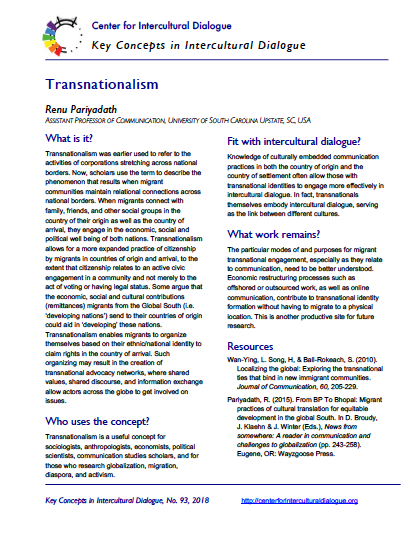
KC93 Transnationalism

Key Concepts in ICDThe next issue of Key Concepts in intercultural Dialogue is now available. This is KC#93: Transnationalism, by Renu Pariyadath. Click on the thumbnail to download the PDF. Lists organized chronologically by publication date and numberalphabetically by concept in English, and by languages into which they have been translated, are available, as is a page of acknowledgments with the names of all authors, translators, and reviewers.

KC93 TransnationalismPariyadath, R. (2018). Transnationalism. Key Concepts in Intercultural Dialogue, 93. Available from:
https://centerforinterculturaldialogue.org/wp-content/uploads/2018/11/kc93-transnationalism.pdf

The Center for Intercultural Dialogue publishes a series of short briefs describing Key Concepts in Intercultural Dialogue. Different people, working in different countries and disciplines, use different vocabulary to describe their interests, yet these terms overlap. Our goal is to provide some of the assumptions and history attached to each concept for those unfamiliar with it. As there are other concepts you would like to see included, send an email to the series editor, Wendy Leeds-Hurwitz. If there are concepts you would like to prepare, provide a brief explanation of why you think the concept is central to the study of intercultural dialogue, and why you are the obvious person to write up that concept.


Creative Commons License
This work is licensed under a Creative Commons Attribution-NonCommercial-NoDerivatives 4.0 International License.

Zhejiang U Job Ad: International Relations (China)

“JobSenior Lecturer/Associate Professor/Professor in International Studies, College of Humanities and Social Science, Zhejiang University, Hangzhou, China. Deadline: December 14, 2018.

The School of International Studies specialises in research fields and specialisations for the following areas: Second Language Acquisition, Pragmatics, Language Testing, Studies of Chinese as a Second Language, British & American Literature, Medieval English, Renaissance Literature, Theoretical Linguistics, Intercultural Communication, French Language and Literature, German Language and Literature, Japanese Language and Literature, Russian Language and Literature.

U York Job Ads: Sociology (UK)

“JobLecturer in Sociology, University of York – Heslington Campus (UK). Deadline: 3 February 2019.

The Department of Sociology invites applications for three full-time, permanent Lecturers in Sociology. You will have expertise in one (or more) of the following three substantive/methodological areas: 1) criminology and/or the sociology of crime and deviance; 2) race and ethnicity; 3) language and social interaction, especially conversation analysis.

Cultural Civil War

Resources in ICD“ width=Hippler, J., & Kamali-Chirani, F. (2018). Cultural civil war. In European Union National Institutes for Culture, Culture Report: EUNIC Yearbook 2017/2018 (pp. 36-41). Stuttgart, Germany:  European Union National Institutes for Culture.

Brief overview provided by the authors:

For a long time, Europe and the United States have presented themselves through “Western values” such as liberalism, liberty, and democracy; nevertheless, currently they are in a state of what can be described as cultural civil war. On one hand stands US President, Donald Trump, who proudly applies the “America first” policy. On the other hand stands Brexit, which demonstrates the rise of populism and Euroscepticism in the UK. At the same time, governments in Poland and Hungary are cultivating extreme nationalist discourses, again with strong xenophobic elements and anti-Muslim hysteria. Remarkably, there has also been a weakening of the independence of the courts, restricting freedom of expression, and aiming for a kind of democracy controlled from above. In France, the Netherlands, Austria, Germany, and Italy there has been a rise of right-wing populist movements doing well at the polls. Such trends are not specific to the West alone. Putin, Erdoğan, and Duterte are part of the right-wing populism that has emerged on every continent. We have to accept that today we are going through a cultural civil war. Jochen Hippler and Fatemeh Kamali-Chirani argue in their article that this war is not being fought with weapons but in people’s minds at the grassroots of society, online, on radio and TV, and in print media. They also present solutions for how to win this war by dealing with the causes of the breakdown of the political culture in the West, and by going on the offensive culturally, in order to re-conquer the hill of cultural hegemony.

U Westminster Global Professorships (UK)

“Fellowships“Global Professorships, University of Westminster, UK. Deadline for initial expression of interest: 9 December 2018.

The University of Westminster is now welcoming expressions of interest from outstanding international researchers not currently working in the United Kingdom to bring their research experience to the UK and the University as part of the British Academy’s Professorships Scheme.

Each four-year appointment is intended to be a complete project in itself and is expected to involve a specific research focus, although the Academy does not have a preferred model for the balance of time to be spent between research and teaching (which may vary over the course of the award and will depend on the UK host institution’s needs). Up to ten awards each year will be offered during the course of the programme.

CFP The Subcontinent Speaks: ICC from/on South Asia

“PublicationCall for Abstracts: Special issue of Journal of International and Intercultural Communication:  The subcontinent speaks: Intercultural communication perspectives from/on South Asia. Deadline: January 31, 2019.

Guest Editors: Shaunak Sastry (University of Cincinnati) and Srividya Ramasubramaniam (Texas A&M University).

“We are calling for 200-500-word abstracts for a special issue of the Journal of International and Intercultural Communication. This special issue is dedicated to showcasing cutting-edge intercultural communication research from/on South Asia, a geopolitical entity that corresponds to the nation-states of Afghanistan, Bangladesh, Bhutan, India, Maldives, Myanmar, Nepal, Pakistan, and Sri Lanka. The internationalization of the discipline of Communication continues to engender critical questions around the locus of knowledge production and theorizing in its various sub-fields. Rather than conceive of South Asia as a unitary or monolithic cultural space, we hope to showcase, through this special issue, the multiple, contested and conflicting understandings around culture, identity and power that inhabit the South Asian context.

CFP French Language Studies (UK)

ConferencesCall for Papers: Association for French Language Studies Conference: ‘Le français d’ici, de là, de là-bas’, 15-17 July 2019, University of Bristol, UK. Deadline: January 14, 2019.

It is perhaps inaccurate to refer to ‘French’ in the singular, as if to imply that the French language is a homogeneous monolithic object. Indeed, modern contemporary French varies and changes over geographical and social space and, while it may seem odd to refer to ‘Frenches’ in the plural, we must acknowledge at the very least that ‘French’ is made up of a plethora of accents, dialects, and varieties. This conference will consider geographical, social, and stylistic variation in French, as well as the implications of such research for pedagogy, language acquisition, and our understanding of the Francophone world in general. The organising committee welcomes abstract submissions on these and any other areas of French linguistics and French language teaching in Higher Education. Conference papers are welcome in either French or English, and abstracts should be written in the language of the presentation.  Speakers will be given 30 minutes for oral papers (20 minutes, plus 10 minutes for questions).

KC92 Kintsugi Translated into Japanese

Key Concepts in ICDContinuing translations of Key Concepts in Intercultural Dialogue, today I am posting KC#92: Kintsugi, which Akari Takenishi wrote for publication in English in 2018, and which she has now translated into Japanese.

As always, all Key Concepts are available as free PDFs; just click on the thumbnail to download. Lists of Key Concepts organized chronologically by publication date and number, alphabetically by concept, and by languages into which they have been translated, are available, as is a page of acknowledgments with the names of all authors, translators, and reviewers.

KC92 Kintsugi-JapaneseTakenishi, A. (2018). Kintsugi [Japanese]. Key Concepts in Intercultural Dialogue, 92. Available from:
https://centerforinterculturaldialogue.org/wp-content/uploads/2018/11/kc92-kintsugi_japanese.pdf

If you are interested in translating one of the Key Concepts, please contact me for approval first because dozens are currently in process. As always, if there is a concept you think should be written up as one of the Key Concepts, whether in English or any other language, propose it. If you are new to CID, please provide a brief resume. This opportunity is open to masters students and above, on the assumption that some familiarity with academic conventions generally, and discussion of intercultural dialogue specifically, are useful.

Wendy Leeds-Hurwitz, Director
Center for Intercultural Dialogue


Creative Commons License
This work is licensed under a Creative Commons Attribution-NonCommercial-NoDerivatives 4.0 International License.

City U of Hong Kong Job Ad: Media & Communication (Hong Kong)

“JobChair Professor / Professor / Associate Professor / Assistant Professor, Department of Media and Communication, City University of Hong Kong. Deadline: Open until filled.

Specialization sought is open, with preferred areas including Mass Communication, Digital Journalism, Digital and Social Media, and Graphic/Visual Communication.

Candidates for Chair Professor/Professor should command a superb record of scholarly achievements and exert leadership in the field of media and communication. Candidates for Associate Professor should have an outstanding record of scholarly achievements in both teaching and research, a strong record in research grant coordination and/or academic management expertise. Candidates for Assistant Professorshould have a solid record of, or evidence of high promise for, scholarly achievements in both teaching and research. Preference will be given those who are willing to teach skills-oriented courses; and possess teaching or practical experience/expertise in Multimedia/Data Journalism, Visual/Video Production, Graphic Design, Digital Media Planning, Social Media Management, Mobile Communication or Game Studies.