Durham U Institute of Advanced Study Fellowship (UK)

Fellowships
Fellowships, Institute of Advanced Study, Durham University, Durham, UK. Deadline: 7 June 2019.

The Institute of Advanced Study is one of Durham University’s flagship interdisciplinary research institutes providing a forum for debate and collaboration across the entire disciplinary spectrum. Durham offers Fellows time and freedom to think, away from the demands of their everyday professional lives. By recruiting Fellows from all around the world, the IAS fosters an exciting intellectual environment in which thinkers from diverse cultural and disciplinary backgrounds can exchange ideas. Applicants may be from any academic discipline or professional background.

KC12 Third Culture Kids Translated into German

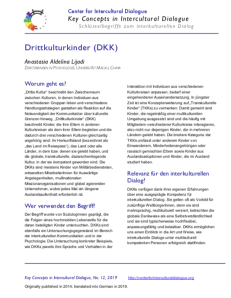
Key Concepts in ICDContinuing translations of Key Concepts in Intercultural Dialogue, today I am posting KC#12: Third Culture Kids, which Anastasia Lijadi published in English in 2014, and which Alina Timofte has now translated into German.

As always, all Key Concepts are available as free PDFs; just click on the thumbnail to download the PDF. Lists organized chronologically by publication date and numberalphabetically by concept in English, and by languages into which they have been translated, are available, as is a page of acknowledgments with the names of all authors, translators, and reviewers.

KC12 Third Culture Kids_GermanLijadi, A. A. (2019). Drittkulturkinder (DKK). (A. Timofte, trans.) Key Concepts in Intercultural Dialogue, 12. Available from:
https://centerforinterculturaldialogue.org/wp-content/uploads/2019/04/kc12-third-culture-kids_german-1.pdf

The Center for Intercultural Dialogue publishes a series of short briefs describing Key Concepts in Intercultural Dialogue. Different people, working in different countries and disciplines, use different vocabulary to describe their interests, yet these terms overlap. Our goal is to provide some of the assumptions and history attached to each concept for those unfamiliar with it. As there are other concepts you would like to see included, send an email to the series editor, Wendy Leeds-Hurwitz. If there are concepts you would like to prepare, provide a brief explanation of why you think the concept is central to the study of intercultural dialogue, and why you are the obvious person to write up that concept.


Creative Commons License
This work is licensed under a Creative Commons Attribution-NonCommercial-NoDerivatives 4.0 International License.

KU Leuven PHD Fellowship: Interactional Linguistics/CA (Belgium)

“Fellowships“
PhD Fellowship, Interactional Linguistics/Conversation Analysis, Katholieke Universiteit Leuven, Belgium. Deadline: 31 May 2019.

A new research project funded by the Research Foundation – Flanders (FWO) and the Swiss National Science Foundation (SNF) is looking for applicants for a fully funded four-year PhD fellowship in interactional linguistics/conversation analysis. The PhD fellowship is part of a larger collaborative project entitled “The first five words: Multilingual cities in Switzerland and Belgium and the grammar of language choice in public space”. The team heading the project is composed of Elwys De Stefani (KU Leuven) and Lorenza Mondada (University of Basel), as well as 4 PhD students. For the Flemish part of the project, the PhD fellows will be based at KU Leuven (Department of Linguistics).

This project studies how unacquainted persons spontaneously engage in interaction in multilingual cities in Belgium and Switzerland. The research will be based on video-recordings collected in various locations and address the following questions:

  • How can people engage in pro-social encounters without knowing in advance which language the other speaks? How do speakers decide, in the very first moments of the encounter, which language(s) they are going to use?

  • How do speakers orient to the multilingual setting in encounter openings? How do speakers align or disalign with a “basic code” proposed in the greeting?

  • Do urban public spaces represent “territories of multilingualism” in the speakers’ actual talk?

  • In public space, the beginning of an encounter emerges first of all through visible embodied behaviour; what is the relation between the organisation of visible embodied conduct and the politics of multilingualism?

The above questions are crucial for research on multilingualism, but also for contemporary societies in general. The project thus highlights the foundations of co-sociality, and the conditions for pro-social encounters between strangers (possibly speaking different languages).

CFP Interpersonal Communication and Social Interaction (Netherlands)

Conferences

Interpersonal Communication and Social Interaction section of ECREA, October 14-16, 2019, Tilburg, the Netherlands. Deadline: 9 June 2019.

ICSI Regional Conference is the 6th bi-annual meeting of the Interpersonal Communication and Social Interaction (ICSI) section of ECREA (European Communication Research and Education Association). This year’s conference is hosted by Tilburg University, Department of Communication and Cognition, and will be held in Tilburg, the Netherlands.

The conference theme this year is “Re-Connecting”. We want to connect scholars from the different sub-disciplines of interpersonal communication and social interaction, for example workplace interaction, communication in interpersonal relationship, impression management, interpersonal and health communication. Connecting our insights from different fields may inform our own research, provide creative ideas for future research, and help theory development. Moreover, the theme reflects the fact that our mediated and unmediated interactions are increasingly connected and integrated. As advanced communication technologies increasingly become part of our everyday experience, we are forced to revisit and connect theories of online and offline social interaction.

The ICSI Regional Conference 2019 provides an opportunity to share our ideas, theories and research about interpersonal communication and social interaction across our different specializations. We call for paper and panel proposals from any communication or communication-related discipline and methodology that address the section’s themes.

CID Video Competition: 2 1/2 Weeks to Submit!

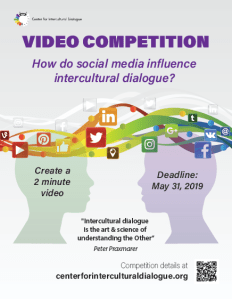
CID Video CompetitionThe CID video competition is open. The first few dozen entries have already been submitted and the first judges have agreed to serve. Just 2 1/2 weeks remain to the final deadline of May 31, 2019

CID Video Competition 2019

To enter, students must submit a video no longer than 2 minutes demonstrating their understanding of intercultural dialogue. Specifically, videos must answer the question: “How do social media influence intercultural dialogue?”

As you prepare your entry, remember to think about the 2 major topics and their relationship. Winning videos must take both of these into account, not merely describe one or the other.

1) Intercultural dialogue is the term for what happens when people from different cultural backgrounds attempt to understand one other’s assumptions. Culture is a general term that includes all sorts of learned behavioral patterns. Intercultural communication can be international, interracial, interethnic, or interfaith. Intercultural dialogue is deliberate, active rather than passive. It is NOT the same as cultural analysis (understanding one culture), or cross-cultural analysis (comparing two different cultures).

2) Social media refers to any tool using the internet to help people communicate, nearly always when they are not in the same place at the same time. It includes such applications as Facebook, Twitter, Instagram, WeChat, WhatsApp, and Tumblr, among others. You can limit your consideration to any one of these, or consider several. But don’t just describe social media and how they work! The question you must answer is how the social media you choose to address influence intercultural dialogue. That means, what changes when people of different cultural backgrounds try to understand one another when they are not even face-to-face? What gets harder? What becomes easier?

If you have questions, see previously published competition rules, FAQ, and resources. See last year’s winning videos. See the reflection by one winning team on creating their video. Or send an email with a question. When you’re ready to submit an entry, click here.

Wendy Leeds-Hurwitz, Director
Center for Intercultural Dialogue

Postdoc Lancaster U: Social Inequalities (UK)

PostdocsPostdoctoral Fellowship in Social Inequalities, Lancaster University, UK. Deadline: 17 May 2019.

Lancaster is searching for a postdoctoral fellow in sociology and/or media and cultural studies to assist Professor Beverley Skeggs in the development of a new research centre in the field of inequalities.

You will be able to demonstrate both outstanding research potential and experience in administration (building profile) and collaborative team working. You will be expected to pursue a high-profile research agenda, generate and support bids for external research funding and produce publications. You will also have an opportunity to supervise BA and MA dissertations, PhD theses and contribute to undergraduate and postgraduate modules (supported by existing staff and balanced with the context of other workload priorities).

Manchester Metropolitan U: Linguistics/Applied Linguistics (UK)

“JobProfessor of Linguistics or Applied Linguistics, Languages, Information & Communications, Manchester Metropolitan University, Manchester, UK. Deadline: 2 June 2019.

Providing inspiring academic leadership and research coordination to your colleagues not only in Linguistics and TESOL, but also across the wider department, you will make a strong contribution to the research culture, including at least one specialist areas: Applied Linguistics, Critical Discourse Analysis, Forensic Linguistics, Pragmatics, Sociolinguistics, and/or TESOL. You will bring a proven ability to generate significant external income through the submission of relevant bids, and ensure a steady pipeline of publications that achieve internationally excellent and world-class recognition. Holding a doctoral qualification or equivalent, you will be able to provide outstanding personal research and leadership whilst leading your team and managing projects involving academic institutions and other partners as well as community organisations.

You will also be able to demonstrate active involvement in relevant national and international networks. In particular, you will be familiar with presenting your work at conferences and symposia as well as within communal and creative spaces, and you will be experienced in supervising postgraduate student work through to doctoral completion. Naturally, your personal research will be at a high level of academic distinction, as recognised by the REF and elsewhere.

Lancaster U at Sunway: Dean (Malaysia)

“Job

Academic Dean, Lancaster University at Sunway, Kuala Lumpur, Malaysia. Deadline: 31 May 2019.

In 2006, Lancaster University established a strategic partnership with Sunway University in Subang Jaya, Kuala Lumpur, Malaysia. They are now seeking to appoint an Academic Dean who will play a substantial role in maintaining the high profile and reputation of the partnership in Malaysia and the broader South East Asia region. As Academic Dean, you will be the senior representative for Lancaster University at Sunway University. You will be expected to build on the successful partnership and advance activities along three major themes: teaching, research and engagement.

You will play a lead role in ensuring the quality of teaching, enhancing standards, promoting existing programmes and developing new opportunities across the academic portfolio of Lancaster/Sunway Dual Degree undergraduate and postgraduate programmes.  Current enrolments on these programmes exceed four thousand students. There will be a requirement for travel, both within Malaysia and overseas – such as to Lancaster – to strengthen the working relationship between partners and to attend student recruitment fairs.

Hong Kong Polytechnic: Applied Language Sciences (Hong Kong)

“JobAssistant Professor in Applied Language Sciences / Bilingualism and Communication / Chinese Linguistics / Translation and Interpreting (two posts), Department of Chinese and Bilingual Studies, The Hong Kong Polytechnic University. Deadline: 2 June 2019.

The Hong Kong Polytechnic University (PolyU) is a government-funded tertiary institution in Hong Kong.  It offers programmes at various levels including Doctorate, Master’s, and Bachelor’s degrees.

The appointees will be required to (a) engage in teaching and related learning activities at both undergraduate and postgraduate levels; (b) assume an important role in curriculum design and development; (c) undertake academic research in their areas of expertise, including but not limited to making applications for external research grants; (d) provide administrative support for academic development and departmental objectives, and play an active role in programme management; and (e) render professional service to the discipline and/or the community at large.

Professor in Applied Language Sciences / Bilingualism and Communication.  Deadline: 29 May 2019.

In addition to comparable duties as listed above, applicants for this position will also be expected to: (f) provide academic leadership in his/her areas of expertise; and (g) perform any other duties as assigned by the Head of Department or his/her delegates.

GESIS/EUROLAB Research Grants (Germany)

EUROLAB Grants to visit GESIS for an onsite research visit, Cologne or Mannheim, Germany. Deadline: May 26, 2019.

GESIS Leibnitz Institute for the Social Sciences offers two grant programs to the academic community: GESIS Grants and EUROLAB (European Data Laboratory for Comparative Social Research) Grants, for which applications are accepted twice a year. Applications for self-funded stays are accepted all year round. The Call for EUROLAB Grants is now open.

For further information on the application process, please see the Call for Applications. Individual researchers who want to work on data available at GESIS may apply for support for a period of one month from September to December 2019.