U Oxford PHD Studentship: Anthropology or Migration Studies (UK)

“Studentships“DPhil Studentship in Anthropology or Migration Studies, School of Anthropology and Museum Ethnography, University of Oxford. Deadline: January 22, 2021.

Applications are invited for a DPhil studentship in anthropology or migration studies. This studentship will be for a maximum duration of 3 years and include a stipend and research expenses of no less than £36,000 per annum (with additional support during the fieldwork year). Starting in October 2021 this studentship will be within the framework of the European Research Council project “Emptiness: Living Capitalism and Democracy After (Post)Socialism.” Funding from the European Research Council means that applicants of all nationalities are eligible for this project. If/when Brexit occurs, the project will be supported by the UK Government under identical rules.

The DPhil student will be part of a research team led by Dr Dace Dzenovska and hosted by the University of Oxford’s School of Anthropology and Museum Ethnography and the Centre on Migration, Policy, and Society. Under the supervision of Dr Dace Dzenovska, the student will be responsible for developing and carrying out their own original project in Ukraine, Belarus, or Russia (other locations within the former socialist world may be considered) within the overarching analytical and methodological frame of the project. The student will also undertake collaborative work with other team members. The project will study the emptying cities, towns, and villages in Eastern Europe and Russia through the lens of “emptiness” as a concrete historical formation that has emerged in conditions when socialist modernity is gone and promises of capitalist modernity have failed.
CFP Crisis, Conflict, and Cultural Relations in Media Environments

“PublicationCall for Papers: Crisis, Conflict, and Cultural Relations in Media Environments, to be edited by Ahmet Atay (Wooster) and Margaret D’Silva (Alabama, Tuscaloosa). Deadline for Abstract only: October 15, 2020.

In the wake of current cultural, social, and political happenings and due to the ongoing global COVID-19 related health crisis, the role of new media technologies is heightened. The current global pandemic created new cultural and political conflicts, presenting new issues, heightening some of the oppressive structures, and creating newer troubles for members of marginalized communities. As a result, people are turning to media technologies to escape reality, to find solutions, and to create new online communities to belong.

Digital communication connects residents of different countries in an invisible web of entanglement that creates a layered global identity beyond the confines of national borders. Our collective ideas of our past, our perceptions of the present, and projections for the future are influenced by our constantly changing information and communicative environment. This book takes a broad theoretical and applied perspective to describing conceptual links among conflict, crisis, and cultural relations in a mediated world.

This call invites abstracts for an edited book that takes qualitative, interpretive, and critical and cultural perspectives in examining the reciprocal relationship among new media, culture, and crisis in the context of communication.

Israel Institute for Advanced Studies Fellowships (Israel)

FellowshipsOpen Call for Individual Fellowships 2022-2023, Israel Institute for Advanced Studies (IIAS), University of Jerusalem, Jerusalem, Israel. Deadline: December 1, 2020.

IIAS invites scholars from Israel and abroad to submit proposals for an individual fellowship at the IIAS for the 2022-2023 academic year. Topics may cover any research area from any discipline and must seek to be innovative, with the potential to impact research in the field. The IIAS provides fellows with a nurturing and stimulating academic environment, as well as administrative support. Fellows from abroad receive a generous fellowship and subsidized accommodation.

Scholars may be from Israel or abroad and must have a tenured position with an academic research institution. This fellowship is not open for post-docs. The IIAS academic year runs from September 1 to June 30. Residencies are open for 10 months and 5 months.

There is also an Open Call for Research Groups 2022-2023.

U Basel Postdoc in Social Exclusion/Ostracism (Switzerland)

PostdocsPostdoctoral Researcher, Center for Social Psychology, Department of Psychology, University of Basel, Basel, Switzerland. Deadline: October 15, 2020.

The Center seeks to expand their research team in either of the two following two areas: 1) fluency research; 2) research on social exclusion/ostracism. You will be working in a highly motivated research team that combines experimental work with the use of representative survey data. This is a postdoctoral position for a period of two years with the possibility of extension by four more years. The salary is very attractive and additional resources are available for research and conference travel. Teaching can be in German or English and amounts to three courses per year. International applications are strongly encouraged.

KC49 Intersectionality Translated into Spanish

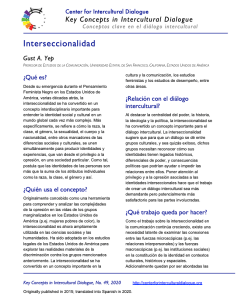
Key Concepts in ICDContinuing translations of Key Concepts in Intercultural Dialogue, today I am posting KC#49: Intersectionality, which Gust Yep published in English in 2015, and which Daniel Mateo Ordóñez has now translated into Spanish.

As always, all Key Concepts are available as free PDFs; just click on the thumbnail to download the PDF. Lists organized chronologically by publication date and numberalphabetically by concept in English, and by languages into which they have been translated, are available, as is a page of acknowledgments with the names of all authors, translators, and reviewers.

KC49 Intersectionality_Spanish

Yep, G. (2020). Interseccionalidad. (D. M. Ordóñez, trans.) Key Concepts in Intercultural Dialogue, 49. Available from:
https://centerforinterculturaldialogue.org/wp-content/uploads/2020/09/kc49-intersectionality_spanish.pdf

The Center for Intercultural Dialogue publishes a series of short briefs describing Key Concepts in Intercultural Dialogue. Different people, working in different countries and disciplines, use different vocabulary to describe their interests, yet these terms overlap. Our goal is to provide some of the assumptions and history attached to each concept for those unfamiliar with it. As there are other concepts you would like to see included, send an email to the series editor, Wendy Leeds-Hurwitz. If there are concepts you would like to prepare, provide a brief explanation of why you think the concept is central to the study of intercultural dialogue, and why you are the obvious person to write up that concept.


Creative Commons License
This work is licensed under a Creative Commons Attribution-NonCommercial-NoDerivatives 4.0 International License.

IMéRA Fellowships (France)

Fellowships

Call for applications: Fellowships, IMéRA Institute for Advanced Study at Aix-Marseille University, France. Deadline: 13 October 2020.

Each year IMéRA hosts about thirty scientists and artists from all disciplines (residents), selected after an evaluation procedure with the most stringent international standards, shortlisting of applications and external evaluators. IMéRA promotes innovative experimental interdisciplinary approaches in all areas of knowledge. Applications accepted in one of the following:

U Edinburgh Lecturer in Language Education (UK)

“Job

Lecturer in Language Education, Institute of Language Education, University of Edinburgh, Edinburgh, Scotland. Deadline: October 15, 2020.

Language Education is an innovative and dynamic emerging field in Moray House School of Education and Sport. They are looking to recruit a Lecturer with particular interest in promoting Language Education throughout the School in order to enhance a substantial team of transdisciplinary researchers and teachers, and to embed Language Education across a range of diverse programmes.

The Language Education Strategy sets out a vision for bringing together three key areas: languages(s); (pluri) literacies; and interculturality. Each of those areas embraces a wide portfolio of research that is informed by a critical framework, including pluriliteracies, first and second language learning and teaching (heritage, English, community, European and other languages); bi/multilingualism, English as an additional language; Content and Language Integrated Learning; Global Englishes, language policy and practice; student and teacher identity; Language Teacher Education; discourse; intercultural communication; TESOL; Applied Linguistics; technology enhanced learning; and internationalisation. The successful applicant will have academic experience at post-doctoral level in one or more of the above areas and will be expected to contribute to our highly successful Masters level teaching programmes, to the supervision of doctoral students, and to secure research grants through our Language Education Thematic Research Hub aligned with REF high quality research outputs.

The post will require a culturally sensitive vision that reflects a commitment to social justice and the provision of high quality student experience. The successful candidate will contribute to the wider work of the subject area and the School, regionally, nationally and internationally.

There is also a position for Senior Lecturer available, with the same deadline.

Intercultural Dialogue Platform Paid Internships (Belgium)

“Job2 Paid Internships: Social Media/Graphics, and Videography/Media, Intercultural Dialogue Platform, Brussels, Belgium. Deadline: 2 October 2020.

Intercultural Dialogue Platform is a Brussels based NGO founded in 2000, aiming at mutual understanding and harmonious interaction among the people of different cultural backgrounds. The organization carries out several international projects on promoting social inclusion, dialogue, civic engagement as well as preventing extremism, racism and discrimination.

U Jyväskylä Senior Lecturer in Communication (Finland)

“JobSenior Lecturer in Communication, Department of Languages and Communication Studies, University of Jyväskylä, Jyväskylä, Finland. Deadline: 2 October 2020.

There is also a position for Assistant or Associate Professor, with a deadline of November 4, 2020.

The Senior Lecturer’s position is allocated to the Department of Language and Communication Studies to the discipline of Communication. Communication is a popular, academic discipline, focusing on communication behaviour and dynamics of social interaction both in face-to-face and technology-mediated contexts. The key focus area in the discipline is interpersonal and group communication in working life. In teaching and research, interpersonal relationships in organisations, groups, teams and networks, technology-mediated and organisational communication, communication and well-being, persuasion and argumentation, communication competence as well as communication ethics are being examined.

Together with co-workers, the Senior Lecturer is responsible for teaching and research of communication. The Senior Lecturer is expected to conduct high-level teaching and scientific research in areas that support the teaching and research profile of the department. Expertise in interpersonal communication, communication in groups, teams and organisations, communication competence and communication development in organisations, as well as methodological competence in the area of communication is emphasized in the position. The duties of Senior Lecturer also include supervision of theses, planning new research projects and acquiring external research funding.

BCCIE Intercultural Dialogue Series (Webinars)

Intercultural Pedagogy

Intercultural Dialogue Series, British Columbia Council for International Education (BCCIE), British Columbia, Canada. Free Webinars 2020-21.

As part of their ongoing conversation around intercultural and international education, BCCIE will be hosting an inaugural fall and winter intercultural series, Intercultural Intersections in International Education: Reflective Practices through Dialogue, discussing intercultural issues facing the international education field today. Prior to attending these webinars, they ask that each participant takes time to review the Foundation Modules (120 minutes) to ensure everyone has a common foundation of intercultural understanding to build from, disrupt and, question.

Fall 2020: “Investigating the Self” (September – December).
Winter 2021: “Putting theory to practice” (January – May).

The first series will be held from 10:00–11:00 am on Sept 29, Oct 27, Nov 24, and Dec 15, as webinars, with recorded videos available on their website approximately one week after each event. September’s topic: A Conversation abut Intercultural and International Education’s Current and Future Direction.