CFP Crossing the Urban-Rural Border: Linguistic Landscapes in Asia & Oceania

“PublicationCall for Papers: Crossing the urban-rural border: Linguistic landscapes in Asia and Oceania, Special issue of Sociolinguistic Studies. Guest editors: guest editor, Xiaofang Yao (University of Melbourne) and Samantha Zhan Xu (University of Sydney). Deadline for abstracts: May 30,2021.

The study of linguistic landscape aims to understand the use of languages and other semiotic resources in the public space. As a new toolkit for sociolinguistics, linguistic landscape studies have focused on documenting multilingualism in urban centres and globalised cities. Although superdiverse city centres offer abundant multilingual and multimodal materials for analysis, this urban-centric focus in linguistic landscape research has been increasingly problematised by emerging studies of rural and remote communities.

Editors invite contributions from scholars which broadly address the theme of crossing the urban-rural border in linguistic landscapes, and are particularly interested in original research from the Asia-Oceania context which seeks to problematise the urban and rural divide in linguistic landscape studies. Also welcomed are comparative studies which explore rural, marginal or peripheral areas vis-à-vis urban areas. Diverse and innovative approaches beyond linguistic focus are strongly encouraged, such as multimodal, multi-semiotic, ethnographic perspectives and interdisciplinary approaches.

Webinar: Interculturalism and Anti-Racism in Cities

EventsInterculturalism and anti-racism in cities, Webinar, Intercultural Cities (ICC) and Laboratory for Research on Intercultural Relations (LABRRI) at the University of Montreal, 26 February 2021, at 9 a.m. (Canada; 3 p.m. CET), online.

In cities across the world, proponents of interculturalism (an approach focused on communication and positive interactions) and anti-racism (an approach more concerned with social and racial discrimination) have been active in the fight for justice and equality. While activists in these two fields clearly have shared goals, the two approaches are sometimes at odds with each in terms of the strategies that should be used to affect change. While it is often argued that the two approaches are complementary, there is also a tendency to subordinate one approach to the other, without asking fundamental questions about which approach is best suited to address a particular set of issues at a particular moment in time.

This webinar, which is aimed at people whose work involves trying to make cities more inclusive places, will address the tensions between interculturalism and anti-racism in an attempt to find ways in which the two can better support each other’s efforts in the global fight for economic equality and social justice.

Anastasia Karakitsou Interview

“Interviews”Anastasia Karakitsou was interviewed about the concept of xenophobia, on February 1, 2021, by Rehana Paul, CID intern.

In the interview, Anastasia addresses the following topics:

  • What is Xenophobia?
  • What is the role of intercultural dialogue in combatting xenophobia?
  • How are linguistics and xenophobia related?
  • Tell us more about critically thinking about and resisting the status quo.
  • How does xenophobia have an impact on issues such as migration?

For further information, see her one-page summary:

Karakitsou, A. (2017). Xenophobia. Key Concepts in Intercultural Dialogue, 89. 

or this brief elaboration:

Karakitsou, A. (2018). Guest post: Xenophobia vs. intercultural dialogue. Center for Intercultural Dialogue.


OECD: Education Policy Analysts (France)

“JobEducation Policy Analysts, (several positions), Policy Advice and Implementation Division (PAI) of the Directorate of Education and Skills (EDU), of the Organization for Education, Co-operation and Development (OECD), Paris, France. Deadline: 28 February 2021.

EDU/PAI is looking for one or more Policy Analyst(s) to support its work providing education policy analysis and advice to countries both within and beyond the OECD. One of the analysts will contribute to a new project researching and analysing policies related to student transitions into, through and out of upper secondary general and vocational education. Other positions as a Policy Analyst may be available in the Division to work on other school education policy areas. Responsibilities include policy analysis and research; assisting countries with the development and implementation of education policy; organizing workshops to familiarize countries with OECD data and research; preparing reports and other publications; organizing policy dialogue and peer learning activities; effectively communicating policy findings; and contributing to EDU’s and PAI’s overall work objectives.

NOTE: There are also several positions for Junior Policy Analysts to support its education policy advice and implementation support work with countries both within and beyond OECD. One of the Policy Analysts will contribute to the OECD’s Strength through Diversity project. The project aims to provide analysis and policy advice to help governments and schools address diversity to achieve more equitable and inclusive education system. Other positions as a Junior Policy Analyst may be available in the Division to work on school education policy issues more generally, with countries both within and beyond OECD.

Duolingo Language Report 2020

Applied ICD

The 2020 Duolingo Language Report, issued December 15, 2020, includes trends, patterns, and analyses about language learning around the world.

The report includes 500 million learners in all 194 countries, and 39 different languages. It describes how interest in learning different languages has changed over time, especially in response to the global pandemic. It is a fascinating window on language learning across the globe and, of course, language learning is  important part of intercultural dialogue.

The major findings include:

KC68 Social Justice Translated into Spanish

Key Concepts in ICDContinuing translations of Key Concepts in Intercultural Dialogue, today I am posting KC#68: Social Justice, which Kathryn Sorrells wrote for publication in English in 2015, and which  Jhon Eduardo Mosquera Pérez has now translated into Spanish.

As always, all Key Concepts are available as free PDFs; just click on the thumbnail to download. Lists of Key Concepts organized alphabetically by conceptchronologically by publication date and number, and by languages into which they have been translated, are available, as is a page of acknowledgments with the names of all authors, translators, and reviewers.

KC68 Social Justice_SpanishSorrells, K. (2021). Justicia social. (J. E. Mosquera Pérez, Trans.). Key Concepts in Intercultural Dialogue, 68. Available from: https://centerforinterculturaldialogue.org/wp-content/uploads/2021/02/kc68-social-justice_spanish.pdf

If you are interested in translating one of the Key Concepts, please contact me for approval first because dozens are currently in process. As always, if there is a concept you think should be written up as one of the Key Concepts, whether in English or any other language, propose it. If you are new to CID, please provide a brief resume. This opportunity is open to masters students and above, on the assumption that some familiarity with academic conventions generally, and discussion of intercultural dialogue specifically, are useful.

Wendy Leeds-Hurwitz, Director
Center for Intercultural Dialogue


Creative Commons License
This work is licensed under a Creative Commons Attribution-NonCommercial-NoDerivatives 4.0 International License.

CFP Casing Conflict Communication

“PublicationCall for book chapter proposals: Casing Conflict Communication, to be edited by Andrea Meluch and Heather Walter. Deadline for abstracts: March 19, 2021.

Drs. Andrea Meluch and Heather Walter are seeking proposals for the forthcoming case study book, Casing Conflict Communication, to be published by Kendall Hunt in Spring 2022. The book will consist of a collection of approximately 25 case studies focusing on conflict communication across a variety of contexts. Each case study will include a brief introduction highlighting a conflict communication theory/concept (e.g., face-negotiation and politeness theory, conflict management styles, structurational divergence, game theory, verbal aggression theory, power, social identity theory) explored in the case study, a case study illustrating conflict, and a list of 5-7 discussion questions. Case studies can be based on empirical research on conflict, hypothetical events created to illustrate a conflict episode, and/or personal/professional experiences with conflict.

The volume will examine the breadth of research on conflict and communication. Potential topics for case studies include:

  • Intrapersonal Conflict (e.g., emotions, attributions, conscience)
  • Interpersonal Conflict (e.g., conflict in families or romantic relationships, forgiveness in interpersonal relationships)
  • Conflict in Computer-Mediated Contexts (e.g., flaming, trolling)
  • Organizational Conflict (e.g., superior-subordinate conflict, workgroup conflict, workplace bullying, work-life conflict, role conflict, conflict negotiation in the workplace, conflict mediation)
  • Conflict in Community Contexts, (e.g., conflict and the environment, political conflict/divisiveness, interracial conflict, conflict and intercultural communication)

If you are interested in having your case study considered for this edited volume, please submit an abstract of no more than 250 words explaining the focus of your case study and its relationship to conflict communication theories/concepts. With your abstract please also include your contact information (name, affiliation, title, email address) and a brief (50 word) biographical sketch for all authors.

Abstracts should be submitted via email to Meluch no later than March 19, 2021. Chapter proposals will be reviewed by the editors and selected contributors will be notified of acceptance by May 1. First drafts of the chapters will be due on July 1. Final manuscripts should be 3500-4000 words.

Live and Learn Podcasts

PodcastsLive and Learn Podcasts, by Inna Koblents and Yuliya Shtaltovna. Weekly conversations about living, learning, teaching, and intercultural communication.

Live and Learn PodcastPassionate teachers and learners, Inna Koblents and Yuliya Shtaltovna talk about how they live and learn, encourage and teach, move countries, adapt to change and mentalities, motivate and let live.

They are inviting members of the CID community to listen to their podcasts, across any of 9 podcast platforms.


They recommend starting with 11 top-episodes on Intercultural Communication and Competence. Podcast titles include:

  • On building up cultural awareness
  • On how to hack a language
  • On teachers’ well-being and intercultural networking
  • Moving countries and cultures

CID Report for UNESCO Futures of Education

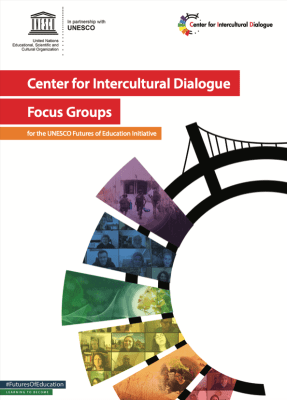
“UNESCO”UNESCO invited CID to host focus groups as part of the Futures of Education Initiative. Three focus groups held discussions in January. The report has now been completed, and submitted to UNESCO.

We are delighted that UNESCO invited our participation, and hopeful that they will incorporate our recommendations into their final conclusions. A copy of the report may be had by clicking on the image below.

CID Focus Groups report for UNESCO

Thanks to Linda de Wit, former CID intern and skilled graphic designer, for taking on the project of turning the written report into a polished final document. Thanks to Nazan Haydari, Advisory Board member, for moderating one of the focus groups, and managing the technology for all of them. Thanks to all of the participants, who are named in the report, for their ideas, their time, and their energy for this project.

Wendy Leeds-Hurwitz
Director, Center for Intercultural Dialogue
intercult.dialogue AT gmail.com


Creative Commons License
This work is licensed under a Creative Commons Attribution-NonCommercial-NoDerivatives 4.0 International License.

U Sheffield: Research Associate (UK)

“Job

Research Associate Covid-19 PPE for Refugees, Sheffield Institute for International Development, University of Sheffield, Sheffield, UK. Deadline: 19 February 2021.

Sheffield Institute for International Development has a position for a Social Science researcher in Sheffield Institute for International Development (SIID). They are looking for someone with a passion for crafting positive change through using your skills in quantitative and qualitative Social Science methodologies. The successful candidate will be part of an interdisciplinary team that is passionate about improving the lives and livelihood opportunities for refugees and marginalised communities. The project seeks to do this through the lens of Covid-19 personal protective equipment (PPE).

You’ll work alongside scientists and engineers, social scientists and arts practitioners, trainers and development workers to improve the quality and access to Covid-19 PPE for the vulnerable groups that they support. The team will be working with research and development organisations in Jordan to use available resources to develop context specific PPE for Covid-19 and to understand how its availability influences people’s behaviour. Participants will work remotely where possible so you will be working primarily from home, and integrate into and support a multi-national, multicultural team while having the ability to work independently and with only intermittent guidance.