NYU: Visiting Scholars, Asian/Pacific/American Institute (USA)

Professional Opportunities

Visiting Scholars, Asian/Pacific/American Institute, New York University. New York, USA. Deadline: 16 August 2021.


The A/P/A Institute at NYU Visiting Scholar Program extends specified courtesy titles and privileges to scholars of distinction who visit the Asian/Pacific/American Institute at New York University in order to engage in research and scholarship, and in general scholarly and cultural interaction with New York University’s faculty and students. The courtesy title may not be granted for the purpose of providing free courses or other privileges to graduate or post-graduate students, or for the sole purpose of providing library privileges. Visiting Scholars are considered guests of the University and the A/P/A Institute who may visit for a temporary period of up to one year (2021-22, renewable). The title Visiting Scholar may be granted to scholars who hold academic appointments elsewhere, to those who have no academic affiliation, or to younger scholars who are sufficiently proficient in their disciplines to be accepted as colleagues by the University’s faculty, but who have yet to obtain academic appointments.

NOTE: There are also other programs of potential interest at A/P/A.

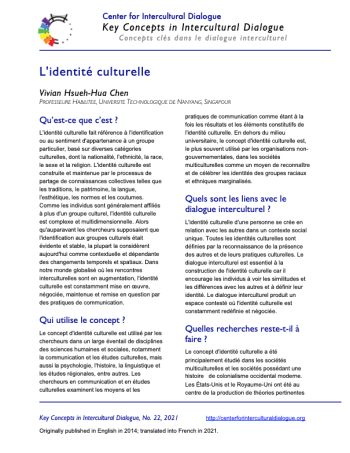
KC22 Cultural Identity Translated into French

Key Concepts in ICDContinuing translations of Key Concepts in Intercultural Dialogue, today I am posting KC#22: Cultural Identity, which Vivian Hsueh-Hua Chen wrote in English in 2014, and which Mohammed Guamguami has now translated into French.

As always, all Key Concepts are available as free PDFs; just click on the thumbnail to download the PDF. Lists organized chronologically by publication date and numberalphabetically by concept in English, and by languages into which they have been translated, are available, as is a page of acknowledgments with the names of all authors, translators, and reviewers.

KC22 Cultural identity_FrenchChen, V. H.-H. (2019). L’identité culturelle. (M. Guamguami, trans.) Key Concepts in Intercultural Dialogue, 22. Available from: https://centerforinterculturaldialogue.org/wp-content/uploads/2021/06/kc22-cultural-identity_french.pdf

The Center for Intercultural Dialogue publishes a series of short briefs describing Key Concepts in Intercultural Dialogue. Different people, working in different countries and disciplines, use different vocabulary to describe their interests, yet these terms overlap. Our goal is to provide some of the assumptions and history attached to each concept for those unfamiliar with it. As there are other concepts you would like to see included, send an email to the series editor, Wendy Leeds-Hurwitz. If there are concepts you would like to prepare, provide a brief explanation of why you think the concept is central to the study of intercultural dialogue, and why you are the obvious person to write up that concept.


Creative Commons License
This work is licensed under a Creative Commons Attribution-NonCommercial-NoDerivatives 4.0 International License.

Hala Asmina Guta Profile

Profiles

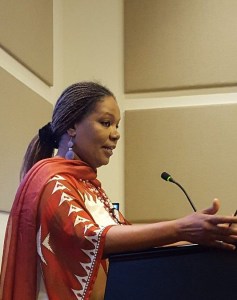
Hala Asmina Guta is Associate Professor of Mass Communication at Qatar University, Doha, Qatar.


Hala Guta

She holds a PhD in Mass Communication from Ohio University, USA. Prior to Qatar University, she taught at Ohio University and in Saudi Arabia. Her research interests include global and transnational communication, gendered communication, communication for social change; and the intersection of communication, culture, and identity. Her publications and conference presentations include papers on the role of culture in communication, communication role in peace building in societies emerging from conflict, and the role media and other cultural institutions play in social change and the construction of identity.

Selected Publications:

Guta, H. (2020). Periphery of the peripheries: Women in Al Jazeera Arabic news. Journal of Applied Journalism and Media Studies. DOI: https://doi.org/10.1386/ajms_00032_1

Guta, H. (2020).  Sectarian politics online: Bahrain and Saudi Arabia. In M. Karolak & N. Allam (Eds.), Gulf Cooperation Council culture and identities in the new millennium: Resilience, transformation, (re)creation and diffusion (pp. 33-52). Singapore: Palgrave Macmillan.

Guta, H. (2019).  Al Jazeera: Non-violence and peace journalism. In H. Sadig (Ed.), Al Jazeera in the Gulf and the World: Is it redefining global communication ethics? (pp. 191-220). Singapore: Palgrave Macmillan.

Guta, H., & Karolak, M. (2015). Veiling and blogging: Social media as sites of identity negotiation and expression among Saudi women. Journal of International Women’s Studies, 16(2), 115-127.

Karolak, M., & Guta, H. (2015). Intercultural communication in the context of Saudi Arab tertiary education. In R. Raddawi (Ed.), Intercultural communication with Arabs: Studies in educational, professional and societal contexts (pp.41-56). New York: Springer.

Guta, H. (2010). Mass media and peace-building in Sudan. In C. Nwokeafor & K. Langmia (Eds.), Media and technology in emerging African democracies (pp. 155-176). Lanham, MD: University Press of America.

Guta, H. (2009). The politicization of the education system: Implications for peace in Sudan. Africa Media Review, 17(1&2), 77-94.


Work for CID:
Hala Asmina Guta has served as a reviewer for Arabic.

UNESCO: Director for Communication and Information Strategy & Policy (France)

“Job

Director for Communication and Information Strategy & Policy. UNESCO, Paris, France. Deadline: 13 September, 2021 (extended).

Under the direct supervision of the Assistant Director-General for Communication and Information, the incumbent is responsible for providing intellectual and strategic leadership and vision to support UNESCO’s global mandate in the various fields of communication and information, including freedom of expression and the safety of journalists, universal access to information, media development and media and information literacy, innovation and digital transformations, and documentary heritage. In collaboration with UNESCO’s worldwide network of field offices, the incumbent will inform the development of UNESCO’s activities and initiatives, including by providing policy analysis and advice, to better meet the challenges and seize the opportunities of the 2030 Agenda for Sustainable Development.  This role does not include responsibility for UNESCO’s wider external communications, which is managed by the Department of Public Information.

Durham U: Community Liaison Lead in Race and Ethnicity (UK)

“Job

Community Liaison Lead in Race and Ethnicity. Durham University, Durham, UK . Deadline: 3 August, 2021.

Durham University is seeking a Community Liaison Lead in Race and Ethnicity for its Community, Participation and Engagement Services. The incumbent will be a recognized service specialist in handling matters related to race and ethnicity related community relations, engagement and liaison; implement changes to enhance the design and development of existing service processes, techniques and deliverables in the area of race and ethnicity related community relations, to extend and develop links with external agencies; provide specialist expertise and support with data and information sources, interpretation and analysis relevant to trends in race and ethnicity related community issues; etc. This is a part-time appointment on a two-year fixed-term.

Fellowships: Forced Migration & Refugee Studies 2021-22 (Germany)

FellowshipsForced Migration and Refugee Studies: Networking and Knowledge Transfer Fellowships (2021-2022), Germany. Deadline: First-round notice to successful applicants: early August 2021.

The cooperation project “Forced Migration and Refugee Studies: Networking and Knowledge Transfer” (FFVT) aims to strengthen interdisciplinary forced migration and refugee research in Germany. It is jointly run by the Bonn International Center for Conversion, the Centre for Human Rights Erlangen-Nürnberg (University of Erlangen Nuremberg), the German Development Institute (Bonn) and the Institute for Migration Research and Intercultural Studies (University of Osnabrück) and funded by the German Federal Ministry of Education and Research. FFVT fellowships are granted to researchers or academics from abroad or with a refugee background working in the field of forced migration and refugee studies to support guest stays at (mainly) one of the collaborative partners of FFVT.  Fellowship allowances include a monthly scholarship and travel costs for 2–6 months between October 1, 2021 and December 31, 2022.

CFP Language Conflict in Educational Settings

“PublicationCall for Chapters: The Impacts of Language Conflict in Educational Settings. Editors: Yliana V. Rodríguez & Adolfo Elizaincín. Deadline for expressions of interest only: August 1, 2021.

One of the many intriguing aspects of contact linguistics is conflict. Although language conflict between ethnic groups is sometimes wrongly perceived as political, economic or sociological in nature, it actually tends to result from language contact. Such conflicts negatively impact educational settings. How education can be used to settle language conflict has been documented to some extent. However, how language conflict interferes in the educational spheres has received much less attention.

For this purpose, the co-editors seek manuscripts looking into conflict linguistics in educational settings. Specifically, they are interested in manuscripts that address one or more of the framing questions listed in the call itself. Researchers interested in contributing to the volume are invited to submit chapter summaries of up to 1000 words for a chapter of 7000-9000 words. The summary should include your research question(s), theoretical and methodological frameworks, findings, and implications for future research.

CFP In Other Words: Otherness

“PublicationCall for proposals: In Other Words (IOW), an online dictionary of contextualized keywords that focuses on how words (re)produce different forms of Otherness.

There is a recent increase of online dictionaries. So, what is IOW’s specificity?

  • The first is precisely its focus: how does a specific word, in a specific context, (re)produce Otherness? And how can discriminating narratives be contested, destablized, subverted?
  • The second is its structure: the discussion of the keywords is highly interdisciplinary, critical, and creative, using different elements from different fields – visual arts, literature, videos, media texts, etc.
  • The third is its addresses: the dictionary does not speak to academics only, but it is a resource to be used for free to favor discussions and appropriations in/by different educational and social contexts.
  • The fourth is its co-construction: it is a collaborative, ongoing project that welcomes the participation of scholars, teachers, practitioners, professionals, educators, activists, artists, individuals from different various fields, formations and experiences.

We invite you to have a tour of IOW dictionary. Submissions are welcome and peer-reviewed year round. For further info, please contact the Editorial Board. Looking forward to receiving your proposals!

Paola Giorgis for IOW Editorial Board

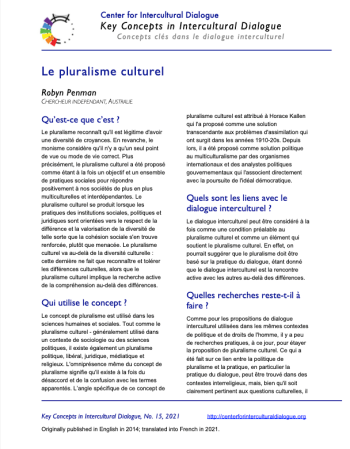
KC15 Cultural Pluralism Translated into French

Key Concepts in ICDContinuing translations of Key Concepts in Intercultural Dialogue, today I am posting KC#15: Cultural Pluralism, which which Robyn Penman wrote in English for publication in 2014, and  which Mohammed Guamguami has now translated into French.

As always, all Key Concepts are available as free PDFs; just click on the thumbnail to download. Lists of Key Concepts organized alphabetically by conceptchronologically by publication date and number, and by languages into which they have been translated, are available, as is a page of acknowledgments with the names of all authors, translators, and reviewers.

KC15 Cultural pluralism_FrenchPenman, R. (2021). Le pluralisme culturel. (M. Guamguami, trans). Key Concepts in Intercultural Dialogue, 15. Available from: https://centerforinterculturaldialogue.org/wp-content/uploads/2021/06/kc15-cultural-pluralism_french.pdf

If you are interested in translating one of the Key Concepts, please contact me for approval first because dozens are currently in process. As always, if there is a concept you think should be written up as one of the Key Concepts, whether in English or any other language, propose it. If you are new to CID, please provide a brief resume. This opportunity is open to masters students and above, on the assumption that some familiarity with academic conventions generally, and discussion of intercultural dialogue specifically, are useful.

Wendy Leeds-Hurwitz, Director
Center for Intercultural Dialogue


Creative Commons License
This work is licensed under a Creative Commons Attribution-NonCommercial-NoDerivatives 4.0 International License.

Constance Mbassi Manga Profile

ProfilesConstance Mbassi Manga earned her Ph.D. from Lancaster University, UK, and wrote her thesis on Camfranglais in use by diasporic Cameroonians living in Western cities, from a sociolinguistic and ethnographic perspective.

Constance Mbassi Manga
Photo credit: Ewane Nja Kwa

A French native of Cameroonian origin, she was raised multilingual and has been working in the field of language for 30+ years, in various capacities (from working as a freelance translator and interpreter, then heading her own translation agency, and later as a Team Lead/an Account Director in Marketing Communications). Moreover, she spent her childhood in a highly multilingual country (Cameroon, where over 250 languages are spoken), speaking 4 languages (2 African languages, English, French) from birth, learning a 5th (German) from the age of 10. She has always been fascinated by language practices and by the unique and powerful link that people draw between the language(s) they speak and who they are.

In terms of academic study, she was introduced to the study of multilingualism and sociolinguistics during her Masters at Kings College London; her Masters thesis focused on ‘Language Practices of Francophone Cameroonians in London.’ Since that time, she has been interested in language practices of non-European background adults in diasporic contexts, and how these tie in with ideologies of language, home and ‘belonging’.

Selected Publications:

Mbassi Manga, C. (2025). Language, home and belonging in migratory contexts: The case of Camfranglais. London: Routledge. (To be published June 10th, 2025)

Mbassi Manga, C. (2019). A case study of Camfranglais in superdiverse contexts: France, the UK and the USA. In R. Siebetcheu & S. Machetti (Eds.), Le camfranglais dans le monde global Contextes migratoires et perspectives sociolinguistiques (175-191). Paris, France: L’Harmattan.


Work for CID:
Constance Mbassi Manga is the author of KC108: Superdiversity, has translated that into French, translated KC23: Afrocentricity into French, and also has served as a reviewer for French.