
Key Concept #63: Interkulturelle Philosophie Translated into Marathi

Key Concepts in ICDContinuing translations of Key Concepts in Intercultural Dialogue, today I am posting KC#63: Interkulturelle Philosophie, originally written by Monika Kirloskar-Steinbach for publication in English in 2015, has now been translated into Marathi by Pradeep Prabhakar Gokhale.

As always, all Key Concepts are available as free PDFs; just click on the thumbnail to download. Lists of Key Concepts organized chronologically by publication date and number, alphabetically by concept, and by languages into which they have been translated, are available, as is a page of acknowledgments with the names of all authors, translators, and reviewers.

KC63 Interkulturelle Philosophie_MarathiKirloskar-Steinbach, M. (2016). Interkulturelle philosophie [Marathi]. Key Concepts in Intercultural Dialogue, 63. (P. P. Gokhale, trans.). Available from:
https://centerforinterculturaldialogue.org/wp-content/uploads/2016/08/kc63-interkulturelle-philosophie_marathi1.pdf

If you are interested in translating one of the Key Concepts, please contact me for approval first because dozens are currently in process. As always, if there is a concept you think should be written up as one of the Key Concepts, whether in English or any other language, propose it. If you are new to CID, please provide a brief resume. This opportunity is open to masters students and above, on the assumption that some familiarity with academic conventions generally, and discussion of intercultural dialogue specifically, are useful.

Wendy Leeds-Hurwitz, Director
Center for Intercultural Dialogue


Creative Commons License
This work is licensed under a Creative Commons Attribution-NonCommercial-NoDerivatives 4.0 International License.

Key Concept #72: Intertextuality Translated into French

Key Concepts in ICDContinuing translations of Key Concepts in Intercultural Dialogue, today I am posting KC#72: Intertextuality, originally written by Michele Koven for publication in English in 2015, which she has now translated into French. This is the first concept to be published in French, but several others are in process.

As always, all Key Concepts are available as free PDFs; just click on the thumbnail to download. Lists of Key Concepts organized chronologically by publication date and number, alphabetically by concept, and by languages into which they have been translated, are available, as is a page of acknowledgments with the names of all authors, translators, and reviewers.

KC72 Intertextuality_French_v2Koven, M. (2016). Intertextualité. Key Concepts in Intercultural Dialogue, 72. Available from:
https://centerforinterculturaldialogue.org/wp-content/uploads/2021/05/kc72-intertextuality_french_v2.pdf

If you are interested in translating one of the Key Concepts, please contact me for approval first because dozens are currently in process. As always, if there is a concept you think should be written up as one of the Key Concepts, whether in English or any other language, propose it. If you are new to CID, please provide a brief resume. This opportunity is open to masters students and above, on the assumption that some familiarity with academic conventions generally, and discussion of intercultural dialogue specifically, are useful.

Wendy Leeds-Hurwitz, Director
Center for Intercultural Dialogue


Creative Commons License
This work is licensed under a Creative Commons Attribution-NonCommercial-NoDerivatives 4.0 International License.
Key Concept #3: Intercultural Competence Translated into Arabic

Key Concepts in ICDContinuing translations of Key Concepts in Intercultural Dialogue, today I am posting KC3: Intercultural Competence, which Lily Arasaratnam wrote in English in 2014, now translated into Arabic by Fahd Alalwi, of the Prince Sattam Bin Abdulaziz University, in Saudi Arabia.

As always, all Key Concepts are available as free PDFs; just click on the thumbnail of the translation to read it. Lists of Key Concepts organized chronologically by publication date and number, alphabetically by concept, and by languages into which they have been translated, are available, as is a page of acknowledgments with the names of all authors, translators, and reviewers.

KC3 Intercultural Competence_Arabic-v2Arasaratnam, L. (2016). Intercultural competence [Arabic]. Key Concepts in Intercultural Dialogue, 3.  (F. Alalwi, Trans.). Available from:
https://centerforinterculturaldialogue.org/wp-content/uploads/2021/07/kc3-intercultural-competence_arabic-v2.pdf

If you are interested in translating one of the Key Concepts, please contact me for approval first because dozens are currently in process. As always, if there is a concept you think should be written up as one of the Key Concepts, whether in English or any other language, propose it. If you are new to CID, please provide a brief resume. This opportunity is open to masters students and above, on the assumption that some familiarity with academic conventions generally, and discussion of intercultural dialogue specifically, are useful.

Wendy Leeds-Hurwitz, Director
Center for Intercultural Dialogue


Creative Commons License
This work is licensed under a Creative Commons Attribution-NonCommercial-NoDerivatives 4.0 International License.
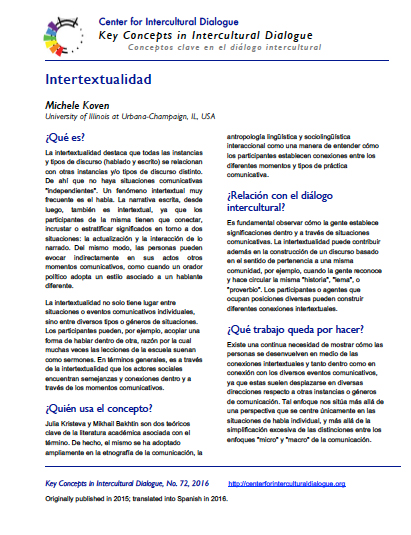
Key Concept #72: Intertextuality Translated into Spanish

Key Concepts in ICDContinuing translations of Key Concepts in Intercultural Dialogue, today I am posting KC#72: Intertextuality, originally written by Michele Koven for publication in English in 2015, now translated into Spanish by Miguel Ángel Guerrero Ramos.

As always, all Key Concepts are available as free PDFs; just click on the thumbnail to download. Lists of Key Concepts organized chronologically by publication date and number, alphabetically by concept, and by languages into which they have been translated, are available, as is a page of acknowledgments with the names of all authors, translators, and reviewers.

KC72 Intertextuality_SpanishKoven, M. (2016). Intertextualidad. Key Concepts in Intercultural Dialogue, 72 (M. A. Guerrero Ramos, Trans.) Available from:
https://centerforinterculturaldialogue.org/wp-content/uploads/2016/08/kc72-intertextuality_spanish.pdf

If you are interested in translating one of the Key Concepts, please contact me for approval first because dozens are currently in process. As always, if there is a concept you think should be written up as one of the Key Concepts, whether in English or any other language, propose it. If you are new to CID, please provide a brief resume. This opportunity is open to masters students and above, on the assumption that some familiarity with academic conventions generally, and discussion of intercultural dialogue specifically, are useful.

Wendy Leeds-Hurwitz, Director
Center for Intercultural Dialogue


Creative Commons License
This work is licensed under a Creative Commons Attribution-NonCommercial-NoDerivatives 4.0 International License.
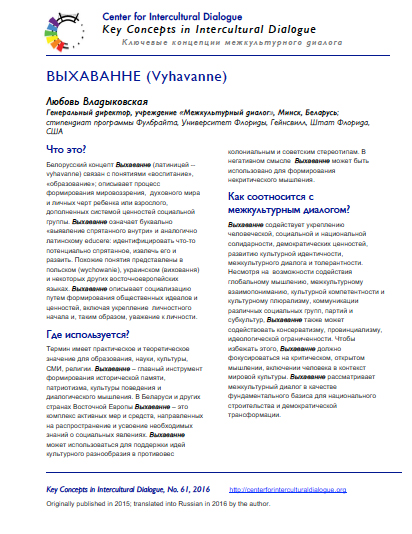
Key Concept #61: Vyhavanne Translated into Russian

Key Concepts in ICDContinuing translations of Key Concepts in Intercultural Dialogue, today I am posting KC61: Vyhavanne, a Belarusian concept originally published in English by Liubou Uladykouskaja in 2015, which she has now translated into Russian.

As always, all Key Concepts are available as free PDFs; just click on the thumbnail of the translation to read it. Lists of Key Concepts organized chronologically by publication date and number, alphabetically by concept, and by languages into which they have been translated, are available, as is a page of acknowledgments with the names of all authors, translators, and reviewers.

KC61 Vyhavanne_RussianUladykouskaja, L. (2016). ВЫХАВАННЕ. Key Concepts in Intercultural Dialogue, 61. Available from:
https://centerforinterculturaldialogue.org/wp-content/uploads/2016/08/kc61-d0b2d18bd185d0b0d0b2d0b0d0bdd0bdd0b5_russian.pdf

If you are interested in translating one of the Key Concepts, please contact me for approval first because dozens are currently in process. As always, if there is a concept you think should be written up as one of the Key Concepts, whether in English or any other language, propose it. If you are new to CID, please provide a brief resume. This opportunity is open to masters students and above, on the assumption that some familiarity with academic conventions generally, and discussion of intercultural dialogue specifically, are useful.

Wendy Leeds-Hurwitz, Director
Center for Intercultural Dialogue


Creative Commons License
This work is licensed under a Creative Commons Attribution-NonCommercial-NoDerivatives 4.0 International License.
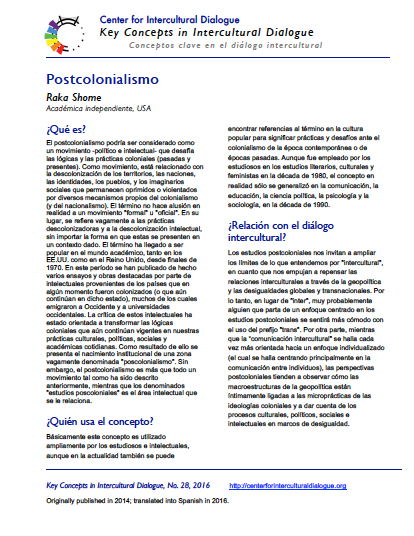
Key Concept #28: Postcolonialism Translated into Spanish

Key Concepts in ICDContinuing translations of Key Concepts in Intercultural Dialogue, today I am posting
KC#28: Postcolonialism, originally written by Raka Shome for publication in English in 2014, now translated into Spanish by Miguel Ángel Guerrero Ramos.

As always, all Key Concepts are available as free PDFs; just click on the thumbnail to download. Lists of Key Concepts organized chronologically by publication date and number, alphabetically by concept, and by languages into which they have been translated, are available, as is a page of acknowledgments with the names of all authors, translators, and reviewers.

KC28 Postcolonialism_SpanishShome, R. (2016). Postcolonialismo. Key Concepts in Intercultural Dialogue, 28 (M. A. Guerrero Ramos, Trans.) Available from:
https://centerforinterculturaldialogue.org/wp-content/uploads/2016/08/kc28-postcolonialism_spanish.pdf

If you are interested in translating one of the Key Concepts, please contact me for approval first because dozens are currently in process. As always, if there is a concept you think should be written up as one of the Key Concepts, whether in English or any other language, propose it. If you are new to CID, please provide a brief resume. This opportunity is open to masters students and above, on the assumption that some familiarity with academic conventions generally, and discussion of intercultural dialogue specifically, are useful.

Wendy Leeds-Hurwitz, Director
Center for Intercultural Dialogue


Creative Commons License
This work is licensed under a Creative Commons Attribution-NonCommercial-NoDerivatives 4.0 International License.
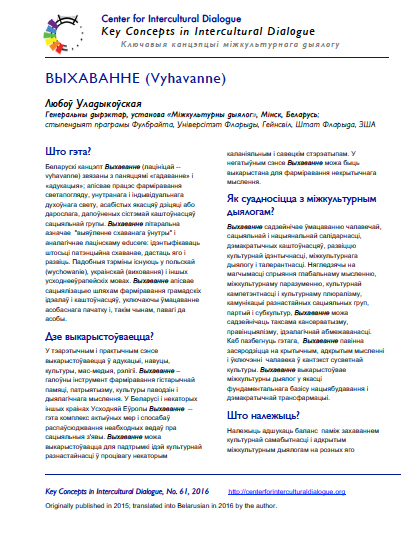
Key Concept #61: Vyhavanne Translated into Belarusian

Key Concepts in ICDContinuing translations of Key Concepts in Intercultural Dialogue, today I am posting KC61: Vyhavanne, a Belarusian concept originally discussed in English by Liubou Uladykouskaja in 2015, which she has now translated into Belarusian.

As always, all Key Concepts are available as free PDFs; just click on the thumbnail of the translation to read it. Lists of Key Concepts organized chronologically by publication date and number, alphabetically by concept, and by languages into which they have been translated, are available, as is a page of acknowledgments with the names of all authors, translators, and reviewers.

KC61 BblXABAHHE_BelarusianUladykouskaja, L.(2016). Выхаванне. Key Concepts in Intercultural Dialogue, 61. Available from:
https://centerforinterculturaldialogue.org/wp-content/uploads/2016/07/kc61-d0b2d18bd185d0b0d0b2d0b0d0bdd0bdd0b5_belarusian.pdf

If you are interested in translating one of the Key Concepts, please contact me for approval first because dozens are currently in process. As always, if there is a concept you think should be written up as one of the Key Concepts, whether in English or any other language, propose it. If you are new to CID, please provide a brief resume. This opportunity is open to masters students and above, on the assumption that some familiarity with academic conventions generally, and discussion of intercultural dialogue specifically, are useful.

Wendy Leeds-Hurwitz, Director
Center for Intercultural Dialogue


Creative Commons License
This work is licensed under a Creative Commons Attribution-NonCommercial-NoDerivatives 4.0 International License.
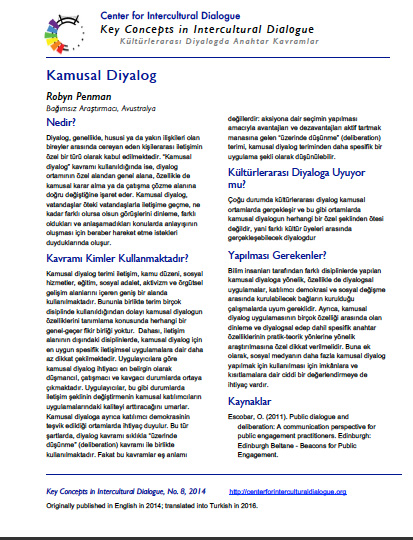
Key Concept #8 Public Dialogue Translated into Turkish

Key Concepts in ICDContinuing translations of Key Concepts in Intercultural Dialogue, today I am posting KC8: Public Dialogue, which Robyn Penman wrote in English in 2014, now translated into Turkish by Kenan Çetinkaya.

As always, all Key Concepts are available as free PDFs; just click on the thumbnail of the translation to read it. Lists of Key Concepts organized chronologically by publication date and number, alphabetically by concept, and by languages into which they have been translated, are available, as is a page of acknowledgments with the names of all authors, translators, and reviewers.

KC8 Public Dialogue_TurkishPenman, R. (2016). Kamusal Diyalog. Key Concepts in Intercultural Dialogue, 8. (K. Çetinkaya, Trans.). Available from:
https://centerforinterculturaldialogue.org/wp-content/uploads/2016/07/kc8-public-dialogue_turkish.pdf

If you are interested in translating one of the Key Concepts, please contact me for approval first because dozens are currently in process. As always, if there is a concept you think should be written up as one of the Key Concepts, whether in English or any other language, propose it. If you are new to CID, please provide a brief resume. This opportunity is open to masters students and above, on the assumption that some familiarity with academic conventions generally, and discussion of intercultural dialogue specifically, are useful.

Wendy Leeds-Hurwitz, Director
Center for Intercultural Dialogue


Creative Commons License
This work is licensed under a Creative Commons Attribution-NonCommercial-NoDerivatives 4.0 International License.
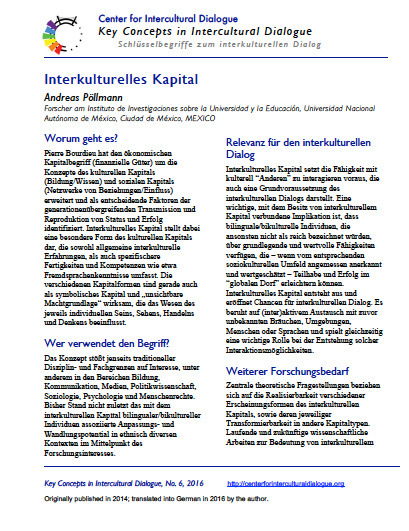
Key Concept #6: Intercultural Capital Translated into German

Key Concepts in ICDContinuing translations of Key Concepts in Intercultural Dialogue, today I am posting KC#6: Intercultural Capital, originally written by Andreas Pöllmann for publication in 2014, and now translated by him into German.

As always, all Key Concepts are available as free PDFs; just click on the thumbnail to download. Lists organized chronologically by publication date and numberalphabetically by concept in English, and by languages into which they have been translated, are available, as is a page of acknowledgments with the names of all authors, translators, and reviewers.

KC6 Intercultural Capital_GermanPöllmann, A. (2016). Interkulturelles Kapital. Key Concepts in Intercultural Dialogue, 6. Available from:
https://centerforinterculturaldialogue.org/publications/

If you are interested in translating one of the Key Concepts, please contact me for approval first because dozens are currently in process. As always, if there is a concept you think should be written up as one of the Key Concepts, whether in English or any other language, propose it. If you are new to CID, please provide a brief resume. This opportunity is open to masters students and above, on the assumption that some familiarity with academic conventions generally, and discussion of intercultural dialogue specifically, are useful.

Wendy Leeds-Hurwitz, Director
Center for Intercultural Dialogue


Creative Commons License
This work is licensed under a Creative Commons Attribution-NonCommercial-NoDerivatives 4.0 International License.

Save

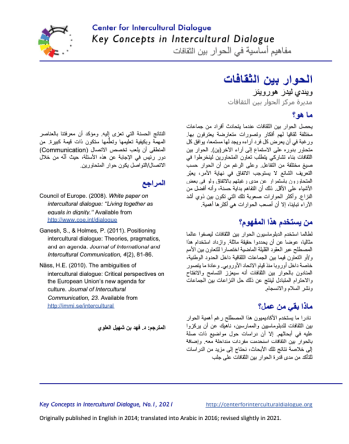
Key Concept #1 Intercultural Dialogue Translated into Arabic

Key Concepts in ICDContinuing translations of Key Concepts in Intercultural Dialogue, today I am posting KC1: Intercultural Dialogue, which I wrote in English to start the series 2 years ago, now translated into Arabic by Fahd Alalwi, of the Prince Sattam Bin Abdulaziz University, in Saudi Arabia.

As always, all Key Concepts are available as free PDFs; just click on the thumbnail of the translation to read it. Lists of Key Concepts organized chronologically by publication date and number, alphabetically by concept, and by languages into which they have been translated, are available, as is a page of acknowledgments with the names of all authors, translators, and reviewers.

KC1 ICD_Arabic v2Leeds-Hurwitz, W. (2021). Intercultural dialogue [Arabic]. Key Concepts in Intercultural Dialogue, 1.  (F. Alalwi, Trans.). Available from: https://centerforinterculturaldialogue.org/wp-content/uploads/2021/06/kc1-icd_arabic-v2.pdf

If you are interested in translating one of the Key Concepts, please contact me for approval first because dozens are currently in process. As always, if there is a concept you think should be written up as one of the Key Concepts, whether in English or any other language, propose it. If you are new to CID, please provide a brief resume. This opportunity is open to masters students and above, on the assumption that some familiarity with academic conventions generally, and discussion of intercultural dialogue specifically, are useful.

Wendy Leeds-Hurwitz, Director
Center for Intercultural Dialogue


Creative Commons License
This work is licensed under a Creative Commons Attribution-NonCommercial-NoDerivatives 4.0 International License.