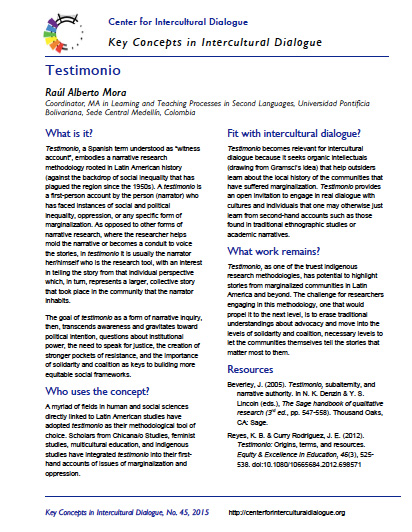
Key Concept #46: Politeness by Sara Mills

Key Concepts in ICDThe next issue of Key Concepts in intercultural Dialogue is now available. This is KC46: Politeness by Sara Mills. As always, all Key Concepts are available as free PDFs; just click on the thumbnail to download. Lists organized  chronologically by publication date and numberalphabetically by concept in English, and by languages into which they have been translated, are available, as is a page of acknowledgments with the names of all authors, translators, and reviewers.

Key Concept #46 Politeness by Sara Mills

Mills, S. (2015). Politeness. Key Concepts in Intercultural Dialogue, 46. Available from: https://centerforinterculturaldialogue.org/wp-content/uploads/2015/01/key-concept-politeness.pdf

The Center for Intercultural Dialogue publishes a series of short briefs describing Key Concepts in Intercultural Dialogue. Different people, working in different countries and disciplines, use different vocabulary to describe their interests, yet these terms overlap. Our goal is to provide some of the assumptions and history attached to each concept for those unfamiliar with it. As there are other concepts you would like to see included, send an email to the series editor, Wendy Leeds-Hurwitz. If there are concepts you would like to prepare, provide a brief explanation of why you think the concept is central to the study of intercultural dialogue, and why you are the obvious person to write up that concept. Feel free to propose terms in any language, especially if they expand our ability to discuss an aspect of intercultural dialogue that is not easy to translate into English.


Creative Commons License
This work is licensed under a Creative Commons Attribution-NonCommercial-NoDerivatives 4.0 International License.

Clothing as a Tool of Intercultural Dialogue: New Zealand and India

New Zealand fashion students recreate modern-day wear from traditional Indian silk saris

In a unique celebration joining New Zealand and Indian cultures, 15 New Zealand Fashion Tech students won Prime Minister’s Scholarships for Asia, covering travel to the Bannari Amman Institute of Technology in India to participate in a five week Apparel and Textile Practicum. Students earned the awards by creating garments made from traditional Indian sari fabrics. The inaugural Resene Designer Selection showcased the hand-crafted silk from Southern India made especially for their garments. Four of the NZ students were Maori. The goal was to take students outside the classroom and give them an international and applied perspective.

Further information about this project is available in a New Zealand journal article entitled “A pattern for success” published in Educator Review, and in an Indian newspaper article entitled “Indian silk, New Zealand patterns”. Continuing descriptions by the students of their experiences are also available on their university’s website.

IPD Academy in Peacebuilding, Mediation, Intercultural Dialogue (2015)

Institute for Peace and Dialogue (IPD)
Academic Programs 2015

A) 2 International Summer Academy programs in Peacebuilding, Mediation, Conflict Resolution & Intercultural Dialogue

– I Summer Academy: 7-17 August, 2015

– II Summer Academy: 17-27 August, 2015

Place: Baar, Switzerland

B) 3 Month Certificated Academic School in Mediation & Conflict Resolution (CAS in MCR)

Date: 17 August – 17 November 2015

Place: Switzerland

Sara Mills Profile

Profiles

Sara Mills is a Research Professor in Linguistics at Sheffield Hallam University in the UK.

Sara Mills


She has published on feminist linguistics, mainly sexism and gender and politeness. Her recent research has specifically focused on politeness, and she is also interested in how groups communicate on social media, languages, and perceptions of “management-speak.”


Work for CID:
Sara Mills wrote KC46: Politeness.

CFP Global Exploitation Cinemas (UK)

CFP
“Global Exploitation Cinemas: Historical and Critical Approaches”, an academic conference and film event organised by the University of Lincoln (UK) in association with the forthcoming Bloomsbury book series of the same name.

University of Lincoln presents …
GLOBAL EXPLOITATION CINEMAS: HISTORICAL AND CRITICAL APPROACHES

An academic conference and film event
The historic Ritz Cinema and Theatre, Lincoln (UK), 28 and 29 May 2015

CONFIRMED KEYNOTE SPEAKERS:

Eric Schaefer (Emerson College, US)
author of Bold! Daring! Shocking! True! A History of Exploitation Films, 1919-1959 (Duke University Press, 1999)
and editor of Sex Scene: Media and the Sexual Revolution (Duke University Press, 2014)

I. Q. Hunter (De Montfort University, UK)
author of British Trash Cinema (BFI, 2012) and Cult Film as a Guide to Life (Bloomsbury, 2015).

The academy’s approach to film history has undergone a significant shift in the 21st century, with previously marginalised, despised and neglected aspects of popular film being afforded unprecedented levels of attention. This process of revaluation has occurred on a global scale, highlighting the development of rich and relatively uncharted alternative film cultures and histories, including those of “exploitation” films, and in turn enabling fresh empirical and critical methodologies.

The academic conference and film event “Global Exploitation Cinemas”-which is being funded by the University of Lincoln (UK) and is working in conjunction with the forthcoming Bloomsbury book series of the same name-aims to bring together an eclectic and diverse range of approaches to exploitation cinema, welcoming any perspective that adds to the burgeoning scholarship in this field of study. Proposals which emphasise the international dimensions of exploitation cinema are especially welcome, but the conference will remain broad and inclusive in considering topics for discussion.

Potential subjects and approaches include, but are by no means limited to:
* Critical reception and/or re-assessment
* Socio-historical dimensions and debates
* Form and aesthetics
* Global and transnational perspectives
* Sexploitation
* The pornographic feature film
* Media controversies and censorship
* Publicity and advertising
* Stardom
* Directors, writers and producers
* Movements, cycles and sub-genres
* Exhibition and distribution
* Geographies
* Restoration and re-appropriation
* Exploitation in the video age
* Nostalgia
* Publishing
* “Mainstream” infiltrations
* DVD documentaries/special features
* Festivals and conventions
* Ephemera and the collector
* The internet and participatory cultures
* Neo-exploitation in the 21st century

Abstracts (of around 300 words) and some brief biographical information (of around 50 words) should be sent no later than FRIDAY 27 FEBRUARY 2015 to the conference email

Organisers:
Shaun Kimber (Bournemouth University)
Neil Jackson (University of Lincoln)
Johnny Walker (Northumbria University)
Thomas Joseph Watson (Northumbria University)

Susan Currier Visiting Prof (California)

The Susan Currier Visiting Professorship for Teaching Excellence in the College of Liberal Arts at California Polytechnic State University in San Luis Obispo, California is a residential teaching professorship that recognizes superior teaching in the liberal arts, emphasizing (where possible) the intersection between gender/women’s issues and global justice/humanitarian concerns. The goal of the Susan Currier Visiting Professorship is to bring a visiting Associate or Full Professor with a distinguished record of teaching excellence to Cal Poly for the purpose of sharing expertise and passion for teaching, social justice, and the liberal arts. It can accommodate visiting scholars on semester or quarter schedules.

The Susan Currier Visiting Professorship is a full-time, one-quarter, non-renewable appointment to cover the Fall 2015 (September 14, 2015 to December 12, 2015) OR Winter 2016 (January 4, 2016 to March 21, 2016) OR Spring 2016 (March 28, 2016 to June 11, 2016) quarter. A half-time, two-consecutive-quarter, non-renewable appointment may be considered. Funding to support the position entails a two-course teaching assignment plus assigned time for service to the university (15 units total). Service includes presentation of the annual Susan Currier Memorial Lecture (a major university-wide presentation on a topic appropriate to the visitor’s field) and other to-be-determined activities promoting excellence in teaching (e.g., participation in Cal Poly’s Center for Teaching, Learning and Technology). In accordance with CSU and university travel reimbursement guidelines, the visiting professorship provides limited funds to partially reimburse documented housing expenses during the visiting appointment, and to reimburse documented travel expenses for one trip to and from the location of the home institution. Salary is commensurate with qualifications, expertise, and experience. In addition, library privileges, some administrative support, and assistance in finding housing are provided.

The Susan Currier Visiting Professorship for Teaching Excellence will be situated in one of the following departments depending on the background of the individual selected for this position: Art & Design, Communication Studies, English, Ethnic Studies, History, Modern Languages and Literatures, Music, Philosophy, Theatre and Dance, or Women’s and Gender Studies, but it is open to applicants in other fields of study traditionally associated with the liberal arts. Ph.D. or other appropriate terminal degree is required in one of the fields of study traditionally associated with the liberal arts. Distinguished record of teaching excellence in a field related to one or more of the academic departments listed above. Preference will be given to candidates whose teaching, research, and/or service emphasizes the intersection between gender/women’s issues and global justice/humanitarian concerns.

To apply, please visit Cal Poly Jobs, complete a required online faculty application, and apply to Requisition #103492. Please attach to your electronic application (1) a cover letter, (2) resume/curriculum vitae, (3) copy of transcripts, (4) statement of teaching philosophy (one page maximum), (5) evidence of teaching excellence and effectiveness, and (6) a brief descriptive listing of possible courses (2 page maximum). In the cover letter, please identify the teaching quarter(s) available/preferred. Applicants must be prepared to provide names and email addresses for a minimum of three professional references when completing the online application. In their letters, references should address your achievements in teaching as well as your work in a field related to one or more of the departments. Cal Poly will directly solicit letters from the individuals listed by applicants. Questions should be sent to Jane Lehr, Search Committee Chair, Susan Currier Visiting Professorship, Women’s and Gender Studies Department, Cal Poly, 1 Grand Avenue, San Luis Obispo, CA 93407-0875 or the Cal Poly’s Women’s and Gender Studies Department.

Review Begin Date: January 30, 2015. Completed applications received by the review begin date (letters can be pending) will be given full consideration. Official sealed transcripts will be required prior to appointment.

CFP Communication History Conference (Venice)

CFP Bridges and Boundaries: Theories, Concepts and Sources in Communication History: An International Conference in Venice, Italy – September 16-18, 2015

The deadline for abstract submission is January 10, 2015.

Organizer: Communication History Section of the European Communication Research and Education Association (ECREA History)

Co-Sponsor: Centre for Early Modern Mapping, News and Networks (CEMMN.net) – Queen Mary University of London

Fernand Braudel in his seminal essay History and the Social Sciences: The Longue Durée pointed out that many academic disciplines/fields which study different aspects of social life inevitably encroach upon their neighbors, yet often remain in “blissful ignorance” of each other. Braudel and others have repeatedly called for historians and social scientists to overcome their deep ontological and epistemological differences in order to work together.

Despite much progress in this regard, communication history remains one of the fields where profitable interdisciplinary dialogue can still take place. Being aware of this need, the Communication History Section of ECREA invites researchers who focus on various aspects of the history of communication, media, networks and technologies (broadly defined), to come together with two main aims: 1) to explore the bridges and boundaries between disciplines; 2) to exchange ideas about how communication history is being done and how it might be done, while emphasizing theories, concepts and sources beneficial to their research, as well as emerging trends and themes.

A three-day conference will take place in Venice, one of the great hubs of early modern communication, at Warwick University’s seat in Palazzo Pesaro Papafava. The opening keynote address will be delivered by Professor Mario Infelise, a leading scholar of early modern print and journalism and the head of the graduate program in the Humanities at the University of Venice Ca’ Foscari. Instead of traditional panels and papers, the conference aims to foster dialogue among scholars of various disciplines through topically organized round-tables, master classes, and countless opportunities for informal discussions.

The organizing committee invites scholars to submit abstracts (max. 400 words) in which they address one of the main themes listed below and outline a short intervention that they might contribute to a round table on that theme. Such interventions should focus mainly on theoretical or methodological approaches, issues and experiences that the speaker has engaged with in his/her research. Historical case studies can be presented only so far as they contain a high degree of historiographical/theoretical significance. Interdisciplinary roundtable sessions will be organized in which participating scholars will also discuss questions raised by a chair and the audience, based on these proposals.

The deadline for abstract submission is January 10, 2015. The conference registration fee will be 140 euro and participants will be asked to cover their own travel expenses. Abstracts should be submitted through the conference website: http://ecreahistoryvenice2015.wordpress.com.

Main Themes:
(1) Theories and Models
Grand theories or meta-narratives often have at their core information networks and communication technologies. To what extent are theoretical premises advocated by scholars such as Braudel, Innis, McLuhan, Habermas, Luhmann, Benedict Anderson, Lefevbre – and more recently by Hallin and Mancini, Castells, Gitelman, Simonson, Mosco, Hendy, Hesmondalgh, F. Kittler, Fickers – applicable in historical inquiry? How has your own research in communication history been inspired by such concepts and theories?

(2) Space and Place
Communication networks and information technologies are always embedded in a material setting that can foster or hinder certain communication practices, call into being new forms of exchange, and drive technological development. What is the place of the geographical imagination in current communication history research? How valuable are the ideas of ‘place’ and ‘space’ in historical research? What are the current trends within the field of historical geography that can advance our understanding of communication history?

(3) News and Networks
How valuable is the idea of ‘the network’? What were the technologies that historically mediated the spread of information through networks? Who participated in networks used in advancing what Bourdieu later called cultural capital? To what extend did such networks contribute to the rise of public opinion and the public sphere? Can we talk about historical continuities between the early modern republic of letters and what Castells later popularized as the network society?

(4) Alternative Media
In order to understand communication history as a long-term, inclusive process, which alternative media or communication technologies (besides the familiar ‘mass media’ of the 20th century) need to be considered, and how? Possibilities might include migration flows, civic and religious ceremonies, theatre, preaching, fashion, the visual arts or architecture. What kinds of methodological or theoretical implications does their consideration carry?

(5) Sources and Methods
The progressive digitization of archives and libraries is opening access to primary sources for increasingly wider circles of scholars. What are the advantages and challenges raised by this development? To what extent do issues of materiality matter particularly to the realm of media and human communication research? What are the most relevant sources that you use for your own research?

(6) ‘New’ Media
At one time, even the oldest communication technologies were looked upon as suspicious novelties. Socrates famously condemned writing; the introduction of print may have been hailed by some as a ‘revolutionary’ enterprise – a term now often applied also to the digital age. What are the lessons that scholars can learn from studying critical periods during which one dominant technology is replaced by a new mode of communication? How do such lessons serve our understanding of the phenomenon called new media?

Organizing Committee:
Rosa Salzberg, PhD – University of Warwick, United Kingdom
Gabriele Balbi, PhD – Università della Svizzera italiana, Switzerland
Juraj Kittler, PhD – St. Lawrence University, USA

Re-Create: Histories of Media Art, Science & Technology 2015 (Montreal)

RE-CREATE 2015
The 10th anniversary and sixth international conference on the histories of Media Art, Science and Technology

Reminder DEADLINE extended January 12, 2015

Hexagram, Concordia University and Université du Québec à Montréal in collaboration with Media@McGill and CIRMMT- McGill Montréal, Canada.
5-8 November 2015
Re-Create CFP Submission

Re-Create 2015, the sixth international Conference on the Histories of Media Art, Science and Technology will mark the 10th Anniversary of the Re conference series. Re-Create 2015 is devoted to exploring what theories, methodologies and techniques can be used to understand past, present and indeed, future paradigms of creative material practice involving technologies within research contexts from a historical and critical point of view.

The title Re-Create is an abbreviation for the term “research-creation”, part of a growing international movement which goes by many names: “practice-led research,” “research-led practice,” and “artistic-research,” among others.

While the link between research and practice seems to be a new horizon, the media-based arts have long been at the intersection of the humanities, sciences, and engineering and present a critical site in which to take up the changing relationships between knowledge, power, and economy.

Research normally signifies modes of acquiring new knowledge that coherently and systematically advance a field and is grounded and validated by both social frameworks (peers) and existing bodies of knowledge. Similarly, research in conjunction with material practice demands that making be historically, theoretically and methodologically framed and valorized.

Re-Create 2015 seeks to interrogate the historical entanglement of research and making within a wide and diverse set of international sites, disciplines and contexts: from non-institutional creative research initiatives driven by artists and designers in the streets, to the labyrinths of industry funded research labs and universities. From unknown or ignored histories of research-based practices in Latin America, Asia and Indigenous communities to government funded initiatives, the conference will thus critically explore the ongoing and productive tensions between theory, method and making in the histories of media art, science and technology.

Potential contributors to the conference should focus thematic panel sessions or individual papers on one of the following areas of concentration:
:: LAB STUDIES: Studies on how artists and designers have historically worked in industry, universities and collective, grass roots-based research environments
:: CURATORIAL ACTIONS AND PRACTICES: How have research paradigms historically entered into curatorial practices and how have they been framed, exhibited and articulated?
:: ANTI-INSTITUTIONAL RESEARCH: Historical profiles of non-institutionally based research-driven explorations.
:: THEORETICAL FRAMEWORKS: How have theoretical paradigms in media, art, science and technology historically evolved structuralism in the 1960s or media studies to current work in affect theory, media archaeology, critical post-humanist approaches derived from STS, appropriation and
remix aesthetics, feminist new materialism, queer and postcolonial studies, enactive and distributed cognition?
:: METHODOLOGIES: What can methodological tools emerging from the human and social sciences like ethnography, historiography, archaeology, genealogy and other qualitative techniques provide to the historical and critical positioning of practice?
:: INTERDISCIPLINARY INTERSECTIONS AND IMPACTS: Exploration of the formation and rise of interdisciplinary research fields (image science, sound studies, science studies, sensory studies, environmental studies) and their impact on the construction of media art histories.
:: DIGITAL HUMANITIES: What is the historical relationship between the digital humanities and the histories of media art, science and technology?
:: SITES: How historically have sites of research and practice in media art, science and technology evolved outside of the predominant spheres of Europe and North America and what forms have they taken?

CONFERENCE PROGRAM
The conference program will include competitively selected peer-reviewed individual papers, panel presentations and poster sessions as well as a number of keynotes and invited speakers and a parallel satellite program of events with Hexagram partners including core cultural institutions in Montreal. In the interest of maintaining a concentrated conference program, there will be a series of plenary sessions as well as accompanying poster sessions. Each of the plenaries as well as the poster sessions will mix together scholars and practitioners representing different cultural perspectives. The conference will be held in English and French, with live translation.

CALL FOR PROPOSALS
Re-Create 2015 welcomes contributions from researchers, artists, designers, scholars and technologists working across diverse disciplines, sites and practices. We particularly encourage scholars and creators from international contexts outside of Europe and North America.

ABOUT THE CONTEXT AND THE HOST
The conference will take place in Montreal hosted by Hexagram, the international network for media, art, design and digital culture. It is the largest network of its kind in Canada and one of the largest internationally dedicated to research-led creative practices. Ten years after the inaugural Re-Fresh conference at the Banff New Media Institute in 2005, the return of the conference to Canada and specifically to Quebec, offers a pertinent context to address the evolution of research in the histories of media, art, science and technology. The conference will be held across the two core Hexagram sites at Concordia University and the Université du Québec à Montréal (UQAM). The venues are within walking distance from each other, centrally located in vibrant, downtown Montreal – the digital arts and culture capital of North America.

SUBMISSIONS
250 word abstracts of proposals, panel presentations and posters should be submitted in either Text, RTF, Word or PDF formats. Texts can be submitted in French and in English. The DEADLINE for submissions is January 12, 2015. INFORMATION about the submission process and general information can be found at: Re-Create Submission Site.

Conference partners include Media@McGill, CIRMMT-McGill, Cinémathèque québécoise, DHC-Art, Elektra/ACREQ, Goethe-Institut Montreal, Department fpr Image Science Danube University and others to be announced.

Conference chairs and Hexagram Co-Directors: Chris Salter, artist, Concordia University Research Chair and Associate Professor, Design and Computation Arts, Concordia University (QC/CA/US/DE) and Gisèle Trudel (QC/CA), artist and professor, École des arts visuels et médiatiques, Université du Québec à Montréal.

Re-Create Local Organizing Committee: Thierry BARDINI, Barbara CLAUSEN, Ricardo DAL FARRA, Jean DUBOIS, Jean GAGNON, Alice JIM, Jason LEWIS, Jonathan LESSARD, Louise POISSANT, Chris SALTER, Cheryl SIM, Jonathan STERNE, Alain THIBAULT, Gisele TRUDEL, Marcelo WANDERLEY

Re-Create 2015 International Advisory Board: Marie-Luise ANGERER, Monika BAKKE, Samuel BIANCHINI, Georgina BORN, Andreas BROECKMANN, Annick BUREAUD, Michael CENTURY, Joel CHADABE, Dooeun CHOI, Ian CLOTHIER, Sarah COOK, Nina CZEGLEDY, Sara DIAMOND, Diane DOMINGUES, Jean Paul FOURMENTRAUX, Zhang GA, Sébastien GENVO, Orit HALPERN, Jens HAUSER, Denisa KERA, Felipe César LONDONO, Natalie LOVELESS, Glenn LOWRY, Rafael LOZANO-HEMMER, Roger MALINA, Sally Jane NORMAN, Nicolas NOVA, Jussi PARIKKA, Christiane PAUL, Simon PENNY, Andrew PICKERING, Sundar SARRUKAI, Yukiko SHIKATA, Michel VAN DARTEL, Ionat ZURR

MAH Honorary Board: Douglas DAVIS, Jasia REICHARDT, Itsuo SAKANE, Peter WEIBEL

MAH Conference Series Board: Sean CUBITT, Oliver GRAU, Linda HENDERSON, Erkki HUHTAMO, Douglas KAHN, Martin KEMP, Machiko KUSAHARA, Tim LENOIR, Gunalan NADARAJAN, Paul THOMAS

Museums in an Intercultural Context

The result of a collaboration between the Department of Cultural Management at the Universiteit Antwerpen (Flanders, Belgium) and the Department of Museum Studies at the Université du Québec a Montréal (Quebec, Canada), an intercultural tool aimed at museums in urban context has recently been published. The grid was conceived as an analytical framework for a research project entitled The city museum in an intercultural context. Fostering dialogue in culturally diverse urban environments: perspectives from Montreal, Antwerp, Ghent and Rotterdam.

Inspired by the Council of Europe’s Intercultural Cities programme, collaboration between researchers and students at both universities involved an analysis of four city museums in Quebec, Flanders and the Netherlands and how they approached intercultural dialogue.

The analytical grid produced in the context of the research project can be used by all types of museums and heritage institutions wishing to reflect upon their engagement with diverse communities. Museums may find it useful for initiating brainstorming sessions and self-assessment exercises, supporting planning processes, conducting intercultural project evaluations or facilitating benchmarking and the exchange of strategic information. Researchers in the heritage and cultural management fields may also find it useful for collecting, analysing and comparing data on issues related to diversity and intercultural dialogue in the museum sector.

The grid addresses three levels of analysis:
*Environmental analysis, including the sociodemographic environment of the city, the policy environment of the museum, the institutional environment of the museum and the governance environment of the museum.
*Museum analysis, including an institutional overview of the museum and an intercultural audit of the museum.
*Project analysis, including an analysis of projects with intercultural components.

Museum professionals and researchers may use one or several of these sections, depending on their needs. Data can be collected using a variety of means, including interviews with museum staff, examination of strategic documents and field observation.

The intercultural tool for museums is available for free.

Original article published by Asia-Europe Museum Network.

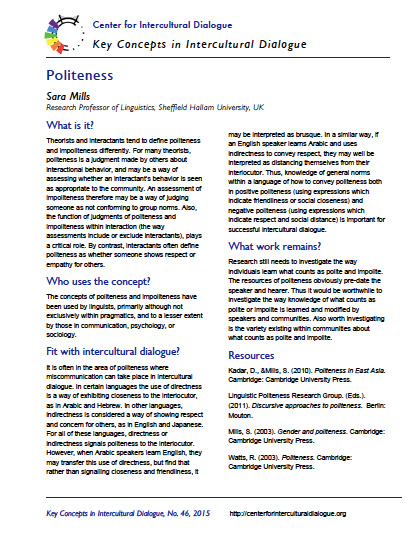
Key Concept #45: Testimonio by Raúl Alberto Mora

Key Concepts in ICDThe next issue of Key Concepts in intercultural Dialogue is now available. This is KC45: Testimonio by Raúl Alberto Mora. As always, all Key Concepts are available as free PDFs; just click on the thumbnail to download. Lists organized  chronologically by publication date and numberalphabetically by concept in English, and by languages into which they have been translated, are available, as is a page of acknowledgments with the names of all authors, translators, and reviewers.

kc45-sm

Mora, R. A. (2015). Testimonio. Key Concepts in Intercultural Dialogue, 45. Available from:
https://centerforinterculturaldialogue.org/wp-content/uploads/2015/01/kc45-testimonio.pdf

The Center for Intercultural Dialogue publishes a series of short briefs describing Key Concepts in Intercultural Dialogue. Different people, working in different countries and disciplines, use different vocabulary to describe their interests, yet these terms overlap. Our goal is to provide some of the assumptions and history attached to each concept for those unfamiliar with it. As there are other concepts you would like to see included, send an email to the series editor, Wendy Leeds-Hurwitz. If there are concepts you would like to prepare, provide a brief explanation of why you think the concept is central to the study of intercultural dialogue, and why you are the obvious person to write up that concept. Feel free to propose terms in any language, especially if they expand our ability to discuss an aspect of intercultural dialogue that is not easy to translate into English.


Creative Commons License
This work is licensed under a Creative Commons Attribution-NonCommercial-NoDerivatives 4.0 International License.