Agence ITER: Ethical Whistle Blowing: Intercultural Perspectives (France)

Events The Agence ITER France yearly Intercultural Think Tank is meeting again on 4 May 2017 in Aix en Provence, hosted at the Institute for American Universities. The subject this year is Ethical Whistle Blowing: Intercultural Perspectives.

DRAFT PROGRAM

13h30 Welcome and coffee
14h Introduction by Shawn SIMPSON, Training Project Manager, Agence ITER France: Cultural interpretations of Codes of Conduct
14h10 Discussion
14h30 Frederique CHOPIN, Director of CSR Master Program, Aix Marseille University: Whistle Blowing in France since the new law of 2016
14h40 Discussion
15h Carolina SERRANO ARCHIMI, Professor, Graduate School of Management, IAE Aix en Provence: Subject to be determined
15h10 Discussion
15h30 Break
15h40 Guillaume Frentz, Human Resource Officer, ITER Organization: The ITER Organization Code of Conduct and Ethics Committee
15h50 Discussion
16h20 To be determined
16h30 Discussion
16h50 End

If you would like to attend please register.

Save

Fairleigh Dickinson U Study Abroad: International Communication (UK)

Study International Communication in England, Summer 2017

MCOM 7002 / COMM 4070 International Corporate Communication and Culture offered at Fairleigh Dickinson University’s Wroxton College located in Oxfordshire, England, May 28 – June 9, 2017.

The course consists of invited speakers, case studies, site visits, and trips to London, Stratford-upon-Avon, and Oxford. The main objective of the course is make students familiar with the cultural, historical, and political contexts in which international business transactions take place. Students will also attend a day of seminars at the Harris-Manchester College of Oxford University ending with High Dinner with the Oxford students.

Wroxton College is the British campus of Fairleigh Dickinson University, situated in the ancestral home of Lord North in Oxfordshire. The main College building is Wroxton Abbey, a fully modernized Jacobean mansion on 56 acres of its own lawns, lakes and woodlands. Originally constructed as an Augustinian priory in 1215, Wroxton Abbey has accommodated several British monarchs and statespeople such as Theodore Roosevelt. It now houses the College’s classrooms and seminar rooms, the library, fully modernized student lodging facilities, and computer laboratories.

At Fairleigh Dickinson University, participating students are drawn from the MA in Communication, the MA in Organizational Behavior, and selected upper-level undergraduate students.

Students from other universities and colleges are invited to register with permission of the course leader, Gary Radford; contact Dr. Radford for more information.

It is highly recommended interested students complete and submit the Commitment Form on or before April 1st, 2017, to ensure a place on the course.

CFP Multicultural Discourses of Security

Special Issue Call: Journal of Multicultural Discourses
Multicultural Discourses of Security

In contemporary global society, ‘security’ is considered an especially complex and contested concept. Historically, this concept has connoted states’ development of institutions, technologies, and strategies enabling their pursuit of foreign policy – particularly, the military use of armed force. More recently, intensified debate among state officials, scholars, and activists has expanded consideration of non-traditional actors, sites, conditions, and processes (e.g., ‘human security’). Amid these changes, the study of security has persistently focused on the efforts of individuals and groups to conceptualize and claim cherished phenomena, to defend those claims against perceived and actual threats, and to maintain a lifeworld characterized by relative stability, liberty, and prosperity.
Communication and discourse scholars have displayed growing interest in the study of security. Reasons include: a desire to engage with material conditions and powerful institutions that produce (often through violent means) fateful outcomes of freedom and oppression; an interdisciplinary convergence of epistemologies, theories, and topics emphasizing the communicative constitution (and mediation) of societal governance; and finally, a desire to ethically intervene in hegemonic discourses of neoliberalism and neo-conservativism that have markedly increased conditions of global risk. To date, those scholars have addressed a variety of related topics, including: conflict; war; peace; militarism and defense; (counter-) terrorism; aid and development; surveillance; globalization; (im-)migration; (post- and neo-)colonialism; nationalism; gender, sexual, ethnic and racial identity; truth, justice and reconciliation; public health; and cyber-threats. The growing challenge posed to liberal democratic governance by populist movements in the U.S. and Europe, further, suggests that international and scholarly concern regarding security matters will remain heightened for the near future.

This special issue provides a forum for scholarship seeking to interpret and critique “security” as a multicultural and discursive phenomenon. It calls for both empirical studies and theoretical essays that expand existing interdisciplinary discussion by elaborating the distinctly communicative status of security, both within and between cultures. In keeping with the journal’s focus, submissions seeking to de-center U.S. and western-alliance/coalition discourses of security, and to promote reflective, dialogic, diverse, and pluralist discourses, are particularly encouraged. Related topics of submissions may include – but are not limited to – the following:
— Local, regional, and vernacular discourses of security, and their relationship to official discourses of national and international security;
— Evolving discursive genres and programs of security (e.g., public diplomacy);
— Discursive practices that elevate and decrease the value of life (and thus entitlement to legal rights and protections) for particular cultural groups;
— Discursive ‘securitization’ of nontraditional security concerns (e.g., climate change; public health; public education, etc.);
— Articulations of media, technology, and discourse contributing to individual and group (in-) security (e.g., surveillance of users facilitated by social media platforms);
— Communicative dilemmas and conflicts arising from the articulation of cultural discourses of identity (e.g., gender, sexual, ethnic, racial, class, religious, etc.) with hegemonic national and state discourses of identity (e.g., of citizenship, patriotism, and modernism);
— Cultural meanings and practices associated with the diffusion of state and sub-state militarism;
— Discursive intersections between the spheres of “domestic” (e.g., criminal justice) and “foreign” policy (e.g., counter-terrorism);
— National, international, and NGO discourses associated with refugee flows from current conflicts in Middle Eastern and Northern African nations;
— Organizational, professional, and institutional discourses of security (e.g., nuclear strategy; intelligence analysis; private military contractors; etc.);
— Analysis of actual interaction occurring in security contexts (e.g., border-crossings; congressional and parliamentary hearings; ‘enhanced interrogations’, etc.); and finally,
— Meta-theoretical critique of existing scholarly discourses of communication and /or security.

This special issue will be co-edited by Hamilton Bean (Associate Professor, Communication, University of Colorado-Denver, USA) and Bryan C. Taylor (Professor, Communication, University of Colorado-Boulder, USA). The deadline for submission of manuscripts is April 1st, 2017. Manuscript length should be no longer than 8000 words, including abstract, references, and tables. All submissions for this special issue should insert the phrase “Special Issue: Multicultural Discourses of Security” in the top left-hand corner of the first manuscript page, as well as noting this status in any cover letter provided.  Otherwise, manuscripts should be formatted and submitted per standard journal policies and procedures. All manuscripts will be peer-reviewed, with the timeline for requested revisions intended to ensure 2017 publication. Please contact the issue co-editors with questions.

Summer School: Vocational Integration in Post-Migrant Society (Germany)

International Summer School: Vocational Integration in Post-Migrant Society
3-7 July 2017
Sponsor: TU-Dresden
Location: Deutsches Hygiene-Museum Dresden (Germany)

As one of the largest common societal tasks in a country of immigrants, Germany qualifies the integration of people of any country of residence (ethnicity, age, gender etc.) in an inclusive, understanding society, especially the challenge to use and develop the potential of a diverse society. One focus of varying diversities within open society is the so-called post-migrant approach that focuses on the perspective of migration to and the resulting process of – social, and political transformations, conflicts, and identity constructions. The topic area of integration and labor in a post-migrational society is, in this context, of enormous importance, which essentially can improve in making societal participation possible here and considers the shortage of skilled workers and demographic advancement as well as the advancement of the job market. By extensively discussing relevant practices and concepts, the Summer School 2017 intensively situates itself within the theme of integration with a special focus on the (further) advancement of structures and processes of professional education and employment under the service of diversity.
 
Target Audience: Competition and Selection Process
 
The participant group from researchers will be composed in varied topic and background contexts who have been awarded for their excellent research activities (on the relevant qualification level) through innovative contributions to migration and integration research. Those interested are asked to describe their expertise in a clearly defined subject matter and their motivation for participation in the form of an application. A commission consisting of the applicants together with representatives of economics and sociology is then carried out for the selection of the candidates. 20 international researchers and 5 researchers of the TU Dresden will be selected.
 
The registration is open now until 31.03.2017.

Constructing Intercultural Dialogues #2: Reconciliation

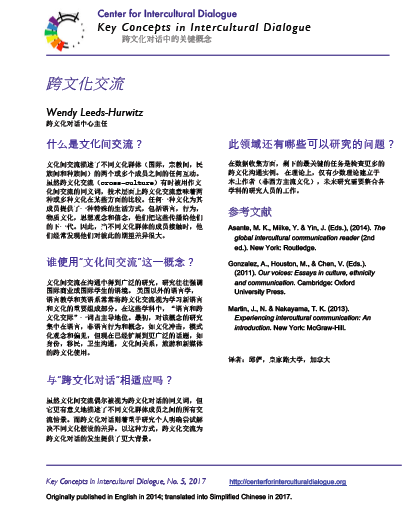
Constructing ICDFollowing the recent announcement of a new series to be published by the Center for Intercultural Dialogue, the second issue of Constructing intercultural Dialogues is now available. Here is “Reconciliation,” by Maria Flora Mangano.

As a reminder, the goal of this series is to provide concrete examples of how actual people have managed to organize and hold intercultural dialogues, so that others may be inspired to do the same. As with Key Concepts in Intercultural Dialogue, these may be downloaded for free. Click on the thumbnail to download the PDF.

Contructing ICDs #2Mangano, M. F. (2017). Reconciliation. Constructing Intercultural Dialogues, 2. Available from: https://centerforinterculturaldialogue.org/wp-content/uploads/2017/03/constructing-icd-2.pdf

If you have a case study you would like to share, send an email to the series editor, Wendy Leeds-Hurwitz.


Creative Commons License
This work is licensed under a Creative Commons Attribution-NonCommercial-NoDerivatives 4.0 International License.

King’s College London Job Ad: International Education (UK)

Lecturer in International Education
King’s College London – School of Education, Communication and Society
This post will be full-time and fixed term to September 2020.

The School of Education, Communication and Society is seeking to recruit an outstanding academic to contribute to research, teaching and programme administration in international education. The post-holder will make a significant contribution, in particular, to the MA in International Education, a new degree for teachers in international schools developed in association with Nord Anglia Education.

The successful candidate, who will be based in the Centre for Public Policy Research, will have a strong research track record, expertise in international education, with a very strong grounding in a foundation discipline, outstanding teaching ability, strong organisational and communication skills, and an interest in and aptitude for communication across disciplines and with education professionals.

The selection process will comprise a presentation and a panel interview.

To apply for this role, please go to the King’s College London HireWire Job Board and register to download and submit the specified application form.

The deadline for applications is midnight on 2 April 2017

Paris Institute for Advanced Studies Job Ad: Director

L’Institut d’études avancées de Paris recrute sa/son directrice/teur

Contexte
Créé en 2008, l’Institut d’études avancées de Paris (IEA Paris) a pour vocation d’accueillir pour une année académique des chercheurs étrangers de haut niveau, émergents et confirmés, principalement en sciences humaines et sociales. Il est un laboratoire d’idées, un lieu d’élaboration de nouveaux paradigmes et de dépassement des frontières établies, par la confrontation de disciplines, de thématiques et de traditions méthodologiques différentes.

L’Institut d’études avancées de Paris est une association soutenue par les principales universités et institutions d’enseignement supérieur et de recherche de la région parisienne, ainsi que par la Ville de Paris, le Conseil régional d’Ile-de-France, la FMSH et la fondation RFIEA.

Depuis 2013, il est installé à l’Hôtel de Lauzun sur l’Île-Saint-Louis. Ce lieu exceptionnel permet d’accueillir jusqu’à 25 chercheurs par an dans des locaux réhabilités en espaces de travail modernes et fonctionnels, au sein d’un cadre historique préservé. La capacité d’invitation de l’IEA de Paris s’élève à 200 mois chercheurs par année académique.

Missions
En collaboration avec les membres du Conseil d’administration et en lien avec le Conseil scientifique, le Directeur est le garant de la politique scientifique de l’Institut. Il participe à l’élaboration de cette politique, à la stratégie générale de l’Institut et à son développement.

  • Il/elle supervise la sélection des résidents en organisant le processus d’évaluation des chercheurs accueillis à l’Institut, en lien étroit avec le Conseil scientifique.
  • Il/elle veille à la qualité, à la cohérence et au développement des projets de recherche des résidents et au maintien du niveau de qualité de leur accueil.
  • Il/elle assure le suivi des relations avec les collectivités territoriales et les établissements d’enseignement supérieur et de recherche membres de l’Institut, ainsi qu’avec le réseau des instituts d’études avancées auquel il appartient.
  • Il/elle est responsable de la préparation et de l’exécution du budget de l’Institut et assure le suivi de sa situation financière pluriannuelle.
  • Il/elle pilote le développement du mécénat, des demandes de subvention (en France et en Europe) et la réponse aux appels à projets appropriés.
  • Il/elle développe des relations avec la presse et les médias afin d’accroître la visibilité et le rayonnement de l’Institut.
Conditions
Mandat de 5 ans, renouvelable une fois.
Conditions salariales équivalente à un.e Président.e d’Université.
Langues de travail : français, anglais
Profil
Personnalité de rayonnement international dans le domaine des sciences humaines et sociales, il/elle bénéficie d’une bonne connaissance des mondes universitaires et académiques en France et à l’étranger.

Les dossiers de candidature, comprenant un CV et une lettre de motivation en français, sont à adresser avant le 31 mars 2017 à :

Institut d’Etudes Avancées de Paris
Madame Dominique Schnapper, Présidente
17 quai d’Anjou
75004 Paris
Ou par courriel à : recrutement@paris-iea.fr
Prise de poste : Septembre 2018

Venice School of Human Rights/Academy of Human Rights 2017 (Italy)

Venice School of Human Rights
9-17 June 2017

European InterUniversity Centre for Human Rights and Democratisation (EIUC) Venice School of Human Rights was born in 2010 with the goal of studying today’s challenges in the field of human rights. It allows its participants coming from all over the world to list these challenges and examine their reasons and possible solutions they can deploy. The EIUC Venice School at the same time, combines theory and practice and its faculty involves both academics and practitioners. The Venice School intends to highlight that the respect for human rights is the responsibility of all, that «Human Rights are our responsibility».

Courses are scheduled to take place in Venice at the premises of EIUC over a period of 9 days. The venue of the European Inter-University Centre for Human Rights and Democratisation is the graceful Benedictine Monastery of San Nicolò, situated on the lagoon side of the Lido of Venice. The Monastery was founded in the 11th century and transformed into a Renaissance cloister in the 16th century. After the suppression of the Benedictine order in 1770, the monastery was re-opened by Franciscan monks for educational purposes.


Venice Academy of Human Rights
3 – 12 July 2017

The Venice Academy of Human Rights is a centre of excellence for human rights education, research and debate. It hosts distinguished experts to promote critical and useful research,
innovation and exchange of current knowledge. The theme Economic, Social, and Cultural Rights as an Answer to Rising Inequalities discusses the prospects for economic and social justice against the background of rising inequalities in the
world. Are human rights an effective tool for the promotion of economic and social equality? Do human rights impose limits to privatization of particular goods and services? How do human rights enable a just economic and social order? These are but some of the questions that participants of the Academy will discuss in an intense programme over ten days this summer.

Branko Milanović, Visiting Presidential Professor at the Graduate Center City University of New York and a LIS Senior Scholar, is going to deliver the opening lecture of the Venice Academy of Human Rights.
Olivier De Schutter, Professor at the University of Louvain (UCL) and at SciencesPo (Paris), will deliver the general course.

Type of courses: Lectures, seminars, discussion sessions and panel presentations
Number of hours: 34 hours
Venue: Monastery of San Nicolò, Venice Lido, Italy

Hong Kong U Job Ad: Language and Communication

Applications are invited for tenure-track appointment as Assistant Professor in English Linguistics/Language and Communication in the School of English of the Faculty of Arts, to commence on January 1, 2018 or as soon as possible thereafter, on a three-year fixed-term basis, with the possibility of renewal and with consideration for tenure before the expiry of a second three-year fixed-term contract.

The School of English offers an integrated programme in English Studies, including undergraduate teaching and supervision of research students in English and American Literatures, World Literature in English, English Linguistics, World Englishes, Sociolinguistics, Discourse Analysis, and Language Acquisition. It also offers an undergraduate interdisciplinary programme in Language and Communication, which focuses on the study and use of language in multilingual contexts, particularly in Asia, as well as languages in socio-cultural contexts. The School also contributes to the teaching of the B.A. & B.Ed. in Language Education (English) and the B.A. (Literary Studies) & L.L.B. double degree programmes.

The position is open to scholars working in any subfield of English linguistics or language and communication. Applicants should have a Ph.D. degree in a relevant discipline and an active research record, and be prepared to teach and supervise at the B.A., M.A., M.Phil. and Ph.D. levels. The appointee should be able to contribute to the teaching of both the English Studies programme and the programme in Language and Communication.

Closes April 30, 2017

EPRIE 2017: Migration, Integration & Belonging (South Korea & Japan)

Applications are being accepted for participation in EPRIE 2017: ‘Migration, integration, and belonging’, to be held from June 21 to July 3 in East Asia (South Korea and Japan).

As an intercultural exchange program, EPRIE (Exchange Program for Regional Integration in East Asia and Europe) aims to contribute through enhanced dialog to improving cooperation among neighboring countries in East Asia and Europe, and to support the process of integration in each region. By strengthening transnational relations, EPRIE shall actively contribute toward promoting international understanding.

Participants will compare historical developments before and after the Second World War, examine the political and social dimensions of mutual relations, and analyze relevant regional cooperation and challenges. Each topic will be dealt with various perspectives and will be presented with the assistance of specialists from the field of politics, economics, academia and media.

In addition, key competencies in intercultural cooperation will be mediated. Through intensive collaborations at the seminar, a network will be created that shall seek to serve long-term cooperation.

Organizer is the Korea Verband e.V., a politically independent association based in Berlin.

Eligibility

Target groups are young people aged between 25 and 35 years from Europe (mainly France, Germany, Poland) and East Asia (mainly China, Japan, Korea). Program participants will include young professionals, and postgraduate students in Master and Research degrees from the field of Area Studies as well as from the disciplines of History, Social and Communication Sciences, among others.

Application deadline will be on Sunday, March 26, 2017