U Pennsylvania 2 Job Ads: Communication & Culture

Job adsTenure and Tenure Track Professor of Communication in the Area of Communication and Culture at University of Pennsylvania

The University of Pennsylvania’s Annenberg School for Communication is seeking to fill one tenured (Associate Professor or Full Professor) and one tenure track (Assistant Professor) faculty position in the area of “communication and culture.” Preference will be given to scholars whose research and teaching include innovative approaches to the study of gender, sexuality, race, and/or ethnicity, as well as those whose work includes a global, transnational, or comparative dimension. Specific areas of focus may include but are not limited to algorithmic culture and platform studies; mobility and migration; technology and identity; and digital culture production. We are searching for candidates who address these or other issues using qualitative methods.

To receive full consideration, applications should be received by Monday, September 4, 2017.

CID Poster #6: Dialogue Defined

CID PostersThis is the next of the posters designed by Linda J. de Wit, in her role as CID intern. For this poster, you literally have to look from a different perspective to read the quote; the picture of birds on a wire also represents taking different perspectives. The source of the quote is:

Leeds-Hurwitz, W. (2016). De la possession des compétences interculturelles au dialogue interculturel: Un cadre conceptuel [Moving from having intercultural competencies to constructing intercultural dialogues: A conceptual framework]. Les Politiques Sociales, 3/4, 7-22.

Dialogue DefinedJust in case anyone wants to cite this poster, the following would be the recommended format:

Center for Intercultural Dialogue. (2017). Dialogue defined. CID Posters, 6. Available from:
https://centerforinterculturaldialogue.org/wp-content/uploads/2017/08/dialogue.png

As with other series, CID Posters are available for free on the site; just click on the thumbnail to download a printable PDF. They may be downloaded, printed, and shared as is, without changes, without cost, so long as there is acknowledgment of the source.

As with other series, if you wish to contribute an original contribution, please send an email before starting any work to receive approval, to minimize inadvertent duplication, and to learn about technical requirements. As is the case with other CID Publications, posters should be created initially in English. Given that translations of the Key Concepts in Intercultural Dialogue have received so many views, anyone who wishes to translate their own poster into another language (or two) is invited to provide that as well. If you want to volunteer to translate someone else’s poster into a language in which you are fluent, send in a note before starting, to receive approval and to confirm no one else is working on the same one.

Wendy Leeds-Hurwitz
Director, Center for Intercultural Dialogue
intercult.dialogue AT gmail.com


Creative Commons License
This work is licensed under a Creative Commons Attribution-NonCommercial-NoDerivatives 4.0 International License.

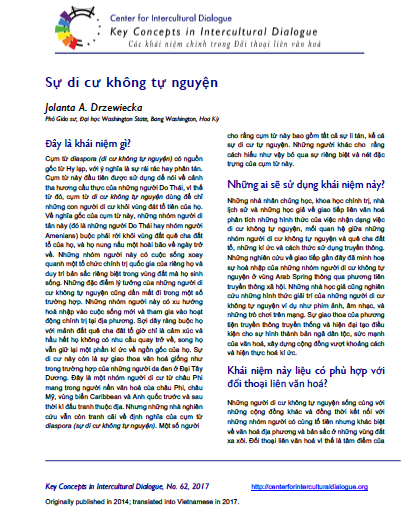
Key Concept #3: Intercultural Competence Translated into Ukrainian

Key Concepts in ICDContinuing translations of Key Concepts in Intercultural Dialogue, today I am posting KC#3: Intercultural competence, which Lily Arasaratnam wrote for publication in English in 2014, and which Roxanna M. Senyshyn has now translated into Ukrainian.

As always, all Key Concepts are available as free PDFs; just click on the thumbnail to download. Lists of Key Concepts organized chronologically by publication date and number, alphabetically by concept, and by languages into which they have been translated, are available, as is a page of acknowledgments with the names of all authors, translators, and reviewers.

KC3 Intercultural Competence_Ukrainian

Arasaratnam, L. A. (2017). Intercultural competence [Ukrainian]. (R. M. Senyshyn, trans). Key Concepts in Intercultural Dialogue, 3. Available from:
https://centerforinterculturaldialogue.org/wp-content/uploads/2017/07/kc3-intercultural-competence_ukrainian.pdf

If you are interested in translating one of the Key Concepts, please contact me for approval first because dozens are currently in process. As always, if there is a concept you think should be written up as one of the Key Concepts, whether in English or any other language, propose it. If you are new to CID, please provide a brief resume. This opportunity is open to masters students and above, on the assumption that some familiarity with academic conventions generally, and discussion of intercultural dialogue specifically, are useful.

Wendy Leeds-Hurwitz, Director
Center for Intercultural Dialogue


Creative Commons License
This work is licensed under a Creative Commons Attribution-NonCommercial-NoDerivatives 4.0 International License.

ICA Regional: Communications Research in the Digital Age (India)

ConferencesInternational Communication Association South Asia Regional Conference 2017: Communications Research in the Digital Age, 14 to 16 December 2017, Mumbai, INDIA, Hosted by SNDT Women’s University. Abstract due: August 31, 2017

The ICA South Asia regional conference intends to examine communications research in digital age under four parallel tracks for paper presentation:

A. Individual and Digital Exposure (IDE): What is the relationship of individual with the digital media?

B. Gender, Culture Technology (GCT): How does community and technology intersect in a given culture?

C. Digital Media Ecology (DME): Who are the stakeholders and players of digital media landscape?

D. Digital Research Methodologies (DRM): What are methodological challenges for digital media research?

We recognize that all the themes are intersecting and can be interwoven, yet we expect that you choose ONE that you think is nearest to your research/panel so that regional interest groups can be formed towards the end of the conference. By submitting abstract you are agreeing to register for the Conference. There will be workshops as well as plenary at the Conference.

Roxanna Senyshyn Profile

ProfilesRoxanna Senyshyn is Associate Professor of Applied Linguistics and Communication Arts and Sciences at Pennsylvania State University, Abington College.

Roxanna SenyshynHer teaching and research focus on intercultural communication and second language learning and teaching. Specifically, her research interests include intercultural and transformative learning in teacher education, intercultural competencies for academic and professional purposes, and ESL pedagogy and assessment with a focus on academic writing.

One strand of Dr. Senyshyn’s research examines the need to prepare both preservice and inservice teachers for working with English language learners in multilingual and multicultural classroom settings.  Through community-based scholarship, she investigates the impact of intercultural engagement and learning on different constituents. From the student perspective, she has studied the impact of intercultural learning through engagement of domestic students with their international peers in semester long projects. She has studied this influence through the lens of Mezirow’s transformative learning theory, which encourages critical reflection and examination of personal beliefs and actions to allow for a change in perspectives and behavior. She has also used transformative learning framework in a faculty professional development context as an assessment tool to investigate the impact of professional development on faculty practices surrounding teaching and learning in a linguistically and culturally diverse college classroom.

The other strand of Dr. Senyshyn’s research focuses on intercultural learning and intercultural competence development to aid in the process of adjustment and acculturation of international students. The primary focus for this scholarship has been on identifying challenges that international students experience when adjusting to both academic and social demands in U.S. colleges and universities and assessing academic support to aid these students in their successful transition. In one of her recent projects, she examined the impact of first-year seminar experience and out-of-class engagement with domestic students on international students’ intercultural competence development.

In addition to her experience in academia, Dr. Senyshyn has been a consultant for BGRS Intercultural and Language Training doing training and coaching for inbound and outbound expatriates and their families in the greater Philadelphia area (Pennsylvania, U.S.).

Selected publications:

Senyshyn, R. with Lypka, A. (2024). Voices of courage and vulnerability: Teaching English in a society at war (Ukraine 2022-2023). Sunshine TESOL Press.

Senyshyn, R. (2024). Humanizing and amplifying voices of displaced children: A narrative of an eight-year-old’s journey and integration. In T.M. Shah (Ed.), Children and youth as ‘sites of resistance’ in armed conflict (pp. 35-54). London, UK: Emerald Publishing.

Han, S. & Senyshyn, R. (2024). Dynamic intercultural learning and collaboration: transforming language teacher perspectives and practices. Journal for Multicultural Education, 18(4), 1-19.

Senyshyn, R.M. (2024). Immigrant families and communities as agents of interculturality in pre-service teacher education. In A.F. Selvi & C. Kocaman (Eds.), International perspectives on critical English language teacher education: Theory and practice (pp. 229-235). New York, NY: Bloomsbury Publishing.

Senyshyn, R. M. (2023). Translanguaging as transformation: The collaborative construction of new linguistic realities. Language and Intercultural Communication, 23(1), 140-142.

Senyshyn, R. M. (2021). Navigating linguistic and cultural identities: (Re)positioning oneself through critical awareness. In A. F. Selvi & B. Yazan (Eds.), Language teacher education for Global Englishes: A practical resource book (pp. 188-196). New York, NY: Routledge.

Senyshyn, R.M. & Martinelli, A. (2021). Learning to support and sustain cultural (and linguistic) diversity: Perspectives of preservice teachers. Journal for Multicultural Education, 15(1). 20-37.

Senyshyn, R. M. (2020). Transformative intercultural learning: Research to practice in teacher education. In C.E. Poteau (Ed.), Pedagogical approaches to intercultural competence development (151-173). Newcastle upon Tyne, UK: Cambridge Scholars Publishing.

Senyshyn, R. M. (2019). A first-year seminar course that supports the transition of international students to higher education and fosters the development of intercultural communication competence. Journal of Intercultural Communication Research, 48(2), 150–170.

Senyshyn, R. M., & Smith, P. (2019). Global awareness dialogue project: Exploring potential for faculty transformation through professional development. Journal of Transformative Education, 17(4), 318–336.

Senyshyn, R.M. (2019). A first-year seminar course that supports the transition of international students to higher education and fosters the development of intercultural communication competence. Journal of Intercultural Communication Research, 48(2), 150-170.

Senyshyn, R.M. (2019). Facilitating transformative intercultural learning. TESOL Connections, February 2019.

Senyshyn, R.M. (2018). Teaching for transformation: Converting intercultural experience of preservice teachers into intercultural learning. Intercultural Education, 29(2), 163-184.

Senyshyn, R.M. (2018). Facilitating preservice teachers’ transformation through intercultural learning: Reflections from a self-study. In J. Sharkey & M. M. Peercy (Eds.), Self-study of language and literacy teacher education practices: Culturally and linguistically diverse contexts (pp.167-184). London, UK: Emerald Group Publishing.

Chamberlin-Quinlisk, C. R. & Senyshyn, R. (2012). Language teaching and intercultural education: Making critical connections. Intercultural Education, 23, 15-23.

Senyshyn, R.M. & Chamberlin-Quinlisk, C.R. (2009).  Assessing effective partnerships in intercultural education: Transformative learning as a tool for evaluation. Communication Teacher, 23 (4), 167-178.

Senyshyn, R.M.  (2001).  Learning cross-cultural competencies: Implications for international management education.  Perspectives in Higher Education Reform.  Proceedings of the 11th Annual International Conference of Alliance of Universities for Democracy, Volume 10, Sofia, Bulgaria.

Senyshyn, R.M., Warford, M., & Zhan, J.  (2000).  Academic and non-academic issues of adjustment to American higher education.  Journal of International Education, 30(1) 17-35.


Work for CID:
Roxanna Senyshyn translated KC3: Intercultural CompetenceKC5: Intercultural Communication, and KC19: Multiculturalism into Ukrainian. She also has served as a reviewer of Ukrainian translations. She will also be participating in an expert group organized by the Center.

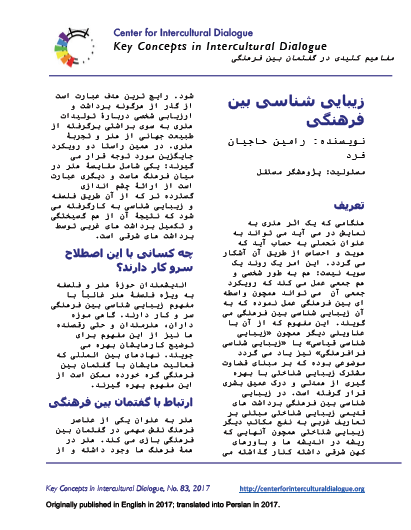
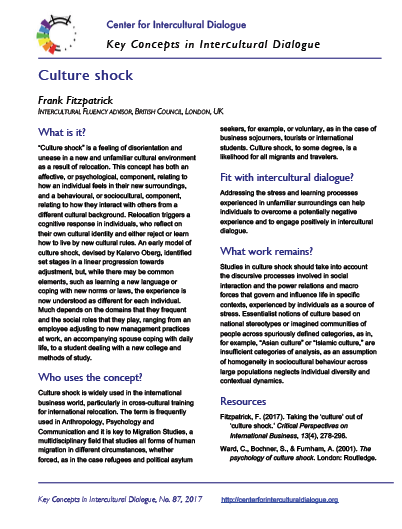
KC82: Convivencia by Kenneth Baxter Wolf

Key Concepts in ICDThe next issue of Key Concepts in intercultural Dialogue is now available. The goal is to expand the concepts available to discussions of intercultural dialogue. Click on the thumbnail to download the PDF. Lists organized chronologically by publication date and numberalphabetically by concept in English, and by languages into which they have been translated, are available, as is a page of acknowledgments with the names of all authors, translators, and reviewers.

KC82 ConvivenciaWolf, K. B. (2017). Convivencia. Key Concepts in Intercultural Dialogue, 82. Available from: https://centerforinterculturaldialogue.org/wp-content/uploads/2017/08/kc82-convivencia.pdf

The Center for Intercultural Dialogue publishes a series of short briefs describing Key Concepts in Intercultural Dialogue. Different people, working in different countries and disciplines, use different vocabulary to describe their interests, yet these terms overlap. Our goal is to provide some of the assumptions and history attached to each concept for those unfamiliar with it. As there are other concepts you would like to see included, send an email to the series editor, Wendy Leeds-Hurwitz. If there are concepts you would like to prepare, provide a brief explanation of why you think the concept is central to the study of intercultural dialogue, and why you are the obvious person to write up that concept.

Wendy Leeds-Hurwitz, Director
Center for Intercultural Dialogue


Creative Commons License
This work is licensed under a Creative Commons Attribution-NonCommercial-NoDerivatives 4.0 International License.

Loughborough U Job Ads: Communication and Interaction (UK)

Job adsThe Department of Social Sciences at Loughborough University has 2 jobs to announce. The job title (for both) is Lecturer in Communication and Interaction. Deadline: 3 September 2017.

Applications are invited from outstanding candidates with research interests that lie in social psychology, or a cognate social science discipline, that bear on communication and social interaction. The candidate should have teaching experience and be able to contribute to the delivery and development of BSc Social Psychology as well as the development of new MA degree pathways in communication and social interaction.

Candidates are expected to have a completed PhD in a social science discipline, an active research profile, the clear potential to contribute to the Department’s research culture, a strong commitment to high quality teaching in an HE environment, and to support the University Strategy, Building Excellence. The lectureship will commence as soon as possible following interview.

[NB: “Lecturer” in the UK system is equivalent to the North American “Assistant Professor” position]

U Edinburgh Job Ad: International Relations/Middle East

Job adsCareer Development Fellow in International Relations/Politics of the Middle EastUniversity of Edinburgh – Politics and International Relations. Closes: August 11, 2017

The University of Edinburgh seeks to appoint a Career Development Fellow in Politics/International Relations of the Middle East, in the School of Social and Political Science. Applicants should have recently obtained, or be close to obtaining, a PhD in a relevant area, and should provide evidence of ability to deliver excellent university-level teaching and research.

This full-time (35 hours per week), fixed-term post is available for three years from 1 September 2017.


CID Poster #5: Communication as Culture Definition

CID PostersThis is the next of the posters designed by Linda J. de Wit, in her role as CID intern. The painting is Winter Landscape with Ice Skaters, by Dutch painter Hendrick Avercamp, painted around 1608. It is on display in the Dutch national museum Rijksmuseum in Amsterdam, which has made many of its paintings available online in high resolution and copyright free. The painting illustrates the quote not only because it shows social interaction, but also because ice skating is considered a typical example of Dutch culture (and recently has officially been named part of Dutch cultural heritage). The silhouettes are designs from vecteezy.com. The quote comes from the following book:

Leeds-Hurwitz, W. (1989). Communication in everyday life: A social interpretation. Norwood, NJ: Ablex.

Communication as Culture

Just in case anyone wants to cite this poster, the following would be the recommended format:

Center for Intercultural Dialogue. (2017). Communication as culture definition. CID Posters, 5. Available from:
https://centerforinterculturaldialogue.org/wp-content/uploads/2017/07/communication.png

As with other series, CID Posters are available for free on the site; just click on the thumbnail to download a printable PDF. They may be downloaded, printed, and shared as is, without changes, without cost, so long as there is acknowledgment of the source.

As with other series, if you wish to contribute an original contribution, please send an email before starting any work to receive approval, to minimize inadvertent duplication, and to learn about technical requirements. As is the case with other CID Publications, posters should be created initially in English. Given that translations of the Key Concepts in Intercultural Dialogue have received so many views, anyone who wishes to translate their own poster into another language (or two) is invited to provide that as well. If you want to volunteer to translate someone else’s poster into a language in which you are fluent, send in a note before starting, to receive approval and to confirm no one else is working on the same one.

Wendy Leeds-Hurwitz
Director, Center for Intercultural Dialogue
intercult.dialogue AT gmail.com


Creative Commons License
This work is licensed under a Creative Commons Attribution-NonCommercial-NoDerivatives 4.0 International License.

Kenneth Baxter Wolf Profile

ProfilesKenneth Baxter Wolf is the John Sutton Miner Professor of History and Professor of Classics at Pomona College. He is also the creator and coordinator of the Late Antique-Medieval Studies (LAMS) program.

Kenneth WolfHe specializes in the history of the medieval Mediterranean, with particular interest in two areas: Christian sanctity and early Christian views of Islam. Among his publications are: Christian Martyrs in Muslim Spain (Cambridge, 1988); Making History: The Normans and their Historians in Eleventh-century Italy (Pennsylvania, 1995); and The Poverty of Riches: St. Francis Reconsidered (Oxford, 2003). He has also produced four book-length translations (from Latin): Conquerors and Chroniclers of Early Medieval Spain (Liverpool University Press, 1990; rev. 1999); The Deeds of Count Roger of Calabria and Sicily and of His Brother Duke Robert Guiscard (University of Michigan Press, 2005); The Life and Afterlife of St. Elizabeth of Hungary: Testimony from her Canonization Hearings (Oxford University Press, 2011); and The Eulogius Corpus (Liverpool University Press, 2019).


Work for CID:
Kenneth Baxter Wolf wrote KC82: Convivencia.