Backtalk: Artists on Native, African & African American Stereotypes

Intercultural Pedagogy

Backtalk: Artists on Native, African, and African American Stereotypes, Online exhibit, National Museum of African Art, Smithsonian Institution, Washington, DC, USA.

Backtalk: Artists on Native, African, and African American Stereotypes is part of a collaborative, broad-reaching examination on the persistence of racial and cultural stereotypes. Following the vision of Johnnetta Betsch Cole, director emerita, National Museum of African Art (NMAfA), to examine stereotypes across cultures, this online exhibition explores how select visual artists interrogate and engage racial and cultural stereotypes in their creative practice. The curatorial team chose to focus on a diverse group of artists from various backgrounds, geographies, and contexts who are represented in Smithsonian Institution collections and have addressed intersecting themes and subjects relevant to the impact of cultural and racial stereotypes. Backtalk features works by nine 20th- and 21st-century artists who capture, reflect, and/or speak back to the stereotype.

The project began as an examination of the ways in which artists are rewriting historical narratives that reinforce racial, cultural, and gender stereotypes through appropriation and subversion of the images traditionally used to stigmatize them. The pieces chosen are each in a Smithsonian collection and represent a range of strategies, including satire, parody, humor, and masking, in response to colonialist depictions of “the Other.” Audiences are invited to view the portrayals of race, gender, and culture in canonical Western paintings through a different lens—one in which the spectacle becomes the spectator and the passive subject becomes the agent. In the process, the power of artists to unveil and respond to social and cultural norms that perpetuate stereotypes is brought to life.

Related materials: KC55: Stereotypes provides a basic introduction to the topic intended to be accessible to undergraduates. This online exhibit would be a great extension of the topic for students.
CFP IAICS: Synergies in Intercultural communication (Macau)

ConferencesCall for papers, 28th International Conference of the International Association for Intercultural Communication Studies: Synergies in Intercultural Communication,  22-25 March 2023, City University of Macau, Macau, China. Deadline: 27 November 2022.

The City University of Macau (CityU Macau) and the International Association for Intercultural Communication Studies (IAICS) will host the 28th International Conference of the International Association for Intercultural Communication Studies on 22-25 March 2023 at CityU Macau, Taipa campus. This year the theme is “Synergies in Intercultural Communication: Languages, Professions and Heritages”. Organizers would like to invite scholars, educators, administrators, graduates, and undergraduate students from all disciplines of cultural sciences, and related fields, to submit proposals to the conference.

The IAICS Conference 2023 focuses on interdisciplinary research in intercultural communication, using a variety of methodology for intercultural communication research and disseminating practical findings to facilitate understanding across cultures. It intends to enhance global intercultural sensitivity and involve educators, business professionals, and students worldwide in effective and satisfying dialogues about diversity and transcultural communication issues.

Families in Global Transition E-poster Discussion (Online)

Events

E-poster discussion with Q&A, Families in Global Transition Research Network, 21 October 2022 at 3pm CEST/Vienna, 9am EDT/New York/ 9pm GMT+8 Singapore (Online via Zoom). Free with registration.

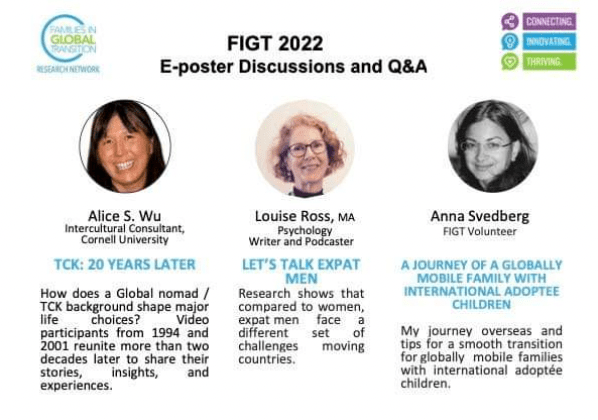
Everyone is invited to the FRN 1st FIGT 2022 E-poster Discussion and Q&A, which will be virtual webinar featuring 3 posters by Alice Wu (longitudinal study following TCK for 20 years), Louise Ross (comparison between expat women and men) and Anna Svedberg (the journey of a family with international adoptee). The posters are the proceeding from the FIGT 2022 conference.Families in Global Transition Research Network E-posters and Q&A

Institute for Study Abroad: Multiple Positions (UK, Argentina)

“Job Institute for Study Abroad (IFSA), (organization is based in Indiana, USA, but some positions are based in other countries). Deadlines vary by position.

  • Director, England and Wales Programmes (based in London; deadline: 22 November 2022)

    The Director of England and Wales Programmes is responsible for the development and leadership of all IFSA sites in England and Wales including the following: inspiring a commitment to first in class customer service for partners and students; ensuring high-quality programming that support student learning and satisfaction outcomes; delivering business results through creative and intentional programme design to support student learning; diversifying the program offering to meet market needs; leading team’s day-to-day programme administration; and growing relationships with host universities, industry, and other partners with a goal of increased enrollment.

  • Director, Argentina (based in Buenos Aires; deadline: open until filled)

    The Director is responsible for the strategic development and leadership including delivering results through creative and intentional program design to support student learning; leading team’s day-to-day program administration; and growing relationships with host universities, industry, and other partners with a goal of increased enrollment and delivery of high-quality programs that support student learning and satisfaction outcomes.

IFSA (Institute for Study Abroad), a US-based nonprofit organization, creates global learning environments to help students gather the critical perspectives, knowledge, and skills essential for future success. Other positions available here.

ASU: Intercultural Communication (USA)

“Job

Assistant Professor of Intercultural Communication, Arizona State University, Tempe, AZ, USA. Deadline: 11 November 2022.

The Hugh Downs School of Human Communication in the College of Liberal Arts and Sciences on the Tempe Campus of Arizona State University invites applications for a full-time, tenure-track position as Assistant Professor who will be required to teach in-person on the Tempe campus with an anticipated start date of August 2023. They are particularly interested in applicants whose scholarship and teaching focus is in intercultural communication and/or performance studies. Salary will be competitive based on qualifications.

Open Anthropology

Resources in ICD“ width=Open Anthropology, the first digital-only, public journal of the American Anthropological Association (AAA), is a pilot experiment envisioned as a way of “opening up” anthropology in several ways.

First, the new online publication helps bring anthropology into the public conversation about critical social issues and policy debates. Each edition of Open Anthropology will focus on a timely theme, offering a selection of articles relevant to contemporary concerns. By means of Open Anthropology, we hope anthropological knowledge, information and insights will figure more prominently in public discussions.

Second, the journal introduces nearly the full archive of AAA journals, past and current-the online “stacks,” so to speak-to potential readers who may not even know these exist. Content in Open Anthropology will be culled from the full archive of participating AAA publications, and curated into editions.

Third, each edition of Open Anthropology is made available free on the public Internet for a minimum of six months permitting any user to read, download, copy, distribute, print, search or link to the full text of the articles in each edition. Content published 35 years ago and longer will remain free on the public Internet in perpetuity; book reviews in Open Anthropology will also remain available on the Internet without cost to readers.

Finally, by means of “The Editor’s Note,” anthropology is opened up to the non-specialist reader by drawing attention to key issues or themes raised in the selected articles (some of which are written in highly technical language), and by identifying each article source-across time and subspecialties of the field-the author, the specialty journal, and the journal’s sponsoring section.

Issues to date have included Skin, Walls, Fences, and Barriers: Anthropology on the Border, and Cultural Heritage, among others.

iDiaspora Photo Contest

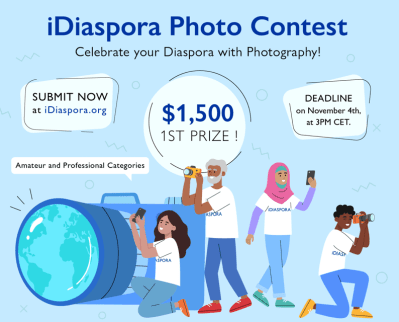
Photo ContestiDiaspora Photo Contest, International Organization for Migration, Geneva, Switzerland. Deadline: 4 November 2022.

iDiaspora photo contextThe International Organization for Migration (IOM) and IBER-RUTAS – Program that aims to contribute to the promotion of cultural diversity in Ibero-America for the protection of migrants’ rights from an intercultural perspective – invite professional and amateurs photographers to participate in the iDiaspora Photo Contest. Through this activity, the IOM and IBER-RUTAS seek to highlight the socio-cultural contributions of diasporas and migrant communities around the world and recognize their talent.

The principal theme of the contest is “Diaspora.” The IOM defines Diaspora as “Migrants or descendants of migrants whose identity and sense of belonging, either real or symbolic, have been shaped by their migration experience and background. They maintain links with their homelands, and to each other, based on a shared sense of history, identity, or mutual experiences in the destination country.”

(For further information on the topic, see Key Concepts in Intercultural Dialogue, 62: Diaspora.)


Robert Wood Johnson Foundation: Equality vs. Equity Graphic

Intercultural Pedagogy

There’s a wonderful graphic image of the difference between equality and equity, created by the Robert Wood Johnson Foundation.

RWJF Equality vs. equity graphic

Their concern is with the context of health, but presumably the same image would be valuable in discussing equality vs. equity in a wide range of contexts, including discussions of intercultural differences. (They ask that people share this image.)

Tamara Makoni provides one example of using the RWJF design within the context of discussing diversity, equity, and inclusion (DEI).

NOTE: A few years after the original poster was made public,  in response to feedback, RWJF created two new, different versions. They have also published the original version in Spanish.

CFP South Asian Media and Cultural Studies 2023 (USA)

ConferencesCall for Papers: South Asian Media and Cultural Studies Conference: #OneSouthAsia:
From Crisis to Resilience
, 3-4 February 2023 (hybrid), Florida State University, Tallahassee, FL. Deadline: 11 November 2022.

The 9th Annual Conference of South Asian Media and Communication Studies (SAMCS) conference, Feb. 3-4, 2023 focuses on the United Nations’ Sustainable Development Goals #16: Peace, Justice, and Strong Institutions, which promotes sustainability by supporting social justice, improved infrastructure, and an end to conflicts in countries around the world. Under the theme of “#OneSouthAsia: From Crisis to Resilience”, the conference aims to discuss the challenges that the region grapples with, and explore how media landscape, communication culture, and digital technologies can help to recover regional resilience.

The South Asian Media and Cultural Studies Conference (SAMCS) is an alliance of scholars, academicians, and practitioners dedicated to fostering greater understanding of the region’s global importance. The annual conference is held at the Center for Global and Multicultural Engagement, Florida State University, Tallahassee, FL. Organizers are glad to partner with the Department of Media Studies, CHRIST (Deemed to be University) Bangalore, India for the annual conference.

KC89 Xenophobia Translated into Turkish

Key Concepts in ICDContinuing translations of Key Concepts in Intercultural Dialogue, today I am posting KC89: Xenophobia which Anastasia Karakitsou wrote for publication in English in 2017, and which Candost Aydın has now translated into Turkish.

KC89 Xenophobia_Turkish

As always, all Key Concepts are available as free PDFs; just click on the thumbnail to download. Lists of Key Concepts organized chronologically by publication date and number, alphabetically by concept, and by languages into which they have been translated, are available, as is a page of acknowledgments with the names of all authors, translators, and reviewers.

Karakitsou, A. (2022). Xenofobia (Trans. C. Aydın). Key Concepts in Intercultural Dialogue, 89. Available from: https://centerforinterculturaldialogue.org/wp-content/uploads/2022/09/kc89-xenophobia_turkish.pdf

If you are interested in translating one of the Key Concepts, please contact me for approval first because dozens are currently in process. As always, if there is a concept you think should be written up as one of the Key Concepts, whether in English or any other language, propose it. If you are new to CID, please provide a brief resume. This opportunity is open to masters students and above, on the assumption that some familiarity with academic conventions generally, and discussion of intercultural dialogue specifically, are useful.

Wendy Leeds-Hurwitz, Director
Center for Intercultural Dialogue


Creative Commons License
This work is licensed under a Creative Commons Attribution-NonCommercial-NoDerivatives 4.0 International License.