Call For Abstracts: 9th Explorations in Ethnography, Language and Communication: Language, Inequality and the Everyday (Un)making of Alliances, Faculty of Education and Society, University College London (UK),
3rd -4th April 202 . Deadline: 21 October 2022.
The ninth EELC conference follows a series of global crises epitomised by moments of spectacular disruption, such as the so-called ‘2008 economic crisis’ or the ‘COVID-19 pandemic’. But far from representing isolated events, these build on long-standing processes, practices and experiences of inequality which are increasingly at the centre of more and more people’s daily lives. The conference aims to provide a platform to reflect on the types of alliances that ethnographic and language scholarship might be able to generate in the (un)making of such inequalities.
The confirmed keynote speakers and featured workshop organisers are:
Dr Julia Snell, University of Leeds (UK)
Dr Daniel Silva, Universidade Federal de Santa Catarina (Brazil)
Dr Beatriz Lorente, University of Bern (Switzerland)
Dr Lian Malai Madsen, University of Copenhagen (Denmark)
Dr Jackie Jia Lou, Birkbeck University of London (UK)
The important role of bilingual education and storytelling in the social development of young students have been two recurring themes running throughout the first week of my summer study abroad program on United Kingdom: Intercultural Perspectives in Teaching and Learning at NYU London (July 4-18, 2022).
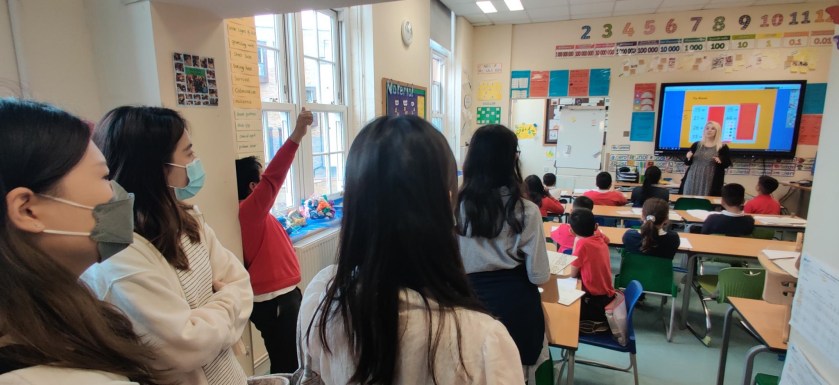
Summer study abroad students from NYU observing a class in session at Mayflower Primary School in London. (Photo credit: Casey Lum)
In her guest lecture to my students on “Rethinking Teaching Languages in European Schools (with a Focus on England): A Healthy Linguistic Diet Approach,” Dina Mehmedbegovic-Smith (July 5) emphasized the importance of bilingual education among the young in the United Kingdom nowadays. This topic was shared by Nicky Busch (July 6) in her special presentation on “The Intersectional Dynamics of Immigration, Intercultural Education, and Intergroup Relations in the United Kingdom,” in which she similarly acknowledged how acquiring English as a second or additional language can help immigrant students gain a voice of their own in their intercultural adaptation to life in the UK.
Our understanding of the above ideas – and many more others that this brief post simply cannot include – has been greatly enhanced by what my students and I witnessed “on the ground level” during our field visit at the Mayflower Primary School, a public school located in the eastern borough of Tower Hamlets in London. While the 2011 census in the UK reported that about one-third of the borough’s population came from Bangladesh, about 90% of the students at Mayflower Primary today are Bangladeshi. Many come from low-income families with a relatively low level of literacy, with parents who are not fluent in spoken English. These are some of the reasons why the school has adopted an approach that emphasizes developing their students’ competence in reading and storytelling in English. At the same time, the teachers encourage their students’ families to speak in their home language, in part to help promote bilingual fluency among the students.
From one practical (or pragmatic) perspective, the emphasis on reading is meant to help the students become savvy information seekers and users for personal and professional development purposes. On the other hand, it is believed that a high level of oracy – with a high degree of competence in taking in one’s experience of the world around them and then in being able to articulate or tell “stories” about their experience orally – can help the young build a solid foundation for acquiring writing skills.
But the above teaching and learning strategies do not and most likely will not automatically or by default lead to the development of students’ competency in intercultural communication, adaptation, or dialogue. For example, Heba Al-Jayoosi, the Assistant Head (Inclusion) at Mayflower Primary School, suggests that many of the parents have never been to London Bridge, which is not far from home. Hence, the school has embarked on a project to take the students and their families on a field trip to London Bridge. Such co-curricular activities are meant to help them gain more exposure to the larger social and cultural environment and help them better adapt. These field trips (similar to my current study abroad program in London) set the stage for follow-up discussion or storytelling among the participants afterward.
Casey Man Kong Lum, Associate Director
Center for Intercultural Dialogue
Applications are invited for the teaching and research post of Lecturer in Intercultural Communication. The post is tenable from 1 September 2022, or as soon as possible thereafter, and offered on an open-ended basis. The appointed person will teach in the MA programme in Intercultural Communication. You must have a PhD (awarded) in a relevant field and demonstrable teaching experience in Intercultural Communication at university level as well as in curriculum/programme development.
You must be able to deliver courses that successfully cover or combine the study of several of the following:
Intercultural communication in the context of crisis communication, diplomacy, international development, international migration
Intercultural communication in international media production and consumption
Intercultural communication in business or institutional contexts
Intercultural communication in transnational popular culture
Intercultural competence skills training
Critical intercultural communication in social identity formation / social movements
Postcolonial intercultural communication
Your research may focus on any aspect of Intercultural Communication. Only applicants with high quality publications will be considered. A successful record of grant capture and of PhD supervision would be highly advantageous. Experience with virtual learning environments and in developing online teaching materials is essential. Expertise in translation studies and/or foreign language proficiency would be beneficial. You must have excellent interpersonal skills and be able to empathise with students.
The Centre for Social Studies at the University of Coimbra calls for applications for one position for a research assistant (at the MA level) within the project “UNCHARTED-Understanding, Capturing and Fostering the Societal Value of Culture”, funded by the Research Executive Agency of the European Commission, and coordinated by the Principal Investigator Nancy Duxbury.
The UNCHARTED project is a research and innovation action about understanding, capturing and fostering the societal value of culture. In recent decades, with the growing emphasis on the creative economy, culture has tended to be increasingly seen in political circles under the exclusive lens of the economy and its contribution to it. To counteract this tendency, it is necessary to define the social values associated with culture on a different basis from the traditional one. The work focuses on the valuation practices of the actors involved in cultural life. In this respect, three areas and three types of fundamental actors in the value dynamics of culture are distinguished: i. the field of cultural participation, in which citizenship is the protagonist; ii. the field of cultural production and heritage, where the professionals of creation and preservation are the ones who take the initiative; iii. the field of cultural administration, in which it is the experts and politicians who decide. These are the starting point to structure the study of the different aspects involved in this evaluative dynamic: the emergence of values, the configuration of a value order, and the political impulse of values.
The ICC programme is pleased to open the registrations for the webinar “Intercultural competence training for local officials – Why and how”. The webinar will be held on Thursday 7 July 2022 from 3 pm to 5 pm (CEST). It is open to the public, and free to attend. This event will present the benefits of intercultural competence training for city staff and zoom in on how cities can work to implement large scale training for all local officials. The webinar will combine presentations from cities, ICC experts and ongoing projects to present the many ways intercultural competence training can be implemented across local authorities. Don’t forget to register if you want to be kept informed about the webinar and receive the link to attend.
UNESCO invites individuals, civil society actors, governmental and non-governmental entities active in strengthening foundations for peace and tolerance to propose candidates for the 2022 UNESCO-Madanjeet Singh Prize for the Promotion of Tolerance and Non-Violence. The deadline for submissions is extended until 15 July 2022 at midnight (GMT +2). Awarded every two years, on the International Day for Tolerance (16 November), the Prize is marked by a ceremony and the winner is presented with the sum of US$ 100,000.
The Prize was established in 1995 on the occasion of the United Nations Year for Tolerance and the 125th anniversary of the birth of Mahatma Gandhi. It was also the year when UNESCO Member States adopted the Declaration of Principles on Tolerance. It bears the name of its benefactor Madanjeet Singh, who was a UNESCO Goodwill Ambassador, Indian artist, writer and diplomat.
Its purpose is to reward women, men, institutions, other entities or non-governmental organizations that have made exceptional contributions and demonstrated leadership in the promotion of tolerance and non-violence.
The Council of Europe’s Intercultural Cities Programme has documented extensive examples of good practice, and made them publicly available.
The Intercultural city aims at building its policies and identity on the explicit acknowledgement that diversity can be a resource for the development of the society. The first step is the adoption (and implementation) of strategies that facilitate positive intercultural encounters and exchanges, and promote equal and active participation of residents and communities in the development of the city, thus responding to the needs of a diverse population. The Intercultural integration policy model is based on extensive research evidence, on a range of international legal instruments, and on the collective input of the cities member of the Intercultural Cities programme that share their good practice examples on how to better manage diversity, address possible conflicts, and benefit from the diversity advantage. This section of their website offers examples of intercultural approaches that facilitate the development and implementation of intercultural strategies.
The Intercultural cities programme supports local and regional authorities worldwide in reviewing their policies through an intercultural and intersectional lens, and accompany them developing comprehensive intercultural strategies to help them manage diversity positively and realise the diversity advantage. The programme proposes a set of analytical and practical tools to help local stakeholders through the various stages of the process.
Launching in 2024 as a journal of the National Communication Association, Communication and Race welcomes submissions that address theorizations of race infrequently published elsewhere. Communication and Race rejects the idea that race is relevant only in reaction to recently publicized events of racism. Instead, the journal’s point of departure is that race plays a significant role in the global circulation of epistemological, political, social, and economic relations. Communication and Race assumes that the serious study of race is of value for a collective push toward thinking about new forms of humanity, far beyond Western race, while also developing a rigorous understanding of Western racial practices. Communication and Race strives to play a central role in imagining a different world, which does not ascribe a higher reality to Europe and its limited classifications of humanity.
While emerging from the field of communication studies, Communication and Race encourages submissions from across the disciplines, with an eye toward fresh theorizations of race. Such approaches may be rhetorical, media analytic, quantitative, qualitative, philosophical, historical and historiographic, (auto)ethnographic, performative, and more. Topics and areas of interest include, but are not limited to, the following:
Global poverty and debt
(Neo)colonialism and decolonization
Climate crises
Robotics and AI
Information economies
Migration, borders, and refugees
Militarism and (anti)imperialism
Finance and consumer capitalism
Labor and unionization
Media archaeology and ecology
Gender and sexuality
Law and legal studies
Nuclear power
Health communication
State-sanctioned violence
Mass incarceration
Nationalism
Fascism
Religion and secularism
Education and knowledge production
Intellectual histories
Literature
Media technology and infrastructure
Essays will be peer reviewed, and should be submitted in MS Word, be no more than 9,000 words long, and should adhere to the most recent edition of the Chicago Manual of Style in bibliographical endnote format. They must not be under review elsewhere or have appeared in any other published forms. The journal’s submission site is forthcoming. For any questions about the journal or the submissions process, or to submit a piece, please email the Editor Armond Towns.
I will be directing and teaching a short-term summer study abroad program for New York University’s Steinhardt School of Education, Culture, and Human Development. Entitled “United Kingdom: Intercultural Perspectives in Teaching and Learning,” the program will be based at NYU London (July 4-18, 2022).
I have invited four distinguished colleagues to share their insights with students from NYU’s main campus on Washington Square in New York City. They include Nicky Busch (NYU London) on The Intersectional Dynamics of Immigration, Intercultural Education, and Intergroup Relations in the UK; Myria Georgiou (London School of Economics and Political Science) on Remote Teaching and Learning during the COVID-19: Challenges and Opportunities; Dina Mehmedbegovic-Smith (University College London) on Language Education in the UK; and Maria Tsouroufli (Brunel University London) on Gender Inequality in Education in the UK.
You will deliver The Hunterian’s three-year programme, ‘Power in this Place: Unfinished Conversations’ funded by the Esmée Fairbairn Foundation. Building on the transformational ‘Curating Discomfort’ project, the Curator of Unfinished Conversations will work across collections and organisation to embed anti-racist, participatory approaches in The Hunterian and the wider university communities with which the museum and gallery work.
The post will seek to restore social capital appropriated through two centuries of collecting to communities, locally and internationally and will ensure that The Hunterian’s own processes undergo fundamental and permanent re-alignment around race and equality issues. Impacts will be delivered beyond The Hunterian, facilitating new critical strategic dialogues at senior levels across the University of Glasgow and in Scotland’s cultural sector and beyond.





 Center for Intercultural Dialogue