
KC54: Critical Moments Translated into Turkish

Key Concepts in ICDContinuing translations of Key Concepts in Intercultural Dialogue, today I am posting KC#54: Critical Moments, which Beth Fisher-Yoshida wrote for publication in English in 2015, and which Candost Aydın has now translated into Turkish.

As always, all Key Concepts are available as free PDFs; just click on the thumbnail to download. Lists of Key Concepts organized chronologically by publication date and number, alphabetically by concept, and by languages into which they have been translated, are available, as is a page of acknowledgments with the names of all authors, translators, and reviewers.
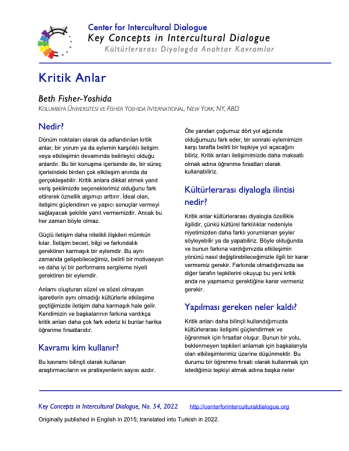
KC54 Critical moments_TurkishFisher-Yoshida, B. (2022). Critical moments [Turkish]. (C. Aydın, trans). Key Concepts in Intercultural Dialogue, 54. Retrieved from: https://centerforinterculturaldialogue.org/wp-content/uploads/2022/06/kc54-critical-moments_turkish.pdf

If you are interested in translating one of the Key Concepts, please contact me for approval first because dozens are currently in process. As always, if there is a concept you think should be written up as one of the Key Concepts, whether in English or any other language, propose it. If you are new to CID, please provide a brief resume. This opportunity is open to masters students and above, on the assumption that some familiarity with academic conventions generally, and discussion of intercultural dialogue specifically, are useful.

Wendy Leeds-Hurwitz, Director
Center for Intercultural Dialogue


Creative Commons License
This work is licensed under a Creative Commons Attribution-NonCommercial-NoDerivatives 4.0 International License.

U Edinburgh: Language Education (UK)

“JobTwo positions in Language Education, The Institute for Language Education, Moray House School of Education and Sport, University of Edinburgh, Edinburgh, UK. Deadline: 24 or 27 June 2022, depending on position.

1. Teaching Fellow in Language Education, with a deadline of 27 June 2022.

The Moray House School of Education and Sport invites applications for the position of Teaching Fellow in Language Education. The successful applicant will have interdisciplinary academic expertise at post-doctoral level in the area of Language and Intercultural Communication, as well as in one or more other areas related to Language Education. S/he will be expected to contribute to their highly successful Masters level teaching programmes (MSc Language and Intercultural Communication, MSc Language Education, MSc TESOL) and to undertake interdisciplinary scholarship activity in the area of Language and Intercultural Communication. The post requires a culturally sensitive vision that reflects a commitment to social justice and the provision of high-quality student experience.

2. Senior Lecturer in Language Education, with a deadline of 24 June 2022.

The Moray House School of Education and Sport invites applications for the position of Senior Lecturer in Language Education. The successful applicant will be expected to contribute to our highly successful Masters level teaching programmes (MSc TESOL, MSc Language Education, MSc Language and Intercultural Communication), to the supervision of doctoral students, and to secure research grants through our Language Education Thematic Research Hub aligned with REF high quality research outputs. The post requires a culturally sensitive vision that reflects a commitment to social justice and the provision of high-quality student experience.

Newcastle U: Intercultural Communication (UK)

“Job

Lecturer in Intercultural Communication, Newcastle University, Newcastle upon Tyne, England, UK. Deadline: 24 June 2022.

The School of Education, Communication and Language Sciences (ECLS) is seeking to appoint a Lecturer in Intercultural Communication. The successful applicant will be part of a diverse and collegiate team of academics, researchers and professional support staff delivering high quality teaching and research in the Applied Linguistics & Communication (ALC) subject area. You will have a strong background in Intercultural Communication and will have expertise in international workplaces, virtual exchange, migration and mobility, or minoritised communities.

You will carry out high quality research in the area of Intercultural Communication, contributing to the profile and research culture of the ALC subject area, the School of ECLS, and the relevant research centres and institutes across the University.

You will make a significant contribution to teaching, personal tutoring, and supervision within the ALC subject area, particularly on the suite of MA Cross-Cultural Communication programmes, and also at undergraduate level. Preferably, you will have experience of teaching Sociolinguistics and/or Research Methods at postgraduate level. You will, where appropriate, make a contribution to academic administration within the School.

CFP Un:real Spaces of Interaction (Germany)

ConferencesCall for abstracts: Graduate Conference 2022: un:real Spaces of Interaction: Forms of Social Order in the Spectrum of Media-specific Interaction, 4-5 November, 2022, Brandenburg Centre for Media Studies, Potsdam, Germany. Deadline: 30 June 2022.

The graduate student conference “un:real Spaces of Interaction. Forms of Social Order in the Spectrum of Media-specific Interaction” focuses on media-specific interaction spaces and the construction of social orders and realities. Therefore, the overarching question of the conference is concerned with the emergence, change, and shaping of interaction spaces in the spectrum between human-human and human-machine, in which actors communicate with each other through or with technologies.

Recently, the COVID-19 pandemic has given new importance to understanding and thinking about interaction spaces, online and offline. Following Erving Goffman’s notion of interaction and related key aspects of interactions, we consider how media-specific interactions are understood and analysed within media studies and media linguistic perspectives. Possible approaches include interface studies and affect theory as well as sociolinguistic studies of human-machine interaction and multimodal interaction analysis. Despite the different theoretical and methodological approaches, it becomes clear that interaction in, with, or through media makes sociocultural transformations visible. They unfold in the form of new social realities “such as virtual space[s], public spheres, or popular culture, which are hardly conceivable without media-based mediation” (Marx/Schmidt 2019, 12). These spaces of interaction move at the intersections of analogue and digital, online and offline, human and machine, real and unreal.

The conference is intended to provide a space in which Master’s students of higher semesters (from 3rd semester) and doctoral candidates from the fields of media linguistics and media studies, but also other associated humanities with relevance to media studies such as sociology, political science, aesthetics and art history, film studies, cultural studies, journalism, philosophy, science and technology studies, or cognitive science can present their research work.

NOTE: While this call does not specifically request work relating to intercultural dialogue, the topic seems particularly appropriate for it.

U Tübingen: Postdoctoral Researcher in Migration (Germany)

Postdocs
Postdoctoral Researcher (Migration), Institute of Political Science, University of Tübingen, Germany.  Deadline: 30 June 2022.

The University of Tübingen is one of Europe’s oldest and most prestigious research universities. The Research Unit Comparative Public Policy at the Institute of Political Science of the University of Tübingen invites applications for a Post-doctoral Researcher / Fixed-term Lecturer Post (d/f/m) for the duration of 2 years from 1 October 2022 (or as soon as possible thereafter). The successful candidate will contribute to the research and teaching portfolio of the Comparative Public Policy Research Unit as well as to third-party funding applications and will be given the opportunity to pursue a Habilitation. Essential requirements include research interest in bureaucratic and administrative barriers for migrants in accessing social rights.

Lisle International: Global Seed Grant Program 2022

GrantsGlobal Seed Grants, Lisle International, Leander, TX, USA. Deadlines: Last date to Request to apply: August 1, 2022; Completed application: September 1, 2022.

Do you have a project idea that will bring people of diverse backgrounds together for shared learning? Lisle International provides Global Seed Grants to support innovative projects which advance intercultural understanding through shared experiences, with the goal of creating a more just social order. Projects may seek to bridge a variety of community divides, including ethnic, cultural, religious, racial or gender perspectives, anywhere in the world.

Lisle International was an early pioneer in intercultural education programming, beginning with US projects in 1936 and expanding internationally in 1952. Since 2004, Lisle has focused on providing small “seed grants” to support programs fostering intercultural understanding.

Grants of $500 to $5,000 are available to innovative projects that match the mission of Lisle. Lisle awards between three and eight grants each year to projects in the Americas, Europe, Asia and Africa.

The Culturally Intelligent Organization (Webinar)

EventsThe culturally intelligent organization by Mercedes Naficy D’Angelo and Nitin Deckha, SIETAR Tri-State group, 22 June 2022, 11am-12pm EST.

The SIETAR Tri-State group (New York, New Jersey, Connecticut) has organized another webinar, and CID followers are again invited to participate.

This session explores how to create an intentional culture of inclusion strategically. Addressing DEI is not about checking the box by simply offering training. While training is an important element in a DEI program, taking the pulse of an organization’s current culture, via a “Lived Experience Survey” and focus groups, offers valuable insight into the examining the dimensions of diversities in an organization, which can then be leveraged to enhance an organization’s diversity, equity and inclusion strategy. This involves identifying the strengths and weaknesses of an organization’s culture and subsequently designing programs to address those weaknesses, thereby providing a more effective DEI approach. Furthermore, when senior leadership better understand the complexity and range of their organization’s culture, they are more able to see the intersections of cultural identities and experiences and the importance of building equity and inclusion with intention and purpose. This culturally-intelligent strategic approach offers greater accountability and with more immediate results.

Mercedes Naficy D’Angelo has consulted with global HR for more than 20 years, designing customized solutions for supporting their talent management needs.

Nitin Deckha holds a PhD in Anthropology from Rice University (Houston, TX), a Master’s Certificate in Adult Training and Development from York University’s Schulich Executive Education Centre and is a Certified Training Development Professional (CTDP).

KC52 Harmony Translated into Turkish

Key Concepts in ICDContinuing translations of Key Concepts in Intercultural Dialogue, today I am posting KC#52: Harmony, which Guo-Ming Chen wrote for publication in English in 2015, and which Candost Aydın has now translated into Turkish.

As always, all Key Concepts are available as free PDFs; just click on the thumbnail to download. Lists of Key Concepts organized alphabetically by conceptchronologically by publication date and number, and by languages into which they have been translated, are available, as is a page of acknowledgments with the names of all authors, translators, and reviewers.

KC52 Harmony_TurkishChen, G.-M. (2022). Harmony [Turkish]. (C. Aydın, trans). Key Concepts in Intercultural Dialogue, 52. Available from: https://centerforinterculturaldialogue.org/wp-content/uploads/2022/06/kc52-harmony_turkish.pdf

If you are interested in translating one of the Key Concepts, please contact me for approval first because dozens are currently in process. As always, if there is a concept you think should be written up as one of the Key Concepts, whether in English or any other language, propose it. If you are new to CID, please provide a brief resume. This opportunity is open to masters students and above, on the assumption that some familiarity with academic conventions generally, and discussion of intercultural dialogue specifically, are useful.

Wendy Leeds-Hurwitz, Director
Center for Intercultural Dialogue


Creative Commons License
This work is licensed under a Creative Commons Attribution-NonCommercial-NoDerivatives 4.0 International License.
U Otago: Communication Studies (New Zealand)

“Job

Lecturer/Senior Lecturer in Communication Studies, University of Otago, Dunedin, New Zealand. Deadline: 3 July 2022.

The University of Otago is seeking to appoint an outstanding Lecturer / Senior Lecturer in Communication Studies to join Pāpāho, Whitiāhua, Pārokoroko/the Media, Film and Communication programme, in Te Wai Pounamu, the stunning South Island of Aotearoa New Zealand. The role is a full time, permanent (confirmation path) position. The successful candidate will contribute to critical cultural and communication research and teaching. This involves developing curriculum at the undergraduate level, supervising postgraduate students, and carrying out independent research.

As a programme they aim to bring Māori culture into an intersectional dialogue with broader issues of representation, race, ethnicity, gender, sexual orientation, and political agency through the study of Media, Film and Communication. As a result, they will welcome applications from outside New Zealand, and particularly welcome applications from Māori and Pacifika scholars with research interests in any area of Communication Studies.


King’s College London: Sociolinguistics (UK)

“Job

Lecturer in Sociolinguistics, School of Education, Communication and Society, King’s College London, London, UK. Deadline: 22 June 2022.

The School of Education, Communication and Society is advertising a 12-month fixed-term lectureship in Sociolinguistics on King’s Academic Education Pathway (AEP). The School is looking for an individual who can make an exceptional contribution to the Centre for Language, Discourse and Communication (LDC). LDC is a major UK centre for Sociolinguistics, Discourse Studies and Applied Linguistics. The centre offers BA, Masters and Doctoral programmes.

Candidates will hold a PhD in Linguistics, Sociolinguistics, Applied Linguistics, or a closely related area. They will be expected to contribute to UG and PGT teaching and supervision, primarily in the area of sociolinguistics. They will be contributing to the teaching on the MA Language and Cultural Diversity, including modules such as ‘Language and Power’ and ‘Linguistic Politeness’ as well as research methods. The role holder will have experience of teaching at PG and/or UG level in the area of Applied and Sociolinguistics, and they will have a passion for teaching and an interest in innovation in teaching and learning.

They particularly welcome candidates from Black, Asian and minority ethnic backgrounds to reflect the community they serve.