KC53 Conflict Management Translated into Greek

Key Concepts in ICDContinuing translations of Key Concepts in Intercultural Dialogue, today I am posting KC#53: Conflict Management, which Qi Wang wrote for publication in English in 2015, and which Anastasia Karakitsou has now translated into Greek.

As always, all Key Concepts are available as free PDFs; just click on the thumbnail to download. Lists of Key Concepts organized chronologically by publication date and number, alphabetically by concept, and by languages into which they have been translated, are available, as is a page of acknowledgments with the names of all authors, translators, and reviewers.
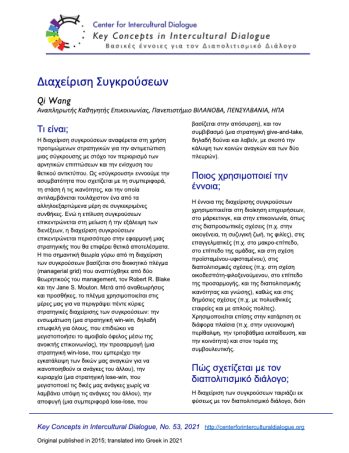
KC53 Conflict management_GreekWang, Q. (2018). Conflict management [Greek]. (A. Karakitsou, trans). Key Concepts in Intercultural Dialogue, 53. Available from: https://centerforinterculturaldialogue.org/wp-content/uploads/2021/03/kc53-conflict-management_greek.pdf

If you are interested in translating one of the Key Concepts, please contact me for approval first because dozens are currently in process. As always, if there is a concept you think should be written up as one of the Key Concepts, whether in English or any other language, propose it. If you are new to CID, please provide a brief resume. This opportunity is open to masters students and above, on the assumption that some familiarity with academic conventions generally, and discussion of intercultural dialogue specifically, are useful.

Wendy Leeds-Hurwitz, Director
Center for Intercultural Dialogue


Creative Commons License
This work is licensed under a Creative Commons Attribution-NonCommercial-NoDerivatives 4.0 International License.
Fulbright in the Classroom

Fulbrights

Call for Volunteers and Grant Applicants, Fulbright in the Classroom, Department of State, Washington, DC. Deadline: May 1, 2021.

For those who have been affiliated with the Fulbright Program, there is an opportunity to promote international understanding by sharing your Fulbright experiences with K-through-College students through Fulbright in the Classroom. All Fulbrighters are welcome to participate, especially recently returning students and ETAs, and visiting grantees. By participating in Fulbright in the Classroom, you can bring a personal perspective on the country you visited or share information about your home country. Please note that you must be a member of the Fulbright Association to participate in FIC or to apply for the grant.

You may participate as (1) a volunteer in your own area, and/or (2) apply for a $750 Fulbright Classroom Grant to reach out digitally to under-represented communities nationwide. Fulbright in the Classroom is primarily an education outreach program, but it will also raise the profile of the Fulbright Program. The goal is to benefit especially communities who are not fully represented in the Program by inspiring future applicants. There is a webinar on March 18 to learn more about the grant and its application.

NOTE: Fulbrighters are also invited to participate in the 75th Anniversary classroom program administered by the State Department (only for the year 2021). Click here to register.

CFP Critical Intercultural Communication Studies

“Publication

Call for Proposals: Critical Intercultural Communication Studies Book Series, Peter Lang. Series Editors: Thomas Nakayama and Bernadette Calafell.

Critical approaches to the study of intercultural communication have arisen at the end of the 20th century and are poised to flourish in the new millenium. As cultures come into contact driven by migration, refugees, the internet, wars, media, transnational capitalism, cultural imperialism, and more, critical interrogations of the ways that cultures interact communicatively are a needed aspect of understanding culture and communication. This series will interrogate – from a critical perspective – the role of communication in intercultural contact, in both domestic and international contexts. Through attentiveness to the complexities of power relations in intercultural communication, this series is open to studies in key areas such as postcolonialism, transnationalism, critical race theory, queer diaspora studies, and critical feminist approaches as they relate to intercultural communication. Proposals might focus on various contexts of intercultural communication such as international advertising, popular culture, language policies, hate crimes, ethnic cleansing and ethnic group conficts, as well as engaging theoretical issues such as hybridity, displacement, multiplicity, identity, orientalism, and materialism. By creating a space for these critical approaches, this series will be a the forefront of this new wave in intercultural communication scholarship. Manuscripts and proposals are welcome which advance this new approach.

ICD Exercise #2

ICD ExercisesThe next ICD Exercise is now available. Maura Di Mauro has written about Developing (multi)cultural identity and global citizenship.

ICD Exercise 2 Di MauroDi Mauro, M. (2021). Developing (multi)cultural identity and global citizenship. Intercultural Dialogue Exercises, 2. Available from: 
https://centerforinterculturaldialogue.org/wp-content/uploads/2021/02/icd-exercise-2-di-mauro.pdf

If you have an exercise you’ve used that works, and you would like to share it, please submit it. All authors will be asked to answer the same set of questions, and to make the exercises available for others to use, thus these are being published with a Creative Commons license (as is the case for all CID publications). If you are new to CID, please provide a brief resume. This opportunity is open to masters students and above, on the assumption that some familiarity with academic conventions generally, and discussion of intercultural dialogue specifically, are useful.

Wendy Leeds-Hurwitz, Director Center for Intercultural Dialogue


This work is licensed under a Creative Commons Attribution-NonCommercial-NoDerivatives 4.0 International License.
Anna Lindh Foundation: Communication Officer (Egypt)

“Job

Communication Officer, Anna Lindh Foundation, Alexandria, Egypt (may start remotely due to the pandemic). Deadline: 15 March 2021.

The Anna Lindh Foundation is seeking to appoint a Communication Officer as a member of its team. They are looking for a dynamic and professional who shares our values and is passionate about scaling – up the impact and reach of intercultural action and voices across the Mediterranean region. The communication officer will support enhancing the Foundations’ media profile in publications and its presence on social media, handle news to the Foundation’s stakeholders, manage the Foundation’s website, support in developing communication and media strategies through different information, communication, visibility activities and tools, such as publications, website, social media, press relations, multimedia, etc. to communicate impact.

Arizona State U: Director of Global Initiatives (USA)

“JobDirector of Global Initiatives, Walter Cronkite School of Journalism and Mass Communication, Arizona State University, Phoenix, Arizona.  Deadline: March 10, 2021.

The Walter Cronkite School of Journalism and Mass Communication at Arizona State University is conducting an international search for a Director of Global Initiatives to lead the School’s growing international education and outreach initiatives. The Director will be responsible for managing the office of Cronkite Global Initiatives as well as leading the School’s curricular and co-curricular international efforts.

For nearly two decades, Cronkite Global Initiatives has fostered meaningful connections among Cronkite students, staff and faculty and international media professionals, scholars and citizens and worked to advance the practice and teaching of journalism and media communications around the world. The Cronkite School is home to the Hubert H. Humphrey Fellowship program in journalism.

Fulbright Teachers for Global Classrooms (USA)

Fulbrights2021-2022 Fulbright Teachers for Global Classrooms (Fulbright TGC) Program, US Department of State, Washington, DC. Application deadline: March 24, 2021.

The Fulbright Teachers for Global Classrooms Program is a yearlong professional learning opportunity and short-term exchange for elementary, middle, and high school educators from the United States to develop skills to prepare students for a competitive global economy. Fulbright Teachers for Global Classrooms equips educators to bring an international perspective to their schools through targeted training, experience abroad, and global collaboration.

Fulbright Teachers for Global Classrooms participate in a rigorous, semester-long online course focused on best practices in global education; gather for an in-person professional development workshop in Washington, D.C.; and travel abroad for two to three weeks to immerse themselves in another country’s culture and education system. Participants create a global education guide that serves as a resource in their local community to share the skills, experiences, and resources they have developed throughout the program.

Access more than 350 resource guides created by Fulbright TGC alumni in the Global Education Guides Resource Library.

KC16: Migration Translated into Spanish

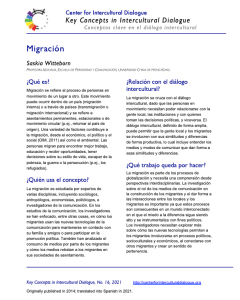
Key Concepts in ICDContinuing translations of Key Concepts in Intercultural Dialogue, today I am posting KC#16: Migration, which Saskia Witteborn wrote for publication in English in 2014, and which Daniel Mateo Ordóñez has now translated into Spanish.

As always, all Key Concepts are available as free PDFs; just click on the thumbnail to download. Lists of Key Concepts organized chronologically by publication date and number, alphabetically by concept, and by languages into which they have been translated, are available, as is a page of acknowledgments with the names of all authors, translators, and reviewers.

KC16 Migration_Spanish


Witteborn, S. (2021). Migración. (Trans. D. M. Ordóñez). Key Concepts in Intercultural Dialogue, 16. Available from: https://centerforinterculturaldialogue.org/wp-content/uploads/2021/03/kc16-migration_spanish.pdf

If you are interested in translating one of the Key Concepts, please contact me for approval first because dozens are currently in process. As always, if there is a concept you think should be written up as one of the Key Concepts, whether in English or any other language, propose it. If you are new to CID, please provide a brief resume. This opportunity is open to masters students and above, on the assumption that some familiarity with academic conventions generally, and discussion of intercultural dialogue specifically, are useful.

Wendy Leeds-Hurwitz, Director
Center for Intercultural Dialogue


Creative Commons License
This work is licensed under a Creative Commons Attribution-NonCommercial-NoDerivatives 4.0 International License.
Musicosophia: Listening as a Necessary Part of Intercultural Dialogue

Applied ICDEscuela Internacional de Musicosophia, in Germany, trains people to listen deeply to classical music. They have suggested that their training may well be relevant to intercultural dialogue, and have shared steps and a meditation video with CID.

The 2020 CID Video Competition asked students to focus on listening, as listening is how intercultural dialogue starts. Listening is what happens when people stop focusing on what they say or do, and start attending to what someone else is saying or doing. Without listening, there can be no intercultural dialogue.

Putting these two together suggests that spending a little time learning to listen carefully to classical music might be useful training for engaging in intercultural dialogue. First, read the steps. Then, view the videotape by clicking on the image above. Try it and let us know what you think.

CFP NAMLE: Media Literacy & Social Justice (Online)

ConferencesCall for Proposals, National Association for Media Literacy Education (NAMLE): Media Literacy and Social Justice, Online,  July 16 – 18, 2021. Deadline: March 14, 2021.

CFP NAMLE 2021

Media literacy has many connections with social justice; in fact, many would say that media literacy is social justice. Specifically, media literacy helps us to understand the relationships between media, information, and power; this is often referred to as critical media literacy. The process of developing media literacy skills helps us to decipher what a piece of media wants you to believe and why, who benefits from you believing it, whose perspectives are valued in mainstream media, whose perspectives are marginalized or missing, and how we might elevate them. It helps us to unpack stereotypes and circulate ideas about various groups. Media literacy promotes inquiry into the effects that propaganda and mis/dis-information have on our politics and how they perpetuate injustices against marginalized groups, the environment, and our sociopolitical climate. In sum, media literacy helps us to understand issues of systemic inequity and who benefits from their maintenance, while also inspiring action, critical change, and the democratization of media industries. Given all of these connections, NAMLE finds it extremely salient to organize a conference around the topic of Media Literacy + Social Justice.

Proposals will be given special consideration if they (1) articulate concrete connections to social justice, and (2) offer a fresh point of view of an issue within the field of media literacy education.