Royal Roads University & Cultural Identity 2016

I spent July, August and September 2016 teaching a graduate seminar at Royal Roads University, located in Victoria, BC, Canada, as part of their Master of Arts in International and Intercultural Communication (MAIIC) for the second time (the first time was described a year ago). The course was Contemporary Issues in Communication: Cultural Identity. The 39 students came from China, Nigeria, India, France, Senegal/France, Japan, Korea, Vietnam, Jordan, Brazil, the US, and Canada.

Near the end of the course, there was a banquet for students in the program, and many photos were taken, including one with those faculty, staff and administrators who were present. We took another the last day of class. None of these includes everyone.

This slideshow requires JavaScript.

Students worked on a major course project on the social construction of migration in the public sphere. Each one looked at a different part of the story – I hope to upload some of their results in later posts.

While at RRU, I arranged for an intern for CID, Min He. She started her work as Assistant to the Director on October 3, 2016.

I also was asked to supervise a doctoral dissertation in Interdisciplinary Studies, and have started working with Liton Furukawa on her project. An international student herself, she will examine the transition international students make after graduation (when Canada offers them a 3 year residency permit) to being international workers.

My thanks to Juana Du, program head of the MAIIC, for again inviting me to her beautiful campus to work with an incredible group of students!

Wendy Leeds-Hurwitz, Director
Center for Intercultural Dialogue
intercult.dialogue[at]gmail.com

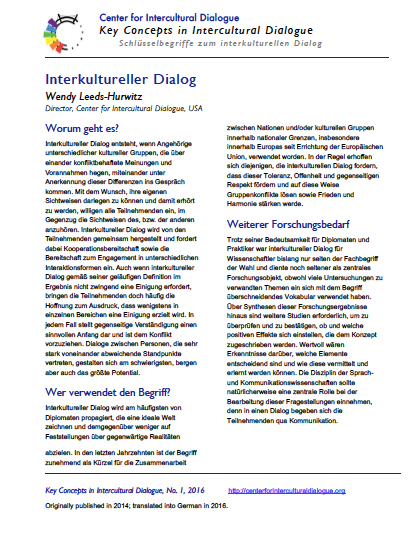
Key Concept #1: Intercultural Dialogue Translated into German

Key Concepts in ICDContinuing translations of Key Concepts in Intercultural Dialogue, today I am posting KC1: Intercultural Dialogue, which I published in English in 2014 as the first in the series, and which Dominic Busch has now translated into German.

As always, all Key Concepts are available as free PDFs; just click on the thumbnail to download. Lists of Key Concepts organized chronologically by publication date and number, alphabetically by concept, and by languages into which they have been translated, are available, as is a page of acknowledgments with the names of all authors, translators, and reviewers.

KC1 Interkultureller dialog_GermanLeeds-Hurwitz, W. (2016). Interkultureller dialog. (D. Busch, trans). Key Concepts in Intercultural Dialogue, 1. Available from:
https://centerforinterculturaldialogue.org/wp-content/uploads/2016/09/kc1-icd_german.pdf

If you are interested in translating one of the Key Concepts, please contact me for approval first because dozens are currently in process. As always, if there is a concept you think should be written up as one of the Key Concepts, whether in English or any other language, propose it. If you are new to CID, please provide a brief resume. This opportunity is open to masters students and above, on the assumption that some familiarity with academic conventions generally, and discussion of intercultural dialogue specifically, are useful.

Wendy Leeds-Hurwitz, Director
Center for Intercultural Dialogue


Creative Commons License
This work is licensed under a Creative Commons Attribution-NonCommercial-NoDerivatives 4.0 International License.

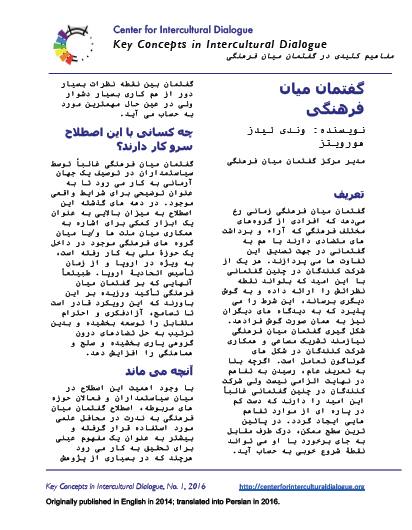
Key Concept #1: Intercultural Dialogue Translated into Persian

Key Concepts in ICDContinuing translations of Key Concepts in Intercultural Dialogue, today I am posting KC#1: Intercultural Dialogue, which I published in English in 2014 as the first in the series, and which Ramin Hajianfard has now translated into Persian.

As always, all Key Concepts are available as free PDFs; just click on the thumbnail to download. Lists of Key Concepts organized chronologically by publication date and number, alphabetically by concept, and by languages into which they have been translated, are available, as is a page of acknowledgments with the names of all authors, translators, and reviewers.

KC1 Intercultural Dialogue_PersianLeeds-Hurwitz, W. (2016). Intercultural dialogue [Persian]. (R. Hajianfard, trans). Key Concepts in Intercultural Dialogue, 1. Available from:
https://centerforinterculturaldialogue.org/wp-content/uploads/2018/08/kc1-intercultural-dialogue_persian.pdf

If you are interested in translating one of the Key Concepts, please contact me for approval first because dozens are currently in process. As always, if there is a concept you think should be written up as one of the Key Concepts, whether in English or any other language, propose it. If you are new to CID, please provide a brief resume. This opportunity is open to masters students and above, on the assumption that some familiarity with academic conventions generally, and discussion of intercultural dialogue specifically, are useful.

Wendy Leeds-Hurwitz, Director
Center for Intercultural Dialogue


Creative Commons License
This work is licensed under a Creative Commons Attribution-NonCommercial-NoDerivatives 4.0 International License.

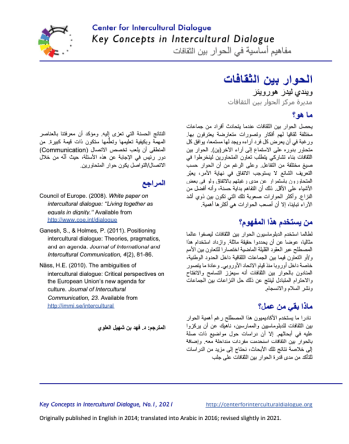
Key Concept #1 Intercultural Dialogue Translated into Arabic

Key Concepts in ICDContinuing translations of Key Concepts in Intercultural Dialogue, today I am posting KC1: Intercultural Dialogue, which I wrote in English to start the series 2 years ago, now translated into Arabic by Fahd Alalwi, of the Prince Sattam Bin Abdulaziz University, in Saudi Arabia.

As always, all Key Concepts are available as free PDFs; just click on the thumbnail of the translation to read it. Lists of Key Concepts organized chronologically by publication date and number, alphabetically by concept, and by languages into which they have been translated, are available, as is a page of acknowledgments with the names of all authors, translators, and reviewers.

KC1 ICD_Arabic v2Leeds-Hurwitz, W. (2021). Intercultural dialogue [Arabic]. Key Concepts in Intercultural Dialogue, 1.  (F. Alalwi, Trans.). Available from: https://centerforinterculturaldialogue.org/wp-content/uploads/2021/06/kc1-icd_arabic-v2.pdf

If you are interested in translating one of the Key Concepts, please contact me for approval first because dozens are currently in process. As always, if there is a concept you think should be written up as one of the Key Concepts, whether in English or any other language, propose it. If you are new to CID, please provide a brief resume. This opportunity is open to masters students and above, on the assumption that some familiarity with academic conventions generally, and discussion of intercultural dialogue specifically, are useful.

Wendy Leeds-Hurwitz, Director
Center for Intercultural Dialogue


Creative Commons License
This work is licensed under a Creative Commons Attribution-NonCommercial-NoDerivatives 4.0 International License.

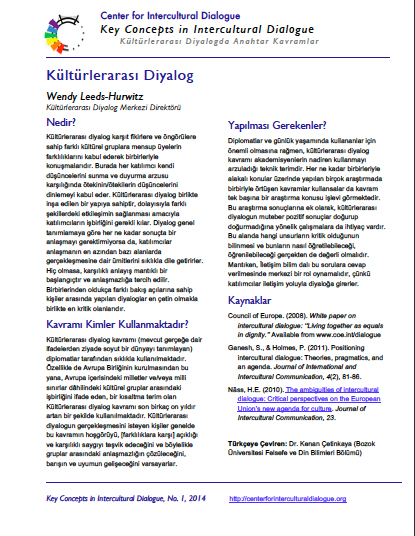
Key Concept #1: Intercultural Dialogue Translated into Turkish

Key Concepts in ICDContinuing translations of Key Concepts in Intercultural Dialogue, today I am posting KC1: Intercultural Dialogue, which I wrote in English to start the series 2 years ago, now translated into Turkish by Kenan Çetinkaya.

As always, all Key Concepts are available as free PDFs; just click on the thumbnail of the translation to read it. Lists of Key Concepts organized chronologically by publication date and number, alphabetically by concept, and by languages into which they have been translated, are available, as is a page of acknowledgments with the names of all authors, translators, and reviewers.

KC1 ICD TurkishLeeds-Hurwitz, W. (2016). Kültürlerarası diyalog. Key Concepts in Intercultural Dialogue, 1 (K. Çetinkaya, Trans.). Available from:
https://centerforinterculturaldialogue.org/wp-content/uploads/2017/09/kc1-icd-turkish.pdf

If you are interested in translating one of the Key Concepts, please contact me for approval first because dozens are currently in process. As always, if there is a concept you think should be written up as one of the Key Concepts, whether in English or any other language, propose it. If you are new to CID, please provide a brief resume. This opportunity is open to masters students and above, on the assumption that some familiarity with academic conventions generally, and discussion of intercultural dialogue specifically, are useful.

Wendy Leeds-Hurwitz, Director
Center for Intercultural Dialogue


Creative Commons License
This work is licensed under a Creative Commons Attribution-NonCommercial-NoDerivatives 4.0 International License.

CID has Passed 2000 Subscribers!

About CIDThanks to all of you who have subscribed to the Center for Intercultural Dialogue’s website, we have crossed the 2000 mark!

2000 followers

This number includes those who have followed through WordPress (available only to those with their own WP sites), those who have signed up for email notifications, as well as those who follow through Facebook, Twitter, or Google+. WordPress cannot directly track those who have joined the CID LinkedIn group (currently at 274 members), or who follow on YouTube or Pinterest, so the actual number of subscribers in fact now totals 2349! It took 3 1/2 years to reach 1000, but only another 2 years to pass 2000. Likes on Facebook, retweets on Twitter, and sharing of posts all expand our reach, and are much appreciated.

Profiles and the CID publication series Key Concepts in Intercultural Dialogue receive considerable numbers of views, as do guest posts (which you can access through the word cloud at the bottom left of any page). Even the Wikipedia article on CID is read half a dozen times each day.

As the number of followers has increased, email sent to CID has increased as well. The largest single number of viewers are from the US, but it is people outside the US who most often write in with requests of various sorts. As an example, the past week brought emails from Colombia, Switzerland, Nigeria, Greece, and New Zealand; the week before that from Ghana, Hong Kong, Malta, Belgium and Serbia. I try to answer all emails within a few days, and to post relevant information that is submitted about conferences, publication opportunities, fellowships, grants, post-docs, etc. within a week, though occasionally there is a longer line.

I very much appreciate your support.

Wendy Leeds-Hurwitz, Director
Center for Intercultural Dialogue
intercult.dialogue [at] gmail.com

April in Paris

For the month of April 2016, I was visiting professor at the Musée des Arts et Métiers in Paris, France. The museum is one part of the Conservatoire National des Arts et Métiers, a unique institution that really has no comparable body in the US. The museum is essentially the equivalent of the Smithsonian Institution in Washington, DC – the repository of objects that play important roles in science, engineering, or various arts and crafts. These range from Foucault’s pendulum to scientific instruments, to vehicles, to many early communication devices (from a visual telegraph to early motion picture cameras). 

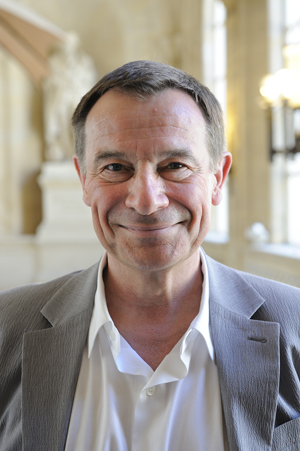
Yves Winkin

My thanks to Yves Winkin, the museum’s director, for the invitation, and the introductions to many of his staff. Specific thanks to Roubina Modely and Emmanuel Lacrois for all their help with the logistics of acquiring an apartment. Those I spent the most time with included Isabelle Taillebourg and Nirina Ramandraivonona of the Documentation Center, Nathalie Giuliani of Exhibits, and Jamila Al Khatib of the pedagogical unit.

Anne Jorro of CNAM graciously invited me to join a full-day international seminar, Arts et faire: Des gestes professionnels de transmission, diffusion, mediation on April 15. Participants came from around France, as well as Belgium and Switzerland. And I was able to meet later with one of Anne’s former doctoral students, Padma Ramsamy-Prat, currently working on a research grant at CNAM.


While in Paris, I had the chance to reconnect with Katérina Stenou, my contact since 2009 with UNESCO, and a member of the Advisory Board of the CID.

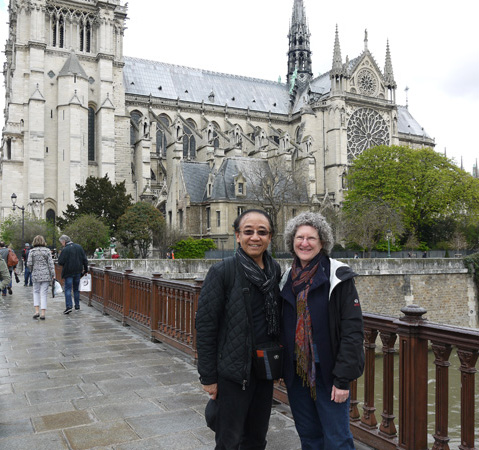
In addition, Casey Man Kong Lum stopped in Paris between a sabbatical stay in Tours and visits to Lisbon and Barcelona. He is one of the editors of a new book entitled Urban foodways and communication: Ethnographic studies in intangible culture food heritages around the world, for which I wrote the final chapter. [Update in May 2016: the book is now in print – follow the link added here to a description and table of contents.]

Casey Lum, Wendy Leeds-Hurwitz

I also had the opportunity to meet Johanna Maccioni, a Belgian psychologist and researcher who is one of the editors of a special issue of Les Politiques Sociales on intercultural competence. I was asked to write one of the articles last fall, which is currently under review, as a result of my role in preparing the UNESCO publication Intercultural competences: A conceptual and operational framework.

As long as I was back in France, Christine Develotte invited me to give a presentation on “Family Socialization to Cultural Identity: How Theory and Method Influence Research” to her doctoral seminar at the Ecole Normale Supérieure de Lyon, on April 8. Afterwards, I gave feedback to her students on questions related to their own research projects.

All in all, a busy month!
Wendy Leeds-Hurwitz, Director

8th Conference on Intercultural Communication (Wuhan, China)

Professor SHAN Bo graciously invited me to participate in the 8th Conference on Intercultural Communication, held at Wuhan University, Wuhan, China, November 20-22, 2015. Since I was unable to get to China this fall, I videotaped my paper, and sent that instead. The title is “The Influence of National Character Studies on Intercultural Communication: Moving Beyond Past Assumptions to Current Complexities.” For others who did not get to Wuhan, I’ve uploaded it to the Center for Intercultural Dialogue’s YouTube site.

My thanks to Xinya Liu, the Conference secretary, for all of her help with logistics, to Dave Adams at Royal Roads University for recording the video, and to Jingya Yang, one of my graduate students while I was at Royal Roads University, for uploading the video to a site accessible within China.

Wendy Leeds-Hurwitz, Director
Center for Intercultural Dialogue

Intercultural Dialogue Described

Several years ago I was invited to describe intercultural dialogue for an entry in the International Encyclopedia of Language and Social Interaction; the volume has now appeared. The citation is:

Leeds-Hurwitz, W. (2015). Intercultural dialogue. In K. Tracy, C. Ilie & T. Sandel (Eds.), International encyclopedia of language and social interaction (vol. 2, pp. 860-868). Boston: John Wiley & Sons. DOI: 10.1002/9781118611463/wbielsi061

Excerpts:
“Intercultural dialogue (ICD) stands at the nexus of language and social interaction (LSI) and intercultural communication (ICC). Unlike other forms of interaction, ICD assumes participants come from different cultural (ethnic, linguistic, religious) contexts, implying that they will have divergent assumptions about, and rules for, interaction. ICD has been used as a technical term having several quite different meanings. First, ICD may refer to any interaction in which participants have different cultural backgrounds. Encompassing virtually all of ICC, this use may be discarded as too broad and thus not especially helpful. Second, ICD may refer to specific types of intercultural interactions, those in which dialogue serves as a specific goal. That narrower use will be taken as the focus here. Unlike other intercultural interactions, which may include nonverbal and unconscious elements, in this usage ICD typically requires both language and intent, being a deliberate verbal exchange of views. ICDs are designed to achieve understanding of cultural others as an immediate goal, taking the more advanced steps of achieving agreement and cooperation as potential later goals. Given existing cultural diversity, not only within political alliances (such as the European Union) but even within individual countries, today ICD typically is granted considerable value as a practical tool used to prevent or reduce conflict between cultural groups, instead fostering respect and tolerance.Thus it is treated as a potential technique for building or maintaining peace. . . The term ICD has been widely used since the 1980s but less often
directly studied than its significance warrants, thus, it is a concept that is not only available
but that calls out for further research. . . Like all dialogue, ICD is an active, co-constructed creation, requiring the cooperation of participants to engage in potentially new ways of interacting.”

Multilingual Signs and Intercultural Pedagogy

When visiting Macau, I was surprised by seeing trilingual street signs (Chinese, Portuguese and English), a rare phenomenon in the US. A recent article in ELT Journal by Chiou-Ian Chern and Karen Dooley documents how such signs can serve as a resource to language teachers and learners. They conclude: “Environmental print . . . has become a useful, if politically complex, resource for learning English in contexts where language teachers once lamented the paucity of English input outside the classroom.” (p. 122).

Chern, C.-I., & Dooley, K. (2014). Learning English by walking down the street. ELT Journal, 68(2), 113-123. Available from: http://eltj.oxfordjournals.org/content/68/2/113.full

(The full article is available to download for free as I write this, though that may temporary.)

Wendy Leeds-Hurwitz, Director
Center for Intercultural Dialogue