U Vienna: Visiting Professor in Language Sciences (Austria)

“JobVisiting Professor of Language Sciences, Faculty of Philological and Cultural Studies, University of Vienna, Austria. Deadline: 9 May 2022.
This is a temporary position, beginning 1 October 2022. Successful candidates should be specialised in linguistics (Spanish), in particular in intercultural research and plurilinguism. They will teach both undergraduates and graduates in the Bachelor and the Master programme “Romanistik”. Their teaching load will be 8 hours per week.

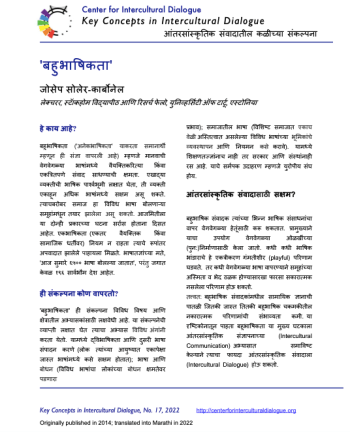
KC17 Multilingualism Translated into Marathi

Key Concepts in ICDContinuing translations of Key Concepts in Intercultural Dialogue, today I am posting KC#17: Multilingualism, which Josep Soler wrote for publication in English in 2014, and which Sameer Patankar and Apurva Chaugule have now translated into Marathi.

As always, all Key Concepts are available as free PDFs; just click on the thumbnail to download. Lists of Key Concepts organized alphabetically by conceptchronologically by publication date and number, and by languages into which they have been translated, are available, as is a page of acknowledgments with the names of all authors, translators, and reviewers.

KC17 Multilingualism_MarathiSoler, J. (2022). Multilingualism [Marathi]. (S. Patankar & A. Chaugule, Trans.). Key Concepts in Intercultural Dialogue, 17. Available from: https://centerforinterculturaldialogue.org/wp-content/uploads/2022/02/kc17-multilingualism_marathi.pdf

If you are interested in translating one of the Key Concepts, please contact me for approval first because dozens are currently in process. As always, if there is a concept you think should be written up as one of the Key Concepts, whether in English or any other language, propose it. If you are new to CID, please provide a brief resume. This opportunity is open to masters students and above, on the assumption that some familiarity with academic conventions generally, and discussion of intercultural dialogue specifically, are useful.

Wendy Leeds-Hurwitz, Director
Center for Intercultural Dialogue


Creative Commons License
This work is licensed under a Creative Commons Attribution-NonCommercial-NoDerivatives 4.0 International License.

Applied Multilingualism: Philip Crowther Reporting in 6 Languages

Applied ICD

Philip Crowther, reporter from Luxembourg, files his reports for The Associated Press in no fewer than six languages.

As a result of his multilingualism, he’s getting a lot of newspaper coverage for his skill: in the Huffington Post, Independent, Daily Mail, Metro, and The Wrap, among others.

Presumably, if more people were so functionally multilingual, intercultural dialogues would be made easier.

U Vienna: Romance Linguistics, Interculturality, Multilingualism (Austria)

“JobUniversity Professor of Romance Linguistics, Interculturality, Multilingualism, University of Vienna, Austria. Deadline: 12 April 2022.

At the Faculty of Philological and Cultural Studies of the University of Vienna the position of a University Professor of Romance Linguistics: Interculturality and Multilingualism (full time, permanent position) is to be filled. The candidate/applicant has a Romance research and teaching profile in the area of linguistics, with a focus on plurilingualism and interculturality. The candidate/applicant should be qualified, for Romance, in the fundamental linguistic fields of grammar, variational linguistics and language change. The candidate/applicant is expected to be able to represent Spanish and at least one other Romance language in linguistic research and teaching.

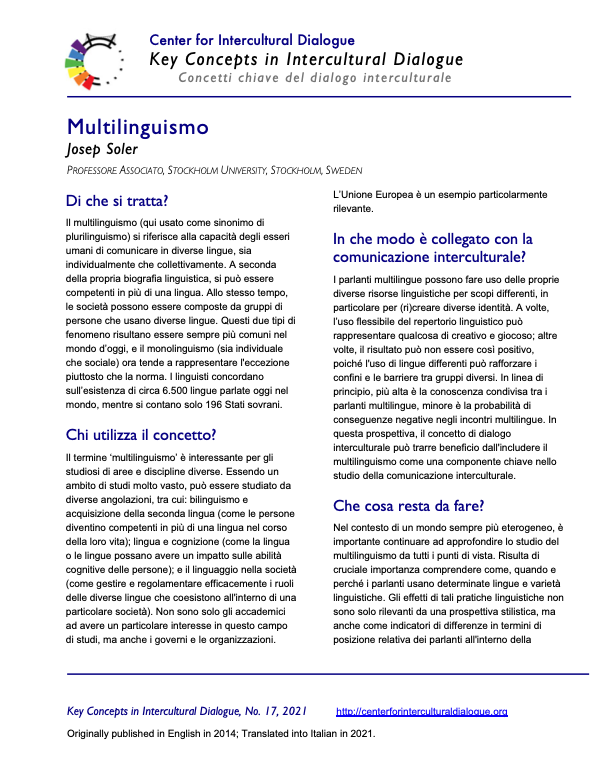
KC17 Multilingualism Translated into Italian

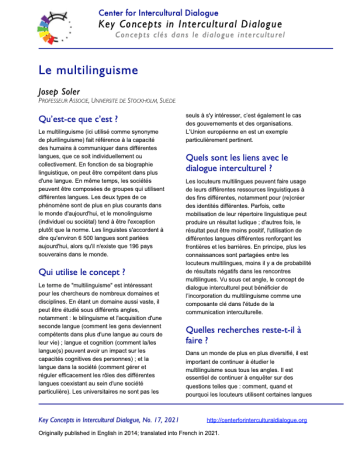
Key Concepts in ICDContinuing translations of Key Concepts in Intercultural Dialogue, today I am posting KC#17: Multilingualism, which Josep Soler wrote for publication in English in 2014, and which Karin Martin has now translated into Italian.

As always, all Key Concepts are available as free PDFs; just click on the thumbnail to download. Lists of Key Concepts organized alphabetically by conceptchronologically by publication date and number, and by languages into which they have been translated, are available, as is a page of acknowledgments with the names of all authors, translators, and reviewers.

KC17 Multilingualism_ItalianSoler, J. (2021). Multilinguismo. (K. Martin, Trans.). Key Concepts in Intercultural Dialogue, 17. Available from: https://centerforinterculturaldialogue.org/wp-content/uploads/2021/08/kc17-multilingualism_italian.pdf

If you are interested in translating one of the Key Concepts, please contact me for approval first because dozens are currently in process. As always, if there is a concept you think should be written up as one of the Key Concepts, whether in English or any other language, propose it. If you are new to CID, please provide a brief resume. This opportunity is open to masters students and above, on the assumption that some familiarity with academic conventions generally, and discussion of intercultural dialogue specifically, are useful.

Wendy Leeds-Hurwitz, Director
Center for Intercultural Dialogue


Creative Commons License
This work is licensed under a Creative Commons Attribution-NonCommercial-NoDerivatives 4.0 International License.

Karin Martin Profile

Profiles

Dr. Karin Martin is Senior Researcher and Lecturer in Italian Language and Culture at the Carinthia University of Applied Sciences in Carinthia, Austria, as well as being an Entrepreneurial Linguist.

Karin MartinMartin specializes in Multilingualism and Foreign Language Learning Difficulties. She teaches Italian Language and Culture to Intercultural Management bachelor students. She works and conducts research in the field of societal change, multilingualism and interculturalism. Her field of expertise lies in promoting multilingualism in education and in society. She supports and assists families who move around the world for different reasons and raise their children with more than one language.
She is also a Dyslexia Trainer and wrote her doctoral thesis about dyslexia, foreign language learning and bilingualism. Martin is a native Italian who has lived and worked in Italy, Germany, Spain and France. She currently lives and works in the South of Austria.


Work for CID:

Karin Martin translated KC17: Multilingualism into Italian.

KC17 Multilingualism Translated into French

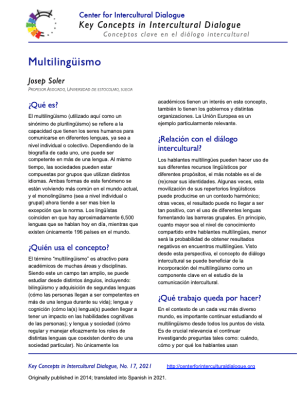
Key Concepts in ICDContinuing translations of Key Concepts in Intercultural Dialogue, today I am posting KC#17: Multilingualism, which Josep Soler wrote for publication in English in 2014, and which Mohammed Guamguami has now translated into French.

As always, all Key Concepts are available as free PDFs; just click on the thumbnail to download. Lists of Key Concepts organized alphabetically by conceptchronologically by publication date and number, and by languages into which they have been translated, are available, as is a page of acknowledgments with the names of all authors, translators, and reviewers.

KC17 Multilingualism_FrenchSoler, J. (2021). Le multilinguisme. (M. Guamguami, Trans.). Key Concepts in Intercultural Dialogue, 17. Available from: https://centerforinterculturaldialogue.org/wp-content/uploads/2021/06/kc17-multilingualism_french.pdf

If you are interested in translating one of the Key Concepts, please contact me for approval first because dozens are currently in process. As always, if there is a concept you think should be written up as one of the Key Concepts, whether in English or any other language, propose it. If you are new to CID, please provide a brief resume. This opportunity is open to masters students and above, on the assumption that some familiarity with academic conventions generally, and discussion of intercultural dialogue specifically, are useful.

Wendy Leeds-Hurwitz, Director
Center for Intercultural Dialogue


Creative Commons License
This work is licensed under a Creative Commons Attribution-NonCommercial-NoDerivatives 4.0 International License.

KC17 Multilingualism Translated into Spanish

Key Concepts in ICDContinuing translations of Key Concepts in Intercultural Dialogue, today I am posting KC#17: Multilingualism, which Josep Soler wrote for publication in English in 2014, and which  Jhon Eduardo Mosquera Pérez has now translated into Spanish.

As always, all Key Concepts are available as free PDFs; just click on the thumbnail to download. Lists of Key Concepts organized alphabetically by conceptchronologically by publication date and number, and by languages into which they have been translated, are available, as is a page of acknowledgments with the names of all authors, translators, and reviewers.

KC17 Multilingualism_SpanishSoler, J. (2021). Multilingüismo. (J. E. Mosquera Pérez, Trans.). Key Concepts in Intercultural Dialogue, 17. Available from: https://centerforinterculturaldialogue.org/wp-content/uploads/2021/01/kc17-multilingualism_spanish.pdf

If you are interested in translating one of the Key Concepts, please contact me for approval first because dozens are currently in process. As always, if there is a concept you think should be written up as one of the Key Concepts, whether in English or any other language, propose it. If you are new to CID, please provide a brief resume. This opportunity is open to masters students and above, on the assumption that some familiarity with academic conventions generally, and discussion of intercultural dialogue specifically, are useful.

Wendy Leeds-Hurwitz, Director
Center for Intercultural Dialogue


Creative Commons License
This work is licensed under a Creative Commons Attribution-NonCommercial-NoDerivatives 4.0 International License.

International Conference on Multilingualism (Greece)

Conferences

Call for speakers, International Conference on Multilingualism, 29 March 2020, Athens, Greece.

The International Conference on Multilingualism officially launches the first annual meeting of professionals and the general public, with an interest in both bilingualism and multilingualism. It aims to bring together leading authors, influencers, scientists, academics, and educators who focus on research and methods, as well as the benefits and the pitfalls of raising bilingual and multilingual children.

CFP GURT 2020: Multilingualism – Global South and North (USA)

ConferencesCall for Papers: Georgetown University Round Table 2020, Multilingualism: Global South and Global North Perspectives, March 13-15, 2020, Georgetown University, Washington D.C. Deadline: October 15, 2019.

The world has always been predominantly multilingual, but in recent decades globalization and the attendant processes of mobility and technologization have catapulted multilingualism into unprecedented levels of public and academic attention. Benefits of multilingualism are actively investigated across neurocognitive, academic, economic, and social domains. At the same time, misunderstanding and mismanagement of multilingualism have also been shown by research to curtail the educational, socioeconomic, and personal opportunities of multilingual individuals, families, and communities. Today’s multilingualism can be the site for overt and covert oppression, a lived experience that is a gift for some and a curse for others, patterning along structural forces related to inequitable distribution of material and symbolic resources in the world, and rooted in histories of (post)colonial domination and human mobility. In light of these paradoxes, research must be able to account for both multilingual learning and multilingual practices at different nested levels – societies, schools and classrooms, communities and families, minds and brains – while never losing sight of material, ideological, and geopolitical inequities. Moreover, the dynamics of multilingualism can vary across diverse Global South and Global North contexts in ways that create resonances and differences and demand innovative research lenses. Reflecting this complex agenda, GURT 2020 will focus on the relation between multilingual learning and multilingual practices, globalization, and social justice with two goals: (a) to bring together research on multilingualism spanning the full spectrum of psycholinguistic-cognitive and sociolinguistic-critical approaches and (b) to facilitate dialogue about multilingualism as it is lived and investigated across diverse contexts in the Global North and the Global South.